Seifert-van Kampen theorem
Anchor (Master): Brown 1967 (originator paper for the groupoid form); Brown — *Topology and Groupoids* §6.7 and §10; tom Dieck *Algebraic Topology* §3.2
Intuition [Beginner]
When you cover a space by two open pieces and , the loops in are built out of loops in and loops in , glued along loops in . Seifert-van Kampen is the theorem that makes this gluing precise: the fundamental group of is the amalgamated free product of the fundamental groups of and , identified along the fundamental group of .
Concretely: a loop in can be cut into pieces, each lying entirely in or in . Each piece contributes an element of or , and the rule for combining them is "concatenate, with the relation that anything coming from a loop in is the same whether read in or in ." That description is the amalgamated free product.
The theorem is the workhorse for actual computations: it lets you compute of complicated spaces by building them up from simpler pieces with known fundamental groups. Brown's groupoid version (1967) lifts the result to the fundamental groupoid and removes the hypothesis that is path-connected, which catches cases the classical theorem misses — most famously the standard cover of by two arcs.
Visual [Beginner]
Two overlapping open sets and inside a space , with their intersection drawn separately. A loop in is shown cut into segments alternating between and .
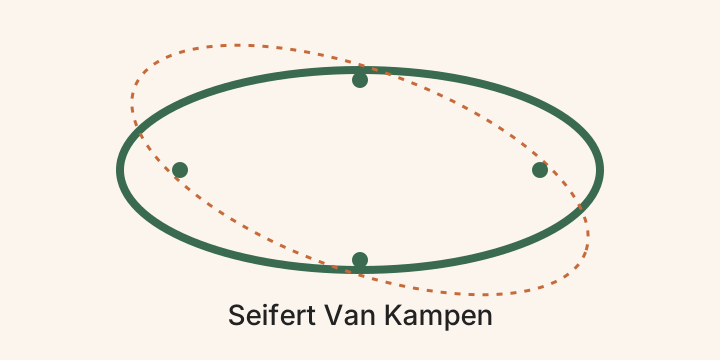
Each segment becomes a generator in the fundamental group of or ; the gluing rule comes from identifying loops that live in both pieces.
Worked example [Beginner]
Compute of the figure eight, the wedge of two circles. Cover it with two open sets: is a small thickening of the left circle (with a tiny opening through to the right), is a small thickening of the right circle. Both and deformation-retract to a circle, so . Their intersection is a small contractible neighbourhood of the wedge point, so .
Seifert-van Kampen gives
the free group on two generators (one loop around each circle). This is the prototypical noncommutative fundamental group: .
Check your understanding [Beginner]
Formal definition [Intermediate+]
Let be a topological space, open sets with , and a base point. Let and be the homomorphisms induced by inclusion. The amalgamated free product is the quotient of the free product by the normal closure of .
In groupoid form: let be a set of base points meeting every path-component of , , and . The pushout in the category of groupoids of
is the colimit of this diagram in .
Key theorem with proof [Intermediate+]
Theorem (Seifert-van Kampen, classical form). Let with open and , , all path-connected, . Then the inclusions and induce an isomorphism
Proof (sketch). Surjectivity. A loop at has image covered by , so by the Lebesgue-number lemma there is a partition such that each lies entirely in or . Path-connectedness of lets us insert paths back to at each subdivision point, expressing as a product of loops each entirely in or in .
Injectivity. Suppose two such expressions yield homotopic loops in . The homotopy admits a fine grid in which each square maps into or ; manipulating the squares one at a time uses only relations in , , or the amalgamating relations . Hence the two factorisations differ by relations in the amalgamated free product, proving the map is injective.
Bridge. The classical form builds toward Brown's groupoid version stated in the next theorem: the same Lebesgue-number subdivision argument works without path-connectedness on once we replace single base points by the groupoid on a base-point set . The construction also appears again in 03.12.02 (covering space), where the universal cover is built by gluing local universal covers over and exactly as Seifert-van Kampen builds . Putting these together, the foundational reason van Kampen works is exactly the Lebesgue-number lemma — the local-to-global passage that splits any path or homotopy into pieces lying in chart-sized opens.
Exercises [Intermediate+]
Advanced results [Master]
The groupoid form of Seifert-van Kampen drops every connectedness hypothesis the classical form requires, gives the cleanest natural-isomorphism statement, and is the form best suited to higher-categorical generalisations.
Theorem (Brown 1967, groupoid Seifert-van Kampen). Let with open, and let be a subset meeting every path-component of , , and . Then the diagram
is a pushout in the category of small groupoids.
The classical group form is recovered by taking a single point and assuming path-connected; in that case both groupoids degenerate to one-object groupoids and the pushout collapses to the amalgamated free product of groups. When is not path-connected — as in the standard arc-cover of , or in any space cut by a multi-component hypersurface — the group form simply does not apply, but the groupoid form still gives the correct answer.
Generalisations.
- Open cover by arbitrarily many sets (Brown): the analogous pushout statement holds for with meeting every path-component of every finite intersection. The 2-set version above is the case .
- Higher-dimensional Seifert-van Kampen (Brown-Higgins): the strict -fold groupoid replaces the fundamental groupoid, and an analogous pushout holds for filtered spaces with the cells in dimensions . This is the engine of Nonabelian Algebraic Topology (Brown-Higgins-Sivera 2011).
- Homotopy van Kampen (Lurie, in the -categorical setting): for any presheaf-of-spaces hypercover, the corresponding -groupoid satisfies a colimit condition that recovers Brown's theorem in the truncation to -groupoids.
Synthesis. Seifert-van Kampen generalises the Mayer-Vietoris philosophy from cohomology to fundamental groups: cover, intersect, and read off the global object from the local data and the gluing. The central insight is that the fundamental groupoid is exactly the right functor to make this work — the group form is dual to a single-base-point version of the same idea, and the dependence on base-point connectivity is exactly the cost of that simplification. Putting these together, the foundational reason every nonobvious computation in classical algebraic topology uses van Kampen is that it is the bridge between local data (loops on charts) and global invariants (the fundamental group of the manifold). The further programme of Brown-Higgins identifies the higher-dimensional groupoids with the strict crossed complexes of cellular topology, and the entire pushout-of-groupoids framework appears again in homotopy type theory as the "van Kampen" rule for higher inductive types.
Full proof set [Master]
Lemma (Lebesgue-number subdivision for paths). Let open and continuous. Then there is a finite partition such that or for each .
Proof. The collection is an open cover of the compact metric space . By the Lebesgue-number lemma there is such that every interval of length in lies entirely in or . Take any partition with mesh .
Proposition (group form, surjectivity). *Under the classical hypotheses, every is in the image of .*
Proof. Apply the lemma to to get a partition with each contained in or . Call . Path-connectedness of supplies paths in (with constant), so each is a loop at entirely in or . Their concatenation is path-homotopic to .
Proposition (group form, injectivity). If two amalgamated-free-product expressions for the same loop agree in , they agree in the amalgamated free product.
Proof sketch. A homotopy between two such loops gives . Apply the Lebesgue lemma in two dimensions to obtain a grid of squares each landing in or ; chase relations square by square — each transition uses either a relation in , a relation in , or an amalgamating identification at a square that lands in . The full sequence assembles into a word-equality in the amalgamated free product.
Theorem (groupoid form, sketch). The pushout statement.
Proof sketch. Universal property: given a groupoid and morphisms , agreeing on , define on a path by Lebesgue-subdividing as above and composing the - and -images. Independence of subdivision uses agreement on the intersection; well-definedness on path-homotopy classes uses the 2-dimensional Lebesgue argument.
Connections [Master]
Fundamental groupoid
03.12.08. The groupoid van Kampen is the theorem about — the pushout statement is what makes the groupoid functor a meaningful global invariant rather than a one-base-point local picture.Homotopy and homotopy group
03.12.01. The classical group form is the special case where is a single base point and is path-connected; recovering the amalgamated free product.Covering space
03.12.02. Computing via van Kampen gives the subgroup data needed to classify covering spaces by the Galois correspondence; the groupoid form generalises this to the equivalence of categories .De Rham cohomology
03.04.06/ Mayer-Vietoris. Van Kampen is the analogue of Mayer-Vietoris in cohomology — the same cover-and-glue strategy applied to a different homotopy invariant. The Mayer-Vietoris sequence is exact; the van Kampen pushout is the corresponding nonabelian statement.CW complex (gap unit, planned). Van Kampen computes of a CW complex inductively over its skeleta: attaching -cells for leaves unchanged (cells are simply-connected), and attaching -cells imposes the boundary words as relations.
Historical & philosophical context [Master]
Herbert Seifert (1931, Konstruktion dreidimensionaler geschlossener Räume, Berichte Sächs. Akad. Wiss.) and Egbert van Kampen (1933, On the connection between the fundamental groups of some related spaces, Amer. J. Math. 55) independently formulated and proved the classical group-form theorem in the 1930s [Seifert 1931; ref: TODO_REF van Kampen 1933]. Seifert's motivation was the construction of three-manifolds by gluing simpler pieces; van Kampen's was Poincaré-style algebraic topology.
The path-connectedness hypothesis on was an artefact of the single-base-point formulation — Poincaré had implicitly considered loops at every point, but the formalism of the early 20th century forced a choice. Ronald Brown's 1967 paper Groupoids and van Kampen's theorem (Proc. London Math. Soc. 17, 385–401) [Brown 1967] reformulated the theorem in the language of fundamental groupoids and observed that the connectedness hypothesis dissolved cleanly. Brown's textbook Topology and Groupoids (1968 / 2006) [Brown 2006] gave the systematic exposition.
The further programme — replacing fundamental groupoids by higher-dimensional strict groupoids and crossed complexes — was developed by Brown, Higgins, and Sivera over the 1970s-2000s, culminating in Nonabelian Algebraic Topology (2011) [Brown-Higgins-Sivera 2011]. The -categorical incarnation of the same idea is part of the modern foundations of algebraic topology in homotopy type theory.