Fundamental groupoid
Anchor (Master): Brown — Topology and Groupoids §6 and §10; Brown 1967 (originator paper)
Intuition [Beginner]
The fundamental group records loops at a chosen base point . Once you fix that base point, you cannot talk directly about loops starting elsewhere — they live in a different group. The fundamental groupoid drops the choice: instead of one group at one point, it keeps a whole web of homotopy classes of paths between every pair of points in .
The picture is a directed graph whose vertices are points of and whose edges are homotopy classes of paths . Concatenating paths gives a partial multiplication — partial because you can only compose two paths when the endpoint of the first equals the starting point of the second. That "compose only when endpoints match" structure is what a groupoid is: a category in which every arrow has an inverse.
Why bother? When the space splits into pieces meeting at several points, the fundamental group at any single point sees only one piece. The fundamental groupoid sees them all at once and lets you reason about the global gluing without artificially picking a base point.
Visual [Beginner]
A space with several points marked, and a few paths drawn between distinct pairs. The diagram is the data of the fundamental groupoid: each vertex is a point, each arrow is a path-up-to-homotopy.
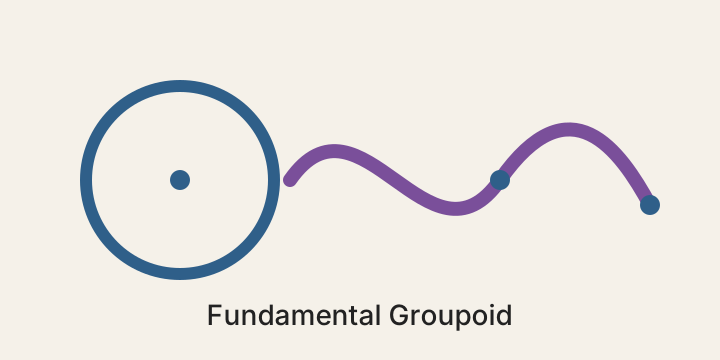
When you collapse to a single base point, you recover the fundamental group as the loops at that point.
Worked example [Beginner]
Take the circle with two marked points: the north pole and the south pole . The fundamental group is the integers — the winding number. The fundamental groupoid keeps the same winding-number data plus the homotopy classes of arcs from to : there are exactly two arcs (the east semicircle and the west semicircle), and they differ by a full loop, which is one unit of winding.
So in the fundamental groupoid you have:
- arrows from to : one for each integer (winding number);
- arrows from to : one for each integer (winding number);
- arrows from to : the east arc, plus that arc composed with any number of full loops at ;
- arrows from to : inverses of the above.
Picking the east arc as a reference gives a bijection between -to- arrows and integers — and the same for -to-.
Check your understanding [Beginner]
Formal definition [Intermediate+]
Let be a topological space. A path in is a continuous map . Two paths with and are path-homotopic (rel. endpoints) if there is a continuous with
This is an equivalence relation [01.01.03 not relevant; the relation lives on paths, not on a vector space — see 03.12.01 for the analogous relation on free homotopies].
Definition. The fundamental groupoid of is the small category whose objects are the points of and whose morphisms are the path-homotopy classes of paths from to . Composition is concatenation:
The constant path is the identity at . The reverse path represents the inverse .
When the choice of base points matters, fix a subset and define to be the full sub-groupoid on the points of .
A continuous map induces a functor by on objects and on morphisms; this assignment is well-defined on homotopy classes and respects composition, so is a functor .
Key theorem with proof [Intermediate+]
Theorem. Let be a topological space, a point. Then the automorphism group recovers the fundamental group:
If is path-connected, the inclusion induces an equivalence of categories from the one-object groupoid to .
Proof. The first claim is by inspection: an automorphism at in is a path-homotopy class of paths from to , which is exactly an element of as defined classically.
For the second claim, suppose is path-connected. For each , choose a path (with the constant path). Define a functor by sending every object to the unique object of and sending to , a loop at . This is well-defined on path-homotopy classes (concatenation respects homotopy) and respects composition (the inserted at the join cancels with ). The choice of 's gives an explicit quasi-inverse, so is an equivalence.
Bridge. The groupoid framing builds toward the groupoid Seifert-van Kampen theorem (Brown 1967), which states that for with open and meeting every path-component of , , and , the groupoid is exactly the pushout of . The same data appears again in 03.12.02 (covering space), where covering spaces of correspond to functors — the Galois correspondence in groupoid form. Putting these together, the foundational reason the groupoid framing is "the right one" is exactly that it removes the path-connectedness hypotheses required by the group form: in disconnected unions , the group version simply does not apply, while the groupoid version still gives a clean pushout.
Exercises [Intermediate+]
Advanced results [Master]
The fundamental groupoid is the prototype of an algebraic-topology functor that takes finite limits to limits and behaves well under disjoint unions, but does not preserve arbitrary colimits. The Seifert-van Kampen theorem identifies the colimit it does preserve: open covers in which the cover and intersection groupoids meet a chosen subset in every path-component.
Theorem (Brown 1967, groupoid van Kampen). Let with open in . Let meet every path-component of , , and . Then the diagram
is a pushout in the category of groupoids.
The classical Seifert-van Kampen theorem on fundamental groups is the special case in which is a single point lying in and the cover and intersection are path-connected. In that case both groupoids degenerate to one-object groupoids, the groupoid pushout collapses to a group amalgamated free product , and the standard Hatcher-style theorem is recovered. When is not path-connected — as for the open cover of by two overlapping arcs — the group form does not apply but the groupoid form still gives a clean answer.
Theorem (Galois correspondence for covering spaces). Let be a path-connected, locally path-connected, semi-locally simply connected space. The functor that sends a covering space to the functor defined by on objects and lifting on morphisms is an equivalence of categories between and .
This is the groupoid version of the classical correspondence between covering spaces and subgroups of . The base-point-free statement is more flexible: a covering space is a functor on the whole groupoid, and the subgroup-version is recovered by restricting to the automorphism group at one chosen point.
Synthesis. The fundamental groupoid generalises the fundamental group from "loops at one base point" to "paths between any pair of points," with the bilinear datum being concatenation up to endpoint-fixing homotopy 03.12.01. The central insight is that the groupoid form is exactly the right construction for spaces that are not path-connected — every problem in classical algebraic topology where the fundamental group runs into trouble (disconnected in van Kampen, the orbit space of a free group action by deck transformations, the Galois correspondence in disconnected covers) admits a clean groupoid solution. Read in the opposite direction, the groupoid is dual to the universal cover: acts on exactly as the morphisms of act on the corresponding fibre, and the central identifications (loops with deck transformations, paths with lifts) become statements about the groupoid acting on its associated covering. The foundational reason this works is exactly the equivalence of categories between and : covering spaces and groupoid representations are the same thing.
Full proof set [Master]
Proposition (functoriality). The assignment , is a functor .
For each continuous and path in , the composition is a path in . If is an endpoint-fixing homotopy from to , then is one from to , so is well-defined on homotopy classes. Identities go to identities (constant paths are preserved) and composition is preserved because .
Proposition (homotopy invariance). If via a homotopy , then as functors via a natural transformation whose component at is the path in .
Naturality is the statement that the diagonal of the unit square has the same homotopy class read horizontally and vertically — a direct consequence of continuity of on the closed unit square.
Proposition (van Kampen pushout, sketch). Under the hypotheses above, is the pushout.
Given a groupoid and functors and agreeing on the intersection, define on a path in by subdividing via the Lebesgue number lemma into pieces lying entirely in or in , then composing the images under and . The choice of subdivision is unique up to refinements, and , agreeing on ensures the composite is independent of subdivision. Path-homotopy invariance follows by applying the same subdivision argument to a homotopy on .
Connections [Master]
Homotopy and homotopy group
03.12.01. The fundamental group is the automorphism group of any object in the fundamental groupoid; . Every result on at a single base point lifts to the groupoid by choosing path-systems.Covering space
03.12.02. The Galois correspondence becomes an equivalence of categories ; the classical subgroup-classification follows by restricting to the automorphism group at a chosen base point.Topological space
02.01.01and continuous map02.01.02. The construction is functorial in the underlying topological data: a continuous map of spaces gives a functor of groupoids, and a homotopy of maps gives a natural transformation. Homotopy equivalences go to equivalences of groupoids.Higher homotopy. The groupoid construction is the case of an entire tower of higher-dimensional groupoids — the fundamental -groupoid — which captures all homotopy information of . Brown-Higgins-Sivera (2011, Nonabelian Algebraic Topology) develops this systematically; the connection to higher categories and homotopy type theory is the modern home of this machinery.
Historical & philosophical context [Master]
The fundamental group was introduced by Henri Poincaré in Analysis Situs (1895, Journal de l'École Polytechnique) [Poincaré 1895] as the first homotopy invariant of a topological space. Poincaré's framing was already implicitly groupoid — he considered loops at every point — but the explicit categorical formulation had to wait nearly seventy years.
Ronald Brown's 1967 paper Groupoids and van Kampen's theorem (Proc. London Math. Soc. 17, 385–401) [Brown 1967] is the originator paper for the groupoid version of the Seifert-van Kampen theorem. Brown observed that the classical theorem's path-connectedness hypothesis on was an artefact of the single-base-point setup, and that replacing the fundamental group by the fundamental groupoid removed the hypothesis cleanly. The textbook Topology and Groupoids (1968 first edition as Elements of Modern Topology, 1988 expansion, 2006 third edition) [Brown 2006] develops the entire programme: identification topology, function spaces, fibrations, covering spaces, and higher-dimensional algebraic topology, all through the groupoid lens.
The further programme — replacing fundamental groups by fundamental ∞-groupoids — was developed by Brown, Higgins, Sivera, and others (most fully in Nonabelian Algebraic Topology, 2011) [Brown-Higgins-Sivera 2011], and finds its modern home in the higher-categorical and homotopy-type-theoretic foundations of contemporary algebraic topology.