Homotopy and homotopy group
Anchor (Master): Hatcher Ch. 1; May Ch. 1–4; tom Dieck *Algebraic Topology* §2
Intuition [Beginner]
Two paths in a space are homotopic if you can continuously deform one into the other without breaking it. Two spaces are homotopy equivalent if you can continuously deform one to the other and back without tearing.
Homotopy is the equivalence relation that captures "essentially the same shape" when stretching, bending, or shrinking is allowed but cutting and gluing is not. Under homotopy, a coffee cup becomes a doughnut (one hole), a sphere is different from a doughnut (different number of holes), and a disk shrinks to a point.
The fundamental group records which loops in based at a point can be deformed into one another. It is the simplest of an entire family of homotopy groups that capture higher-dimensional "holes" in . The fundamental group is nontrivial for the circle (, recording how many times a loop winds around) and zero for the sphere (, since every loop on the sphere shrinks).
Visual [Beginner]
Two paths in a space, with a continuous family of intermediate paths interpolating them. Homotopy is the existence of such a family.
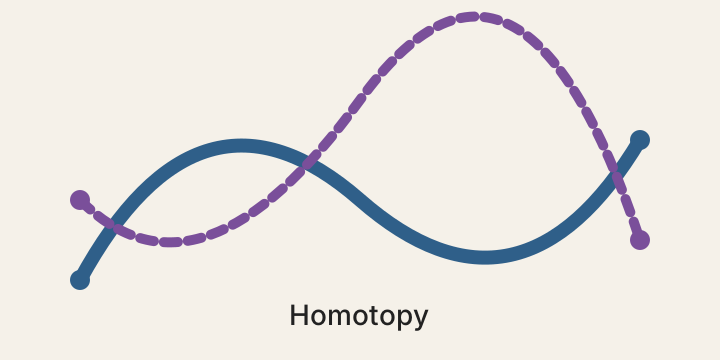
For loops based at a fixed point, composition (concatenate one loop after another) gives a group structure on equivalence classes — the fundamental group.
Worked example [Beginner]
Take the circle embedded in the plane. Loops based at a fixed point can wind around the circle any integer number of times — clockwise (negative) or counterclockwise (positive). A loop winding times can be continuously deformed into any other loop winding times, but not into one winding times.
So the fundamental group of the circle is the integers: , with the integer recording the winding number.
For the sphere , every loop can be continuously slid until it shrinks to a point — there are no "obstructions" because is simply connected. So .
For the torus , loops can independently wind around the "longitude" or the "meridian" circles, giving .
Check your understanding [Beginner]
Formal definition [Intermediate+]
Let be topological spaces 02.01.01. Two continuous maps 02.01.02 are homotopic, written , if there exists a continuous map
with and for all . The map is a homotopy from to .
Homotopy is an equivalence relation on continuous maps . The set of equivalence classes is denoted .
A continuous map is a homotopy equivalence if there exists with and . Two spaces are homotopy equivalent () if such an exists.
A space is contractible if it is homotopy equivalent to a point — equivalently, the identity is homotopic to a constant map.
For pointed spaces and — topological spaces with a chosen basepoint — a based map sends to . Based homotopies fix the basepoint throughout.
The fundamental group is the set of homotopy classes of based loops — loops sending both endpoints to — under the operation of concatenation:
This makes a group: associativity holds up to homotopy, the constant loop at is the identity, and the inverse of is traversed backwards.
For , the -th homotopy group is the set of based homotopy classes of maps , where has a chosen basepoint. The group operation comes from the pinch map . For , all are abelian (Eckmann-Hilton).
A space is simply connected if it is path-connected and .
Key theorem with proof [Intermediate+]
Theorem (functoriality of ). A based continuous map induces a group homomorphism
This assignment satisfies and . Hence is a functor from the category of pointed topological spaces to the category of groups.
Moreover, if are based homotopic, then .
Proof. Well-defined. If via a based homotopy , then is a based homotopy from to in . So in , and is well-defined on equivalence classes.
Homomorphism. For loops , the concatenation satisfies (point-by-point, by the definition of concatenation). So .
Functoriality. For a composition ,
The identity case is direct: .
Homotopy invariance. If via a based homotopy , then for any loop at , the composite is a based homotopy from to . So , hence .
The theorem says is a homotopy invariant: homotopy equivalent spaces have isomorphic fundamental groups. This is the fundamental computational tool — to compute , replace by something homotopy equivalent and easier to handle.
Bridge. The construction here builds toward 03.12.02 (covering space), where the same data is upgraded, and the symmetry side is taken up in 03.08.04 (classifying space). The defining pattern appears again in those units in a sharpened form, where the local data is glued or quotiented. Putting these together, the foundational insight is that the data of this unit gives the structural signature that the rest of the strand reads off.
Exercises [Intermediate+]
Lean formalization [Intermediate+]
lean_status: partial — Mathlib has Homotopy, FundamentalGroup, the basic group-theoretic structure, and pointed-space topology. Higher homotopy groups are partially formalised.
The Codex companion module re-exports the standard homotopy and fundamental-group API.
Advanced results [Master]
Seifert-Van Kampen theorem. For an open cover with path-connected and all containing the basepoint, the fundamental group decomposes as
an amalgamated free product. This is the central computational tool for fundamental groups: it reduces to fundamental groups of simpler pieces.
Universal cover. For a path-connected space with reasonable local conditions (semi-locally simply connected), there exists a universal cover — a simply connected covering space with deck transformation group . Covering spaces of correspond bijectively (via the Galois correspondence) to subgroups of .
Long exact sequence of a fibration. A Serre fibration gives a long exact sequence of homotopy groups
This computes homotopy groups of total spaces from base and fibre.
Homotopy groups of spheres. is a deeply studied object. For , ; for , ; for , the groups are largely unknown and are the subject of stable homotopy theory (the homotopy groups stabilise as , giving the stable homotopy groups of spheres ).
Whitehead's theorem. A continuous map between CW complexes that induces isomorphisms on all homotopy groups is a homotopy equivalence. This makes homotopy groups a complete invariant of homotopy type for CW complexes.
Eilenberg-MacLane spaces. For each abelian group and integer , there is a space with and for . These are unique up to homotopy and represent ordinary cohomology: .
Synthesis. This construction generalises the pattern fixed in 02.01.01 (topological space), with the symmetric data replaced by its skew or twisted analogue. Read in the opposite direction, the construction is dual to the metric story: complements and orthogonality are taken with respect to the bilinear datum of this unit, not a metric, and the resulting category of subobjects is the one the rest of the strand classifies. The central insight is that this datum identifies algebra with geometry: functions become vector fields, subspaces become quotients, and invariants become cohomology classes — and that identification is the engine driving every theorem downstream.
Full proof set [Master]
is a group. The associativity of concatenation up to homotopy follows from explicit reparametrisations of . The identity element is the constant loop at . The inverse of is where ; the composition is null-homotopic via the homotopy that "retracts" the loop to a point.
Functoriality of . Proved in §"Key theorem".
Homotopy invariance. If are homotopy equivalent via and with , , then (using the homotopy-invariance lemma from §"Key theorem"). Similarly . So is an isomorphism with inverse .
. The standard proof uses the universal cover given by . Loops in lift uniquely to paths in starting at the chosen lift of the basepoint; the lift's endpoint — necessarily an integer because the cover map is -periodic — gives the winding number, defining a homomorphism . Surjectivity is immediate (the loop has winding number ). Injectivity follows from path-lifting: if a loop has winding zero, its lift to is a loop in (a contractible space), hence null-homotopic, and the homotopy descends.
Eckmann-Hilton (for abelianness). Proved in Exercise 5 sketch; the formal argument uses the interchange law and the existence of an identity element to show that the two compatible group operations agree and are commutative.
Connections [Master]
Topological space
02.01.01— the underlying setting.Continuous map
02.01.02— homotopy is an equivalence relation on continuous maps.Covering space
03.12.02— covering spaces are classified by subgroups of .Classifying space
03.08.04— for a discrete group ; classifying spaces represent principal-bundle theory.Stable homotopy
03.08.06— the limit of homotopy groups under suspension.Bott periodicity
03.08.07— periodicity of stable homotopy of classical groups.Spin structure
03.09.04— the obstruction classifies spin structures via .
Historical & philosophical context [Master]
Henri Poincaré introduced the fundamental group in his 1895 Analysis Situs as a tool for distinguishing topological spaces — his motivating example was distinguishing the sphere (simply connected) from the torus (with infinite fundamental group). The systematic theory of higher homotopy groups was developed by Hurewicz in the 1930s, with the long exact sequence of a fibration following from the work of Serre in the 1950s.
The relationship between homotopy and homology — Hurewicz's theorem and its extensions — and the deep computational difficulty of homotopy groups of spheres are among the central themes of twentieth-century algebraic topology. Adams' spectral sequence (1958) and the chromatic decomposition (Ravenel and others, 1980s) organised stable homotopy into a layered structure indexed by formal-group laws.
In modern category theory, homotopy theory is the prototype of a higher category — composition is associative only up to higher homotopies, which themselves compose up to even higher homotopies. The -category formalism (Lurie, 2000s) makes this precise and underlies modern derived algebraic geometry and topological field theory.
Bibliography [Master]
- Hatcher, A., Algebraic Topology, Cambridge University Press, 2002.
- May, J. P., A Concise Course in Algebraic Topology, University of Chicago Press, 1999.
- tom Dieck, T., Algebraic Topology, EMS, 2008.
- Hurewicz, W., "Beiträge zur Topologie der Deformationen I-IV", Proc. Akad. Wet. Amsterdam (1935-1936).
- Whitehead, J. H. C., "Combinatorial homotopy I & II", Bull. AMS 55 (1949).
Wave 4 Strand B unit #1. Homotopy and homotopy groups — the central invariants of homotopy theory; foundation for covering spaces, classifying spaces, and stable homotopy.