Universal coefficient theorem
Anchor (Master): Hatcher §3.1 + §3.A (full proof); Cartan-Eilenberg *Homological Algebra* (1956); tom Dieck *Algebraic Topology* §17; Spanier *Algebraic Topology* §V
Intuition [Beginner]
The universal coefficient theorem answers a basic bookkeeping question. Once you know the homology of a space with integer coefficients, can you read off the homology with coefficients in some other group, like or ? The answer is almost yes. The integer homology determines the answer up to one extra correction, and the correction is computable from the integer homology alone.
The intuition is that integer homology already records everything the space has to offer, but in a form where torsion (cycles that vanish only after being multiplied by some integer) is mixed in with free generators. Switching coefficients is a kind of measurement: a field of characteristic zero (like ) cannot see torsion, while sees torsion of order two but is blind to other features. The theorem says exactly how each measurement reads the integer answer.
The reason this matters: many computations are easier with coefficients in a field, because then everything becomes a vector space and dimensions add up. The theorem lets you do the computation in the easier setting and reconstruct the integer answer from a small handful of cases.
Visual [Beginner]
A schematic showing two columns: on the left, the integer homology groups of a space, written as a free part plus a torsion part; on the right, the homology with new coefficients, computed by tensoring the free part and applying a correction term to the torsion. An arrow between them is labelled "universal coefficient theorem" and a small caption indicates that the correction comes from a derived functor.
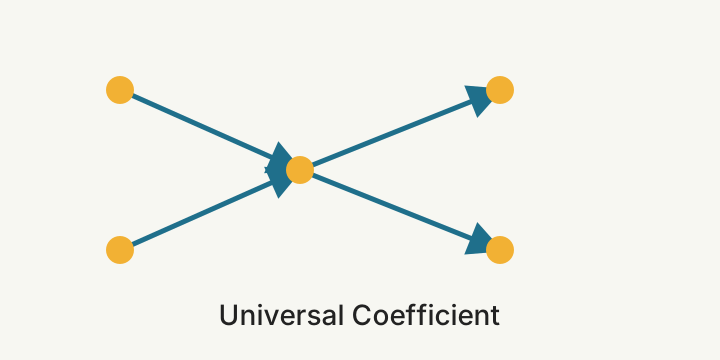
The picture captures the essential message: the integer answer determines the new answer, but you have to track torsion and free pieces separately. Free pieces tensor straightforwardly; torsion pieces undergo a correction.
Worked example [Beginner]
Compute the cohomology of the real projective plane with integer and with coefficients, starting from the known integer homology.
Step 1. The integer homology of is , , . The free rank in dimension zero comes from path-connectedness; the torsion in dimension one comes from the orientation-reversing loop; the higher dimension is zero because the space is two-dimensional.
Step 2. To get integer cohomology, the universal coefficient theorem says equals the dual of the free part of plus a correction from the torsion of . In dimension zero, (the free part of , no correction since ). In dimension one, because has no free part and has no torsion. In dimension two, because has no free part but contributes a correction of .
Step 3. The integer cohomology is . The torsion has shifted up by one dimension compared to the homology — this is a general feature.
Step 4. With coefficients, every group becomes a -vector space and the picture simplifies. A direct application gives — the cohomology gains a class in every dimension. This reflects the fact that with coefficients, both the free part and the order-two torsion contribute.
What this tells us: the universal coefficient theorem turns one homology computation into many. Once the integer homology of is known, the answer with any coefficient group follows from a small dictionary.
Check your understanding [Beginner]
Formal definition [Intermediate+]
Let and be abelian groups. The tensor product is the abelian group generated by symbols for , , modulo bilinearity relations. The Hom group is the abelian group of group homomorphisms , with addition pointwise.
For a fixed , the assignments and extend to functors on the category of abelian groups. The first is right-exact; the second is left-exact. They fail to be exact at one end, and the failure is measured by the derived functors and .
Definition (Tor and Ext). Let be an abelian group. Choose a free resolution , where are free abelian groups. (Every abelian group admits such a resolution of length at most one because subgroups of free abelian groups are free.) Define $$ \mathrm{Tor}(A, G) = \ker(F_1 \otimes G \to F_0 \otimes G), \qquad \mathrm{Ext}(A, G) = \mathrm{coker}(\mathrm{Hom}(F_0, G) \to \mathrm{Hom}(F_1, G)). $$ Both groups are independent of the chosen resolution up to canonical isomorphism.
For a topological space and a coefficient group , the homology with coefficients is defined as the homology of the chain complex , where is the singular chain complex with integer coefficients. The cohomology with coefficients is the cohomology of the cochain complex .
A short exact sequence of abelian groups $$ 0 \to A \to B \to C \to 0 $$ is split if there exists a homomorphism section of the projection. A split short exact sequence is isomorphic to the sum sequence .
Counterexamples to common slips
- The splitting in the universal coefficient theorem is not natural in . A continuous map induces compatible maps on the three terms of the short exact sequence, but the chosen splittings need not commute with . Naturality fails on the splitting; the short exact sequence itself is natural.
- The correction term in the cohomology version uses , not . The dimension shift is opposite to the homology version: tensor pairs with , pairs with ; pairs with , pairs with .
- is not the -torsion of in general; it equals the kernel of multiplication by on . For free, this is zero, but for it is .
- The free-resolution definition gives for over , because every abelian group has a free resolution of length one. Over more general rings (group rings, polynomial rings), higher groups appear and the universal coefficient theorem becomes a spectral sequence.
Key theorem with proof [Intermediate+]
Theorem (Universal coefficient theorem for homology; Hatcher Theorem 3A.3). Let be a topological space and an abelian group. There is a short exact sequence of abelian groups $$ 0 \to H_n(X) \otimes G \to H_n(X; G) \to \mathrm{Tor}(H_{n-1}(X), G) \to 0 $$ natural in and in , and the sequence splits (the splitting is not natural).
Proof. The argument is purely algebraic once one observes that the singular chain complex consists of free abelian groups (free on the set of singular simplices in each degree). The theorem follows from the corresponding algebraic statement applied to this chain complex.
Algebraic version. Let be a chain complex of free abelian groups with boundary and let be an abelian group. Write and for cycles and boundaries. Both are subgroups of the free abelian group , hence themselves free.
The short exact sequence $$ 0 \to Z_n \to C_n \xrightarrow{\partial} B_{n-1} \to 0 $$ splits because is free, so a splitting exists. Tensoring with preserves split exactness: $$ 0 \to Z_n \otimes G \to C_n \otimes G \xrightarrow{\partial \otimes 1} B_{n-1} \otimes G \to 0. $$ Splice these short exact sequences across to form the long exact sequence relating to the homology of the complexes and (each with zero differential). Since the differentials on and vanish, their homologies coincide with the groups themselves, and the long exact sequence reduces to the short exact sequence $$ 0 \to H_n(C_\bullet) \otimes G \to H_n(C_\bullet \otimes G) \to \ker(B_{n-1} \otimes G \to Z_{n-1} \otimes G) \to 0. $$ The kernel on the right is identified with via the free resolution . This is the asserted short exact sequence.
Splitting. Choose a splitting of the inclusion . (This exists because is free and the quotient is free.) The composite defines a left inverse on , providing the splitting. The choice of depends on , so the splitting is not natural.
Topological case. Apply the algebraic version to , the singular chain complex. Naturality in follows because the construction uses only the chain-map functoriality of . Naturality in follows because and are functorial in their second argument.
Theorem (Universal coefficient theorem for cohomology; Hatcher Theorem 3.2). Let be a topological space and an abelian group. There is a natural short exact sequence $$ 0 \to \mathrm{Ext}(H_{n-1}(X), G) \to H^n(X; G) \to \mathrm{Hom}(H_n(X), G) \to 0 $$ and the sequence splits (the splitting is not natural).
The proof parallels the homology version, replacing by at each step, with care that is contravariant in the first argument and so dimension indexing flips. Details are deferred to the Master section.
Bridge. The universal coefficient theorem builds toward the entire coefficient-changing infrastructure of algebraic topology. The foundational reason it holds is exactly that the singular chain complex consists of free abelian groups, so tensoring and Hom-ing preserve enough exactness to leave only the derived functors and as corrections. This is the same algebraic mechanism that appears again in 03.13.02 (Leray-Serre spectral sequence), where the page identifies as with the inner cohomology already involving Tor and Ext through the universal coefficient theorem applied fibrewise. The central insight is that ordinary homology with arbitrary coefficients factors algebraically through integer homology — putting these together, every coefficient-changing question reduces to one tensor product and one correction term, and the correction is computable from the integer answer alone. The bridge is the recognition that Tor and Ext are not auxiliary curiosities but the only obstructions to coefficient change being a clean tensor or Hom, and this same pattern appears again in 03.13.02 (spectral sequences) when computing pages in the presence of torsion in fibre or base.
Exercises [Intermediate+]
Lean formalization [Intermediate+]
Mathlib has the categorical infrastructure for derived functors and a definition of and via the abelian-category derived functor framework, but the universal coefficient theorem for singular (co)homology is not yet packaged as a named theorem. The intended formalisation would read schematically:
[object Promise]The proof gap is substantive. Mathlib needs a ShortExact.Splits notion, a packaging of the algebraic universal coefficient theorem for an arbitrary free chain complex, the identification of the singular chain complex as free over on the singular simplices of , and the dimension-zero base case checks. Each piece is formalisable from existing infrastructure but has not been packaged. The non-naturality of the splitting is itself a content statement that would require an explicit counter-example in the Mathlib library.
Advanced results [Master]
Theorem (Universal coefficient theorem for cohomology; Hatcher Theorem 3.2). Let be a topological space and an abelian group. There is a natural short exact sequence $$ 0 \to \mathrm{Ext}(H_{n-1}(X), G) \to H^n(X; G) \to \mathrm{Hom}(H_n(X), G) \to 0 $$ and the sequence splits non-naturally.
This is the cohomology dual of Theorem 3A.3. The map is evaluation: a cohomology class represented by a cocycle maps a homology class represented by a cycle to . The kernel of this evaluation is the image of , measuring cohomology classes detected only through their relation to torsion in lower-dimensional homology.
Theorem (Algebraic universal coefficient theorem). Let be a chain complex of free abelian groups and let be an abelian group. There are natural short exact sequences $$ 0 \to H_n(C_\bullet) \otimes G \to H_n(C_\bullet \otimes G) \to \mathrm{Tor}(H_{n-1}(C_\bullet), G) \to 0, $$ $$ 0 \to \mathrm{Ext}(H_{n-1}(C_\bullet), G) \to H^n(\mathrm{Hom}(C_\bullet, G)) \to \mathrm{Hom}(H_n(C_\bullet), G) \to 0, $$ both split.
The topological UCT is the algebraic UCT applied to . The algebraic version applies to cellular chains, simplicial chains, Morse-theoretic chains, and any other free chain complex computing the same homology. This is the source of the universal coefficient theorem for de Rham cohomology, Čech cohomology, and group cohomology.
Theorem (computation of Ext and Tor for finitely generated abelian groups). Let be a finitely generated abelian group. Write where is the torsion subgroup. Then for any abelian group , $$ \mathrm{Tor}(A, G) = \mathrm{Tor}(T, G), \qquad \mathrm{Ext}(A, G) = \mathrm{Ext}(T, G). $$ Free summands contribute zero to derived functors. For , $$ \mathrm{Tor}(T, G) = \bigoplus_i G[n_i], \qquad \mathrm{Ext}(T, G) = \bigoplus_i G/n_i G, $$ where is the -torsion of .
Combined with the universal coefficient theorem, this gives a finite recipe: from the free rank of and the elementary divisors of its torsion, one reads off and for any .
Theorem (Bockstein and Tor). The short exact sequence of coefficient groups induces a long exact sequence in homology and a long exact sequence in cohomology, with connecting homomorphisms denoted in both. The image of is the -torsion subgroup of , and the composition with reduction mod identifies as the inclusion of the universal coefficient summand. Dually for cohomology.
The Bockstein detects the torsion that the universal coefficient theorem records. The full Bockstein spectral sequence iterates this construction and converges to the integer (co)homology modulo torsion of order prime to .
Theorem (field coefficients). Let be a field. The universal coefficient theorem gives $$ H_n(X; \mathbb{F}) \cong H_n(X; \mathbb{Z}) \otimes_\mathbb{Z} \mathbb{F}, \qquad H^n(X; \mathbb{F}) \cong \mathrm{Hom}_\mathbb{Z}(H_n(X; \mathbb{Z}), \mathbb{F}).$$ If , the right-hand sides reduce to the rationalisation of the free part of integer homology; torsion vanishes.
For of characteristic zero, is the dual of the homology, and the cohomology determines the free rank of the homology. For of positive characteristic, the piece detects -torsion through the formula .
Theorem (functoriality and multiplicative structure). The universal coefficient short exact sequence is natural with respect to continuous maps and with respect to homomorphisms of abelian groups . The cohomology UCT is natural in and as a sequence of abelian groups; the splitting is not natural in either argument.
The non-naturality of the splitting is the substantive content of the theorem beyond the existence of the short exact sequence: a natural splitting would exhibit as a functor of and alone, which it is not — the higher chain-level data of enters through the cup-product structure and the Steenrod operations.
Synthesis. The universal coefficient theorem is the foundational reason that ordinary (co)homology is determined by the integer answer plus a small dictionary of derived functors. The central insight is that the singular chain complex is a chain complex of free abelian groups, and over a principal ideal domain free chain complexes admit a clean exactness analysis: tensoring or Hom-ing introduces only one correction, and that correction is exactly the first derived functor. Putting these together, the short exact sequences of Hatcher Theorem 3A.3 and Theorem 3.2 reduce every coefficient-changing question for ordinary (co)homology to two computations: a tensor (or Hom) and a single Tor (or Ext) term. The corollaries are immediate: torsion-free coefficients eliminate the correction; field coefficients linearise everything; the Euler characteristic is field-independent; and the Bockstein homomorphism is the homological detector of the same torsion that the Tor term records.
This same algebraic mechanism appears again in 03.13.02 (Leray-Serre spectral sequence) when the page acquires Tor and Ext terms from a fibrewise application of the universal coefficient theorem. The bridge to the spectral-sequence framework is the recognition that the universal coefficient theorem is the simplest non-degenerate spectral sequence: a two-row page collapsing at because every abelian group has a free resolution of length one. Over more complicated rings (group rings of non-cyclic groups, polynomial rings, structured ring spectra), higher Tor and Ext groups appear and the universal coefficient theorem becomes a genuine spectral sequence — the universal coefficient spectral sequence of Adams, the Künneth spectral sequence, the change-of-rings spectral sequence in group cohomology. Putting these together, the universal coefficient theorem is the chain-complex-level shadow of a much wider phenomenon: every coefficient change in homological algebra is governed by derived functors, and the derived functors compute through resolutions whose length controls the spectral-sequence depth. This is exactly the same organising idea that appears again in 03.13.02 (spectral sequences) where filtration depth controls page convergence.
Full proof set [Master]
Theorem (Universal coefficient theorem for homology), proof. Let be the singular chain complex of . The boundary has kernel and image , both free abelian groups (subgroups of free abelian groups are free). The short exact sequence $$ 0 \to Z_n \hookrightarrow C_n \xrightarrow{\partial} B_{n-1} \to 0 $$ splits, so for any abelian group the tensored sequence $$ 0 \to Z_n \otimes G \to C_n \otimes G \xrightarrow{\partial \otimes 1} B_{n-1} \otimes G \to 0 $$ remains exact. Splice across . The complex has its homology computed from these short exact sequences via the connecting homomorphism. The cycles of are , and the boundaries are the image of , where is the inclusion. Thus $$ H_n(C_\bullet \otimes G) = \mathrm{coker}(i_n \otimes 1: B_n \otimes G \to Z_n \otimes G). $$
Apply the snake lemma to the short exact sequence of chain complexes (where and have zero differentials and is the homology), tensored with : $$ 0 \to \ker(i_n \otimes 1: B_n \otimes G \to Z_n \otimes G) \to \mathrm{Tor}(H_n, G) \to 0, $$ $$ 0 \to H_n \otimes G \to \mathrm{coker}(i_n \otimes 1) \to 0. $$ Combining: since is a free resolution of . Re-indexing by one to align with the convention that the Tor correction sits in dimension of , the short exact sequence $$ 0 \to H_n(C_\bullet) \otimes G \to H_n(C_\bullet \otimes G) \to \mathrm{Tor}(H_{n-1}(C_\bullet), G) \to 0 $$ follows.
Splitting. Choose splittings of the inclusion for each (free over a PID). The maps assemble into a chain map that is the identity on . Tensoring with and passing to homology, the composition followed by the projection produces a left inverse to the map . The splitting depends on , hence on the chain complex , and not just on its homology — this is the source of non-naturality.
Naturality of the SES. A chain map between free chain complexes induces a commutative diagram of short exact sequences. Apply to the singular chain map induced by a continuous .
Theorem (Universal coefficient theorem for cohomology), proof. Apply to the chain-level short exact sequence : $$ 0 \to \mathrm{Hom}(B_{n-1}, G) \to \mathrm{Hom}(C_n, G) \to \mathrm{Hom}(Z_n, G) \to 0. $$ This is exact because is free and the inclusion has a section. Splice across and apply the cohomology snake-lemma argument analogous to the homology case. The cocycles in degree of are restricted to those killing the boundary; the coboundaries in degree are the image from . Working through the snake lemma using the resolution , $$ H^n(\mathrm{Hom}(C_\bullet, G)) = \mathrm{Hom}(H_n, G) \oplus \mathrm{coker}(\mathrm{Hom}(Z_{n-1}, G) \to \mathrm{Hom}(B_{n-1}, G)). $$ The cokernel is . The short exact sequence $$ 0 \to \mathrm{Ext}(H_{n-1}, G) \to H^n(\mathrm{Hom}(C_\bullet, G)) \to \mathrm{Hom}(H_n, G) \to 0 $$ follows. The splitting is dual to the homology splitting, and again non-natural. The naturality of the sequence in and is by functoriality of , , and .
Theorem (algebraic UCT), proof. The argument of the homology UCT used only that is a free chain complex; it did not use any topology. The proof transfers verbatim to an arbitrary free chain complex of abelian groups.
Theorem (computation of Ext and Tor for finitely generated abelian groups), proof. Both and are additive in the first argument: , and similarly for . So computation reduces to the cases (free) and (cyclic torsion). For , the resolution has length zero, so . For , the resolution tensored with gives . Hom-applied gives . The asserted formulas follow by additivity.
Theorem (Bockstein and Tor), proof. The coefficient short exact sequence induces, by the long-exact-sequence-of-coefficients lemma, the exact sequence $$ \cdots \to H_k(X; \mathbb{Z}) \xrightarrow{n} H_k(X; \mathbb{Z}) \to H_k(X; \mathbb{Z}/n) \xrightarrow{\beta} H_{k-1}(X; \mathbb{Z}) \to \cdots. $$ The image of is the kernel of multiplication by on , which is the -torsion. Compose with the reduction map . The image of this composite consists of mod- reductions of -torsion elements. By the universal coefficient theorem applied in dimension with , the summand is precisely the -torsion of , embedded in . The composite Bockstein-then-reduce realises this embedding.
Theorem (field coefficients), proof. A field is a torsion-free -module: tensoring is exact, so for every . The universal coefficient SES collapses to . For cohomology, for every (since is divisible), and . For , both functors annihilate torsion, so the answer reduces to the rank of the free part of .
Theorem (functoriality and multiplicative structure), proof. Naturality of the SES in follows from the functoriality of the singular chain complex and the algebraic UCT. Naturality in follows from the functoriality of , , , in their second argument. The non-naturality of the splitting is detected by the example of Exercise 6: the inclusion induces an isomorphism on with coefficients, but the Tor summand on the right corresponds to the tensor summand on the left, so any pair of splittings exhibits this map as a non-block-diagonal matrix.
Connections [Master]
Singular homology
03.12.11. The universal coefficient theorem is the core coefficient-changing tool for singular homology. Once the integer singular homology of a space is computed, the universal coefficient theorem produces the homology and cohomology with coefficients in any abelian group through one tensor (Hom) and one Tor (Ext) computation. Without the universal coefficient theorem, every coefficient choice would require a separate chain-level argument; with it, the integer answer is the canonical input.Cellular homology
03.12.13. The algebraic UCT applies to any free chain complex, and the cellular chain complex of a CW complex is free. So the universal coefficient theorem identifies with — the same answer as the singular version, by agreement of cellular and singular homology. Concretely: the integer-coefficient cellular boundary formula tensored with computes .Leray-Serre spectral sequence
03.13.02. The page of the Leray-Serre spectral sequence for a fibration identifies as . When has torsion or when the local coefficients carry non-zero Tor and Ext content, the universal coefficient theorem applied fibrewise produces the Tor and Ext corrections that show up on the page. The universal coefficient theorem is therefore a prerequisite for unfolding the spectral-sequence input.Eilenberg-MacLane spaces
03.12.05. The cohomology ring is computed inductively using the universal coefficient theorem to convert between integer and mod- coefficients, together with the path-space fibration. Steenrod operations on mod- cohomology are detected by Bockstein homomorphisms, which are the connecting maps for — another application of the universal coefficient long exact sequence.Künneth theorem
03.04.12. The Künneth theorem expresses in terms of and via a tensor product and a Tor correction. The two theorems are companions: the universal coefficient theorem changes coefficients while keeping the space fixed, and the Künneth theorem combines spaces while keeping coefficients fixed. Both rely on the same Tor-detected obstruction to exactness of the tensor product on chain complexes.Cup product and cohomology rings
03.04.13. The non-naturality of the universal coefficient splitting reflects the fact that cohomology rings carry information beyond what the homology determines: the cup product structure on is not recoverable from the integer homology of alone via the universal coefficient theorem. The cohomology ring is genuinely finer data, and the universal coefficient theorem captures only the additive part.
Historical & philosophical context [Master]
The algebraic underpinnings of the universal coefficient theorem — the functors and — were given their modern systematic treatment by Henri Cartan and Samuel Eilenberg in their 1956 monograph Homological Algebra (Princeton) [pending]. The book introduced derived functors as a unified formalism for what had been a collection of ad-hoc constructions across topology and algebra. and were defined via projective and injective resolutions, identified as the derived functors of and , and shown to compute the obstructions to exactness in both directions.
The functor in particular had earlier roots in the 1942 paper of Eilenberg and Saunders Mac Lane, Group extensions and homology (Ann. Math. 43, 757-831) [pending], which classified extensions of one abelian group by another and identified the classifying group with what would later be named . The connection to topology was made through the universal coefficient theorem for cohomology, which reads the extension classification group as a contribution to cohomology with arbitrary coefficients.
The topological universal coefficient theorem itself was implicit in the Eilenberg-Steenrod axiomatic framework of Foundations of Algebraic Topology (Princeton 1952) [pending]: any homology theory satisfying the seven axioms is determined by its value on a point, and the value on a point is determined by the choice of coefficient group. The chain-complex-level theorem giving the explicit Tor and Ext short exact sequences was packaged in the modern form by the Cartan-Eilenberg framework, then re-presented in the form most graduate students learn it today by Peter Hilton and Urs Stammbach in A Course in Homological Algebra (Springer GTM 4, 1971) [pending]. Hilton-Stammbach's treatment is the source of the standard proof that splices the short exact sequence of cycles, chains, and boundaries through the snake lemma.
The conceptual reach of the theorem extended through the 1960s and 1970s. The change-of-rings spectral sequence (Cartan-Eilenberg Ch. XVI), the universal coefficient theorem for generalised homology theories (Adams 1969 Lectures on Generalised Cohomology), and the universal coefficient theorem in -theory (Atiyah-Hirzebruch, then refined by Karoubi 1978) all generalise the same algebraic mechanism: a coefficient change for a (co)homology theory is governed by derived functors of the change-of-coefficients functor, with depth determined by the homological dimension of the coefficient ring. Over the depth is one and the universal coefficient theorem is a short exact sequence; over more complicated rings it becomes a spectral sequence.