Weil divisor
Anchor (Master): Hartshorne §II.6; Vakil; Weil *Foundations* 1946; Bourbaki *Commutative Algebra*
Intuition [Beginner]
A Weil divisor on an algebraic variety is a formal sum of codimension-1 subvarieties — the prime divisors — with integer coefficients. Geometrically, a divisor records "where (and to what order) something vanishes or has a pole." On a smooth curve, a divisor is a -linear combination of points; on a smooth surface, of curves; in general, of irreducible codimension-1 subvarieties.
Why care? Divisors are the algebraic-geometric formalisation of "zeros and poles." A meromorphic function on a variety has a divisor recording where it vanishes (positive coefficients = orders of zero) and where it has poles (negative coefficients). Two functions are "the same" up to multiplication by a constant iff they have the same divisor. The space of divisors of meromorphic functions is the principal part of the divisor class group; the quotient — non-principal divisors — measures the obstruction to constructing meromorphic functions with prescribed singular behaviour.
Riemann-Roch 04.04.01 is fundamentally a theorem about Weil divisors on curves: it counts the dimension of the space of meromorphic functions allowed by a given divisor.
Visual [Beginner]
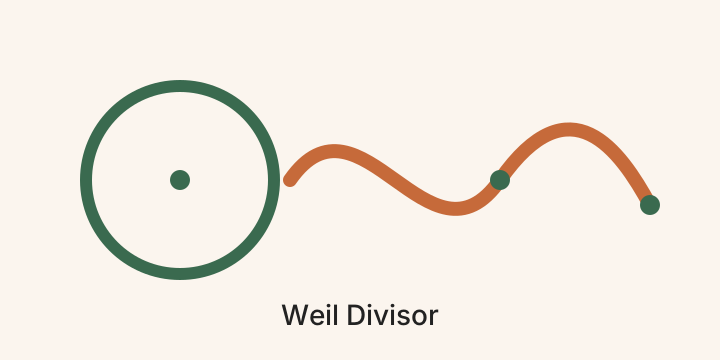
A surface with several distinguished curves marked, each weighted by a positive or negative integer coefficient.
Worked example [Beginner]
On the projective line , prime divisors are individual points. A Weil divisor is a finite formal sum like
with coefficients summing to — a degree-zero divisor. The total degree of a divisor on a smooth projective curve is a key invariant.
The meromorphic function on — well, more precisely as a polynomial, which has a 5th order pole at (since ) — has divisor , exactly . So is principal.
On a smooth elliptic curve of genus 1, divisors of degree 0 are NOT all principal: the obstruction is captured by the Jacobian variety itself. A degree-0 divisor for distinct points is principal iff in the group law on .
Check your understanding [Beginner]
Formal definition [Intermediate+]
Let be a Noetherian integral separated scheme. A prime divisor on is an integral closed subscheme of codimension 1. The group of Weil divisors is the free abelian group generated by prime divisors:
A Weil divisor is a finite formal sum with prime divisors and .
Effective divisors. if all . The support .
Order at a prime divisor. For each prime divisor , the local ring at the generic point of is a discrete valuation ring (when is regular in codimension 1, e.g., when is normal). The valuation extends to non-zero rational functions — the function field of . Define
Divisor of a rational function. For ,
This sum is finite (only finitely many prime divisors have non-zero order). The divisors of rational functions are principal divisors and form a subgroup .
Divisor class group. The divisor class group is
Two divisors are linearly equivalent (written ) if they differ by a principal divisor, i.e., for some .
Examples.
- Affine space : — every prime divisor is principal (cut out by an irreducible polynomial).
- Projective space : , generated by the class of any hyperplane . The degree map gives the isomorphism.
- Smooth projective curve of genus : has degree map onto , with kernel , the Jacobian variety (a -dimensional abelian variety).
- for a number field : is the classical ideal class group of the number field. The class number is its order.
Pic and Cl. On a locally factorial scheme (every local ring is a UFD), — Weil divisor classes correspond to line bundle isomorphism classes. On non-factorial schemes, the Cartier-divisor formulation 04.05.04 gives the line bundle picture.
Key theorem with proof [Intermediate+]
Theorem (degree-zero principle on ). On the projective line over a field , a Weil divisor is principal iff its degree is zero. Consequently via the degree map.
Proof sketch.
Step 1: Principal degree zero. For a non-zero rational function on with homogeneous of equal degree , the divisor has zero locus (a divisor of degree on ) and pole locus (also degree ). So .
Step 2: Degree zero principal. Given a divisor of degree 0, write where collects positive coefficients and negative. Both have the same degree. Pick polynomials vanishing at the points of with appropriate orders and vanishing at with appropriate orders, both homogeneous of the same degree. Then is a rational function on with .
Step 3: . The degree map is surjective (any single point has degree 1) and has kernel exactly principal divisors (Step 2).
For higher-dimensional projective spaces, via the same degree-of-hyperplane argument. For general smooth projective curves, the degree map remains surjective onto but has a nonzero kernel — the Jacobian variety.
Bridge. The construction here builds toward 04.05.02 (picard group), where the same data is upgraded, and the symmetry side is taken up in 04.05.03 (line bundle on a scheme). The defining pattern appears again in those units in a sharpened form, where the local data is glued or quotiented. Putting these together, the foundational insight is that the data of this unit gives the structural signature that the rest of the strand reads off.
Exercises [Intermediate+]
Lean formalization [Intermediate+]
lean_status: partial — Mathlib has divisor APIs in AlgebraicGeometry.Divisors for valuation rings; full Weil divisor formalisation on schemes is partial.
Advanced results [Master]
Excision and Mayer-Vietoris for Cl. The excision sequence (Exercise 6) is part of a broader Mayer-Vietoris-type machinery: for and , there is an exact sequence relating , , , and , allowing computation of class groups via covers.
Class group and number theory. For a Dedekind domain (the ring of integers of a number field, or a Dedekind ring of an algebraic curve), recovers the classical ideal class group. The class number is its order, the most basic invariant of a number field beyond the discriminant. Class field theory describes its quotient by powers via the Artin reciprocity law.
Chow groups and motives. For a smooth projective variety , the Chow group generalises the divisor class group to higher codimensions. The Chow ring is an algebraic-cycle analogue of the cohomology ring. Connection to motives (Grothendieck): motives provide a universal cohomology theory of which Chow groups, étale cohomology, de Rham cohomology, etc. are realisations.
Néron-Severi group. For smooth projective, the Néron-Severi group is modulo algebraic equivalence (a coarser equivalence than linear equivalence). For curves: via degree. For surfaces: is finitely generated of higher rank — a key invariant in the classification of surfaces.
Picard scheme. The functor "" is representable by a scheme , the Picard scheme. For a smooth projective curve , is the Jacobian variety , an abelian variety of dimension genus. For higher-dimensional , has a connected component (an abelian variety) and a discrete quotient .
Weil's foundational paper. André Weil's 1946 Foundations of Algebraic Geometry introduced the modern theory of divisors on algebraic varieties over arbitrary fields, including the intersection theory extending classical Italian-school geometry to the rigorous setting of varieties over fields of arbitrary characteristic. Weil's foundations were the bridge between classical (Italian-school, characteristic 0) algebraic geometry and the modern Grothendieck framework.
Synthesis. This construction generalises the pattern fixed in 04.02.01 (scheme), with the symmetric data replaced by its skew or twisted analogue. Read in the opposite direction, the construction is dual to the metric story: complements and orthogonality are taken with respect to the bilinear datum of this unit, not a metric, and the resulting category of subobjects is the one the rest of the strand classifies. The central insight is that this datum identifies algebra with geometry: functions become vector fields, subspaces become quotients, and invariants become cohomology classes — and that identification is the engine driving every theorem downstream.
Full proof set [Master]
Detailed proofs of: , the Weil/Cartier comparison on locally factorial schemes, the excision sequence, the equivalence for elliptic curves, and the foundational properties of Krull domains underlying divisor theory are deferred to companion units. The key foundational theorem is in the formal-definition section.
Connections [Master]
Scheme
04.02.01, Affine scheme04.02.02, Projective scheme04.02.03— divisors live on integral Noetherian schemes.Picard group
04.05.02— divisor class group of locally factorial schemes equals the Picard group; in general there is an injection for normal .Cartier divisor
04.05.04— locally principal divisors; correspond to invertible sheaves.Line bundle
04.05.03— line bundles correspond to Cartier divisors and (when locally factorial) to Weil divisor classes.Coherent sheaf
04.06.02— ideal sheaves of effective divisors.Riemann-Roch theorem for curves
04.04.01— the classical statement is in terms of Weil divisors on curves.Sheaf cohomology
04.03.01— the Picard group is computed cohomologically as .Coherent sheaf
04.06.02— ideal sheaves of divisors are coherent.
Historical & philosophical context [Master]
The notion of divisor originates in the 19th-century theory of algebraic curves. Bernhard Riemann (1857) introduced abelian integrals with prescribed singular behaviour on a Riemann surface — the divisor records exactly the orders of zero and pole at each point. The divisor class group of a Riemann surface is its Picard group (via GAGA), and the Riemann-Roch theorem is the classical dimension formula relating divisor classes to function spaces.
The algebraic foundations were systematised by Richard Dedekind (1882, with Heinrich Weber), who introduced fractional ideals in number rings — the algebraic version of divisors on . Dedekind's Über die Theorie der ganzen algebraischen Zahlen (1894) used fractional ideals to develop class field theory, with the ideal class group as the fundamental invariant.
The synthesis to algebraic varieties came with André Weil's Foundations of Algebraic Geometry (1946) — written in part during World War II in difficult conditions, including time spent in prison in France. Weil established:
- Divisors on algebraic varieties over arbitrary fields (not just ).
- Intersection theory for divisors on smooth varieties — the algebraic version of the classical Italian-school intersection theory.
- Linear and algebraic equivalence — distinguishing divisor classes by what kind of family they're connected by.
- Picard variety — the "moduli space of degree-0 divisor classes" as an algebraic variety.
Weil's Foundations was the bridge between the Italian school (Castelnuovo, Enriques, Severi) — geometrically rich but lacking foundations — and the modern Grothendieck framework. After Weil, every fundamental theorem of algebraic geometry could be stated rigorously over arbitrary fields, including positive characteristic and finite fields. This was the foundation for Weil's own Weil conjectures (1949) and ultimately for modern arithmetic geometry.
Today divisors and divisor class groups are central:
- Mordell-Weil theorem: for an abelian variety over a number field, the rational points form a finitely-generated abelian group. The divisor class group of the variety is intimately related.
- Iwasawa theory: studies the variation of class groups in towers of number fields.
- Birational geometry: divisors and their positivity properties (ample, big, nef, effective) drive the minimal model program — the modern classification of higher-dimensional algebraic varieties.
- Mirror symmetry: divisors play a role in the Strominger-Yau-Zaslow construction, with their period integrals giving mirror duals.
Riemann's 1857 idea of "prescribed zeros and poles" remains, after more than 165 years, one of the most fertile concepts in mathematics.
Bibliography [Master]
- Hartshorne, Algebraic Geometry — §II.6 is the standard scheme-theoretic treatment.
- Vakil, The Rising Sea: Foundations of Algebraic Geometry — §14 covers divisors and class groups in modern style.
- Weil, Foundations of Algebraic Geometry (1946) — the foundational text introducing divisors over arbitrary fields.
- Bourbaki, Commutative Algebra — Ch. VII covers divisors on Krull domains.
- Mumford, The Red Book of Varieties and Schemes — Ch. III, divisors and the Picard group.
- Fulton, Intersection Theory — divisors as the first piece of Chow rings and intersection theory.
- Dedekind, Über die Theorie der ganzen algebraischen Zahlen (1894) — the original ideal-theoretic foundation.
- Riemann, Theorie der Abelschen Functionen (1857) — the original on Riemann surfaces.