Affine scheme
Anchor (Master): Hartshorne §II; Vakil; Grothendieck-Dieudonné EGA I; Mumford *Red Book*
Intuition [Beginner]
An affine scheme is the geometric object built from a commutative ring. The fundamental dictionary of modern algebraic geometry: every commutative ring corresponds to a geometric space, and ring homomorphisms correspond to maps of those spaces — backwards.
The key construction: take a commutative ring , and form the space whose points are the prime ideals of . So a polynomial ring like has a point for every prime ideal — and the maximal ideals correspond to ordinary geometric points via . The non-maximal primes correspond to "generic" points: the prime corresponds to the curve , the zero ideal corresponds to all of .
This dictionary lets you do geometry by manipulating rings and ideals. Polynomial rings give affine spaces; quotient rings give zero loci of polynomials; localised rings give open subsets. The affine scheme is the most fundamental geometric object: every scheme is built from affine schemes by gluing.
Visual [Beginner]
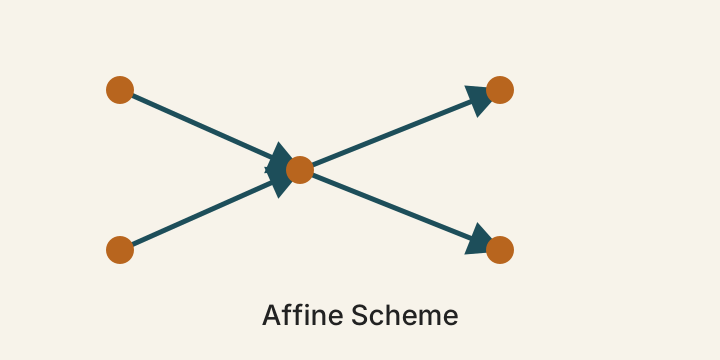
A commutative ring on one side, the spectrum (set of prime ideals) on the other; the Zariski topology and structure sheaf complete the picture.
Worked example [Beginner]
The affine scheme is the affine line over . Its prime ideals are:
- The zero ideal : the generic point of the line.
- The maximal ideals for each : the closed points, corresponding to ordinary points of .
So the affine line as a scheme has all the ordinary -points, plus one extra "generic point" that hovers over everything. This generic point is closed in no nonempty open set — it lives in every nonempty Zariski open. Its presence makes the algebraic geometry richer: properties that hold "generically" (away from a closed proper subset) are exactly properties of the generic point.
A more interesting example: . The prime ideals of are: the zero ideal , and the maximal ideals for each prime number . So has one closed point per prime number plus a generic point. This is a 1-dimensional affine scheme — the arithmetic line. The geometry of is one of the deepest objects in mathematics: it carries the foundations of number theory.
Check your understanding [Beginner]
Formal definition [Intermediate+]
Let be a commutative ring with unit. The affine scheme consists of three pieces of data:
(1) Underlying set. .
(2) Zariski topology. Closed subsets are the vanishing loci
for ideals . Open subsets are complements of these. The distinguished open subsets for form a basis.
(3) Structure sheaf. The structure sheaf is the sheaf of rings characterised by
extended to general open sets by sheafification. The stalk at a prime is the localisation:
The triple is a locally ringed space: each stalk is a local ring, with maximal ideal .
Examples.
- , the affine -space.
- the arithmetic line: closed points are prime numbers , plus the generic point .
- the union of the two coordinate axes in .
- a "thickened point": one closed point with a tangent direction. Reduced: . Non-reduced: this carries nilpotent information.
- — affine spaces fibre over base schemes.
Functor of points. The contravariant functor (locally ringed spaces) factors through the equivalence
For a ring and a scheme , — the geometric maps from to are determined by ring maps in the reverse direction.
Properties.
- is connected iff has no nontrivial idempotents.
- is irreducible iff has a unique minimal prime (i.e., is prime).
- is quasi-compact (every open cover has a finite subcover) — always.
- is Noetherian iff is Noetherian.
- The generic points of correspond to minimal primes; closed points to maximal ideals.
The affine scheme is universal among locally ringed spaces. Given any locally ringed space , . This adjunction (the Spec / Γ adjunction) is the foundational structural theorem of algebraic geometry.
Key theorem with proof [Intermediate+]
Theorem (Spec / Γ adjunction). The functors (Spec construction) and (global sections) are adjoint:
The adjunction restricts to an equivalence of categories .
Proof sketch.
Forward direction. A morphism in pulls back the structure sheaf, giving a ring map .
Backward direction. Given a ring map , construct a morphism as follows. For each , the stalk is a local ring with maximal ideal , and the composition has a kernel . Define (a prime of , i.e., a point of ). The map is continuous (preimage of is the closed locus where is in the maximal ideal of every stalk) and the structure sheaf morphism is induced by on global sections, then sheafified.
The two constructions are mutually inverse on global sections by direct verification, and the local-ring condition makes each natural map respect the local structure.
This adjunction is the foundational theorem of scheme theory: it identifies the category of affine schemes with the opposite of commutative rings, providing the dictionary that powers the entire subject. When is itself affine, the adjunction reduces to the identity , confirming the equivalence.
Bridge. The construction here builds toward 04.02.03 (projective scheme), where the same data is upgraded, and the symmetry side is taken up in 04.02.04 (morphism of schemes). The defining pattern appears again in those units in a sharpened form, where the local data is glued or quotiented. Putting these together, the foundational insight is that the data of this unit gives the structural signature that the rest of the strand reads off.
Exercises [Intermediate+]
Lean formalization [Intermediate+]
lean_status: partial — Mathlib has AlgebraicGeometry.Spec, AlgebraicGeometry.AffineScheme, and the Spec / Γ adjunction.
Advanced results [Master]
Spec / Γ adjunction. The full statement: is right-adjoint to global sections , and the unit and counit witness the equivalence of with affine schemes.
Hilbert's Nullstellensatz (geometric form). For a finitely-generated -algebra over an algebraically closed field :
- Maximal ideals of correspond bijectively to points of the classical variety .
- is a contravariant equivalence between finitely-generated reduced -algebras and affine algebraic varieties.
Thus the affine scheme generalises the classical variety: every closed point of for finitely-generated over corresponds to a classical point.
Krull dimension. , the Krull dimension of the ring (length of longest chain of primes). For , dimension 1. For , dimension .
Local cohomology. For an ideal, the local-cohomology functors on -modules correspond geometrically to cohomology supported on . This was developed by Grothendieck and is essential in commutative algebra and algebraic geometry.
Étale topology. A finer Grothendieck topology on , where covers consist of étale (locally finite, unramified, smooth) morphisms. Étale cohomology of a scheme generalises sheaf cohomology and provides the deepest invariants in arithmetic geometry — the foundation of Grothendieck's proof program for the Weil conjectures.
Formal schemes and adic spaces. Beyond Spec are formal schemes (for completing along closed subschemes, used in deformation theory) and adic spaces (for -adic geometry, Huber spaces, Berkovich spaces — Scholze's perfectoid spaces).
Spec for non-commutative rings. The non-commutative analogue is the theory of spectra of non-commutative rings (the Pierce spectrum, Goodearl-Warfield prime spectrum), with non-commutative algebraic geometry following Artin, Stafford, Lurie, and others.
Synthesis. This construction generalises the pattern fixed in 04.01.01 (sheaf), with the symmetric data replaced by its skew or twisted analogue. Read in the opposite direction, the construction is dual to the metric story: complements and orthogonality are taken with respect to the bilinear datum of this unit, not a metric, and the resulting category of subobjects is the one the rest of the strand classifies. The central insight is that this datum identifies algebra with geometry: functions become vector fields, subspaces become quotients, and invariants become cohomology classes — and that identification is the engine driving every theorem downstream.
Full proof set [Master]
Detailed proofs of: the Spec/Γ adjunction, the Nullstellensatz reformulation, Hilbert's basis theorem implying Spec of a Noetherian ring is Noetherian, the Going Up / Going Down theorems, and the dimension formula are deferred to companion units. The key conceptual content is in the formal-definition section above.
Connections [Master]
Sheaf
04.01.01— the structure sheaf is the foundational example of a sheaf in algebraic geometry.Scheme
04.02.01— affine schemes are the building blocks; every scheme is locally an affine scheme.Projective scheme Proj(S)
04.02.03— global complement to affine schemes; built from graded rings.Quasi-coherent sheaf
04.06.01— quasi-coherent sheaves on correspond bijectively to -modules.Coherent sheaf
04.06.02— coherent sheaves on Noetherian correspond to finitely-presented -modules.Sheaf cohomology
04.03.01— affine schemes are cohomologically vanishing for quasi-coherent sheaves (Serre's theorem).Associative algebra
03.01.02and Ideal03.01.03— the foundational algebraic data underlying .Topological space
02.01.01— the underlying Zariski topology.
Historical & philosophical context [Master]
The classical (pre-Grothendieck) view of algebraic geometry was variety-theoretic: an algebraic variety over an algebraically closed field is the zero set of a system of polynomial equations in or . The associated ring is the coordinate ring — a finitely-generated reduced -algebra. This worked beautifully for many problems but had structural limitations:
- Non-reduced phenomena were invisible. Tangent directions, infinitesimal deformations, intersection multiplicities all required ad hoc workarounds.
- Non-classical fields broke the dictionary. Over or finite fields, "varieties" were Galois-orbits of points and didn't fit cleanly.
- Number theory lived elsewhere. wasn't naturally a "variety," yet number theory has obvious geometric content.
The breakthrough was Grothendieck's Éléments de Géométrie Algébrique (EGA, 1960–67) building on the Cartan seminars (1954–64) and Serre's Faisceaux Algébriques Cohérents (1955). The defining insight: don't define varieties by zero sets of polynomials — define them by their rings of functions, allow arbitrary commutative rings (including those with nilpotents and non-zero characteristic), and recover geometry through .
This Grothendieck revolution unified:
- Classical algebraic geometry (varieties over ): special case of schemes over .
- Number theory: , are arithmetic schemes.
- Deformation theory: nilpotents encode infinitesimal data.
- Étale cohomology: Grothendieck topologies generalise the Zariski one to capture arithmetic.
By the early 1970s, this framework had been used to prove the Weil conjectures (Deligne 1974, completing Grothendieck's program) — one of the great achievements of 20th-century mathematics. The conceptual framework of schemes built from affine schemes now dominates algebraic geometry, arithmetic geometry, and large parts of number theory and mathematical physics.
The philosophical core: geometry is the language of commutative rings, in disguise. The affine scheme is the most direct embodiment of this principle. Every more elaborate scheme is glued from affine pieces, just as every smooth manifold is glued from open subsets of .
Bibliography [Master]
- Hartshorne, Algebraic Geometry — §II.2 is the standard treatment.
- Vakil, The Rising Sea: Foundations of Algebraic Geometry — §3–§5, modern and pedagogical.
- Grothendieck-Dieudonné, Éléments de Géométrie Algébrique I (EGA I, 1960) — the foundational reference.
- Eisenbud & Harris, The Geometry of Schemes — geometrically-oriented introduction.
- Mumford, The Red Book of Varieties and Schemes — classic introduction.
- Liu, Algebraic Geometry and Arithmetic Curves — strong on number-theoretic schemes.
- Görtz & Wedhorn, Algebraic Geometry I and II — comprehensive modern treatment.
- Serre, Faisceaux Algébriques Cohérents (FAC, 1955) — the seminal paper introducing sheaf-cohomology methods to algebraic geometry.