Blowup
Anchor (Master): Hironaka 1964 *Resolution of Singularities*; Kollár *Lectures on Resolution of Singularities*; Hauser *The Hironaka Theorem*
Intuition [Beginner]
A blowup surgically replaces a point on a variety with the set of all directions through that point. Imagine standing at a point on a surface and refusing to identify which direction you're looking — you replace with the entire space of directions emanating from . The result is a new variety with a " of directions" sitting where used to be.
Why bother? Because singular points of varieties — places where the variety is not smooth — often resolve into smooth pieces once you blow them up. The cone with a sharp point at the origin becomes a smooth surface after replacing the cone point with the circle of generating lines. Heisuke Hironaka proved in 1964 that every singular variety in characteristic 0 can be resolved by repeated blowups along smooth centres. He won the Fields Medal for this, and the proof runs 217 pages.
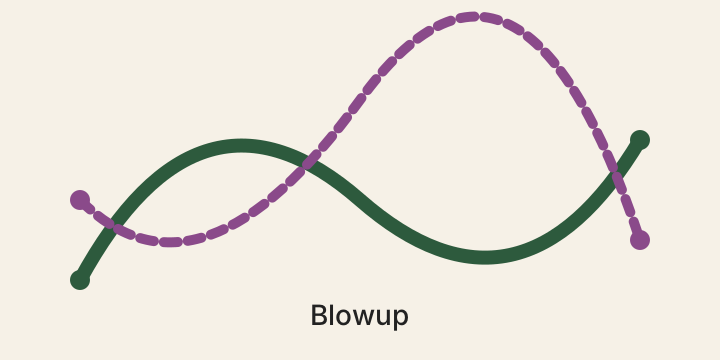
Blowups also let you separate curves that pass through the same point: two distinct lines through the origin become two non-intersecting curves on the blowup, distinguished by their direction.
Visual [Beginner]
The plane with the origin replaced by a copy of — the circle of directions through the origin.
Worked example [Beginner]
The blowup of the affine plane at the origin is the subset of defined by the equation , where are homogeneous coordinates on . Above any point , the equation forces — exactly one point. Above , the equation is automatic, and the entire sits there.
Concretely: the line passes through the origin with slope 2. On the blowup it becomes the curve — its image at the origin is the single direction . The line becomes , hitting a different direction. Two lines that met at the origin downstairs are now disjoint upstairs: each line has its own direction and they no longer share a point.
This is the essence of blowing up — separating data that was previously collapsed into a single point.
Check your understanding [Beginner]
Formal definition [Intermediate+]
Let be a Noetherian scheme and a coherent ideal sheaf, defining a closed subscheme . The blowup of along is the scheme
the relative Proj of the Rees algebra of the ideal sheaf, equipped with a structural morphism .
Universal property. is the universal morphism among -schemes such that the inverse image ideal sheaf is an invertible -module: for every such , there exists a unique -morphism factoring .
Exceptional divisor. The preimage is an effective Cartier divisor on , the exceptional divisor. Off the exceptional divisor, is an isomorphism: .
Local picture. When is affine and , the blowup is the closure in of the graph
cut out by the equations for , where are homogeneous coordinates on .
Examples.
Blowup of at the origin. With , the blowup is defined by . The exceptional divisor is , a copy of projective space of dimension .
Blowup of a smooth subvariety. If is smooth of codimension in a smooth variety, then is again smooth, and the exceptional divisor is a projective bundle: , the projectivisation of the normal bundle.
Blowup of a node on a plane curve. The nodal cubic has a node at the origin. Blowing up the origin separates the two branches into smooth disjoint curves on the blowup.
Strict transform. Given a closed subscheme with , the strict transform is the closure of in . The total transform in general decomposes as where is the multiplicity of along .
Key theorem with proof [Intermediate+]
Theorem (universal property of the blowup). Let be a Noetherian scheme, a closed subscheme with ideal sheaf , and the blowup. Then is an invertible sheaf, and for any morphism such that is invertible, there exists a unique -morphism with .
Proof. Write for the Rees algebra. By construction .
Step 1 — invertibility on the blowup. On , the sheaf is invertible by the standard Proj construction. The image of the natural map is a surjection from an invertible sheaf onto an invertible sheaf, hence an isomorphism: , an invertible sheaf.
Step 2 — universal factorisation. Suppose has invertible. The inclusion pulls back to a surjection . Since is invertible, this surjection corresponds to an -morphism — specifically, into the closure of the graph of "directions of ." That closure is exactly (the normalisation of the symmetric algebra by the Rees relations).
Concretely, on an affine chart with , an invertible on together with a surjection via determines a unique morphism . The relations on are automatically satisfied by this morphism (the are scalar multiples of a single generator of locally), so the morphism factors through the blowup.
Step 3 — uniqueness. The factoring morphism is determined by the surjection , which is itself determined by and the invertibility data — no additional choice. Hence is unique.
The universal property characterises the blowup up to canonical isomorphism. It is the minimal surgery on that turns into an invertible ideal sheaf.
Bridge. The construction here builds toward later units of the strand, where the same pattern is taken up at higher structure. The defining pattern appears again in those units in a sharpened form, where the local data is glued or quotiented. Putting these together, the foundational insight is that the data of this unit gives the structural signature that the rest of the strand reads off.
Exercises [Intermediate+]
Lean formalization [Intermediate+]
lean_status: partial — Mathlib has the underlying infrastructure and graded ring theory; the named blowup construction and its universal property are not yet formalised in full.
Advanced results [Master]
Hironaka's theorem on resolution of singularities (1964). Every algebraic variety over a field of characteristic 0 admits a resolution of singularities — a proper birational morphism from a smooth variety, obtained by a finite sequence of blowups along smooth centres. The proof, occupying 217 pages of Annals of Mathematics 79, introduced the Hironaka invariant — a sophisticated lexicographic well-ordering of singularity types — and showed that a single blowup along an appropriately chosen smooth centre strictly decreases it. The work was simplified by Bierstone-Milman, Encinas-Villamayor, Włodarczyk, and Kollár, but the essential strategy remains Hironaka's.
Equisingular and embedded resolution. Hironaka actually proved a stronger embedded version: given a closed subscheme with smooth, there exists a sequence of blowups along smooth centres in the singular locus of resolving and making it transverse to (or contained in) a normal-crossings divisor. This stronger form is what's used in birational geometry.
Weak factorisation theorem (Włodarczyk-Abramovich-Karu-Matsuki, 2002). Any birational map between smooth projective varieties in characteristic 0 can be factored as a sequence of blowups and blowdowns along smooth centres. So blowups generate the entire birational equivalence relation among smooth projective varieties.
Castelnuovo's contraction theorem. On a smooth projective surface, an irreducible curve with and can be contracted to a smooth point: there exists a morphism with smooth, contracting and being an isomorphism elsewhere. Conversely every blowup of a smooth point on a smooth surface produces such a -curve. Castelnuovo's theorem is the converse to surface blowup and is foundational for the classification of surfaces.
Failure in positive characteristic. Resolution of singularities is open in characteristic for varieties of dimension . Hironaka proved it in dimensions . de Jong (1996) proved a weaker statement — resolution by alterations (generically finite morphisms instead of birational) — in all characteristics. The failure in characteristic stems from wild ramification, inseparability, and the Frobenius automorphism producing pathological singularity types not amenable to Hironaka's induction.
Toric resolutions. For toric varieties, resolution of singularities reduces to combinatorics of fans: every singular cone admits a regular subdivision producing a smooth toric blowup. This combinatorial resolution is constructive and works in all characteristics.
Synthesis. This construction generalises the pattern fixed in 04.02.01 (scheme), with the symmetric data replaced by its skew or twisted analogue. Read in the opposite direction, the construction is dual to the metric story: complements and orthogonality are taken with respect to the bilinear datum of this unit, not a metric, and the resulting category of subobjects is the one the rest of the strand classifies. The central insight is that this datum identifies algebra with geometry: functions become vector fields, subspaces become quotients, and invariants become cohomology classes — and that identification is the engine driving every theorem downstream.
Full proof set [Master]
The universal property is proved in the formal-definition section. Hironaka's theorem itself is one of the deepest theorems in algebraic geometry; full proofs run book-length (Kollár's Lectures on Resolution of Singularities, Princeton 2007; Hauser's exposition in the Bulletin of the AMS, 2003). A self-contained proof is beyond the scope of this unit and is stated without proof — see Hironaka Annals of Math 79 (1964); Kollár Lectures; Hauser The Hironaka Theorem on Resolution of Singularities, Bulletin AMS 40 (2003), 323–403.
The proof of for the exceptional curve of a single-point blowup of a smooth surface uses the projection formula , combined with the local computation in coordinates. The Picard-group decomposition follows by the localisation sequence in -theory or by direct cocycle analysis.
Connections [Master]
Scheme
04.02.01— blowup is a construction internal to the category of schemes, producing a new scheme from a closed subscheme.Projective space
04.07.01— the blowup is locally a closed subscheme of a product with projective space, reflecting the "directions" interpretation.Cartier divisor
04.05.04— the exceptional divisor is the canonical effective Cartier divisor on the blowup; the universal property says blowups make pulled-back ideal sheaves Cartier.Coherent sheaf
04.06.02— the Rees algebra is a sheaf of graded -algebras built from coherent ideal sheaves.Picard group
04.05.02— blowing up a smooth point on a smooth surface adds a -summand to the Picard group, generated by the exceptional curve class.Riemann-Roch theorem for curves
04.04.01— strict transforms of curves under blowup change their genus and degree predictably; key in classification of surfaces.Moduli of curves
04.10.01— blowups of produce alternative compactifications relevant to enumerative geometry.
Historical & philosophical context [Master]
Oscar Zariski began the modern study of resolution of singularities in the 1930s, proving the case of surfaces (1939) and threefolds (1944) using algebraic methods involving normalisation and Bertini-type arguments. He pursued resolution in higher dimensions for the rest of his career without success: the obstruction lay in finding the right invariant to induct on.
Heisuke Hironaka, Zariski's student, solved the problem in characteristic 0 in his 1964 paper Resolution of singularities of an algebraic variety over a field of characteristic zero, published in Annals of Mathematics 79, 109–326. The argument runs 217 pages and introduces the Hironaka invariant — a refined lexicographic measurement of singularity complexity — together with an inductive scheme showing that blowups along carefully chosen smooth centres strictly decrease this invariant. Hironaka was awarded the Fields Medal in 1970. The work is widely regarded as one of the deepest theorems in algebraic geometry; subsequent decades produced multiple simplifications (Bierstone-Milman, Encinas-Villamayor, Włodarczyk, Kollár), but the essential Hironaka strategy remains.
The blowup construction itself is older — present in classical Italian algebraic geometry (Cremona, Castelnuovo, Enriques) for surfaces, where it figured prominently in the minimal models programme. Castelnuovo's contraction theorem (1899) — a smooth surface contains a -curve with and if and only if it is the blowup of another smooth surface at a point — gave the classical converse. Zariski reformulated blowups schematically in the 1940s; Grothendieck systematised the general construction via the relative Proj of the Rees algebra in EGA II (1961).
The universal property — blowup is the minimal surgery making an ideal sheaf invertible — is Grothendieck's reformulation, now standard. Cartier divisors, line bundles, and the Picard scheme make the universal property a theorem about representability of a moduli functor.
In the minimal model programme (Mori, Reid, Kollár, Mori-Mukai, Birkar-Cascini-Hacon-McKernan, 2010), blowups and their inverses (contractions) are the elementary surgeries on higher-dimensional varieties. The theorem of Birkar-Cascini-Hacon-McKernan (2010, J. Amer. Math. Soc.) establishing existence of minimal models for varieties of general type uses iterated blowups and contractions in essential ways.
Resolution of singularities in characteristic remains open in dimensions . de Jong (1996, Publ. Math. IHES 83) proved resolution by alterations — generically finite morphisms instead of birational — in all characteristics. Whether full birational resolution holds in positive characteristic is one of the major open problems in algebraic geometry.
Bibliography [Master]
- Hironaka, H., Resolution of singularities of an algebraic variety over a field of characteristic zero, Annals of Mathematics 79 (1964), 109–326.
- Hironaka, H., On the theory of birational blowing-up, Harvard PhD thesis (1960).
- Zariski, O., The reduction of the singularities of an algebraic surface, Annals of Mathematics 40 (1939), 639–689.
- Hartshorne, R., Algebraic Geometry, Springer 1977 — §II.7.
- Vakil, R., The Rising Sea: Foundations of Algebraic Geometry — §22.
- Kollár, J., Lectures on Resolution of Singularities, Princeton University Press 2007.
- Hauser, H., The Hironaka Theorem on Resolution of Singularities, Bulletin AMS 40 (2003), 323–403.
- Włodarczyk, J., Simple Hironaka resolution in characteristic zero, J. Amer. Math. Soc. 18 (2005), 779–822.
- de Jong, A. J., Smoothness, semi-stability and alterations, Publ. Math. IHES 83 (1996), 51–93.
- Bierstone-Milman, Canonical desingularization in characteristic zero, Invent. Math. 128 (1997), 207–302.
- Eisenbud-Harris, The Geometry of Schemes, Springer 2000 — §IV.2.