Moduli of curves
Anchor (Master): Harris-Morrison; Mumford-Fogarty-Kirwan *GIT*; Arbarello-Cornalba-Griffiths *Geometry of Algebraic Curves* Vol II
Intuition [Beginner]
The moduli space of curves is a remarkable mathematical object: a single space whose points are themselves entire algebraic curves. Each point of corresponds to one isomorphism class of smooth projective curves of genus . So a path in is a continuous deformation of curves, a divisor in is a family of curves with some special property, and so on.
Riemann introduced the idea in 1857 in Theorie der Abelschen Functionen: he counted the moduli — the parameters needed to specify a curve of genus — and got the formula
For there are no moduli (every genus-0 curve is the projective line). For there is one modulus (the j-invariant of an elliptic curve). For , Riemann's .
David Mumford in 1965 gave the first rigorous construction of as a quasi-projective scheme using Geometric Invariant Theory (GIT) — a Hilbert-style construction: parameterise embedded curves with abundant linear data, then quotient by the group of changes of basis. Deligne-Mumford in 1969 extended to a compactification allowing curves with mild singularities.
Visual [Beginner]
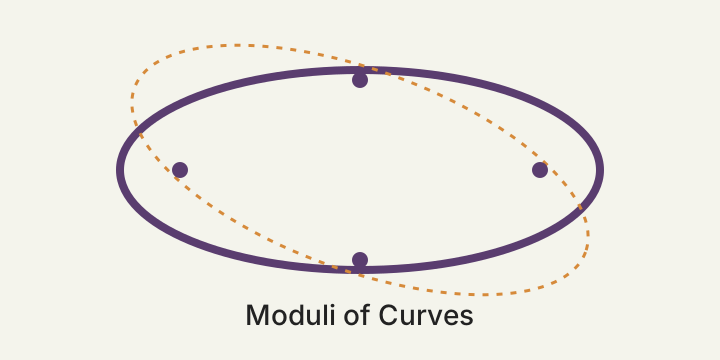
A space whose points are smooth projective curves of genus , with paths corresponding to continuous deformations.
Worked example [Beginner]
For (elliptic curves): the moduli space has dimension via the naive Riemann count, but it actually has dimension 1 — the formula requires .
The moduli space is the modular curve: every elliptic curve over corresponds to a point in the upper-half plane modulo the action of the modular group . Two elliptic curves are isomorphic iff their lattice parameters differ by a Möbius transformation in .
The quotient is identified with the affine line via the j-invariant — a specific rational function on that descends to a coordinate on the quotient. So , with the j-invariant as the universal coordinate. Each value of corresponds to one elliptic curve up to isomorphism.
For : . The moduli space of genus-2 curves is 3-dimensional, parametrising the position of branch points of the unique 2-to-1 map to .
Check your understanding [Beginner]
Formal definition [Intermediate+]
Let be an integer.
Coarse moduli space (Mumford 1965). The moduli space of smooth projective genus- curves is the coarse moduli space representing the moduli functor
where is a scheme and denotes isomorphism. Mumford 1965 (Geometric Invariant Theory) proves that is a quasi-projective scheme over of dimension (for ).
Caveat: not a fine moduli space. is not a fine moduli space (no universal family on representing the functor) because curves can have nonzero (non-identity) automorphisms. The Deligne-Mumford stack is the right object — a Deligne-Mumford stack representing the moduli functor exactly.
Moduli with marked points. is the moduli space of smooth projective genus- curves with ordered marked points , all distinct. for .
Construction via GIT. The construction (Mumford 1965):
(M1) Tri-canonical embedding. For , every smooth projective genus- curve admits a closed embedding via the linear system — tri-canonical sections. This embeds as a curve of degree in (via Riemann-Roch and asymptotic vanishing).
(M2) Hilbert scheme. The Hilbert scheme parametrises closed subschemes of with given Hilbert polynomial . For tri-canonically embedded smooth curves, the Hilbert polynomial is . Let be the open subscheme of smooth curves.
(M3) PGL action. The group acts on by changing the embedding (different choices of basis for tri-canonical sections). Two points of correspond to the same abstract curve iff they differ by a action.
(M4) GIT quotient. The moduli space is the GIT quotient , taken with respect to a suitable linearisation. Mumford's GIT theorem (1965) identifies this quotient as a quasi-projective scheme.
Stable-curve compactification (Deligne-Mumford 1969). The non-compactness of comes from families of smooth curves that degenerate (one curve in the family becomes singular). Deligne-Mumford 1969 The irreducibility of the space of curves of given genus (Publ. Math. IHES 36) introduced the moduli space of stable curves :
A stable curve of genus is a connected projective curve such that:
- Every singularity of is a node (i.e., analytically isomorphic to ).
- The automorphism group is finite.
- Equivalently: is ample on .
Stability ensures the moduli space is Hausdorff / separated and proper (compact in the sense of algebraic geometry). is a projective scheme (or proper Deligne-Mumford stack) containing as a dense open.
Boundary divisors. has a stratification by boundary strata. The components for :
- : irreducible nodal curves of geometric genus .
- for : reducible curves with two components of genera and joined at a single node.
The Picard group is generated by the 's and the Hodge class — modulo a few relations (Harer 1983; Arbarello-Cornalba 1987).
Tautological classes. On there are distinguished classes:
- for , where is the cotangent line at the -th marked point.
- for , with the forgetting map.
- where is the Hodge bundle — the rank- vector bundle whose fibre over is .
These classes generate a subring — the tautological ring — central in modern moduli theory.
Key theorem with proof [Intermediate+]
Theorem (Mumford 1965). For , the moduli space of smooth projective genus- curves over exists as a quasi-projective complex variety of dimension .
Proof outline. Step 1 — tri-canonical embedding. For , is ample on a smooth genus- curve , so is very ample (Mumford-Fogarty-Kirwan §6). The complete linear system has dimension (by Riemann-Roch: for , since the first cohomology vanishes by Serre's vanishing for sufficiently positive bundles). It defines a closed embedding as a curve of degree .
Step 2 — Hilbert scheme parameter space. The Hilbert scheme of all closed subschemes of with Hilbert polynomial exists as a projective scheme (Grothendieck 1961). The locus of tri-canonically embedded smooth genus- curves is an open subscheme.
Step 3 — group action and GIT. The group acts on by changes of basis on the tri-canonical sections. The orbits are exactly the isomorphism classes of curves: two points of correspond to the same abstract curve iff they differ by a action.
Step 4 — GIT quotient. Mumford's GIT theorem produces the quotient as a quasi-projective scheme. The technical input: smooth curves of have finite automorphism groups, so the GIT quotient is well-defined (no positive-dimensional stabilisers). The result is .
Step 5 — dimension count. . By tangent-space analysis, this equals . Subtracting the dimension of :
This recovers Riemann's 1857 count, now rigorously established.
The construction depends on . For : is a point (no moduli), is the affine line via the -invariant.
Bridge. The construction here builds toward later units of the strand, where the same pattern is taken up at higher structure. The defining pattern appears again in those units in a sharpened form, where the local data is glued or quotiented. Putting these together, the foundational insight is that the data of this unit gives the structural signature that the rest of the strand reads off.
Exercises [Intermediate+]
Lean formalization [Intermediate+]
lean_status: partial — Mathlib has algebraic-geometry foundations and stack infrastructure in development; the moduli stack of curves is not yet a named Mathlib construction.
Advanced results [Master]
Deligne-Mumford compactification (1969). is a smooth Deligne-Mumford stack, projective over . The boundary is a normal-crossing divisor with components . Deligne-Mumford 1969 proved is irreducible — a long-conjectured statement now standard.
Tautological ring. The tautological ring is generated by the -classes, -classes, -classes, and boundary classes. Faber-Pandharipande conjectured (1999) explicit generators and relations; Pixton's relations (2012) gave a conjectural complete set of relations, with substantial progress (Janda 2018, Pixton-Pandharipande-Zvonkine).
Mumford-Morita-Miller (kappa) classes. The classes on generate the stable cohomology by Madsen-Weiss (2007, proving Mumford's 1983 conjecture). For , .
Witten-Kontsevich theorem. The generating function of -class intersection numbers on satisfies the KdV hierarchy. Kontsevich proved Witten's 1991 conjecture using matrix integrals (1992, Comm. Math. Phys.). The first major bridge between moduli-space intersection theory and integrable systems.
Faber's intersection conjecture. Faber (1999) conjectured that is a Gorenstein ring with explicit socle. The conjecture is verified through genus 23 by computational methods (Faber-Pandharipande). Pixton's relations are conjecturally a complete set of relations.
Birational geometry of . Harris-Mumford 1982 proved is of general type for . This was a major breakthrough: it shows for large has positive Kodaira dimension and is far from rational. Subsequent work (Eisenbud-Harris, Farkas) refined the bounds.
Hyperelliptic locus and Brill-Noether theory. The hyperelliptic locus has dimension (Riemann-Hurwitz: 6 branch points modulo + degree-2 morphism data). Brill-Noether theory studies the loci of curves with linear systems of given rank and degree.
Modular forms and . is the modular curve , with sections of line bundles corresponding to modular forms of weight . The Eichler-Shimura theory and Galois representations of modular forms tie to number theory (Wiles' proof of Fermat's Last Theorem).
Synthesis. This construction generalises the pattern fixed in 04.04.01 (riemann-roch theorem for curves), with the symmetric data replaced by its skew or twisted analogue. Read in the opposite direction, the construction is dual to the metric story: complements and orthogonality are taken with respect to the bilinear datum of this unit, not a metric, and the resulting category of subobjects is the one the rest of the strand classifies. The central insight is that this datum identifies algebra with geometry: functions become vector fields, subspaces become quotients, and invariants become cohomology classes — and that identification is the engine driving every theorem downstream.
Full proof set [Master]
Mumford's GIT construction is sketched in the formal-definition section; the full proof occupies Mumford-Fogarty-Kirwan §6. Deligne-Mumford 1969 (Publ. Math. IHES 36) constructs . Tautological-ring relations: Faber-Pandharipande, Pixton 2012, Janda 2018. Mumford conjecture: Madsen-Weiss 2007 (Annals 165). Witten-Kontsevich: Kontsevich 1992 (CMP).
Connections [Master]
Riemann-Roch theorem for curves
04.04.01— the dimension count comes via deformation theory and Riemann-Roch.Coherent sheaf
04.06.02— the Hodge bundle and tautological classes are coherent sheaves on .Sheaf cohomology
04.03.01— cohomology of curves and their moduli is governed by sheaf-cohomology techniques.Geometric invariant theory
04.10.02— Mumford's GIT is the construction tool for .Canonical sheaf
04.08.02— tri-canonical embedding is the key step.Hodge decomposition
04.09.01— the Hodge bundle on extracts the holomorphic forms.Riemann surface
06.03.01— points of are isomorphism classes of compact Riemann surfaces of genus .Theta function
06.06.05— theta-divisors on Jacobians of curves trace out divisors on .
Historical & philosophical context [Master]
Bernhard Riemann's 1857 Theorie der Abelschen Functionen (J. reine angew. Math. 54) introduced the term moduli (singular Modul) for the parameters needed to describe a Riemann surface. Riemann argued: a Riemann surface of genus is described by parameters (for ) — his celebrated moduli formula. The argument was heuristic, using the Dirichlet principle and dimension counts on spaces of meromorphic differentials, but the answer was correct.
Riemann's count was rigorised in stages. Felix Klein and Henri Poincaré in the 1880s developed the analytic theory: the moduli space is identified with Teichmüller space modulo the mapping class group — Teichmüller space is the simply connected upper half-space, and where is the mapping class group of a genus- surface.
The algebraic-geometric construction came in 1965 with David Mumford's Geometric Invariant Theory (Springer 1965). Mumford realised as a quasi-projective scheme via the GIT quotient of the Hilbert scheme of tri-canonically embedded curves by . This was the first rigorous algebraic construction; previously was known to exist only as an analytic space (via Teichmüller theory).
The compactification problem — completing to a proper space — was solved by Pierre Deligne and David Mumford in 1969 (The irreducibility of the space of curves of given genus, Publ. Math. IHES 36). Their key idea: allow stable curves with at-worst-nodal singularities and finite automorphism groups. The result is a projective scheme (or Deligne-Mumford stack), proving Mumford's conjectural compactification works. Deligne-Mumford simultaneously proved is irreducible — a long-conjectured statement.
The 1980s-90s saw an explosion of moduli-space activity:
- Mumford's tautological ring (1983, Towards an Enumerative Geometry of the Moduli Space of Curves): introduced the -classes and the tautological subring of .
- Harris-Mumford (1982, Invent. Math.): proved is of general type for , a major birational-geometry breakthrough.
- Witten's conjecture (1991, Surveys in Differential Geometry): proposed that intersection numbers of -classes on satisfy KdV.
- Kontsevich (1992, Comm. Math. Phys.): proved Witten via matrix integrals, opening the Gromov-Witten / quantum cohomology era.
In the 2000s-10s:
- Mirzakhani's hyperbolic-geometry proof of Witten-Kontsevich (2006, Fields Medal 2014).
- Madsen-Weiss (2007, Annals of Math. 165): proved Mumford's 1983 conjecture on stable cohomology.
- Pixton's relations (2012): conjectural complete set of relations for the tautological ring.
- Galatius-Randal-Williams and the moduli of manifolds program: extended moduli theory to higher-dimensional manifolds.
Today, moduli spaces of curves sit at the intersection of algebraic geometry, mathematical physics, and topology. They appear in:
- String theory (worldsheet path integrals over ).
- Mirror symmetry (Gromov-Witten invariants of Calabi-Yau threefolds vs. period integrals).
- Number theory (modular forms, Galois representations, the Wiles-Taylor proof of Fermat).
- Topology (stable cohomology, mapping class groups, Madsen-Weiss).
- Integrable systems (Witten-Kontsevich, KdV hierarchy).
Riemann's 1857 prescient remains the fundamental invariant. The modern theory has uncovered far richer structures, but the basic count came first.
Bibliography [Master]
- Riemann, B., Theorie der Abelschen Functionen, J. reine angew. Math. 54 (1857), 115–155.
- Mumford, D., Geometric Invariant Theory, Springer-Verlag 1965; 3rd ed. with Fogarty & Kirwan 1994.
- Deligne, P. & Mumford, D., The irreducibility of the space of curves of given genus, Publ. Math. IHES 36 (1969), 75–109.
- Mumford, D., Towards an enumerative geometry of the moduli space of curves, in Arithmetic and Geometry II, Birkhäuser 1983, 271–328.
- Harris, J. & Morrison, I., Moduli of Curves, Springer GTM 187, 1998.
- Arbarello, E., Cornalba, M., Griffiths, P. & Harris, J., Geometry of Algebraic Curves I, II, Springer Grundlehren 267 (1985), 268 (2011).
- Harris, J. & Mumford, D., On the Kodaira dimension of the moduli space of curves, Invent. Math. 67 (1982), 23–86.
- Witten, E., Two-dimensional gravity and intersection theory on moduli space, Surveys in Differential Geometry 1 (1991), 243–310.
- Kontsevich, M., Intersection theory on the moduli space of curves and the matrix Airy function, Comm. Math. Phys. 147 (1992), 1–23.
- Madsen, I. & Weiss, M., The stable moduli space of Riemann surfaces: Mumford's conjecture, Annals of Math. 165 (2007), 843–941.
- Mirzakhani, M., Simple geodesics and Weil-Petersson volumes of moduli spaces of bordered Riemann surfaces, Invent. Math. 167 (2007), 179–222.
- Pandharipande, R., Pixton, A. & Zvonkine, D., Relations on via 3-spin structures, J. Amer. Math. Soc. 28 (2015), 279–309.