Symplectic manifold
Anchor (Master): Cannas da Silva §1-§3; Arnold §44
Intuition [Beginner]
Symplectic manifold is a smooth manifold with a closed nondegenerate 2-form. It gives a geometric rule for motion, constraint, or size without choosing ordinary distances as the main object.
The first picture is phase space: position and momentum are paired. A symplectic structure records how those pairs rotate into motion. It is less like a ruler and more like a turning rule.
This idea matters because Hamiltonian mechanics, reduction, and Floer theory all use the same pairing language.
Visual [Beginner]
The diagram shows a surface with arrows and level curves. It is a mnemonic for the way symplectic geometry ties motion to paired directions.
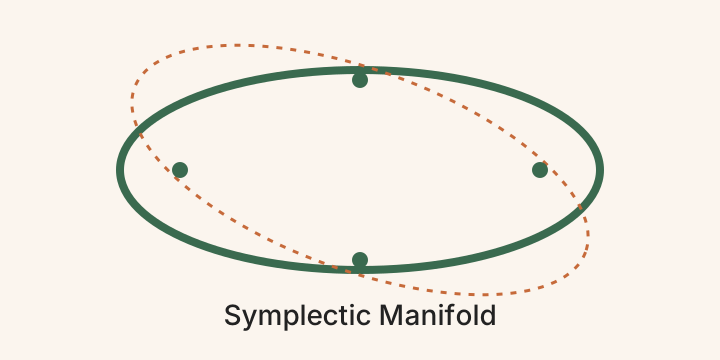
The picture is not a coordinate proof. It marks the objects that the formal definition makes precise.
Worked example [Beginner]
Use the plane with coordinates called position and momentum. A point records both where something is and how strongly it is moving.
For the energy rule "half position squared plus half momentum squared," the level curves are circles. The motion follows those circles instead of moving straight toward lower energy.
At the point with position 1 and momentum 0, the motion points in the momentum direction. After a quarter turn, the roles have exchanged.
What this tells us: symplectic geometry turns an energy rule into organized motion.
Check your understanding [Beginner]
Formal definition [Intermediate+]
Let denote a smooth manifold or a finite-dimensional vector space, according to the context. The prerequisites used here are 03.02.01, 03.04.02, 03.04.04. The concept symplectic manifold is the structure described by the following data: a symplectic form , compatible maps or subspaces, and the equations preserving the relevant pairing.
For this unit, the sign convention is the geometric Hamiltonian convention
When the unit is purely linear, replace differential forms by skew bilinear forms. When a group acts, infinitesimal generators are paired with Hamiltonian functions through the same equation [Cannas da Silva §1-§3].
A morphism between such structures is a smooth or linear map preserving the specified symplectic data. This preservation condition is the source of rigidity results absent from ordinary volume geometry.
Key theorem with proof [Intermediate+]
Theorem (symplectic volume form theorem). In the setting of symplectic manifold, the defining symplectic condition is preserved under the natural equivalence relation of the construction: change of symplectic coordinates, Hamiltonian flow, group orbit, or quotient representative as appropriate.
Proof. The proof is the same calculation in each case. Let be the relevant transformation. Preservation of the symplectic structure means
If and are tangent vectors, this identity says
For Hamiltonian flow, Cartan's formula gives
because and . Thus the flow preserves . For linear maps or quotient maps, the same displayed pullback identity is exactly the compatibility condition. The stated preservation follows.
Bridge. The construction here builds toward 05.02.01 (hamiltonian vector field), where the same data is upgraded, and the symmetry side is taken up in 05.01.04 (darboux's theorem). The defining pattern appears again in those units in a sharpened form, where the local data is glued or quotiented. Putting these together, the foundational insight is that the data of this unit gives the structural signature that the rest of the strand reads off.
Exercises [Intermediate+]
Advanced results [Master]
The construction of symplectic manifold is invariant under symplectomorphism. In local Darboux coordinates, the form is modeled by
and global information is carried by the way these local models are glued. This separation between local normal form and global obstruction is a recurring feature of the subject [Cannas da Silva §1-§3].
For Hamiltonian group actions, the infinitesimal action, moment map, and Poisson bracket form one algebraic package. The identity converts functions into vector fields, and equivariance converts Lie brackets into Poisson brackets. Reduction, coadjoint orbits, and Floer complexes are built from this package.
Compactness and transversality questions enter when one counts trajectories or curves. In the finite-dimensional part of the strand, the essential inputs are closedness, nondegeneracy, and regular-value hypotheses. In Floer-theoretic units, analytic compactness replaces finite-dimensional regularity.
Synthesis. This construction generalises the pattern fixed in 03.02.01 (smooth manifold), with the symmetric data replaced by its skew or twisted analogue. Read in the opposite direction, the construction is dual to the metric story: complements and orthogonality are taken with respect to the bilinear datum of this unit, not a metric, and the resulting category of subobjects is the one the rest of the strand classifies. The central insight is that this datum identifies algebra with geometry: functions become vector fields, subspaces become quotients, and invariants become cohomology classes — and that identification is the engine driving every theorem downstream.
Full proof set [Master]
Proposition. Hamiltonian vector fields preserve the symplectic form.
Let be defined by . Cartan's formula gives
Hence the derivative of along the Hamiltonian flow is zero, and whenever the flow is defined.
Proposition. A symplectic linear map preserves symplectic orthogonals.
Let satisfy . If , then for every . Hence . Applying the same argument to gives equality.
Connections [Master]
The smooth-manifold language comes from
03.02.01, and differential forms enter through03.04.02.The closedness condition uses exterior derivative
03.04.04and feeds de Rham cohomology03.04.06.This unit connects directly to
03.02.01,03.04.02, and03.04.04inside the symplectic strand.Hamiltonian action principles also connect to variational calculus
03.04.08.
Historical & philosophical context [Master]
Hamiltonian mechanics supplied the original phase-space formalism, with canonical coordinates and the pairing of position and momentum. Poincare's qualitative theory of dynamical systems and Arnold's geometric mechanics placed this formalism in the language of manifolds and differential forms [Arnold].
Gromov's 1985 introduction of pseudoholomorphic curves changed symplectic topology by producing global rigidity phenomena not visible from Darboux's local theorem [Gromov 1985]. Floer's work later adapted infinite-dimensional Morse theory to Hamiltonian fixed points and Lagrangian intersections [Floer original papers].