Sheaf
Anchor (Master): Hartshorne §II.1; Godement *Topologie algébrique et théorie des faisceaux*; Bredon
Intuition [Beginner]
A sheaf is the formal notion of "consistent local data with a gluing rule." For a topological space , a sheaf assigns to every open subset a set (or group, or ring) of "sections over ." The key requirement: if you have compatible sections on a covering of , they glue to a unique section on .
The motivating example: continuous functions on a topological space. To every open , assign , the set of continuous real-valued functions on . If you have continuous functions on each piece of an open cover of that agree on overlaps, they assemble into a single continuous function on . That's the sheaf axiom.
Sheaves are the universal language for "objects on a topological space whose local information determines global information": holomorphic functions, smooth differential forms, sections of vector bundles, solutions to PDEs locally. They are the central organising concept of modern algebraic geometry, complex analysis, and parts of differential geometry.
Visual [Beginner]
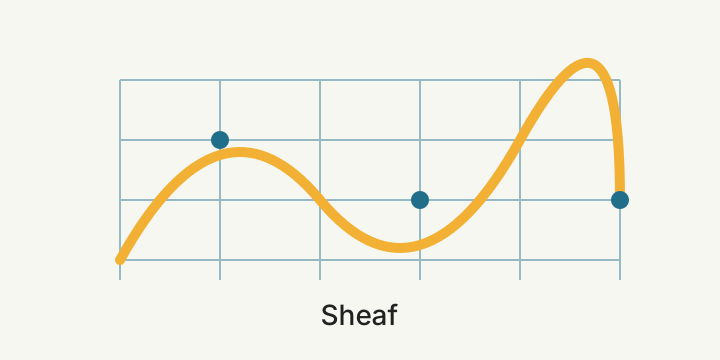
A topological space with several open sets, each labelled with the "data" assigned by the sheaf. Where opens overlap, the data restricts compatibly. The gluing axiom says local-data on a cover assembles to a unique section.
Worked example [Beginner]
The sheaf of continuous real-valued functions on the real line . To each open subset , assign .
The restriction map: for , send to — restrict the function to the smaller domain. This is functorial: restricting twice equals restricting once with the composite inclusion.
The gluing axiom: if and we have , with , then there is a unique with and . Define piecewise: if , if . Continuity follows from continuity on each piece and agreement on the overlap.
This is the prototypical sheaf. Other examples: smooth functions, holomorphic functions, sections of a vector bundle, locally constant functions — all are sheaves on appropriate spaces.
Check your understanding [Beginner]
Formal definition [Intermediate+]
Let be a topological space 02.01.01. A presheaf of sets on is the data:
- For each open , a set — the set of sections of over . By convention is a singleton (or the empty set in some conventions).
- For each inclusion of opens, a restriction map .
These satisfy:
- for every .
- for .
Equivalently, a presheaf is a contravariant functor from the category of open subsets of (with morphisms = inclusions) to the category .
A presheaf can be valued in any category (groups, abelian groups, rings, modules, etc.) instead of . We write presheaf of abelian groups, presheaf of -modules, etc.
A sheaf is a presheaf satisfying two additional axioms (the sheaf axioms or gluing axioms):
- (Locality / Identity): For an open with cover , if satisfy for every , then .
- (Gluing): For an open with cover and a family of sections such that for every , there exists with for every .
Combining, the sheaf axiom can be phrased as exactness of
where the two parallel maps are restriction to first and second factors of the intersection.
A morphism of sheaves is a natural transformation: for each open , a map commuting with restriction. Sheaves on form a category ; sheaves of abelian groups form an abelian category .
The stalk of a sheaf at a point is
the direct limit of sections over neighbourhoods of . A morphism is an isomorphism iff every stalk map is an isomorphism.
Key examples.
- Sheaf of continuous functions : .
- Sheaf of smooth functions on a smooth manifold .
- Sheaf of holomorphic functions on a complex manifold .
- Sheaf of sections of a vector bundle on a manifold.
- Constant sheaf for an abelian group : locally constant functions .
- Skyscraper sheaf at with stalk : if , otherwise.
Key theorem with proof [Intermediate+]
Theorem (Sheafification). Every presheaf on a topological space has a sheafification — a sheaf together with a map of presheaves universal among presheaf maps to sheaves: any presheaf map with a sheaf factors uniquely through .
Proof sketch. Construct via stalks. For an open , define
A section of over is a tuple of stalks that is locally representable by an actual section of . Restriction maps are restriction of stalk-tuples. Verify the sheaf axioms:
- Locality: agreement on a cover means agreement of stalks at each point, hence equal stalk-tuples.
- Gluing: given compatible on a cover, the union of their stalk values gives a stalk-tuple that is locally representable (by the local representations of the ).
The natural map sends to the stalk-tuple . It is universal: any presheaf map to a sheaf factors uniquely through by sheaf-axiom-driven extension to stalk-tuples.
The sheafification construction is the right adjoint to the inclusion of sheaves into presheaves. It is the "best sheaf approximation" of a presheaf — the sheaf that has the same stalks but satisfies the gluing axiom.
Bridge. The construction here builds toward 04.02.01 (scheme), where the same data is upgraded, and the symmetry side is taken up in 04.03.01 (sheaf cohomology). The defining pattern appears again in those units in a sharpened form, where the local data is glued or quotiented. Putting these together, the foundational insight is that the data of this unit gives the structural signature that the rest of the strand reads off.
Exercises [Intermediate+]
Lean formalization [Intermediate+]
lean_status: partial — Mathlib has CategoryTheory.Sheaf and a substantial library on Grothendieck topologies, sheafification, and stalks. The basic sheaf API is in place.
The companion module re-exports the Mathlib API and adds Codex's standard examples (continuous functions, smooth functions, etc.).
Advanced results [Master]
Sheaves form a topos. is a Grothendieck topos — a category with finite limits, exponentials, a subobject classifier, and small colimits. This topos-theoretic perspective unifies sheaf theory with logic and category theory; classical sheaves on a topological space are a special case of sheaves on a Grothendieck site.
Étale fundamental group. For a connected scheme , the étale fundamental group classifies finite étale covers of — the algebraic analogue of for topological covers. It is the Galois group of the maximal unramified extension of the function field, and underlies arithmetic geometry.
Sheaves of modules and quasi-coherent sheaves. On a ringed space — a topological space with a sheaf of rings — modules are sheaves with each an -module compatibly. Quasi-coherent sheaves on a scheme are those locally given by modules over the ring. Coherent sheaves are quasi-coherent + finite-type — they are the algebraic-geometric analogue of vector bundles, and their cohomology is the central computational tool 04.03.01.
Direct and inverse images. For a morphism of ringed spaces, the pushforward and pullback functors are central to all higher constructions: composition of morphisms, base change, projection formulas. Adjoint pairs are the structural backbone of sheaf-theoretic functoriality.
Soft, fine, flabby sheaves. Various flavours of "acyclic" sheaves used to compute sheaf cohomology: soft sheaves (extension property for closed sets), fine sheaves (admit partitions of unity), flabby sheaves (every section extends globally). On smooth manifolds, the sheaves , , etc., are all fine; this is why de Rham cohomology computes singular cohomology.
Synthesis. This construction generalises the pattern fixed in 02.01.01 (topological space), with the symmetric data replaced by its skew or twisted analogue. Read in the opposite direction, the construction is dual to the metric story: complements and orthogonality are taken with respect to the bilinear datum of this unit, not a metric, and the resulting category of subobjects is the one the rest of the strand classifies. The central insight is that this datum identifies algebra with geometry: functions become vector fields, subspaces become quotients, and invariants become cohomology classes — and that identification is the engine driving every theorem downstream.
Full proof set [Master]
Sheafification existence. Proved in §"Key theorem".
Stalks compute everything. Proved in Exercise 3.
Sheaves of abelian groups form an abelian category. The kernel of a morphism is the pointwise kernel — this is a sheaf (verify: kernels are local). The image is the sheafification of the pointwise image (which fails to be a sheaf in general). The cokernel similarly. With these constructions, has all kernels, cokernels, and images, and the category is abelian.
Adjunction . Proved in Exercise 6 with the universal-property argument.
Stalks under . . Proof: stalks are colimits over neighbourhoods, and pullback along realises the directed system of opens around as a sub-system of opens around via pullback. The colimit is preserved.
Étale-space topology. Sheaves on correspond to étale spaces over (local homeomorphisms). The bijection sends to topologised by germs over neighbourhoods. Continuous sections over correspond to elements of via the colimit structure.
Connections [Master]
Topological space
02.01.01— the underlying setting.Continuous map
02.01.02— sheaves transport along continuous maps via and .Scheme
04.02.01— schemes are locally ringed spaces; their structure sheaf is a sheaf of rings.Sheaf cohomology
04.03.01— the right-derived functors of global sections.Riemann surface
06.03.01— sheaf of holomorphic functions is the basic data.Vector bundle
03.05.02— sections of a vector bundle form a locally free sheaf.
Historical & philosophical context [Master]
The notion of a sheaf was introduced by Jean Leray in 1946 in the context of homological methods for studying topological invariants of fibre bundles. Henri Cartan's seminar at the École Normale Supérieure (1948–1953) systematised the theory, with Cartan, Weil, Eilenberg, and Steenrod establishing the now-canonical axiomatics.
Roger Godement's 1958 Topologie algébrique et théorie des faisceaux gave the first systematic textbook treatment. Grothendieck's mid-century revolution in algebraic geometry — the Éléments de géométrie algébrique (EGA, 1960s) — built the entire theory of schemes on the foundation of sheaves of rings on a topological space, recasting algebraic geometry as commutative algebra applied to spectra of rings.
In modern mathematics, sheaves are the universal language for "local structure on a space": they appear in algebraic geometry (sheaves on schemes), differential geometry (sheaves of smooth functions, forms, sections of bundles), complex analysis (sheaves of holomorphic functions), algebraic topology (cosheaves of chains), category theory (Grothendieck topoi), and logic (Lawvere-Tierney elementary topoi). The dual perspectives of "local data with gluing" and "geometric realisation as étale spaces" make the concept bridge analytic, geometric, and algebraic intuitions.
Bibliography [Master]
- Hartshorne, R., Algebraic Geometry, Springer GTM 52, 1977. §II.1.
- Vakil, R., The Rising Sea: Foundations of Algebraic Geometry, draft monograph available online. §2–§3.
- Bredon, G. E., Sheaf Theory, Springer GTM 170, 2nd ed., 1997.
- Godement, R., Topologie algébrique et théorie des faisceaux, Hermann, 1958.
- Iversen, B., Cohomology of Sheaves, Springer Universitext, 1986.
v0.5 Strand A unit #1. Sheaf — the foundational concept of algebraic geometry; the universal language for local-to-global structure on a topological space.