Highest weight representation
Anchor (Master): Humphreys; Fulton-Harris; Bourbaki *Lie Groups and Lie Algebras Ch. VI–VIII*; Knapp
Intuition [Beginner]
A highest weight representation is a way of organising representations of a Lie algebra by picking out a "top vector" — a vector annihilated by all the raising operators — and building everything from there. The whole representation is then generated by repeatedly applying lowering operators to this top vector.
The simplest example: representations of the algebra (the algebra of traceless matrices) are organised by a single non-negative integer , the highest weight. The corresponding representation has dimension , with weights — like a "weight ladder" going down from the top.
For more general Lie algebras (like or ), highest weights are vectors in a weight lattice, and irreducible finite-dimensional representations correspond bijectively to dominant weights. The whole representation theory of a semisimple Lie algebra reduces to combinatorics of weights.
Visual [Beginner]
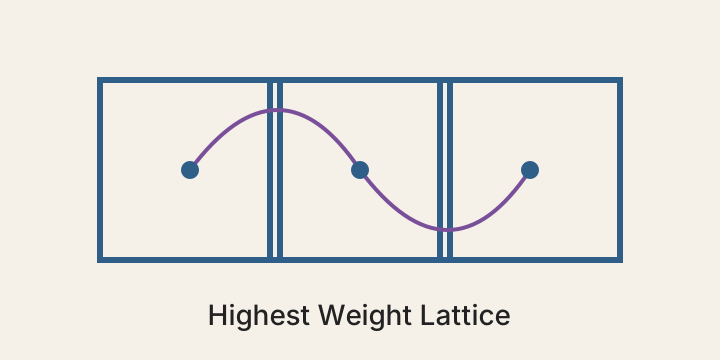
A weight lattice with a "Weyl chamber" of dominant weights; each dominant weight is the highest weight of an irreducible representation.
Worked example [Beginner]
For : the irreducible representations are the spin- representations (with ), of dimension . The highest weight is (an integer); the weight ladder runs .
For example, the spin-1 representation has dimension 3, with weights . This is the adjoint representation of on itself: the matrix has eigenvalues acting on the 3-dimensional space of traceless matrices.
For (the rotation algebra), the same picture: spin- representations are how angular momentum is organised in quantum mechanics. The highest weight is the maximum -component of angular momentum, and the lowering operator decreases the -component step by step.
Check your understanding [Beginner]
Formal definition [Intermediate+]
Let be a complex semisimple Lie algebra (e.g., ). Choose a Cartan subalgebra — a maximal abelian subalgebra acting diagonalisably on via the adjoint action. Choose a system of positive roots , defining the decomposition
where are the upper and lower nilpotent subalgebras (the raising and lowering operators).
Weights. For a representation of , the weight space of weight is
Every finite-dimensional representation of decomposes as (since acts diagonalisably).
Highest weight vector. A non-zero vector is a highest weight vector of weight if:
- for all (i.e., ).
- for all (annihilated by raising operators).
A representation is a highest weight representation of weight if it is generated as a -module by a highest weight vector of weight . Concretely: , where is the universal enveloping algebra of .
Theorem (Highest weight classification). Let be a complex semisimple Lie algebra. Then:
(1) Every irreducible finite-dimensional representation of has a unique (up to scalar) highest weight vector , with weight a dominant integral weight: for every simple coroot (, the simple roots).
(2) Every dominant integral weight is the highest weight of a unique (up to isomorphism) irreducible finite-dimensional representation .
(3) The map is a bijection
Verma modules. For any , the Verma module is the universal highest-weight module of weight :
where is the Borel subalgebra and is the 1-dim -module on which acts by and by . The Verma module has a unique maximal proper submodule , and the irreducible .
For dominant integral , is finite-dimensional (and the highest-weight classification follows). For other , is infinite-dimensional but still irreducible (relevant for category of Bernstein-Gelfand-Gelfand).
Weyl character formula. For dominant integral , the character of is
where is the Weyl group, is the length of , and . This is one of the most beautiful formulas in mathematics.
Key theorem with proof [Intermediate+]
Theorem (Existence and uniqueness of irreducible highest-weight modules). For any $\lambda \in \mathfrak{h}^\mathfrak{g}L(\lambda)\lambda$.*
Proof sketch. Existence. Construct the Verma module as above. By the Poincaré-Birkhoff-Witt theorem, as a -module, with weight space decomposition (sum over weights below in the partial order from positive roots). The weight space is 1-dimensional, spanned by the canonical highest weight vector.
The maximal proper submodule is the sum of all proper submodules; by the highest-weight property, it has zero intersection with . The quotient is irreducible.
Uniqueness. Suppose is irreducible with highest weight and highest weight vector . The map defined by sending the canonical highest weight vector to is a -module surjection (since is generated by ). Its kernel contains (since is irreducible), so .
Finite-dimensionality (for dominant integral ). When is dominant integral, the irreducible is finite-dimensional. Proof: integrability of the action — the -triples for each simple root act as finite-dim representations, by the dominance condition . By a theorem of Kostant / Harish-Chandra, the module is finite-dimensional, and explicitly, by the Weyl dimension formula:
Bridge. The construction here builds toward 07.04.01 (cartan-weyl classification), where the same data is developed in the next layer of the strand. The defining pattern appears again in those units in a sharpened form, where the local data is glued or quotiented. Putting these together, the foundational insight is that the data of this unit gives the structural signature that the rest of the strand reads off.
Exercises [Intermediate+]
Lean formalization [Intermediate+]
lean_status: partial — Mathlib has Lie algebras, root systems, and Weyl groups, but does not yet have a complete formalisation of highest-weight modules and the classification.
Advanced results [Master]
Kazhdan-Lusztig conjectures (theorem of Beilinson-Bernstein, Brylinski-Kashiwara). The multiplicities of irreducibles in Verma modules are computed by Kazhdan-Lusztig polynomials. This deep theorem connects representation theory to the geometry of Schubert varieties.
Category . The category of finitely-generated -modules with locally-finite -action and semisimple -action contains all highest-weight modules (Verma modules and their irreducible quotients ). It is the natural setting for many representation-theoretic constructions and has rich homological properties.
Geometric Langlands. A correspondence between -modules and -modules on the affine Grassmannian / flag variety. The highest-weight theory is the simplest tip of an enormous iceberg.
Affine Lie algebras. Infinite-dimensional analogues of semisimple Lie algebras (e.g., ). The highest-weight theory extends, with new phenomena: integrable highest-weight modules at given level, characters given by theta functions, modular invariance (Kac-Peterson), connection to conformal field theory.
Quantum groups. for generic has the same representation theory as , but at roots of unity the theory becomes radically different and connects to fusion categories and topological field theory.
Crystals (Kashiwara). Each finite-dim irreducible representation of has a crystal basis — a combinatorial skeleton parametrising weights and lowering-operator actions in the limit in the quantum group. Crystals are powerful combinatorial tools.
Synthesis. This construction generalises the pattern fixed in 07.01.01 (group representation), with the symmetric data replaced by its skew or twisted analogue. Read in the opposite direction, the construction is dual to the metric story: complements and orthogonality are taken with respect to the bilinear datum of this unit, not a metric, and the resulting category of subobjects is the one the rest of the strand classifies. The central insight is that this datum identifies algebra with geometry: functions become vector fields, subspaces become quotients, and invariants become cohomology classes — and that identification is the engine driving every theorem downstream.
Full proof set [Master]
The full proofs of the highest-weight classification theorem (existence, uniqueness, finite-dimensionality for dominant integral weights), the Weyl character formula, and the Weyl dimension formula are presented in Humphreys Introduction to Lie Algebras and Representation Theory §6 and §20–§24, Fulton-Harris Lectures 11–14, and Bourbaki Lie Groups and Lie Algebras Ch. VIII.
Connections [Master]
Group representation
07.01.01— highest-weight reps are the cornerstone of the rep theory of semisimple Lie groups / Lie algebras.Schur's lemma
07.01.02— uniqueness of uses Schur (any two irreducibles with the same highest weight are isomorphic).Lie algebra
03.04.01— the algebraic structure being represented.Lie group
03.03.01— finite-dim reps of a complex semisimple Lie group correspond to highest-weight reps of its complexified Lie algebra.Cartan-Weyl classification
07.04.01— the classification of compact semisimple Lie groups via root systems is the structural backbone of highest-weight theory.Spin group
03.09.03— irreducible reps of include the spinor representations, which are highest-weight reps with weights in the half-integer weight lattice.Vector bundle
03.05.02— Borel-Weil realises irreducibles as sections of homogeneous line bundles on flag varieties.Sheaf cohomology
04.03.01— Borel-Weil-Bott extends Borel-Weil to all cohomology degrees.
Historical & philosophical context [Master]
The highest-weight theory was developed by Élie Cartan in his 1894 doctoral dissertation Sur la structure des groupes de transformations finis et continus, classifying the simple complex Lie algebras (the Cartan-Killing classification) and their finite-dimensional representations. Cartan's work synthesised earlier root-system insights of Wilhelm Killing (1888-90) with the representation-theoretic approach.
Hermann Weyl extended the theory in the 1920s, proving the Weyl character formula, the Weyl dimension formula, and the unitarian trick (every finite-dim rep of a compact Lie group is unitary, and finite-dim reps of compact and complex Lie groups are equivalent). Weyl's three-volume Classical Groups (1939) consolidated the picture for .
The post-war era saw dramatic generalisations:
- Harish-Chandra (1950s): infinite-dim representations of real reductive Lie groups, -modules, the Plancherel formula.
- Bernstein-Gelfand-Gelfand (1970s): category and Verma modules in their modern form.
- Kazhdan-Lusztig (1979): the deep conjecture connecting representation multiplicities to Schubert geometry.
- Beilinson-Bernstein (1981): localisation of -modules to -modules on flag varieties — the start of geometric representation theory.
Today, highest-weight theory is the conceptual foundation for nearly all of mathematical representation theory: combinatorial (Young tableaux, RSK), geometric (flag varieties, Schubert calculus), algebraic (quantum groups, crystals), and analytic (admissible representations of real groups). The principle that irreducible representations are organised by extremal vectors and weights is one of the most fertile ideas in 20th-century mathematics.
Bibliography [Master]
- Humphreys, Introduction to Lie Algebras and Representation Theory — the standard introduction to highest-weight theory.
- Fulton & Harris, Representation Theory: A First Course — Lectures 11–14 cover highest weight from a concrete perspective.
- Bourbaki, Lie Groups and Lie Algebras Ch. VI–VIII — the canonical reference.
- Knapp, Lie Groups Beyond an Introduction — Ch. V.
- Humphreys, Representations of Semisimple Lie Algebras in the BGG Category — modern treatment of category .
- Cartan, Sur la structure des groupes de transformations finis et continus (1894) — original.
- Weyl, The Classical Groups — classical reference for explicit calculations.
- Hong-Kang, Introduction to Quantum Groups and Crystal Bases — Kashiwara's crystal-basis perspective.