Schur's lemma
Anchor (Master): Fulton-Harris; Knapp; Vogan *Representations of Real Reductive Lie Groups*
Intuition [Beginner]
Schur's lemma is the simplest, deepest, and most foundational theorem in representation theory: a linear map between two irreducible representations of a group is either zero or an isomorphism, and over an algebraically closed field, a linear map from an irreducible representation to itself must be a scalar multiple of the identity.
The intuition: an irreducible representation has "no room to wiggle" — there's no proper invariant subspace, so any linear map that respects the group action must either send everything to zero or be a complete isomorphism. The scalar-from-self statement says that an equivariant self-map can't have any structure beyond a single complex number.
This is a rigidity result: irreducible representations are the "atoms" of representation theory, and Schur's lemma says they have no internal structure that an equivariant map can detect. It powers character orthogonality, the dimension formula, and the structure theorems for irreducibles in classical and Lie-theoretic representation theory.
Visual [Beginner]
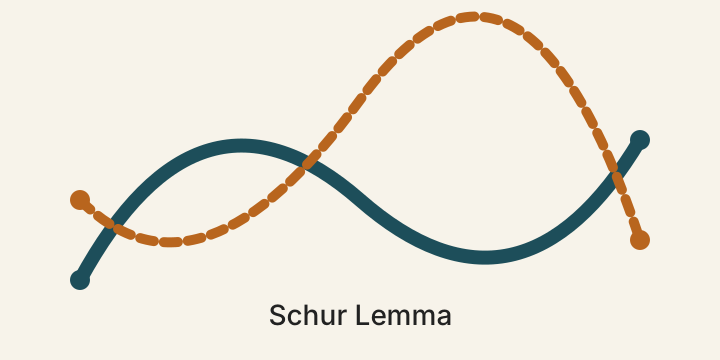
A linear map between irreducible representations of — either zero, or an isomorphism. There is no middle ground.
Worked example [Beginner]
The 1-dimensional representations , for , give inequivalent irreducible representations.
Take any two of them, say and (assume ). An equivariant linear map (call them ) is a complex number satisfying , i.e., for all . So — for some this difference is nonzero, forcing .
So the only equivariant map is zero. Schur's lemma confirms: distinct irreducibles have no equivariant maps between them.
For : any works (the equation is automatic). The space of equivariant self-maps is 1-dimensional, exactly , as Schur predicts.
Check your understanding [Beginner]
Formal definition [Intermediate+]
Theorem (Schur's lemma, two parts). Let be a group and irreducible representations of over a field .
(1) Any -equivariant linear map is either zero or an isomorphism.
(2) If and is algebraically closed, then \mathrm{End}_G(V) := \{\text{G-equivariant linear maps } V \to V\} = k \cdot \mathrm{id}_V.
The second statement requires algebraic closure to ensure that the characteristic polynomial of an equivariant self-map has a root in .
Proof.
Part (1). The kernel is a -invariant subspace: if , then . By irreducibility of , is either or .
Similarly, is -invariant. By irreducibility of , is either or .
The four combinations: ⟹ . and ⟹ , contradicting irreducibility. and ⟹ is a bijection, hence an isomorphism.
Part (2). Let be -equivariant. Pick any eigenvalue of (exists by algebraic closure: characteristic polynomial has a root). Then is -equivariant and has nonzero kernel (the -eigenspace). By part (1), , i.e., .
Corollaries.
- for irreducible over (the Hom-orthogonality of irreducibles).
- Centre of the group algebra. The centre is the space of class functions; it acts on each irreducible by a scalar (the central character).
- Characters separate representations. Two finite-dimensional representations of over are isomorphic iff they have the same character.
Generalisations.
Schur's lemma extends:
- To irreducible representations of associative algebras over algebraically closed fields.
- To irreducible representations of compact groups in the topological setting.
- To irreducible objects in any abelian category (a Schur abelian category is one where Schur's lemma holds).
- To irreducible -modules in the theory of real reductive Lie groups.
Key theorem with proof [Intermediate+]
The proof above (Parts 1 and 2) constitutes the key theorem. We elaborate the corollary on character orthogonality, which Schur's lemma directly powers.
Corollary (Character orthogonality, type I). Let be irreducible complex representations of a finite group . Then
Proof sketch. Define the averaged map ,
The image lies in -equivariant maps. By Schur, this is if and otherwise. The trace of on computes (after some manipulation) the inner product , which thus equals .
This orthogonality is one of the most useful facts in representation theory: it lets you compute multiplicities of irreducibles in any representation by inner products of characters.
Bridge. The construction here builds toward 07.03.01 (highest weight representation), where the same data is developed in the next layer of the strand. The defining pattern appears again in those units in a sharpened form, where the local data is glued or quotiented. Putting these together, the foundational insight is that the data of this unit gives the structural signature that the rest of the strand reads off.
Exercises [Intermediate+]
Lean formalization [Intermediate+]
lean_status: partial — Mathlib has Representation.Schur (in some form), and Schur for endomorphisms of simple modules is in Mathlib.RingTheory.SimpleModule.
Advanced results [Master]
Generalised Schur's lemma (von Neumann). For unitary representations of locally compact groups on Hilbert spaces, the commutant is a von Neumann algebra. The representation is irreducible iff . The non-irreducible case is governed by the type classification of von Neumann algebras (type I, II, III).
Schur-Weyl duality. For the natural representation of , the commuting algebra is the symmetric group (acting by permuting tensor factors). The decomposition
(where runs over partitions of , is the Schur module, is the irreducible -module) is the foundational example of a double centraliser theorem and underlies Schur-Weyl duality.
Duflo's theorem on infinitesimal characters. For a real reductive Lie group, the infinitesimal character of an irreducible -module is well-defined by Schur, and Duflo gives an explicit formula in terms of the Harish-Chandra isomorphism.
Categorical Schur. In a -linear semisimple abelian category (over algebraically closed ), simple objects have . This is the foundation for fusion categories, modular tensor categories, and 2-representation theory.
Synthesis. This construction generalises the pattern fixed in 07.01.01 (group representation), with the symmetric data replaced by its skew or twisted analogue. Read in the opposite direction, the construction is dual to the metric story: complements and orthogonality are taken with respect to the bilinear datum of this unit, not a metric, and the resulting category of subobjects is the one the rest of the strand classifies. The central insight is that this datum identifies algebra with geometry: functions become vector fields, subspaces become quotients, and invariants become cohomology classes — and that identification is the engine driving every theorem downstream.
Full proof set [Master]
The core proof is given in the formal-definition section. Detailed proofs of the corollaries (character orthogonality, dimension formula) are deferred to the unit on character theory. The von Neumann generalisation requires the spectral theorem and the type theory of von Neumann algebras, deferred to functional analysis units.
Connections [Master]
Group representation
07.01.01— Schur's lemma is the foundational result organising the structure of representations.Highest weight representation
07.03.01— Schur's lemma underwrites the uniqueness statement: a highest-weight vector determines an irreducible representation up to scalar.Cartan-Weyl classification
07.04.01— Schur is a building block in the classification of irreducible representations of semisimple Lie groups.Character theory — orthogonality of characters follows directly from Schur via the averaging argument.
Group algebra and module theory — Schur is a special case of a general statement about simple modules over an algebra.
Tannakian formalism — recovering a group from its representation category requires Schur to identify simple objects.
Quantum groups — analogous statements for irreducible modules over Hopf algebras and quantum groups.
Historical & philosophical context [Master]
Issai Schur proved the lemma in his 1901 doctoral dissertation under Frobenius at Berlin. Schur was 26 at the time and established several other foundational tools: the Schur multiplier (the cohomology ), the theory of Schur indices (related to division algebras), and the orthogonality of characters. His student Frobenius had introduced characters in 1896, and Schur's lemma made the orthogonality relations rigorous and constructive.
Schur's lemma later became absorbed into the more general framework of simple modules over rings (Wedderburn, Artin, Noether), and from there into the abstract theory of abelian categories (Grothendieck). The principle that simple objects have endomorphism ring equal to the base field over algebraically closed fields is one of the most general statements in modern algebra.
The 20th century extended Schur's lemma in several directions:
- Operator algebras (Murray-von Neumann, 1930s): the type classification of von Neumann algebras began with the question of what fails when irreducibility weakens.
- Lie group representations (Harish-Chandra, 1950s): Schur's lemma for -modules underlies the classification of admissible representations of real reductive groups.
- Categorification (1990s-): higher categorical analogues (semi-simplicity, fusion rings, modular tensor categories) all rest on a categorified version of Schur.
The remarkable fact that an apparently elementary linear-algebra observation underlies essentially all of modern representation theory is one of the most striking instances of the conceptual depth of seemingly simple statements.
Bibliography [Master]
- Fulton & Harris, Representation Theory: A First Course — §1.2 is the standard textbook treatment.
- Serre, Linear Representations of Finite Groups — §2.2, masterful and concise.
- Sternberg, Group Theory and Physics — §1.7, Schur in physical contexts.
- Knapp, Lie Groups Beyond an Introduction — Ch. I.5, Schur for Lie groups.
- Vogan, Representations of Real Reductive Lie Groups — Schur in modern reductive Lie group theory.
- Jacobson, Basic Algebra II — Schur in the context of simple modules.
- Schur, "Über eine Klasse von Matrizen, die sich einer gegebenen Matrix zuordnen lassen" (1901) — Schur's original dissertation.