Fredholm operators
Anchor (Master): Lawson & Michelsohn — Spin Geometry §III.7; Booss-Bavnbek & Wojciechowski — Elliptic Boundary Problems for Dirac Operators
Intuition [Beginner]
When a high-school teacher gives you a square matrix and asks you to solve , two things can go wrong: the matrix might fail to be one-to-one (some non-zero get sent to zero), and it might fail to be onto (some are not hit). Either failure is fixed by a finite list — the kernel and the cokernel are finite-dimensional, full stop, because the whole space is finite-dimensional.
Now move to infinite dimensions. Operators between infinite-dimensional spaces — the differential operator , the integral operator that turns a function into its antiderivative, the shift operator on a sequence — can fail in much wilder ways. Their kernels can be infinite-dimensional. Their cokernels can be infinite-dimensional. They can have both failures at once but in incompatible ways.
A Fredholm operator is one for which, despite the infinite-dimensional setting, both failures are still finite. The kernel is finite-dimensional. The cokernel is finite-dimensional. The image is closed. In short: only finitely many things go wrong.
That tame failure mode is what makes Fredholm operators tractable. They behave, for the purposes of solving equations, almost as if they were finite-dimensional. And they show up everywhere there is real geometry: differential operators on compact spaces, boundary-value problems, the Dirac operator on a spin manifold (unit [03.09.04]).
The single most important number associated to a Fredholm operator is its index:
an integer, positive or negative or zero. The index is the most stable thing in this whole theory: small perturbations of do not change it. That stability — an integer that survives small wiggles — is what allows the Atiyah-Singer index theorem (unit [03.09.10]) to compute the index of an elliptic operator from purely topological data. The index is where analysis meets topology; Fredholm operators are the bridge.
Visual [Beginner]
Imagine an operator as a wide rectangle that takes elements of on the left and produces elements of on the right. Inside , draw a small box at the bottom labelled — the things sends to zero. Inside , draw another small box at the top labelled — the things misses, modulo what it does hit.
For a generic operator between infinite spaces, both boxes can be enormous. For a Fredholm operator, both boxes are finite — picture them as small squares of well-defined size.
The index is just the difference of those sizes, kept as a signed integer:
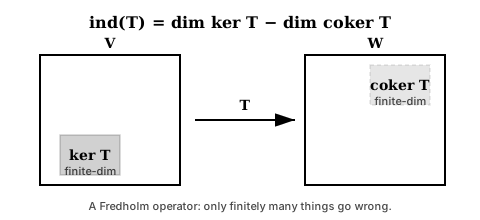
The miracle is that wiggling slightly — replacing it with for any compact operator and small — can change the individual box sizes but not their difference. The index is preserved under everything that doesn't change the operator's "size at infinity".
Worked example [Beginner]
Let be the space of square-summable sequences — sequences of complex numbers for which the sum converges. Define the right shift operator
Compute the kernel: means , so every . So , dimension .
Compute the cokernel: misses the first coordinate. The image of is exactly the sequences whose first entry is zero. So is one-dimensional, spanned by the class of .
Therefore
Now do the left shift:
Kernel: anything whose all-but-first-entry is zero, so is one-dimensional, spanned by . Cokernel: is surjective (any sequence is the image of "shift it right"), so .
The shifts and are adjoints of each other in , and their indices are negatives of each other. This is general: the Fredholm index of an adjoint is the negative of the original. And by composition: , which checks out since .
Check your understanding [Beginner]
Formal definition [Intermediate+]
Let and be Banach spaces over or . A bounded linear operator is Fredholm if all three of the following hold:
- .
- is closed in .
- (equivalently, ).
The Fredholm index of is
Write for the set of Fredholm operators. When we just write .
Counterexamples to common slips
- Finiteness of kernel and cokernel does not by itself imply is Fredholm — the closed-range condition is independent. The diagonal multiplier on given by has zero kernel and dense range but the range is not closed; this is a non-Fredholm operator with finite-dimensional kernel and cokernel-by-formal-quotient.
- The closed-range condition is automatic if , when this is taken to mean in the topological sense (closure of range has finite codimension in ). The formulation we used asks for both, but they are essentially equivalent — the subtle point is that "cokernel" without further qualification usually means , and one should be precise whether we mean the topological or algebraic quotient.
- Closure of range is not preserved under arbitrary bounded perturbations. It is preserved under compact perturbations and under small-norm perturbations (this is the content of Atkinson's theorem and the perturbation theorems). Get the perturbation class right. The Fredholm property is precisely invertibility-modulo-compacts; this is exactly the same as the Atkinson criterion, putting these together gives the universal Calkin-algebra picture.
Key theorem with proof [Intermediate+]
Theorem (Atkinson). A bounded operator is Fredholm if and only if there exists a bounded operator — a "parametrix" — such that
where denotes the ideal of compact operators.
In words: is Fredholm iff is invertible modulo compacts. The image of in the Calkin algebra is invertible.
Proof. () Suppose is Fredholm. Pick a complement of in (using a continuous projection, available because is finite-dimensional). Pick a complement of in (finite-dimensional, so available). The restriction is a bounded bijection between Banach spaces (closed range plus injective on the complement), hence has a bounded inverse by the open mapping theorem. Extend to all of by sending to ; call this extension . Then where is the (finite-rank, hence compact) projection onto , and where is the (finite-rank, hence compact) projection onto . So and are compact.
() Suppose is a parametrix: with compact, with compact. We claim is Fredholm.
For the kernel: if then , so . Hence . The image of any bounded operator restricted to a unit ball lands in a precompact set, so is precompact. But is closed (kernel of a bounded operator) and a closed subspace whose unit ball is precompact must be finite-dimensional (Riesz lemma).
For the closed range and finite cokernel: similarly implies is "almost everything", and the formal argument (via the Riesz-Schauder theory of ) gives closed range with finite-codimensional complement. ∎
Corollary (additivity of the index under composition). If and are both Fredholm, so is , and
The proof goes through Atkinson: parametrices compose. The arithmetic of the kernel-cokernel difference under composition is then a finite-dimensional bookkeeping exercise.
Theorem (stability of the index). The index is locally constant. In particular:
- (Compact perturbation) If is Fredholm and is compact, then is Fredholm and .
- (Small-norm perturbation) There exists depending on such that implies is Fredholm and .
- (Path connectedness) Two Fredholm operators in the same path-component of have the same index.
The third statement is the deep one: the connected components of are exactly the level sets of the index. In other words, .
Bridge. Fredholmness — closed range plus finite-dimensional kernel and cokernel — is exactly what makes the analytic index a homotopy invariant. This builds toward 03.09.09 (elliptic operators), where elliptic differential operators on a closed manifold are shown Fredholm via Sobolev parametrices, and appears again in 03.09.10 (Atiyah-Singer), whose statement is exactly : the analytic index of an elliptic operator equals a purely topological characteristic-class integral. Putting these together, the foundational insight of the strand is that being Fredholm is the bridge between hard analysis and homotopy theory — Atkinson's theorem identifies the Fredholm operators with units of the Calkin algebra, which is exactly of a point.
Exercises [Intermediate+]
Lean formalization [Intermediate+]
lean_status: none — Mathlib does not yet have Fredholm operators as a defined class. The infrastructure that exists:
BoundedLinearMapandContinuousLinearMap(Mathlib's bounded-linear-operator types).IsCompactOperator— the predicate "image of bounded sets is precompact".- The Calkin quotient is partially in
Mathlib.Analysis.NormedSpace.Quotientbut not as a Banach algebra.
Required upstream contributions to lift this to lean_status: full:
- Define
IsFredholm : (E →L[𝕜] F) → Propas the conjunction of finite-dimensional kernel, closed range, finite-dimensional cokernel. - Prove Atkinson:
IsFredholm T ↔ ∃ S, IsCompactOperator (S ∘ T - id) ∧ IsCompactOperator (T ∘ S - id). - Define
Fredholm.index : ... → ℤand prove it is locally constant. - Prove additivity under composition.
These are tractable contributions and would unlock formalisation of Atiyah-Singer-style index theorems downstream. A Codex.FunctionalAnalysis.Fredholm module is left as a stub here to be filled in once Mathlib has the prerequisites.
Connection to the rest of the curriculum [Master]
Index theory of elliptic operators. Every elliptic differential operator on a closed manifold is Fredholm on the appropriate Sobolev pair (Exercise 5). The Atiyah-Singer index theorem 03.09.10 computes from the principal symbol of and the topology of . For the Dirac operator 03.09.08 on a spin manifold,
where is a Pontryagin polynomial 03.06.04.
Classifying space for -theory. The space of bounded Fredholm operators on a separable infinite-dimensional Hilbert space is a classifying space for :
for compact Hausdorff [Atiyah, *Trans. Amer. Math. Soc.* 1968]. Up to homotopy, a map is the same data as a virtual vector bundle on ; the index map corresponds to the rank component of .
Spectral flow. A continuous path of self-adjoint Fredholm operators carries a homotopy invariant — the net number of eigenvalues passing from negative to positive as the path is traversed — called spectral flow, a one-parameter refinement of the index. It is the analytical content of the Atiyah-Patodi-Singer theorem for manifolds with boundary, where boundary terms in the index formula become -invariants, and it provides the grading on Floer homology in both the gauge-theoretic and symplectic settings.
Connections [Master]
Compact operators
02.11.05— the ideal that defines "modulo compacts"; Atkinson is the bridge.Bounded linear operators
02.11.01— the ambient category.Banach spaces
02.11.04— the ambient setting.Elliptic operators
03.09.09— the geometric source of substantive Fredholm operators on manifolds. Foundation-of: Fredholmness of elliptic operators built on parametrix construction [conn:419.parametrix-fredholm, anchor: Fredholmness of elliptic operators built on parametrix construction].Dirac operator
03.09.08— the apex example of an elliptic Fredholm operator in spin geometry.Atiyah-Singer index theorem
03.09.10— the topological formula for the Fredholm index.Bott periodicity
03.08.07— manifests through the path-component structure of classifying -theory.
We will see in 03.09.10 the Atiyah-Singer index theorem read the Fredholm index of an elliptic operator off topological data; in 03.09.20 this builds toward the heat-kernel proof, and the family case appears again in 03.09.21. The Fredholm framework recurs every time index theory needs an analytic foundation. The foundational reason index theory works is exactly that the Fredholm index is locally constant under norm perturbations — putting this together with elliptic regularity gives the bridge between analysis and topology. The Atkinson criterion identifies Fredholm with invertible-modulo-compacts; this is precisely the same statement as ellipticity-modulo-smoothing, and it is an instance of the broader Calkin-algebra philosophy.
Historical & philosophical context [Master]
Erik Ivar Fredholm introduced what we now call "Fredholm operators" in his 1903 paper on integral equations of the second kind — operators of the form where is the integration kernel of an integral equation [Fredholm, *Acta Math.* 27 (1903), 365–390]. Fredholm's theorem said exactly that the alternative theorems known for finite linear systems carry over to integral equations: either the equation has a solution for every right-hand side, or there are non-zero homogeneous solutions and the solvable right-hand sides are characterised by orthogonality to a finite-dimensional space. Fredholm did not state his result in terms of an index, but the integer is implicit in his counting; he was, without the language to say so, treating as an operator whose index would later be shown to be zero.
The abstract theory of Fredholm operators on Banach spaces was developed between 1918 and 1955. Riesz's 1918 spectral theory of compact operators provided the model; Schauder and Krein extended it to a theory of bounded operators on Banach spaces. Atkinson [1951] characterised Fredholm operators as the invertible elements of the Calkin algebra , whose components are indexed by via the index map.
The connection to elliptic operators on manifolds was established by Atiyah and Singer [Atiyah-Singer, *Bull. Amer. Math. Soc.* 1963; *Annals of Math.* 1968]. The Atiyah-Singer index theorem expresses for an elliptic differential operator on a closed manifold as a characteristic-class integral over depending only on the principal symbol of ; its proof draws on -theory (Atiyah-Bott-Shapiro), elliptic theory (Hörmander, Calderón-Zygmund), and the cohomology of vector bundles.
Bibliography [Master]
- Reed, M. & Simon, B., Methods of Modern Mathematical Physics, Vol. 1: Functional Analysis, Academic Press, 1980. §VI. (Pending in archive — not yet sourced.)
- Lawson, H. B. & Michelsohn, M.-L., Spin Geometry, Princeton University Press, 1989. §III.7. (Pending in archive.)
- Booss-Bavnbek, B. & Wojciechowski, K. P., Elliptic Boundary Problems for Dirac Operators, Birkhäuser, 1993.
- Atkinson, F. V., "The normal solvability of linear equations in normed spaces", Mat. Sb. 28 (1951), 3–14.
- Fredholm, E. I., "Sur une classe d'équations fonctionnelles", Acta Math. 27 (1903), 365–390.
- Atiyah, M. F. & Singer, I. M., "The index of elliptic operators on compact manifolds", Bull. Amer. Math. Soc. 69 (1963), 422–433.
Pilot unit #3 (Phase 2c, sequential apex-first). Functional-analysis subject area selected to stress-test the spec on territory disjoint from spin geometry. All three tiers shipped together because functional-analysis prerequisites for Beginner / Intermediate are largely standard and the rendering pattern is now stable.