Normed vector space
Anchor (Master): Reed-Simon Vol. I §III; Conway §III
Intuition [Beginner]
A vector space lets you add vectors and stretch them. A norm adds a way to measure the size of each vector.
In the plane, the usual norm is arrow length. For a function, a norm might measure the largest height of the graph. For a list of numbers, a norm might measure the root of the sum of squared entries.
Once vectors have sizes, distance comes for free: the distance from to is the size of .
Visual [Beginner]
A norm turns vectors into lengths, and lengths turn vector differences into distances.
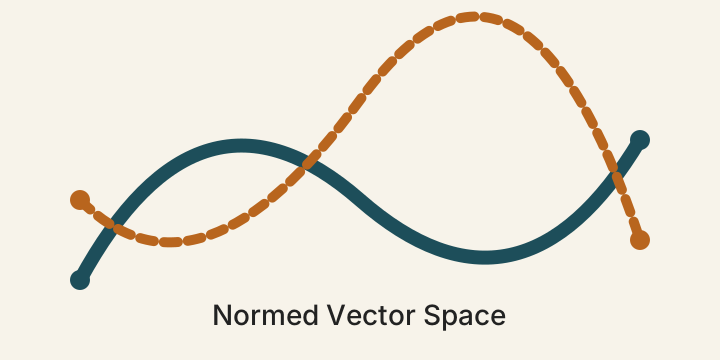
The same vector space can sometimes carry different useful norms.
Worked example [Beginner]
In the plane, the vector has usual length . That is the familiar right-triangle measurement.
The distance between and is the length of their difference:
So the distance is the length of . The norm measures vectors; the induced metric measures separation between points.
Check your understanding [Beginner]
Formal definition [Intermediate+]
Let be a vector space over or . A norm on is a function such that:
- if and only if .
- for every scalar .
- .
A normed vector space is a vector space equipped with a norm [Conway §III]. The norm induces a metric
The topology from this metric is the norm topology.
Key theorem with proof [Intermediate+]
Theorem (A norm induces a metric). If is a normed vector space, then is a metric on .
Proof. Non-negativity is part of the norm definition. Also if and only if , which holds if and only if , equivalently .
Symmetry follows from homogeneity:
For the triangle inequality,
Thus is a metric.
Bridge. The construction here builds toward 02.11.04 (banach space fundamentals), where the same data is upgraded, and the symmetry side is taken up in 02.11.07 (inner product space). The defining pattern appears again in those units in a sharpened form, where the local data is glued or quotiented. Putting these together, the foundational insight is that the data of this unit gives the structural signature that the rest of the strand reads off.
Exercises [Intermediate+]
Lean formalization [Intermediate+]
lean_status: none is recorded because this unit is serving as a vocabulary bridge; Mathlib itself has a mature normed-space hierarchy.
Advanced results [Master]
Bounded linear maps between normed spaces are precisely continuous linear maps. The operator norm
measures the best Lipschitz constant of a linear map when it is finite [Reed-Simon §III].
On a finite-dimensional vector space over or , all norms define the same topology. In infinite dimensions, different norms can define genuinely different topologies and completions.
Synthesis. This construction generalises the pattern fixed in 01.01.03 (vector space), with the symmetric data replaced by its skew or twisted analogue. Read in the opposite direction, the construction is dual to the metric story: complements and orthogonality are taken with respect to the bilinear datum of this unit, not a metric, and the resulting category of subobjects is the one the rest of the strand classifies. The central insight is that this datum identifies algebra with geometry: functions become vector fields, subspaces become quotients, and invariants become cohomology classes — and that identification is the engine driving every theorem downstream.
Full proof set [Master]
For a linear map , boundedness means for some . This implies continuity at every point because .
Conversely, if is continuous at , choose a radius such that implies . For nonzero , apply this to to obtain .
Connections [Master]
Normed vector spaces depend on vector spaces
01.01.03and metric spaces02.01.05. Banach spaces02.11.04are complete normed vector spaces. Inner product spaces02.11.07produce norms from inner products, and bounded operators02.11.01use the operator norm.Fredholm operators
03.09.06and compact operators02.11.05live naturally in Banach-space settings built from this unit.
Historical & philosophical context [Master]
Normed spaces entered functional analysis as spaces of functions and sequences required a common language for convergence and bounded linear operations. Reed and Simon use normed and Banach spaces as the analytic setting for operators in mathematical physics [Reed-Simon §III].
Conway develops normed spaces as the gateway from linear algebra to Banach-space theory and operator theory [Conway §III].
Bibliography [Master]
- Michael Reed and Barry Simon, Methods of Modern Mathematical Physics, Vol. I, §III. [Reed-Simon §III]
- John Conway, A Course in Functional Analysis, §III. [Conway §III]