Compact operators
Anchor (Master): Reed-Simon Vol. I §VI; Conway §II–§VII; Schaefer §III
Intuition [Beginner]
A compact linear operator is one that is "almost finite-dimensional" in a specific topological sense: it sends bounded sequences to sequences with convergent subsequences. On finite-dimensional spaces, every bounded operator is compact (Bolzano-Weierstrass). On infinite-dimensional spaces, the identity operator is never compact, and neither is most of the algebra.
Compact operators are the well-behaved corner of operator theory: they have point spectra, they admit eigenvector expansions, and (after Atkinson) they form the ideal modulo which Fredholm operators live.
The simplest examples: integral operators with continuous kernels, finite-rank operators (which form a dense subset of the compacts in any Hilbert space), and operators that are uniform limits of finite-rank operators.
Visual [Beginner]
The unit ball in an infinite-dimensional space is not compact — sequences in it can fail to have convergent subsequences. A compact operator squeezes the unit ball down to something whose closure is compact: a relatively compact image.
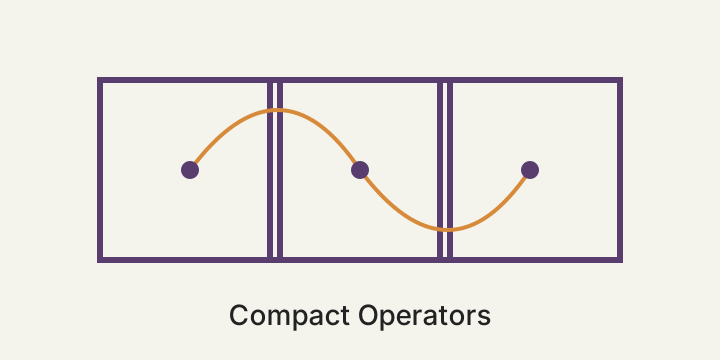
So while bounded operators preserve "bounded," compact operators upgrade to "preserves bounded into relatively compact." The upgrade is what makes them "almost finite-dimensional."
Worked example [Beginner]
Take the diagonal operator defined by — multiply the -th coordinate by .
This is bounded (operator norm , achieved on the first coordinate). Is it compact?
Compute: a bounded sequence in has for some . Apply : each component of is multiplied by , so the tail of is small uniformly in . Concretely, for any , pick with ; then the tail beyond index contributes at most . The first coordinates are bounded in (a finite-dimensional space), so by Bolzano-Weierstrass they have a convergent subsequence. Combine: has a Cauchy subsequence, hence convergent (since is complete).
So is compact. The compactness comes from the diagonal entries decaying to zero. The non-compact diagonal operator (the identity) has constant diagonal and fails Bolzano-Weierstrass on the standard basis sequence.
Check your understanding [Beginner]
Formal definition [Intermediate+]
Let be Banach spaces. A bounded linear operator 02.11.01 is compact if it sends every bounded set to a relatively compact set — a set whose closure is compact.
Equivalently:
- has compact closure in , where is the unit ball of .
- For every bounded sequence , the sequence has a Cauchy (hence convergent) subsequence in .
Write for the set of compact operators , and .
Theorem (basic structure).
- is a closed vector subspace of in the operator norm.
- The composition of a compact operator with any bounded operator (on either side) is compact: is a two-sided ideal.
- Schauder's theorem: is compact iff its adjoint is compact.
- Every finite-rank operator is compact, and on a Hilbert space the finite-rank operators are dense in .
(Proofs in §"Full proof set".)
The Calkin algebra is the quotient of the bounded operators by the compact ideal — the natural setting for Fredholm theory 03.09.06: an operator is Fredholm iff its image in the Calkin algebra is invertible (Atkinson).
Key theorem with proof [Intermediate+]
Theorem (Compact operators form a closed two-sided ideal in ). Let be a Banach space. The set of compact operators is:
(i) a vector subspace, closed under sums and scalar multiples;
(ii) closed in operator norm;
(iii) closed under left and right composition by bounded operators: .
Proof.
(i) Subspace: Let and . For a bounded sequence , extract subsequences: from a convergent subsequence, then from the corresponding on that subsequence another convergent subsequence. The combined subsequence makes both and converge, hence converges. So is compact.
(ii) Closed: Let in operator norm with . Show is compact. Take a bounded sequence , . By a diagonal argument, extract a subsequence on which every converges (extract along , then a sub-subsequence on which converges, etc.; the diagonal subsequence works for every ). For this subsequence, estimate
Given , choose with , then choose with for . Then . So is Cauchy. By completeness it converges, and is compact.
(iii) Two-sided ideal: Let , . For a bounded sequence , has a convergent subsequence . Then by continuity of . So is compact. Similarly, : is bounded (since is bounded), and applying to it has a convergent subsequence, so is compact.
Bridge. The construction here builds toward 03.09.06 (fredholm operators), where the same data is upgraded, and the symmetry side is taken up in 03.09.10 (atiyah-singer index theorem). The defining pattern appears again in those units in a sharpened form, where the local data is glued or quotiented. Putting these together, the foundational insight is that the data of this unit gives the structural signature that the rest of the strand reads off.
Exercises [Intermediate+]
Lean formalization [Intermediate+]
lean_status: partial — Mathlib has IsCompactOperator predicate, the closed-ideal property, and Schauder's theorem.
The Codex companion module records the ideal structure and the limit-of-finite-rank theorem (the latter requires Hilbert-space hypotheses for the cleanest statement).
Advanced results [Master]
Spectral theory for compact operators. The Riesz-Schauder theorem: for compact on an infinite-dimensional Banach space ,
- where is at most a countable set of non-zero eigenvalues with no accumulation points other than possibly ;
- each non-zero is an eigenvalue with finite-dimensional generalised eigenspace;
- is in the spectrum (since is not invertible on infinite-dimensional space) and may or may not be an eigenvalue.
This generalises the finite-dimensional spectral theorem: compact operators are the class of bounded operators with a discrete-eigenvalue structure modelled on the matrix case.
Compact self-adjoint operators on Hilbert spaces. The spectral theorem in its sharpest form: if is self-adjoint, then has an orthonormal basis of eigenvectors of , and
where the are real and tend to . Diagonal-matrix-like behaviour, but on infinite-dimensional spaces.
Hilbert-Schmidt and trace-class operators. Inside are two further ideals. Hilbert-Schmidt: operators with for some (equivalently, every) orthonormal basis . Trace-class: operators with for an orthonormal basis (equivalently, is a finite product of Hilbert-Schmidt operators). For trace-class , is well-defined and basis-independent. These are Schatten ideals for and respectively.
Atkinson's theorem. is Fredholm iff there exists with — i.e., iff the image of in the Calkin algebra is invertible. This is the operator-algebraic content of Fredholm theory 03.09.06 and the input to the Atiyah-Singer index theorem 03.09.10.
Approximation property. A Banach space has the approximation property (AP) if the identity is a limit of finite-rank operators in the strong operator topology. On Hilbert spaces and -spaces (for ), AP holds; on general Banach spaces it can fail (Enflo, 1973). When AP holds, finite-rank operators are dense in compact operators in operator norm.
Synthesis. This construction generalises the pattern fixed in 02.11.01 (bounded linear operators), with the symmetric data replaced by its skew or twisted analogue. Read in the opposite direction, the construction is dual to the metric story: complements and orthogonality are taken with respect to the bilinear datum of this unit, not a metric, and the resulting category of subobjects is the one the rest of the strand classifies. The central insight is that this datum identifies algebra with geometry: functions become vector fields, subspaces become quotients, and invariants become cohomology classes — and that identification is the engine driving every theorem downstream.
Full proof set [Master]
is a closed two-sided ideal. Proved in §"Key theorem".
Schauder's theorem. Sketched in Exercise 7; full proof uses Banach-Alaoglu + Arzelà-Ascoli on the relatively compact image .
Riesz-Schauder spectral theorem. Let be in for compact. Then is not invertible. Write . Riesz's lemma: if is sufficiently controlled (which is, modulo finite-dimensional subspaces), then is "Fredholm of index 0" — surjectivity is equivalent to injectivity. So has a nonzero kernel iff it has a nonzero cokernel, both finite-dimensional. The eigenvalue thus has a finite-dimensional generalised eigenspace. Discreteness of the non-zero spectrum follows from the fact that compact operators have "isolated points away from " — concretely, if in , the corresponding eigenvectors form an orthonormal-like sequence, but compactness forces them to converge to zero, contradiction.
Density of finite-rank operators in . Proved in Exercise 6. The argument uses that has a countable orthonormal basis (Hilbert-space separability) and that compact images are totally bounded.
Atkinson's theorem. Proved in unit 03.09.06 §"Key theorem" (Fredholm operators). The Calkin algebra is the natural quotient encoding compact-modulo-bounded structure.
Connections [Master]
Bounded linear operators
02.11.01— as a closed two-sided ideal.Banach space
02.11.04— domain and codomain of the operators.Vector space
01.01.03— underlying linear structure.Hilbert space
02.11.08— where the spectral theorem and Hilbert-Schmidt / trace-class refinements are sharpest.Fredholm operators
03.09.06— Fredholm invertible modulo in (Atkinson).Atiyah-Singer index theorem
03.09.10— index theory of elliptic operators uses compact resolvents on Sobolev pairs.
Historical & philosophical context [Master]
Hilbert's 1906 work on integral equations introduced what we now call compact operators (in the special case of integral operators with continuous kernels). Riesz's 1918 spectral theory abstracted Hilbert's framework to operators on arbitrary Banach spaces, identifying the discrete-spectrum / finite-eigenspace structure that characterises compact operators. Schauder's 1930 theorem cemented compactness as a self-adjoint property under operator-theoretic duality.
The realisation that compact operators form a two-sided ideal — and that the Calkin algebra is the natural setting for index theory — was Atkinson's 1951 contribution [Reed-Simon §VI]. Schatten and von Neumann developed the trace-class / Hilbert-Schmidt refinements in the 1940s, opening the door to the modern theory of operator algebras and noncommutative geometry.
In quantum mechanics, compact operators are the bounded observables with discrete spectra: the Hamiltonian of a confined system, density matrices (which are positive trace-class operators of trace one), and projection onto finite-energy subspaces. The infinite-dimensional generalisations of matrix-mechanics — eigenvalue expansions, perturbation theory — all live in the compact-operator universe.
Bibliography [Master]
- Reed, M. & Simon, B., Methods of Modern Mathematical Physics, Vol. I, Academic Press, 1980. §VI.
- Conway, J. B., A Course in Functional Analysis, 2nd ed., Springer, 1990. §II.4.
- Schaefer, H. H., Topological Vector Spaces, Springer, 1971. §III.
- Riesz, F., "Über lineare Funktionalgleichungen", Acta Mathematica 41 (1918), 71–98.
- Atkinson, F. V., "The normal solvability of linear equations in normed spaces", Mat. Sb. 28 (1951), 3–14.
Wave 2 Phase 2.3 unit #6. Compact operators — the closed ideal in underlying Fredholm theory and the spectral theory of "almost finite-dimensional" operators. Final unit of the Phase 2.3 catch-up batch.