Elliptic operators on a manifold
Anchor (Master): Lawson-Michelsohn §III.5; Hörmander Vol. III §19; Wells §IV
Intuition [Beginner]
An elliptic operator is a differential operator with no missing top-order direction. At very small scales, it sees every direction strongly enough to control the function or section it acts on.
The Laplacian is the model example. It measures how a function bends in all directions, not just along one preferred line.
This directional control is why elliptic equations are rigid. On compact spaces, elliptic operators behave like finite-dimensional linear maps except for controlled finite-dimensional errors.
Visual [Beginner]
At a point, test every nonzero direction. Ellipticity says the symbol map is invertible in all of them.
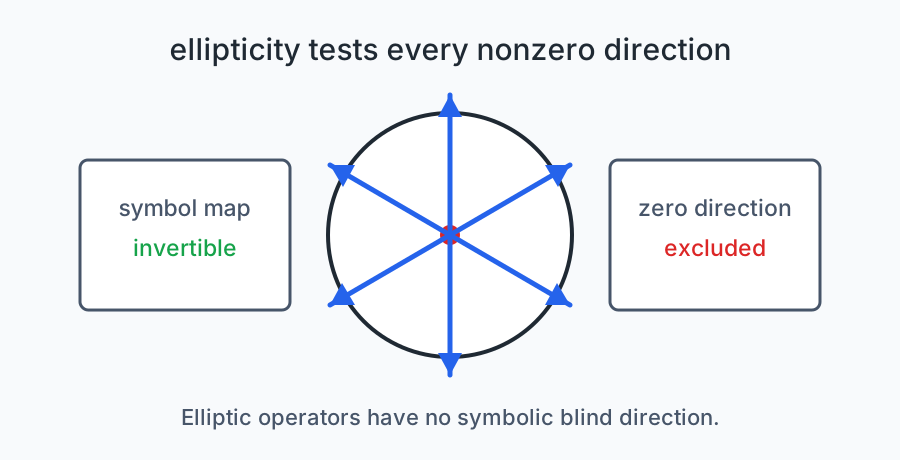
The zero direction is excluded because every homogeneous symbol vanishes there.
Worked example [Beginner]
For a function on the plane, the Laplacian records bending in the horizontal and vertical directions together.
If a wave wiggles strongly in any direction, the highest-order part of the Laplacian detects it. There is no direction in which the top-order part becomes blind.
By contrast, an operator that measures only horizontal change misses vertical-only wiggles. That operator is not elliptic.
Check your understanding [Beginner]
Formal definition [Intermediate+]
Let be smooth vector bundles and let
be a linear differential operator of order . Its principal symbol is a bundle map
for 03.09.07.
The operator is elliptic if is an isomorphism for every and every nonzero [Lawson-Michelsohn §III.5].
For scalar operators, this says that the leading homogeneous polynomial in is nonzero whenever . For operators between vector bundles of equal rank, it says the symbol matrix is invertible away from the zero section. Ellipticity is precisely invertibility of the principal symbol off the zero section; this is exactly the same as the parametrix condition, putting these together gives the bridge between symbol calculus and Fredholmness.
Key theorem with proof [Intermediate+]
Theorem (the Euclidean Laplacian is elliptic). On , the operator
has principal symbol
and is elliptic.
Proof. The top-order part of is the sum of the second derivatives with coefficient . The principal symbol is obtained by replacing each derivative direction by the corresponding covector component and keeping the order-two part. With the standard elliptic sign convention for , this gives
If , at least one component is nonzero, so . For a scalar operator, multiplication by a nonzero number is an isomorphism. Hence is elliptic.
Bridge. The construction here builds toward 03.09.08 (dirac operator), where the same data is upgraded, and the symmetry side is taken up in 03.09.10 (atiyah-singer index theorem). The defining pattern appears again in those units in a sharpened form, where the local data is glued or quotiented. Putting these together, the foundational insight is that the data of this unit gives the structural signature that the rest of the strand reads off.
Exercises [Intermediate+]
Lean formalization [Intermediate+]
lean_status: none — Mathlib does not yet expose elliptic differential operators on vector bundles with principal symbols and Sobolev mapping theory.
Formalization would define ellipticity as invertibility of the principal symbol over the complement of the zero section in , then prove stability under lower-order perturbation and the ellipticity of the Laplacian and Dirac operator.
Advanced results [Master]
On a compact manifold, an elliptic operator extends between Sobolev completions
It is Fredholm, and elliptic regularity identifies distributional solutions of with smooth sections whenever is smooth [Hörmander §19]. A parametrix exists in the pseudodifferential calculus, with
where and are smoothing operators. Compactness of smoothing remainders on compact manifolds gives Fredholmness 03.09.06.
The symbol class of an elliptic operator defines an element of compactly supported K-theory of . Atiyah-Singer computes the analytic Fredholm index from that topological class 03.09.10.
Synthesis. This construction generalises the pattern fixed in 03.09.07 (symbol of a differential operator), with the symmetric data replaced by its skew or twisted analogue. Read in the opposite direction, the construction is dual to the metric story: complements and orthogonality are taken with respect to the bilinear datum of this unit, not a metric, and the resulting category of subobjects is the one the rest of the strand classifies. The central insight is that this datum identifies algebra with geometry: functions become vector fields, subspaces become quotients, and invariants become cohomology classes — and that identification is the engine driving every theorem downstream.
Full proof set [Master]
Fredholmness from a parametrix. If and with compact on suitable Sobolev spaces, then is invertible modulo compact operators. Atkinson's theorem identifies such operators as Fredholm 03.09.06.
Dirac ellipticity. The Dirac symbol is 03.09.07. Under the Lawson-Michelsohn convention,
For , the inverse is , so the Dirac operator is elliptic.
Connections [Master]
Symbol of a differential operator
03.09.07— ellipticity is a condition on the principal symbol.Fredholm operators
03.09.06— compact-manifold elliptic operators are Fredholm after Sobolev completion. Foundation-of: Fredholmness of elliptic operators built on parametrix construction [conn:419.parametrix-fredholm, anchor: Fredholmness of elliptic operators built on parametrix construction].Dirac operator
03.09.08— Dirac operators are first-order elliptic operators.Atiyah-Singer index theorem
03.09.10— the index theorem applies to elliptic operators through their symbol class.
We will see in 03.09.22 the parametrix construction globalised to pseudodifferential operators, and this builds toward the heat-kernel proof in 03.09.20 and the family case in 03.09.21. The pattern recurs every time an elliptic operator's analytic index is identified with a topological one. The foundational reason an elliptic operator on a closed manifold is Fredholm is exactly that ellipticity gives a parametrix and a parametrix gives invertibility modulo compacts. Putting these together gives the bridge between symbol classes and Fredholm indices. Every elliptic operator is an instance of the same parametrix-then-Atkinson construction.
Historical & philosophical context [Master]
Elliptic regularity grew from potential theory and the classical study of the Laplace equation. The modern form uses Sobolev spaces, parametrices, and pseudodifferential operators.
Hörmander's symbol calculus and Atiyah-Singer's index theorem placed ellipticity at the intersection of analysis and topology: an analytic estimate becomes a K-theory class through the principal symbol [Hörmander §19].
Bibliography [Master]
- Lawson, H. B. and Michelsohn, M.-L., Spin Geometry, Princeton University Press, 1989. §III.5.
- Hörmander, L., The Analysis of Linear Partial Differential Operators III, Springer, 1985. §19.
- Wells, R. O., Differential Analysis on Complex Manifolds, Springer, 1980. §IV.
- Atiyah, M. F. and Singer, I. M., "The index of elliptic operators I", Annals of Mathematics 87 (1968), 484-530.
Wave 2 Phase 2.4 unit #3. Produced as the elliptic-operator prerequisite for Dirac and Atiyah-Singer.