Symbol of a differential operator
Anchor (Master): Hörmander Vol. III §18; Lawson-Michelsohn §III.1
Intuition [Beginner]
A differential operator can contain several layers of change. Some terms measure the strongest local response; other terms make smaller corrections.
The symbol keeps the strongest layer. It is like zooming in so far that only the fastest-changing part of the operator remains visible.
For the operator "take two changes, then add a small multiple of the original function," the symbol remembers the two-change part and forgets the smaller original-function part.
Visual [Beginner]
The symbol is the output of a principal filter: lower-order pieces are discarded, and the top-order directional part remains.
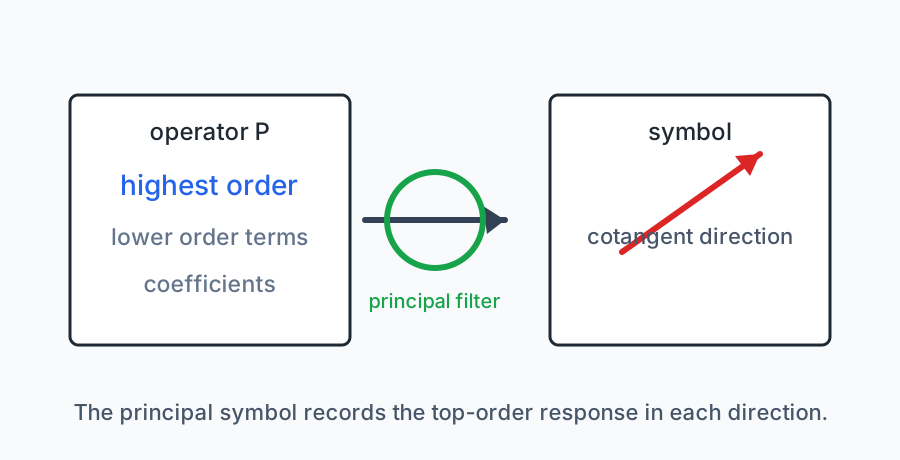
This top-order part controls whether an operator is elliptic, hyperbolic, or degenerate.
Worked example [Beginner]
Imagine a rule for a function of one variable:
When a function wiggles very fast, the second-change term grows fastest. The first-change and original-function terms matter less at that scale.
The symbol records that leading second-change behavior. In geometric analysis, this leading behavior is the part that determines ellipticity and the Fredholm property on compact manifolds.
Check your understanding [Beginner]
Formal definition [Intermediate+]
Let be smooth vector bundles. A linear differential operator of order at most is a linear map
whose local expression has the form
where is a bundle-homomorphism matrix in a local trivialization [quantum-well Differential operator.md].
The principal symbol of at a covector is
Equivalently, it is the homogeneous degree- part of the full symbol. It is independent of local coordinates and local frames [Lawson-Michelsohn §III.1]. The principal symbol identifies an analytic operator with a topological K-theory class on the cotangent bundle; this is exactly the bridge between analysis and topology that recurs in every elliptic theorem.
Key theorem with proof [Intermediate+]
Theorem (principal symbol of a composition). If has order and has order , then
Proof. Work in a local coordinate chart and trivialize the bundles. Write
In the composition , the terms of order arise only when falls entirely on rather than on the coefficient . Any derivative hitting a coefficient lowers the number of derivatives applied to the section.
Thus the coefficient of the top-order term is obtained by multiplying the top-order coefficients:
Replacing by gives
which is exactly .
Bridge. The construction here builds toward 03.09.09 (elliptic operators on a manifold), where the same data is upgraded, and the symmetry side is taken up in 03.09.10 (atiyah-singer index theorem). The defining pattern appears again in those units in a sharpened form, where the local data is glued or quotiented. Putting these together, the foundational insight is that the data of this unit gives the structural signature that the rest of the strand reads off.
Exercises [Intermediate+]
Lean formalization [Intermediate+]
lean_status: none — Mathlib lacks the differential-operator filtration and principal-symbol infrastructure used here.
A formalization would need smooth vector bundles, sheaves or modules of sections, filtered differential operators, associated graded symbols, and coordinate-invariance proofs for the principal symbol.
Advanced results [Master]
The principal symbol gives the associated graded map for the filtration of differential operators by order. In invariant terms,
over , homogeneous of degree in the cotangent variable. The exact sequence
identifies the principal symbol as the quotient by lower-order operators [Hörmander §18].
For the Dirac operator, the symbol at is Clifford multiplication by . The Clifford relation makes this symbol invertible for , which is the elementary source of Dirac ellipticity 03.09.08.
Synthesis. This construction generalises the pattern fixed in 01.01.03 (vector space), with the symmetric data replaced by its skew or twisted analogue. Read in the opposite direction, the construction is dual to the metric story: complements and orthogonality are taken with respect to the bilinear datum of this unit, not a metric, and the resulting category of subobjects is the one the rest of the strand classifies. The central insight is that this datum identifies algebra with geometry: functions become vector fields, subspaces become quotients, and invariants become cohomology classes — and that identification is the engine driving every theorem downstream.
Full proof set [Master]
Lower-order quotient. If two order- operators have the same principal symbol, their order- local coefficients agree after coordinate transformation. Their difference has no order- part and therefore has order at most . Conversely, any operator of order at most has zero order- principal symbol.
Dirac symbol. In a local orthonormal frame, the Dirac operator has leading part
The principal symbol is . Under the Lawson-Michelsohn convention, , so is invertible for with inverse .
Connections [Master]
Dirac operator
03.09.08— the Dirac symbol is Clifford multiplication.Elliptic operators
03.09.09— ellipticity is invertibility of the principal symbol away from the zero section.Atiyah-Singer index theorem
03.09.10— the symbol defines the topological K-theory class whose index is computed.Fredholm operators
03.09.06— elliptic symbols lead to Fredholm operators after Sobolev completion.
We will see in 03.09.22 the symbol calculus globalised to pseudodifferential operators, and this builds toward the index theorem of 03.09.10; in the next two units the symbol becomes the analytic side of the bridge to topology. The foundational insight is that the principal symbol identifies an analytic operator with a topological K-theory class on the cotangent bundle — this is exactly the bridge between analysis and topology that makes Atiyah-Singer possible. The symbol calculus is precisely the tool that recurs in every modern microlocal argument; putting these patterns together gives the universal language of pseudodifferential analysis.
Historical & philosophical context [Master]
The symbol calculus developed from the study of linear partial differential equations, where characteristic directions determine propagation and solvability. Hörmander's theory placed symbols and pseudodifferential operators at the center of modern microlocal analysis [Hörmander §18].
In index theory, Atiyah and Singer used the principal symbol as the topological datum of an elliptic operator. The analytic operator is local and differential; its symbol class is stable under lower-order perturbation.
Bibliography [Master]
- Hörmander, L., The Analysis of Linear Partial Differential Operators III, Springer, 1985. §18.
- Lawson, H. B. and Michelsohn, M.-L., Spin Geometry, Princeton University Press, 1989. §III.1.
- Atiyah, M. F. and Singer, I. M., "The index of elliptic operators I", Annals of Mathematics 87 (1968), 484-530.
- Wells, R. O., Differential Analysis on Complex Manifolds, Springer, 1980.
Wave 2 Phase 2.4 unit #2. Produced as the symbol prerequisite for elliptic operators and index theory.