Exterior derivative
Anchor (Master): Spivak Vol. I §7; Bott-Tu §I; Lee §14; Cartan, *Differential Forms*
Intuition [Beginner]
The exterior derivative takes a -form to a -form. It is the unique generalisation of "take the derivative" that makes sense on differential forms of any degree, on any smooth manifold, in a coordinate-free way.
For a function (a 0-form), is the gradient — the 1-form whose value on a tangent vector is the directional derivative of along . For higher-degree forms, extends this by the Leibniz rule and the structural identity .
The identity is the geometric heart of de Rham cohomology: it says that exact forms (those equal to for some ) are automatically closed (those satisfying ). The reverse — when is a closed form exact? — is the global question that de Rham cohomology answers.
Visual [Beginner]
A 1-form on a surface, with arrows indicating its values. Apply and you get a 2-form, a signed-area density that detects how much the original 1-form "rotates" or fails to be conservative.
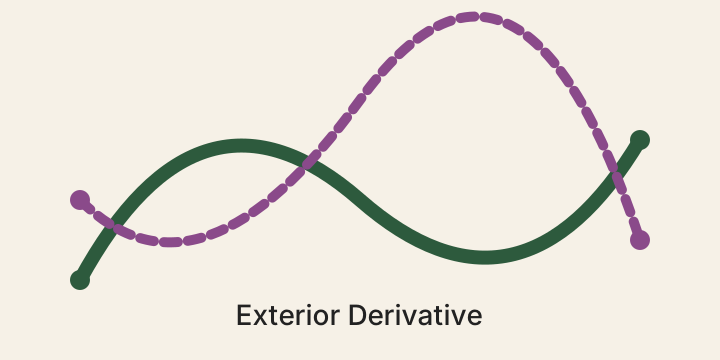
The pattern recurs in higher degrees: on a -form produces a -form measuring the "twisting" of the original.
Worked example [Beginner]
In two dimensions with coordinates : take the 1-form . Apply :
The derivative is a 2-form — twice the standard area form. This 1-form is "rotational": it generates rotation, and its exterior derivative captures that rotation as twice the area density.
By contrast, has
since each summand has a wedge of a 1-form with itself, which vanishes by antisymmetry. So is closed. In fact , so is exact — the gradient of the squared-distance function.
The exterior derivative tells you, in one calculation, whether a 1-form on a 2D region is potentially the gradient of some function (closed forms are candidates) and computationally extracts when it isn't (nonzero ).
Check your understanding [Beginner]
Formal definition [Intermediate+]
Let be a smooth manifold 03.02.01 and the space of differential -forms on 03.04.02.
The exterior derivative is the unique -linear operator
(for each ) characterised by the following four axioms:
- On 0-forms (functions): for and tangent vector ,
-linearity: and for .
Graded Leibniz rule: for and ,
- : for every form .
These four properties uniquely determine , and exists. (Existence and uniqueness are proved in §"Key theorem".)
In a local chart with coordinates , the formula is:
The exterior derivative commutes with pullback: for a smooth map and ,
This makes natural with respect to smooth maps.
A form with is closed; a form for some is exact. By , every exact form is closed; the converse fails in general, and the failure is captured by the de Rham cohomology groups 03.04.06.
The pair is the de Rham complex of :
Key theorem with proof [Intermediate+]
Theorem (existence and uniqueness of ). On any smooth manifold , there exists a unique linear operator satisfying the four axioms above.
Proof. Uniqueness. Suppose and both satisfy the axioms. We show they agree on every .
In a local chart with coordinates , write where ranges over multi-indices and . By linearity, it suffices to check .
Apply the Leibniz rule to :
By axiom 1, , which is determined.
For : write and apply Leibniz iteratively:
But by axiom 4. So .
Therefore , the same formula for both and . Hence in every chart, and globally.
Existence. Define in each chart by the formula
Verify the four axioms hold (linearity is direct; Leibniz follows by computation; from symmetry of mixed partials and antisymmetry of wedge — see below).
To show this chart-defined glues consistently across overlapping charts: the formula in different coordinate systems must agree on overlaps. Compute in a different coordinate system on the overlap. The chain rule plus the local-formula expansion shows the two expressions agree (this is essentially the chain rule for partial derivatives plus antisymmetry of wedge). Hence is globally defined.
proof. Compute :
For each unordered pair with , the contributions cancel by symmetry of mixed partials () and antisymmetry of wedge (). Diagonal contributions vanish since . So .
Bridge. The construction here builds toward 03.04.05 (stokes' theorem), where the same data is upgraded, and the symmetry side is taken up in 03.04.06 (de rham cohomology). The defining pattern appears again in those units in a sharpened form, where the local data is glued or quotiented. Putting these together, the foundational insight is that the data of this unit gives the structural signature that the rest of the strand reads off.
Exercises [Intermediate+]
Lean formalization [Intermediate+]
lean_status: partial — Mathlib has differential calculus on manifolds (mfderiv, MDifferentiable) and exterior algebra constructions, but a full bundled exterior-derivative API on differential forms is in progress.
The Codex companion module records the conventions used in this unit.
Advanced results [Master]
Naturality and pullback. The exterior derivative commutes with pullback (Exercise 5). Combined with the de Rham complex being a functor, this gives a contravariant functor from smooth manifolds to chain complexes of -vector spaces. Cohomology of this functor is de Rham cohomology 03.04.06, which is a homotopy invariant of smooth manifolds.
Cartan magic formula. , where is the Lie derivative along a vector field and is the interior product (contraction with ). This relates the three fundamental operations on differential forms — , , — and is the key identity for working with vector fields and forms together.
Poincaré lemma. On a star-shaped (or more generally, contractible) open subset of , every closed form is exact. The proof uses a cone construction (homotopy operator). The lemma fails on non-contractible domains — its failure is exactly de Rham cohomology.
De Rham complex and cohomology. The complex has cohomology . By de Rham's theorem 03.04.06, this is canonically isomorphic to the singular cohomology with real coefficients .
Exterior derivative on Lie groups. On a Lie group , the Maurer-Cartan form is the canonical -valued 1-form satisfying . It satisfies the Maurer-Cartan equation , the structural identity that encodes the bracket.
Generalisation: covariant exterior derivative. For bundle-valued forms (forms with values in a vector bundle with connection ), the covariant exterior derivative generalises . It satisfies , where is the curvature of — the failure of to square to zero measures curvature 03.05.09.
Synthesis. This construction generalises the pattern fixed in 03.04.02 (differential forms), with the symmetric data replaced by its skew or twisted analogue. Read in the opposite direction, the construction is dual to the metric story: complements and orthogonality are taken with respect to the bilinear datum of this unit, not a metric, and the resulting category of subobjects is the one the rest of the strand classifies. The central insight is that this datum identifies algebra with geometry: functions become vector fields, subspaces become quotients, and invariants become cohomology classes — and that identification is the engine driving every theorem downstream.
Full proof set [Master]
Existence and uniqueness. Proved in §"Key theorem".
. Proved in §"Key theorem" supplement. Symmetry of mixed partials + antisymmetry of wedge cancellation.
Naturality (commutation with pullback). Proved in Exercise 5 — uniqueness of + verification on 0-forms.
Cartan magic formula. Compute , so on 0-forms. For higher forms, both sides are derivations of degree 0 satisfying the same recursive structure under Leibniz; equality on 0-forms + matching derivation property forces equality on all forms.
Poincaré lemma. Proved in Exercise 7 in dimension 1; the higher-degree version uses the same cone-construction homotopy operator with .
Maurer-Cartan equation. Direct computation on a Lie group: is the -valued left-invariant 1-form with . Its exterior derivative satisfies for left-invariant vector fields generated by . Combining with : , i.e., .
Connections [Master]
Differential forms
03.04.02— the input to .Smooth manifold
03.02.01— the underlying setting.Stokes' theorem
03.04.05— relates to integration via .De Rham cohomology
03.04.06— the cohomology of the de Rham complex .Curvature of a connection
03.05.09— covariant exterior derivative squared gives curvature.Chern-Weil homomorphism
03.06.06— Bianchi identity () is the source of closedness in Chern-Weil forms.
Historical & philosophical context [Master]
The exterior derivative crystallised in Élie Cartan's 1899 paper Sur certaines expressions différentielles, which introduced what we now call differential forms and the exterior derivative as the unifying language for line, surface, and volume integrals. Cartan's exterior calculus unified the gradient, curl, divergence, and higher analogues into a single operator acting on forms of all degrees.
Goursat (1922) and Élie Cartan (1934) developed Stokes's theorem in its modern form, and de Rham (1931) proved the cohomological version that connects analytic data (closed forms modulo exact) to topological data (singular cohomology with real coefficients). Bott and Tu's monograph (1982) systematised the theory for modern algebraic-topology audiences.
In modern physics, is the universal "field-strength" operator: for a gauge potential (a connection 1-form), the field strength uses the covariant exterior derivative. Conservation laws are statements about closed forms; the lack of magnetic monopoles in Maxwell's theory is the closedness of the magnetic-flux 2-form.
Bibliography [Master]
- Spivak, M., A Comprehensive Introduction to Differential Geometry, Vol. I, Publish or Perish, 1979. Ch. 7.
- Bott, R. & Tu, L. W., Differential Forms in Algebraic Topology, Springer GTM 82, 1982. §I.1.
- Lee, J. M., Introduction to Smooth Manifolds, 2nd ed., Springer GTM 218, 2013. Ch. 14.
- Cartan, H., Differential Forms, Hermann, 1970.
- Cartan, É., "Sur certaines expressions différentielles", Annales scientifiques de l'É.N.S. (1899).
Wave 4 Strand B unit #3. Exterior derivative — the canonical degree-raising operator on differential forms; foundation for de Rham cohomology, Stokes' theorem, and curvature.