Chern-Weil homomorphism
Anchor (Master): Kobayashi-Nomizu Vol. II Ch. XII; Milnor-Stasheff Appendix C
Intuition [Beginner]
Imagine hiking on a foggy mountain. At each tiny patch of ground, your compass tells you how the slope bends nearby. A single patch is local information. A good map should turn all those small compass readings into something global: a fact about the whole mountain that does not depend on where you started walking.
Chern-Weil theory does the same job for bundles. A connection tells you how to compare nearby fibres, and its curvature measures the failure of a tiny loop to come back unchanged. The Chern-Weil homomorphism feeds that curvature into special symmetry-respecting recipes. The output is a cohomology class: a global topological fingerprint of the bundle.
The surprise is stability. You may choose many different connections, like choosing different measuring tools. The curvature forms change, but the final cohomology class does not. Geometry gives the measurement; topology keeps the part that survives every reasonable choice.
Visual [Beginner]
The picture is a three-step machine. First, a connection gives a local curvature reading. Second, an invariant rule ignores arbitrary choices of gauge or frame. Third, the resulting closed form represents a global class.
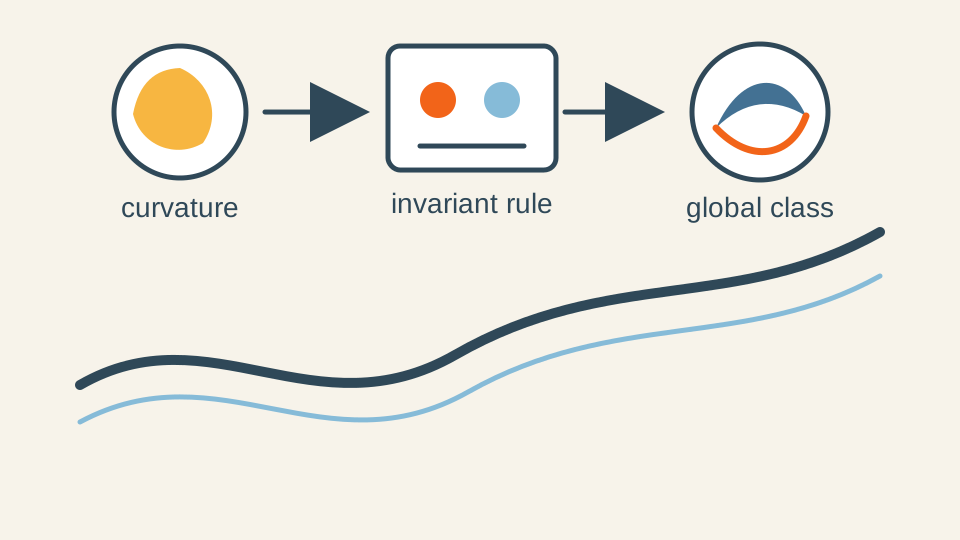
The middle box is the key. If a local observer renames all internal coordinates, the rule gives the same answer. That is why the final object can live on the base space rather than inside one chosen coordinate system.
Worked example [Beginner]
Think about a complex line bundle, the simplest kind of bundle with complex one-dimensional fibres. A connection on it behaves like a tiny dial attached to every point. When you move around a small square and return to the start, the dial may rotate by a small angle. That local rotation is curvature.
One small square might contribute a rotation rate of units, another might contribute unit, and a third might contribute units. The raw readings depend on the measuring convention, but the total winding recorded by the bundle is the durable part.
For line bundles, the first Chern class is the cohomology class represented by the curvature with a standard normalization. If the bundle is the tautological line bundle over the complex projective line, that class detects one unit of twisting. If the bundle is a product bundle, the class is zero.
What this tells us: curvature is not just a force-like quantity. In the right normalization, it records how a bundle is globally twisted.
Check your understanding [Beginner]
Formal definition [Intermediate+]
Let be a Lie group with Lie algebra [quantum-well Lie algebras.md], and let be a smooth principal -bundle 03.05.01. Write for the vector space of homogeneous degree- symmetric multilinear functions
that are invariant under the adjoint action:
for every and . Elements of are called invariant polynomials [Kobayashi-Nomizu Vol. II Ch. XII].
Choose a connection on , with curvature 03.05.07 03.05.08. For , define a -form on by evaluating on copies of :
Because is adjoint-invariant and is horizontal and equivariant, is basic. It therefore descends to a unique differential form on , also written [Milnor-Stasheff Appendix C].
The Chern-Weil homomorphism of the principal bundle is the graded algebra map
The defining theorem says this is well-defined: is closed, and its de Rham cohomology class does not depend on the connection 03.04.06.
Adjoint invariance is the operative hypothesis: a polynomial on that is not -invariant evaluates on to a form that is not basic and does not descend to . The output of the construction is the cohomology class of a scalar form produced from curvature, not the curvature form itself; different connections produce different representative forms in the same class.
Key theorem with proof [Intermediate+]
Theorem (Chern-Weil well-definedness). Let be a principal -bundle with connection and curvature . If , then descends to a closed -form on . If and are two connections with curvatures and , then
So defines a graded algebra homomorphism independent of the chosen connection.
Proof. The curvature form of a principal connection is horizontal and equivariant: it vanishes when one input vector is vertical, and . Since is adjoint-invariant, the scalar form is horizontal and -invariant. Therefore it is basic, so it descends from to a unique form on .
We next prove closedness. Let be the covariant exterior derivative associated to . The Bianchi identity gives
Using the covariant Leibniz rule and symmetry of ,
For a scalar basic form, the covariant exterior derivative agrees with the ordinary exterior derivative after descending to . Thus on .
It remains to show connection-independence. Let be the affine path , with curvature , and set . The variation formula for curvature is
Differentiate the Chern-Weil form:
By adjoint invariance of , the covariant derivative may be moved through the polynomial:
where the Bianchi identity removes the terms containing . Integrating from to gives
The two forms differ by an exact form, so they represent the same de Rham cohomology class. Multiplicativity follows because evaluating a product of invariant polynomials on curvature gives the wedge product of the corresponding scalar forms. This proves the theorem.
Synthesis. The Chern-Weil homomorphism is the foundational reason curvature represents characteristic classes. This is exactly the construction that identifies invariant polynomials in curvature with elements of . Chern-Weil generalises the classical Gauss-Bonnet identity from surfaces to arbitrary principal bundles.
Bridge. Specialising the Chern-Weil construction to invariant polynomials of and builds toward 03.06.04 (Pontryagin and Chern classes), where the same Chern-Weil image becomes the universal characteristic classes and . Feeding the curvature of a Yang-Mills connection into the same homomorphism appears again in 03.07.05 (Yang-Mills action), where is the foundational topological-charge integral, and the second Chern number is exactly the instanton number. The bridge between curvature on the analytic side and cohomology on the topological side is what putting these together exposes as the engine of the entire characteristic-class programme.
Exercises [Intermediate+]
Lean formalization [Intermediate+]
lean_status: none — the theorem cannot yet be stated naturally in Mathlib. A future Lean development would need smooth principal bundles, connection forms, curvature, invariant polynomials, basic forms, and de Rham cohomology in a shared namespace.
A plausible future statement would have this shape:
[object Promise]The named gap is concrete: implementing this unit upstream would first require the bundle and differential-form infrastructure, then the transgression proof.
Advanced results [Master]
The Chern-Weil homomorphism is most naturally a map
attached to a principal -bundle . It is functorial in pullbacks, multiplicative, and compatible with change of structure group. If is a Lie-group homomorphism and , then invariant polynomials on pull back to invariant polynomials on , and the corresponding Chern-Weil classes agree under this pullback [Kobayashi-Nomizu Vol. II Ch. XII].
For compact connected , the universal version of this construction identifies invariant polynomial generators with the real cohomology of in even degrees:
This is the bridge between the differential-geometric construction and the topological characteristic classes of classifying spaces [Milnor-Stasheff Appendix C]. For the elementary symmetric polynomials in the eigenvalues of curvature give the Chern classes; for the invariant polynomials in even powers give Pontryagin classes and the Pfaffian gives the Euler class.
The transgression form in the proof is not only a technical device. On a manifold of odd dimension, it becomes the Chern-Simons form, whose exterior derivative is a Chern-Weil form:
This is the source of Chern-Simons theory in gauge theory and low-dimensional topology. The same mechanism reappears in anomaly theory, secondary characteristic classes, eta invariants, and the boundary correction terms in index theory.
Second route to Chern classes — pullback from the classifying space
The Chern-Weil construction has a topological twin. Every principal -bundle is classified, up to isomorphism, by a homotopy class of maps pulling back the universal bundle 03.08.04. The cohomology of is itself an algebra of universal characteristic classes:
The classifying-space route to characteristic classes defines as the pullback of the universal generator. This is the second canonical route — alongside the Chern-Weil curvature route given in this unit. The two routes give the same classes:
Theorem (unification). Let be a principal -bundle with classifying map . The Chern-Weil class produced by the elementary symmetric polynomial agrees with the pullback of the universal Chern class, after passing to real coefficients via the change-of-rings map .
Proof sketch. The universal classes have de Rham representatives obtained by Chern-Weil applied to a connection on the universal bundle — for instance, the limit of Chern-Weil-on-Stiefel-manifold constructions used in Bott-Tu §23 [Bott-Tu §23]. Pulling back along commutes with the Chern-Weil construction (Exercise 6 of this unit, naturality), so is represented by Chern-Weil applied to the pulled-back connection. Two connections on produce Chern-Weil forms differing by an exact form (the main theorem of this unit), so the de Rham class agrees with . The integrality lift — that is in fact an integer class, not merely a real one — is supplied separately by the classifying-space construction, which produces an integer class by definition.
The two routes are not redundant. The Chern-Weil route gives explicit differential-form representatives computable from a chosen connection — used throughout gauge theory, index theory, and Yang-Mills field equations. The classifying-space route gives integrality and naturality for free, identifying the characteristic classes as universal cohomology operations independent of any choice of connection. The Atiyah-Singer index theorem 03.09.10 uses both faces simultaneously: the Chern-Weil representative on the analytic side, the classifying-space integrality on the topological side.
Unification arc — local-to-global as one story
The four threads of Chern-Weil theory — de Rham cohomology, Čech cohomology, spectral sequences, and characteristic classes — fit one local-to-global pattern. De Rham cohomology measures the failure of closed forms to be exact, locally a question about Poincaré-lemma neighbourhoods that glue via Mayer-Vietoris. Čech cohomology of the constant sheaf on a good cover is, by Leray's theorem, isomorphic to de Rham; the Čech-de-Rham double complex of Bott-Tu makes this isomorphism a calculation, not a name. Spectral sequences refine the calculation: the Čech-de-Rham spectral sequence converges from local data on covers to global cohomology, and the Leray-Serre spectral sequence does the analogous job for fibrations. Characteristic classes, finally, are the global obstructions detected by these calculations: Chern-Weil produces them via curvature on a single bundle; the classifying-space route produces them via universal classes on . Bott and Tu's §1.7 architectural arc names this as "one local-to-global story" — the same pattern recurs across the entire characteristic-class apparatus, with different machinery (forms vs. cocycles vs. spectra vs. universal bundles) implementing the same descent from local to global.
Full proof set [Master]
Proof of basic descent. Let be a -invariant horizontal form on . For each local section , define . If is another local section, then by invariance, with the usual pointwise version when varies. The horizontal condition removes vertical correction terms. Therefore the local forms glue to a unique form on . Applying this to proves descent.
Proof of closedness. The Bianchi identity is a structural identity for the curvature of any connection. Since is symmetric and invariant, . For scalar basic forms, the descended covariant derivative is the de Rham differential. Thus .
Proof of independence. Let and . The curvature satisfies . Differentiating gives
By the invariant-polynomial identity,
because the terms involving vanish by Bianchi. Descending to turns into , and integration in gives the exact transgression formula. The cohomology class is therefore independent of .
Proof of naturality. A smooth map pulls a connection to a connection and pulls curvature to curvature. Since pullback commutes with wedge product and scalar evaluation by , it sends to . This proves .
Connections [Master]
Principal bundles
03.05.01— Chern-Weil theory is a construction on principal bundles before it becomes a theory of vector bundles.Connections and curvature
03.05.07,03.05.08— the geometric input is a connection and its curvature.De Rham cohomology
03.04.06— the output class lives in de Rham cohomology.Pontryagin and Chern classes
03.06.04— this unit supplies the geometric representatives for those characteristic classes.Thom global angular form
03.04.09— byconn:433.thom-de-rham-chern-weil, de Rham Thom class equivalent to Chern-Weil Euler form on the same oriented Euclidean bundle (equivalence). For an oriented rank- Euclidean bundle with metric connection, the Euler class admits two de Rham realisations: (zero-section pullback of the Thom class) and (Chern-Weil); both routes give the same cohomology class.Yang-Mills action
03.07.05— gauge theory uses the same curvature forms, though with metric-dependent action functionals rather than topological cohomology classes.Atiyah-Singer index theorem
03.09.10— the topological side of the index formula is written in characteristic classes obtained through Chern-Weil theory.Classifying space
03.08.04— equivalence: the second canonical route to characteristic classes is pullback of universal classes from ; on real coefficients, the classifying-space route and the Chern-Weil route produce the same classes.
Throughlines and forward promises. Chern-Weil is the foundational construction that produces curvature representatives of characteristic classes. We will see the Chern-Weil Euler form recur in the Hopf index theorem of 03.05.10 pending and in the Atiyah-Singer index density of 03.09.20; we will see the Pfaffian-of-curvature representative agree with the global-angular-form representative via . This pattern recurs in every curvature computation in differential geometry. The foundational reason curvature gives a topological class is exactly that the curvature transforms as a tensor and invariant polynomials descend to gauge-invariant cohomology. Putting these together: every characteristic-class identity (Whitney sum, multiplicativity, naturality) is an instance of the Chern-Weil homomorphism's algebraic structure. The bridge between connection-dependent curvature and connection-independent cohomology is exactly the transgression form ; this is precisely the homotopy that makes Chern-Weil a topological invariant.
Historical & philosophical context [Master]
The Chern-Weil homomorphism crystallized a postwar synthesis: differential geometry could manufacture the same characteristic classes that algebraic topology had defined abstractly. Weil formulated the algebraic framework of invariant polynomials, and Chern's curvature proof of the Gauss-Bonnet theorem showed how curvature forms could carry topological information [Chern, Topics in Differential Geometry]. Kobayashi and Nomizu systematized the bundle-and-connection formulation in their second volume [Kobayashi-Nomizu Vol. II Ch. XII].
The theorem extracts topological information of from any connection on it: curvature is a representative of the characteristic class, not the class itself, and the exact correction is precisely the freedom in the choice.
Bibliography [Master]
- Chern, S. S., "Characteristic Classes of Hermitian Manifolds", Annals of Mathematics 47 (1946), 85–121.
- Chern, S. S., "A Simple Intrinsic Proof of the Gauss-Bonnet Formula for Closed Riemannian Manifolds", Annals of Mathematics 45 (1944), 747–752.
- Weil, A., "Sur les théorèmes de de Rham", Commentarii Mathematici Helvetici 26 (1952), 119–145.
- Kobayashi, S. & Nomizu, K., Foundations of Differential Geometry, Vol. II, Wiley, 1969. Ch. XII.
- Milnor, J. & Stasheff, J., Characteristic Classes, Princeton University Press, 1974. Appendix C.
- Bott, R. & Tu, L. W., Differential Forms in Algebraic Topology, Springer, 1982. Characteristic-class chapters.
Pilot unit #4. Produced in the Wave C parallel-session pass with all three tiers present; principal bundles, connections, curvature, Lie algebras, and de Rham cohomology remain pending prerequisite units.