Variational calculus on manifolds
Anchor (Master): Arnold Mathematical Methods of Classical Mechanics §III.12; Spivak Vol. I §10
Intuition [Beginner]
Variational calculus studies quantities that depend on a whole path, surface, or field. Instead of changing one number, you change an entire object a tiny amount and ask how the total score changes.
The shortest path is the basic picture. Try nearby paths with the same endpoints. The shortest one has no first-order improvement: tiny allowed changes do not decrease its length to first order.
Physics uses the same idea. An action assigns a number to a motion or field. The physical equation says that the first-order change of the action vanishes.
Visual [Beginner]
The dashed paths are variations of the blue path. The critical path is the one whose action has zero first-order change under all allowed variations.
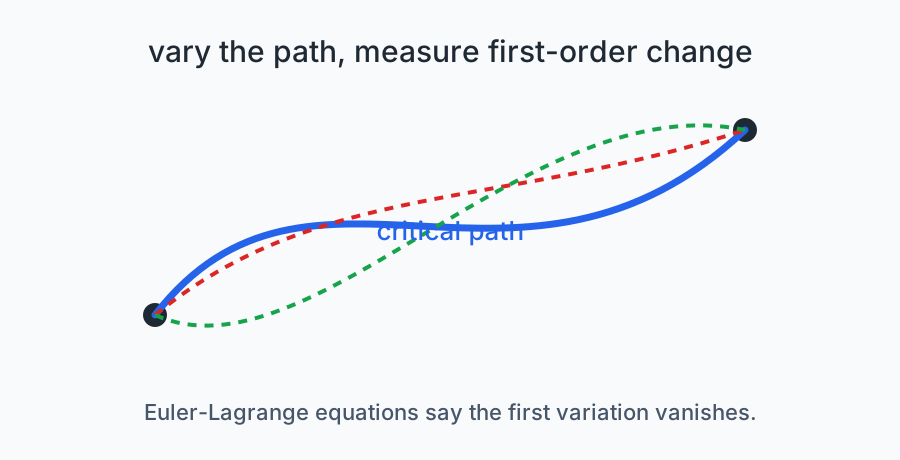
Variational calculus turns "best among nearby objects" into a differential equation.
Worked example [Beginner]
Consider paths from point A to point B in a flat plane. The action is the path length.
If a path bends outward, you can usually shorten it by nudging the bend inward while keeping the endpoints fixed. A straight line has no such first-order shortening.
What this tells us: the equation for a critical path is a local condition that comes from testing every allowed tiny change.
Check your understanding [Beginner]
Formal definition [Intermediate+]
Let be a space of smooth fields or paths on a manifold, and let
be an action functional, typically defined by integrating a Lagrangian density over a manifold 03.04.03. A variation of is a smooth one-parameter family with and prescribed boundary behavior.
The first variation of at in the direction is
The field is critical if for every allowed variation [Arnold §III.12].
Key theorem with proof [Intermediate+]
Theorem (Euler-Lagrange equation in one dimension). Let
for smooth paths with fixed endpoints. If is critical, then
Proof. Let , where . Differentiating under the integral gives
Integrate the second term by parts:
The boundary term vanishes because . Therefore
If this is zero for every compactly supported variation , the fundamental lemma of variational calculus gives the Euler-Lagrange equation.
Bridge. The construction here builds toward 03.07.05 (yang-mills action), where the same data is developed in the next layer of the strand. The defining pattern appears again in those units in a sharpened form, where the local data is glued or quotiented. Putting these together, the foundational insight is that the data of this unit gives the structural signature that the rest of the strand reads off.
Exercises [Intermediate+]
Lean formalization [Intermediate+]
lean_status: none — Mathlib does not yet support the manifold-level variational calculus needed here.
Formalization would require smooth mapping spaces, variations with boundary conditions, differentiability of action functionals, integration by parts on manifolds, and Euler-Lagrange operators for sections of bundles.
Advanced results [Master]
For fields given by sections of a bundle , a first-order Lagrangian density depends on the first jet . The first variation decomposes into an Euler-Lagrange term plus a boundary term:
With compactly supported variations or fixed boundary data, the boundary term vanishes and critical points satisfy [Spivak §10].
For a principal connection , the Yang-Mills action has first variation
so the Euler-Lagrange equation is 03.07.05.
Synthesis. This construction generalises the pattern fixed in 03.04.03 (integration on manifolds), with the symmetric data replaced by its skew or twisted analogue. Read in the opposite direction, the construction is dual to the metric story: complements and orthogonality are taken with respect to the bilinear datum of this unit, not a metric, and the resulting category of subobjects is the one the rest of the strand classifies. The central insight is that this datum identifies algebra with geometry: functions become vector fields, subspaces become quotients, and invariants become cohomology classes — and that identification is the engine driving every theorem downstream.
Full proof set [Master]
Fundamental lemma. If a smooth function on an interval satisfies
for every compactly supported smooth , then . If , continuity gives an interval where has a fixed sign. Choosing nonnegative and supported there gives a nonzero integral, a contradiction.
Yang-Mills first variation. The curvature variation is . Differentiating gives . The covariant integration-by-parts formula moves to its formal adjoint, yielding .
Connections [Master]
Integration on manifolds
03.04.03— action functionals integrate Lagrangian densities.Principal bundle connection
03.05.07— gauge fields are varied as connections.Curvature
03.05.08— Yang-Mills varies curvature energy.Yang-Mills action
03.07.05— the Yang-Mills equation is an Euler-Lagrange equation.
Historical & philosophical context [Master]
The calculus of variations grew from the brachistochrone problem, geodesics, and classical mechanics. Euler and Lagrange developed the differential equations for extrema of integral functionals, and Hamilton's principle made the action central to mechanics.
Arnold's formulation places variational principles inside symplectic geometry and mechanics, while gauge theory applies the same structure to spaces of connections [Arnold §III.12].
Bibliography [Master]
- Arnold, V. I., Mathematical Methods of Classical Mechanics, Springer, 1978. §III.12.
- Spivak, M., A Comprehensive Introduction to Differential Geometry, Vol. I, Publish or Perish, 1970. §10.
- Gelfand, I. M. and Fomin, S. V., Calculus of Variations, Prentice-Hall, 1963.
- Hamilton, W. R., "On a General Method in Dynamics", Philosophical Transactions of the Royal Society 124 (1834), 247-308.
Wave 2 Phase 2.4 unit #5. Produced as the variational-calculus prerequisite for Yang-Mills.