Yang-Mills action
Anchor (Master): Atiyah-Bott — Yang-Mills equations over Riemann surfaces; Donaldson-Kronheimer §2
Intuition [Beginner]
A gauge field is a rule for comparing internal directions at nearby points. Curvature measures the failure of those comparisons to close up after a tiny loop. When the failure is large, the field stores more energy.
Yang-Mills theory turns that idea into a number. It looks at the curvature everywhere on the space and adds up its squared size. Low action means the field bends gently or cancels itself well. High action means strong curvature is spread through the space.
Electromagnetism is the abelian example. Yang-Mills keeps the same field-energy idea but allows the internal rotations to fail to commute, which is the source of non-abelian gauge theory.
Visual [Beginner]
The surface carries a grid of local comparisons. The colored loops mark places where transport around a small loop does not return the internal arrow to its starting direction.
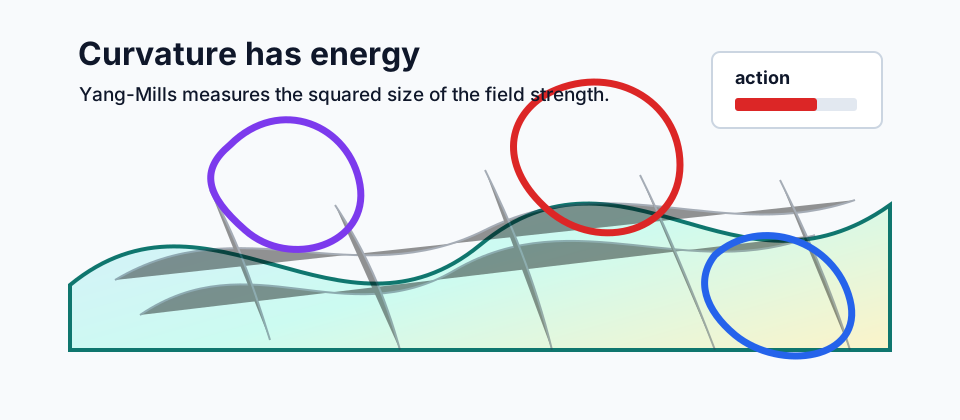
The action meter is a mnemonic: Yang-Mills does not count loops. It measures the total squared size of curvature.
Worked introduction [Beginner]
Imagine walking around a small square while carrying an arrow that can rotate in an internal color space. If the arrow returns unchanged, the field is flat along that square. If it returns rotated, the square has curvature.
Now compare two fields. Field A rotates the arrow a little on most squares. Field B rotates it strongly on a few squares and gently elsewhere. Yang-Mills assigns a cost by squaring the size of each rotation before adding the costs. Strong curvature is punished more than weak curvature.
The preferred fields are the stationary ones: small allowed changes do not lower the action to first order.
Check your understanding [Beginner]
Formal definition [Intermediate+]
Let be a principal -bundle over a compact oriented Riemannian manifold, let be the Lie algebra of , and fix an -invariant inner product on . A connection has curvature
The Yang-Mills action is
The first expression uses the Riemannian metric and the inner product on ; the second is the differential-form expression with the Hodge star. This is the standard non-abelian generalization of Maxwell field energy [tong §2].
A connection is a Yang-Mills connection if it is a critical point of on the affine space of connections. Its Euler-Lagrange equation is
together with the Bianchi identity
Key theorem with proof [Intermediate+]
Theorem (gauge invariance of the Yang-Mills action). Let be a gauge transformation of . If is the transformed connection, then
Proof. Under a gauge transformation, curvature transforms by the adjoint action:
The chosen inner product on is -invariant, so
pointwise. The gauge transformation acts only in the internal Lie-algebra direction; it does not change the Riemannian volume form on . Therefore the integrands in and agree at every point. Integrating gives the stated equality.
Bridge. Coupling a Dirac operator to a Yang-Mills connection builds toward 03.09.08 (Dirac operator) by producing the twisted Dirac operator , whose spectrum encodes the gauge sector's curvature. The action's topological-charge integral appears again in 03.09.10 (Atiyah-Singer), where it is exactly for SU(2)-instantons, and Atiyah-Singer identifies that integer with the index of the chiral Dirac operator twisted by . Putting these together, the foundational reason instantons are physically nontrivial is the Yang-Mills-Atiyah-Singer bridge: minima of in a fixed topological sector are dual to ASD connections, and the moduli space of ASD connections is what carries the geometric content.
Exercises [Intermediate+]
Lean formalization [Intermediate+]
lean_status: none — the differential-geometric infrastructure required for this unit is not yet present in Mathlib.
The missing formalization work includes principal connections, curvature, gauge transformations, vector-bundle-valued forms, Hodge star, and the variational calculus needed for .
Advanced results [Master]
On a compact oriented four-manifold, the decomposition
gives the identity
The Chern-Weil term
is topological after normalization, while depends on the metric 03.06.06. This yields lower bounds for the action in fixed topological sectors, attained by self-dual or anti-self-dual connections.
Atiyah and Bott described Yang-Mills theory over a Riemann surface as an infinite-dimensional symplectic quotient problem. The curvature map is a moment map for the gauge-group action on the space of connections, and the Yang-Mills functional is the squared norm of that moment map [Atiyah-Bott 1983].
In four dimensions the same functional underlies Donaldson theory. Anti-self-dual connections satisfy first-order equations whose moduli spaces carry invariants of smooth four-manifolds [Donaldson-Kronheimer §2].
Synthesis. The Yang-Mills functional generalises the harmonic-map energy from to connections on a principal -bundle 03.05.01, with the bilinear datum being the -invariant inner product on rather than a Riemannian metric on . The central insight of the Yang-Mills programme is exactly the Bogomolny bound with equality precisely on (anti-)self-dual connections — this is dual to the Bianchi identity and identifies the absolute minimum in each topological class with a first-order PDE. Putting these together, the foundational reason gauge theory has both physics and topology is the four-dimensional Hodge-star coincidence: splits into only in dimension four, and that single accident is the bridge between the action functional and the Donaldson invariants.
Full proof set [Master]
First variation. For a variation , curvature satisfies
Thus
On a closed manifold, integration by parts gives
The first variation vanishes for all exactly when .
Four-dimensional instantons. If or , then the Yang-Mills equation follows from the Bianchi identity:
These first-order equations are stronger than the second-order Yang-Mills equation and are elliptic modulo gauge after imposing a slice condition.
Relation to Chern-Weil. The expression represents a characteristic class after applying the appropriate invariant polynomial 03.06.06. Yang-Mills uses instead. Replacing the second by introduces the metric and turns a topological representative into an energy density.
Connections [Master]
Chern-Weil homomorphism
03.06.06— both theories evaluate curvature through invariant inner products or polynomials.Pontryagin and Chern classes
03.06.04— topological charge terms in four-dimensional gauge theory are characteristic classes.Dirac operator
03.09.08— coupled Dirac operators use the same gauge connections, and curvature appears in Weitzenbock formulas.Atiyah-Singer index theorem
03.09.10— instanton moduli-space dimensions are computed by elliptic deformation complexes.CFT basics
03.10.02— two-dimensional gauge and conformal theories share stress-energy and symmetry methods, though Yang-Mills itself is not conformal in every dimension.
Historical & philosophical context [Master]
Yang and Mills introduced non-abelian gauge fields in 1954 as a symmetry principle for isospin. The modern geometric formulation identifies their field strength with curvature of a connection, and the action with the norm of curvature [tong §2].
Atiyah and Bott's 1983 paper placed Yang-Mills equations over Riemann surfaces in symplectic and Morse-theoretic form [Atiyah-Bott 1983]. Donaldson's four-dimensional theory used anti-self-dual Yang-Mills connections to distinguish smooth structures on topological four-manifolds [Donaldson-Kronheimer §2].
Bibliography [Master]
- Yang, C. N. & Mills, R. L., "Conservation of Isotopic Spin and Isotopic Gauge Invariance", Physical Review 96 (1954), 191–195.
- Atiyah, M. F. & Bott, R., "The Yang-Mills equations over Riemann surfaces", Philosophical Transactions of the Royal Society of London A 308 (1983), 523–615.
- Donaldson, S. K. & Kronheimer, P. B., The Geometry of Four-Manifolds, Oxford University Press, 1990. §2.
- Tong, D., Lectures on Gauge Theory, §2.
Pilot unit #8. Produced in the continuation pass; principal-bundle connection prerequisites remain pending.