Complex vector bundle
Anchor (Master): Milnor-Stasheff §14–§17; Wells — Differential Analysis on Complex Manifolds
Intuition [Beginner]
A real vector bundle attaches a real vector space — say — to every point of a manifold. A complex vector bundle does the same but with complex vector spaces — fibres are copies of .
Why complex? Because complex linear algebra is genuinely richer than real. Two real dimensions can be packaged as one complex dimension if you also remember "what multiplication by does." A complex line bundle (rank one over ) is a real rank-2 bundle plus the extra data of a 90-degree rotation in each fibre — and that extra data has its own topological meaning.
Complex vector bundles arise naturally in algebraic geometry (holomorphic line bundles on Riemann surfaces), in physics (wave functions in quantum mechanics), and in K-theory (where complex bundles are the basic invariants).
Visual [Beginner]
Each fibre over a point of the base is a complex vector space — which you can visualise as with a fixed orientation-preserving rotation built in.
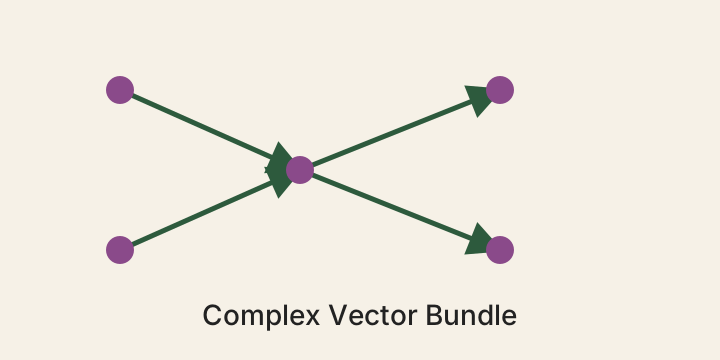
The rotation is the operation "multiply by ." It must vary smoothly across the manifold and square to in every fibre.
Worked example [Beginner]
The simplest non-product complex vector bundle is the tautological line bundle over the complex projective line .
Points of are complex lines through the origin in . The fibre over the line is the line itself. Every point of the base is a 1-dimensional complex subspace of , and the bundle's total space is
This is a non-product complex line bundle — it cannot be untwisted to a product . The obstruction is one unit of "complex twist," recorded by its first Chern class . The dual bundle has .
Physical intuition: think of an electron's wave function on the surface of a sphere. The complex phase of the wave function lives in a complex line bundle, and the first Chern class counts how many times the phase winds around as you traverse the equator — the source of monopole quantisation in physics.
Check your understanding [Beginner]
Formal definition [Intermediate+]
Let be a smooth manifold (or topological space). A complex vector bundle of rank over is a real vector bundle 03.05.02 of real rank together with a smooth bundle endomorphism
satisfying in every fibre. The pair has fibres that are -vector spaces of complex dimension via .
Equivalently, a complex vector bundle of rank is determined by transition functions
satisfying the cocycle condition . The complex structure is then the multiplication-by- operator under each local trivialisation.
A Hermitian metric on a complex vector bundle is a smooth choice, in each fibre , of a Hermitian inner product — sesquilinear in the first argument, linear in the second, and positive-definite. Every paracompact base manifold admits a Hermitian metric (partition of unity argument). With a Hermitian metric, the structure group reduces from to .
Several constructions:
- Direct sum : rank .
- Tensor product : rank .
- Dual : same rank.
- Conjugate : same underlying real bundle, complex structure . The conjugate of a holomorphic line bundle is anti-holomorphic; the operation is contravariant on holomorphic structure but identity-on-real-bundle.
- Complexification of a real bundle : , a complex bundle of complex rank equal to the real rank of .
- Realification (forgetting structure): the underlying real bundle of has real rank .
For complexified real bundles, has a canonical complex conjugation , and as a complex bundle [Milnor-Stasheff §14].
Key theorem with proof [Intermediate+]
Theorem (Complexified real bundle is self-conjugate up to twist). Let be a real vector bundle and its complexification. Then admits a -antilinear bundle involution with , whose fixed points are exactly .
Consequently, the conjugate bundle is canonically isomorphic to (as a complex bundle), and the Chern classes of satisfy , i.e., the odd Chern classes are 2-torsion.
Proof. Define fibrewise: for with and , set . This is well-defined on the tensor product (both factors are in their respective categories) and extends to a smooth bundle map. It is antilinear over : . Squaring: .
The fixed points of are the elements with , i.e., real, which is exactly the image of via .
For the consequence: an antilinear involution on defines a complex-bundle isomorphism (an antilinear bundle map between and itself is the same as a linear bundle map to its conjugate). Chern classes satisfy (standard) [Milnor-Stasheff §14], so . For odd, this forces , i.e., is 2-torsion.
This theorem is the reason Pontryagin classes are defined as rather than odd Chern classes: the odd ones are 2-torsion and don't carry rational information, while the even ones do 03.06.04.
Bridge. The construction here builds toward 03.06.04 (pontryagin and chern classes), where the same data is upgraded, and the symmetry side is taken up in 03.06.06 (chern-weil homomorphism). The defining pattern appears again in those units in a sharpened form, where the local data is glued or quotiented. Putting these together, the foundational insight is that the data of this unit gives the structural signature that the rest of the strand reads off.
Exercises [Intermediate+]
Lean formalization [Intermediate+]
lean_status: none — Mathlib has -vector spaces but the bundle-level packaging for complex vector bundles, conjugate bundles, and complexification is not yet in place.
A formalization needs the typeclass machinery for "complex structure on a real vector bundle," the Hermitian-metric structure, and the standard constructions (sum, tensor, dual, conjugate, complexification, realification).
Advanced results [Master]
Holomorphic vector bundles. When is a complex manifold, the natural refinement is a holomorphic vector bundle: the transition functions are required to be holomorphic. The set of holomorphic line bundles forms the Picard group . For Riemann surfaces, has a continuous part (the Jacobian, isomorphic to a complex torus of dimension ) and a discrete part (degrees in ).
Hermitian-Yang-Mills connections. A Hermitian metric and complex structure together canonically determine a Chern connection on a holomorphic vector bundle: the unique connection compatible with the Hermitian metric whose -part agrees with the Cauchy-Riemann operator . The Donaldson-Uhlenbeck-Yau theorem states that an irreducible holomorphic bundle on a compact Kähler manifold admits a Hermitian-Einstein metric iff it is stable (a slope-stability condition). This is the algebraic-geometric / differential-geometric bridge underlying much of modern moduli theory.
Complex vector bundles in K-theory. Topological complex K-theory is the Grothendieck group of complex vector bundles on under direct sum and tensor product 03.08.01. The space is a classifying space, and Bott periodicity makes complex K-theory periodic with period 2 03.08.07. For real K-theory the period is 8 (real Bott).
Splitting principle. Every complex vector bundle of rank pulls back, via a flag-bundle map that is cohomologically injective, to a direct sum of complex line bundles . This reduces every characteristic-class identity to symmetric polynomial identities in the Chern roots . The total Chern class becomes , and characteristic classes like (the Chern character) follow 03.06.04.
Complex structures vs. almost-complex structures. A complex structure on a manifold is a system of holomorphic charts; an almost-complex structure is just an endomorphism of with . The Newlander-Nirenberg theorem says these agree iff a certain integrability tensor (the Nijenhuis tensor) vanishes. Almost-complex manifolds inherit Chern classes via the resulting -bundle structure on .
Synthesis. This construction generalises the pattern fixed in 03.05.02 (vector bundle), with the symmetric data replaced by its skew or twisted analogue. Read in the opposite direction, the construction is dual to the metric story: complements and orthogonality are taken with respect to the bilinear datum of this unit, not a metric, and the resulting category of subobjects is the one the rest of the strand classifies. The central insight is that this datum identifies algebra with geometry: functions become vector fields, subspaces become quotients, and invariants become cohomology classes — and that identification is the engine driving every theorem downstream.
Full proof set [Master]
Equivalence of -bundle and -cocycle definitions. Given with , choose a local real frame for over . Transition functions on overlaps are real matrices commuting with , hence elements of via the standard embedding. Conversely, -cocycles assemble a -bundle whose fibrewise multiplication-by- provides the .
Conjugate bundle Chern classes. The conjugate of a complex bundle is . Under a local frame, the standard -cocycle is ; for the conjugate, the cocycle is . Chern classes pull back along complex conjugation by (this is computed at the level of the universal bundle on , where complex conjugation acts on by alternating signs in degree).
Complexification self-conjugacy. Proved in §"Key theorem".
Hermitian-metric reduction. Given a Hermitian metric , choose at each point an orthonormal basis. Transition functions between two such bases must preserve , hence land in . The reduction is canonical up to the choice of orthonormal basis, which is the action of on the space of orthonormal frames — i.e., the structure group is exactly .
Splitting principle (proof sketch). Form the flag bundle whose fibre over is the variety of complete flags in . The pullback on has a tautological filtration by subbundles; each successive quotient is a line bundle. Leray-Hirsch (using the Schubert cell decomposition of flag manifolds) shows is a free module over , so is injective on cohomology, and any universal characteristic-class identity can be checked after pulling back to .
Connections [Master]
Vector bundle
03.05.02— supplies the underlying real bundle.Vector space
01.01.03— fibres are -vector spaces, with the complex structure giving the -action.Pontryagin and Chern classes
03.06.04— the natural characteristic classes; Chern classes are integral cohomology classes of complex bundles, Pontryagin classes are derived from complexified real bundles.Chern-Weil homomorphism
03.06.06— Chern classes have de Rham representatives via curvature of a Hermitian connection.Topological K-theory
03.08.01— complex bundles are the basic objects of complex K-theory.Bott periodicity
03.08.07— complex K-theory has period 2; the algebraic shadow is the classification's complex 2-periodicity.Dirac operator
03.09.08— twisted Dirac operators couple a Dirac operator to a complex auxiliary vector bundle.
Historical & philosophical context [Master]
Complex vector bundles emerged from the study of holomorphic functions on Riemann surfaces (Riemann, Klein, Poincaré) and from Cartan's theory of holomorphic fibre bundles in the 1920s. Hodge theory (1930s) and Kodaira's vanishing theorem (1953) made holomorphic line bundles a central tool in algebraic geometry. The topological theory in the 1950s (Chern, Hirzebruch, Atiyah) abstracted away the holomorphicity and yielded characteristic classes for arbitrary complex vector bundles [Milnor-Stasheff §14].
K-theory (Grothendieck for the algebraic version, 1957; Atiyah-Hirzebruch for the topological version, 1959) made complex bundles the basic invariants: every complex vector bundle is built from line bundles by elementary operations, and these operations are exactly the ring operations in . Bott periodicity then turned this into a periodic generalised cohomology theory.
In physics, complex line bundles encode the topology of phase factors: monopole quantisation (Dirac), the Aharonov-Bohm effect, and the Berry phase all live as monodromies in a complex line bundle. Higher-rank complex bundles encode gauge fields with internal symmetry , which is the mathematical content of non-abelian gauge theory.
Bibliography [Master]
- Milnor, J. & Stasheff, J., Characteristic Classes, Princeton University Press, 1974. §14.
- Atiyah, M. F., K-Theory, W. A. Benjamin, 1967.
- Husemoller, D., Fibre Bundles, Springer, 3rd ed., 1994.
- Wells, R. O., Differential Analysis on Complex Manifolds, Springer, 1980.
- Griffiths, P. & Harris, J., Principles of Algebraic Geometry, Wiley, 1978.
Wave 2 Phase 2.3 unit #4. Complex vector bundles — the natural setting for Chern classes, K-theory, and the complex side of characteristic-class theory.