Principal bundle with connection
Anchor (Master): Kobayashi-Nomizu Vol. I §II; Steenrod §17
Intuition [Beginner]
A principal bundle attaches a symmetry group to every point of a base space 03.05.01. Moving inside the total space can mean two different things: moving across the base, or spinning inside the symmetry group above one base point.
A connection separates those two motions. It declares which directions are horizontal, meaning they count as real movement along the base rather than pure gauge motion inside a fiber.
Once horizontal directions are chosen, a path in the base has a horizontal lift upstairs. That lifted path tells how to transport gauges, frames, or internal labels along the base path.
Visual [Beginner]
The red directions move along the group fiber. The green directions are horizontal choices made by the connection.
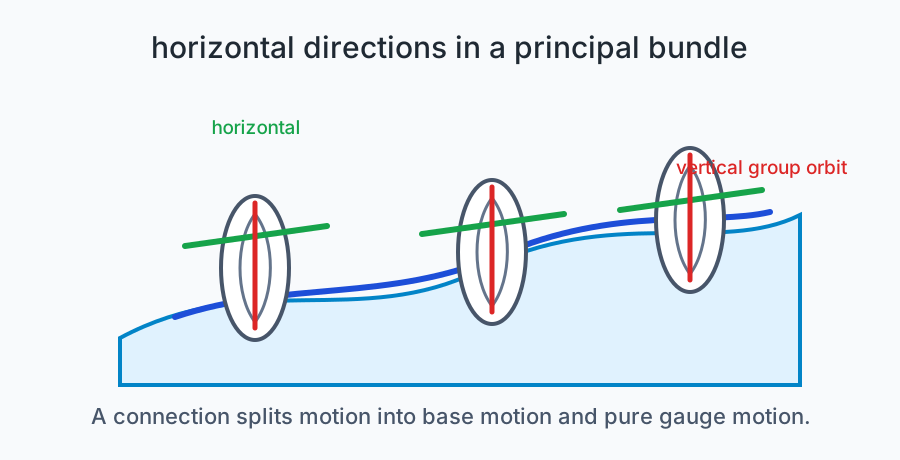
Changing the connection tilts the green directions. The principal bundle stays the same, but the rule for parallel transport changes.
Worked example [Beginner]
Take the frame bundle of a surface. A point upstairs is not just a point of the surface; it is a point together with a chosen frame.
If you move along a curve on the surface, many lifted motions are possible because the frame can also rotate while the base point moves. A connection chooses the lift where the frame is transported as parallel as possible.
On a flat plane, carrying a frame around a small rectangle returns it unchanged. On a curved surface, the frame can return rotated. That returned rotation is curvature, and it is measured from the connection.
Check your understanding [Beginner]
Formal definition [Intermediate+]
Let be a smooth principal right -bundle, and let be the Lie algebra of . For , write for the fundamental vertical vector field on generated by the right action.
A principal connection form is a -valued one-form
satisfying two conditions [Kobayashi-Nomizu §II]:
- for every ;
- for every .
The first condition says that reproduces vertical group motion. The second says that the definition is compatible with the principal right action.
The associated horizontal subspace at is
These spaces form a -equivariant horizontal distribution complementary to the vertical tangent spaces.
Key theorem with proof [Intermediate+]
Theorem (connection forms and horizontal distributions are equivalent). A principal connection form on determines a smooth -equivariant splitting
with . Conversely, any smooth -equivariant horizontal distribution complementary to the vertical tangent bundle determines a unique principal connection form.
Proof. Let be a connection form. The vertical tangent space is spanned by fundamental vectors . Since , the restriction is an isomorphism. Therefore intersects only at zero, and dimensions give
The equivariance identity implies , so the horizontal spaces are -equivariant.
Conversely, suppose is a smooth -equivariant splitting. Every tangent vector decomposes uniquely as . Since is identified with by , define to be the unique such that . This construction is smooth, reproduces fundamental fields, and the -equivariance of gives the adjoint transformation law. Uniqueness follows because a connection form must vanish on and reproduce the vertical component.
Bridge. The construction here builds toward 03.06.06 (chern-weil homomorphism), where the same data is upgraded, and the symmetry side is taken up in 03.07.05 (yang-mills action). The defining pattern appears again in those units in a sharpened form, where the local data is glued or quotiented. Putting these together, the foundational insight is that the data of this unit gives the structural signature that the rest of the strand reads off.
Exercises [Intermediate+]
Lean formalization [Intermediate+]
lean_status: none — Mathlib currently lacks the principal-bundle, fundamental-vector-field, and equivariant Lie-algebra-valued-form infrastructure needed to state this unit.
The formal path should start with smooth principal bundles and their vertical tangent bundles, then define principal connection forms and prove equivalence with equivariant horizontal distributions.
Curvature and gauge transformations [Master]
The curvature of a principal connection is the -valued two-form
where the bracket combines the Lie algebra bracket with the exterior product of forms [Kobayashi-Nomizu §II]. Curvature is horizontal and equivariant, so it descends to associated adjoint-bundle data on the base.
In a local section , the connection form pulls back to a local gauge potential
Changing the local section by a gauge function transforms the local form by
The curvature transforms tensorially:
This is the local form used in Yang-Mills theory 03.07.05.
Associated vector bundles [Master]
Let be a principal -bundle with connection and let be a representation. The associated vector bundle is
A principal connection induces a vector-bundle connection on by differentiating equivariant -valued functions on . This construction is the bridge from gauge fields to covariant derivatives on matter fields, spinor bundles, and characteristic forms [Steenrod §17].
For the frame bundle of a vector bundle, principal connections and vector-bundle connections are equivalent descriptions. For a spin structure, the lifted principal connection induces the spinor covariant derivative used in the Dirac operator 03.09.08.
Connections [Master]
Principal bundle
03.05.01— the connection is extra differential structure on a principal bundle.Vector-bundle connection
03.05.04— associated bundles inherit covariant derivatives from principal connections.Curvature
03.05.08— curvature measures the failure of horizontal lifts to close under brackets.Chern-Weil homomorphism
03.06.06— invariant polynomials evaluated on curvature produce de Rham cohomology classes.Yang-Mills action
03.07.05— gauge fields are principal connections and the action is built from curvature.
Historical & philosophical context [Master]
Ehresmann's formulation of a connection as a horizontal distribution separated the idea from affine coordinates and made it natural on arbitrary fiber bundles. Kobayashi and Nomizu developed the principal-bundle connection form as the standard differential-geometric language for curvature, holonomy, and associated bundles [fast-track Kobayashi-Nomizu-1-683x1024__72960fe9e3.jpg].
Gauge theory adopted the same object with different vocabulary: a local gauge potential is a local pullback of a principal connection, and field strength is curvature. Chern-Weil theory and Yang-Mills theory use the same geometric data with different outputs: cohomology classes in the first case, variational field equations in the second.
Bibliography [Master]
- Kobayashi, S. and Nomizu, K., Foundations of Differential Geometry, Vol. I, Wiley, 1963. §II.
- Steenrod, N., The Topology of Fibre Bundles, Princeton University Press, 1951. §17.
- Ehresmann, C., "Les connexions infinitesimales dans un espace fibre differentiable", Colloque de Topologie, Brussels, 1950.
- Chern, S.-S. and Weil, A., "The characteristic classes and curvature", unpublished notes, 1940s.
Wave 2 Phase 2.2 unit #6. Produced as the principal-connection prerequisite for Chern-Weil, Yang-Mills, and Dirac-type constructions.