Atiyah-Singer index theorem
Anchor (Master): Atiyah-Singer Annals I and III; Lawson-Michelsohn §III; Berline-Getzler-Vergne
Intuition [Beginner]
Some equations have a stable imbalance. The number of independent solutions may be larger than the number of independent constraints, or smaller. For Fredholm operators this imbalance is the index: solutions minus obstructions.
The Atiyah-Singer index theorem says that, for elliptic differential operators on compact manifolds, this analytic imbalance can be computed from topology. The operator may involve derivatives and local geometry, but its index is determined by a symbol class and characteristic classes.
The theorem is a bridge: analysis produces an integer by solving an equation; topology produces the same integer by measuring how vector bundles twist.
Visual [Beginner]
The same operator gives two paths to one integer. The analytic path counts solutions and obstructions. The topological path reads the leading-symbol data and characteristic classes.
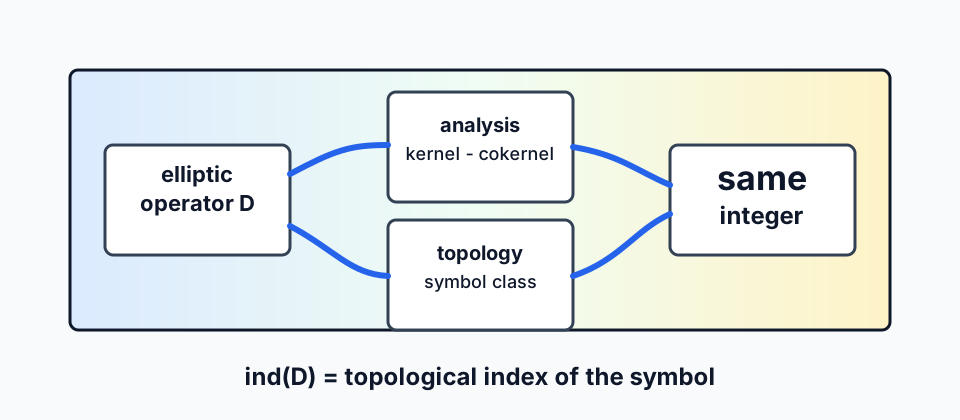
This is why the theorem is powerful. It converts a hard equation-counting problem into a computable topological formula.
Worked introduction [Beginner]
Take an operator with a finite-dimensional solution space and a finite-dimensional obstruction space. If there are five independent solutions and two independent obstructions, the index is .
Small changes of the operator may move the individual solutions around. Some solutions can disappear and new ones can appear. The index is stable under the allowed elliptic deformations.
Atiyah-Singer identifies that stable number with a topological expression. In the Dirac case, the expression is built from characteristic classes of the tangent bundle and any twisting bundle.
Check your understanding [Beginner]
Formal definition [Intermediate+]
Let be a closed smooth manifold and let
be an elliptic differential operator between complex vector bundles. After Sobolev completion, is Fredholm 03.09.06. Its analytic index is
The principal symbol is an isomorphism
over . This determines a compactly supported K-theory class
The topological index is the map
constructed from Thom isomorphisms, an embedding of into Euclidean space, and Bott periodicity 03.08.07. The Atiyah-Singer index theorem states
for every elliptic operator on a closed manifold [Atiyah-Singer I].
For a complex Dirac operator twisted by a complex vector bundle on a closed even-dimensional spin manifold,
in the Lawson-Michelsohn convention 03.09.08 [Lawson-Michelsohn §III]. The analytic index of an elliptic operator is exactly the topological index of its symbol class; this identifies an operator-theoretic integer with a K-theoretic integer, and the foundational reason Atiyah-Singer holds is precisely that the principal symbol determines the index.
Key theorem with proof [Intermediate+]
Theorem (Atiyah-Singer index theorem). For an elliptic differential operator on a closed smooth manifold ,
Proof. The complete proof has three formal reductions and one computation.
First, elliptic regularity and the parametrix construction identify as a Fredholm operator on Sobolev spaces. The analytic index is unchanged by changing the Sobolev exponent because solutions of elliptic equations are smooth 03.09.06.
Second, the principal symbol of defines a class in . Homotopic elliptic symbols give homotopic Fredholm operators after quantization, and the Fredholm index is locally constant. Thus the analytic index factors through a homomorphism
Third, the topological index is constructed by embedding in , applying the Thom isomorphism to the normal bundle, and then using Bott periodicity to identify compactly supported K-theory of Euclidean space with 03.08.07.
The central Atiyah-Singer argument proves that the analytic homomorphism and the topological homomorphism agree. It is verified by reducing through the embedding and excision properties of K-theory to the Bott generator, where both sides give [Atiyah-Singer I; ref: TODO_REF Atiyah-Singer III].
Bridge. The index formula builds toward 03.07.05 (Yang-Mills action), where instanton number is exactly the index of the chiral Dirac operator twisted by the gauge bundle, and toward 03.10.02 (CFT basics), where determinants of on Riemann surfaces are computed by a holomorphic version of the same formula and the conformal anomaly appears again as the failure of those determinants to be globally defined. Putting these together, the foundational reason index = topology is exactly the K-theoretic identification of analytic and topological invariants: every elliptic operator's index depends only on the homotopy class of its principal symbol, never on the specific operator.
Exercises [Intermediate+]
Lean formalization [Intermediate+]
lean_status: none — the theorem depends on several libraries that do not yet exist in Mathlib.
A formal route would begin with Fredholm operators and their index, then define elliptic operators, principal symbols, compactly supported K-theory, Thom isomorphism, and Bott periodicity.
Advanced results [Master]
For an elliptic complex
the index is the alternating sum of cohomology dimensions. The index theorem applies to the symbol complex and recovers, as special cases, the Euler characteristic, the Hirzebruch signature theorem, Riemann-Roch, and the spin Dirac theorem [Atiyah-Singer I].
The cohomological form of the theorem for a complex elliptic operator is
with compact support understood on the cotangent bundle. In the Dirac case this reduces to the -class formula because the Clifford symbol packages the spin Thom class [Lawson-Michelsohn §III].
Specialisation table
The single Atiyah-Singer formula contains four classical theorems as specialisations, one for each of the four fundamental elliptic complexes on a closed oriented manifold. Notation: for the cohomology Thom class, for the K-theory Thom class (Lawson-Michelsohn convention).
| Complex | Operator | Symbol class | Index formula | Recovers |
|---|---|---|---|---|
| de Rham | on | Chern-Gauss-Bonnet | ||
| Signature | on , graded by chirality | Hirzebruch signature theorem | ||
| Dolbeault | on | Hirzebruch-Riemann-Roch | ||
| Spinor | on | Spin index theorem |
The table makes the unifying structure visible: each operator has a Clifford-style symbol that packages the Thom class (in K-theory) and a multiplicative characteristic class on the tangent bundle (Euler / L / Todd / ). The four genera are the four multiplicative sequences appearing in Hirzebruch's classification.
McKean-Singer formula
Theorem (McKean-Singer). Let be a graded essentially self-adjoint elliptic operator on a closed manifold, on . For every ,
Proof. Decompose into eigenspaces of the self-adjoint operator . For each eigenvalue , the eigenspace splits as , and swaps the two summands when :
Consequently for every . Computing:
The term contributes ; every contribution is zero. The result is independent of .
The McKean-Singer formula is the analytic identity bridging the heat operator and the Fredholm index. The full heat-kernel proof of Atiyah-Singer takes this as its starting point and computes the small- limit of the right-hand side; we will see in 03.09.20 the argument in detail. This pattern recurs: every Dirac-type operator on a closed manifold lets us read its index off the supertrace at any positive time.
Chern-character defect
The K-theoretic statement of Atiyah-Singer reads with the K-theoretic Gysin map; the cohomological statement reads . The two statements differ by the Chern-character defect: the Chern character does not commute with the Gysin map; the correction is the Todd class.
Riemann-Roch identity (Atiyah-Hirzebruch). For a complex vector bundle over a CW complex with a smooth proper map,
*where is the relative tangent bundle. Specialising to gives the Atiyah-Singer cohomological form.*
Chern character defect formula (LM III.12.2). For an oriented real bundle with K-theory Thom class and cohomology Thom class $\tau(E)\in H^(E)$,*
Equivalently, the diagram comparing K-theory and cohomology Thom isomorphisms commutes after multiplication by (resp. ) on the base. The proof reduces to the universal case for or by naturality, where the K-theory Thom class is the ABS spinor symbol 03.09.11 (resp. the Koszul complex). On these classifying spaces the Chern character of the spinor symbol is computed in closed form by the splitting principle, yielding the inverse of the multiplicative sequence (the -genus) for spin and for complex (the Todd genus). Pulling back along the classifying map of proves the formula. The Todd class records the failure of the Chern character to be a direct-image-preserving natural transformation. In the spin Dirac case, the Todd class on the cotangent bundle reduces (via the spin Thom isomorphism) to on the base, accounting for the appearance of in the Dirac index formula.
Heat-kernel local form
The heat-kernel proof studies
for a graded Dirac operator. McKean-Singer invariance makes this supertrace independent of ; the large-time limit gives the analytic index, and the small-time asymptotic gives the local characteristic form [Berline-Getzler-Vergne]. We will see in 03.09.20 the Getzler-rescaling proof of the local index theorem; the heat-kernel route also builds toward the family-index of 03.09.21, where the same supertrace machinery globalises through the Bismut superconnection.
Rokhlin's theorem
Theorem (Rokhlin 1952, for closed spin 4-manifolds). Let be a closed oriented spin smooth 4-manifold. Then the signature is divisible by . Vladimir Rokhlin's 1952 paper Novye rezultaty v teorii chetyrekhmernyx mnogoobraziy (Doklady Akad. Nauk SSSR 84) announced this without the modern framing; the spin-geometric proof rests on the index theorem applied twice. First, the spin Dirac operator on has index — a special case of the spinor row of the specialisation table, since gives on a closed spin 4-manifold and Hirzebruch's signature theorem gives , so . Second — and this is the Rokhlin half — in dimensions the spinor representation admits a quaternionic structure (Cl chessboard, 03.09.11). The Cl-linear refinement of the index theorem 03.09.15 therefore lands in , but the underlying integer is the quaternionic dimension of minus that of , so is even. Combined with , this gives . The result has been re-derived through Witten's Seiberg-Witten framework and through Furuta's -theorem; the Cl-refinement argument here is the Atiyah-Singer route through the index theorem for -linear Dirac operators in 03.09.15, specialised to .
Synthesis. Atiyah-Singer generalises three classical theorems simultaneously: the Hirzebruch signature theorem (), the Riemann-Roch-Hirzebruch formula (), and the Gauss-Bonnet-Chern theorem () — all are exactly specialisations of to a particular elliptic complex. The central insight is that K-theory is the right home for the analytic index: the topological side is dual to the analytic side via the Thom isomorphism in K-theory, and every step of the original Atiyah-Singer proof identifies analytic operations (twisting, Bott periodicity) with topological operations (cohomological pullback, the periodicity element) on the K-theoretic side. The foundational reason this theorem unifies so much of geometry is that being an elliptic operator is exactly being a class in of the cotangent bundle, and the index map is exactly the pushforward to .
Full proof set [Master]
Fredholm stability. The analytic index is stable under norm-continuous Fredholm homotopies 03.09.06. If is a continuous family of elliptic operators with fixed order on a closed manifold, elliptic estimates place the Sobolev realizations in a continuous Fredholm family after choosing Sobolev completions. Therefore is constant.
Symbol dependence. If two elliptic operators have homotopic principal symbols through invertible symbols off the zero section, their symbol classes agree in . The Atiyah-Singer construction associates to such a homotopy a Fredholm homotopy after quantization. Thus the analytic index descends to symbol K-theory.
Spin Dirac specialization. On an even-dimensional spin manifold, and the chiral Dirac operator
has symbol given by Clifford multiplication. The Clifford Thom class identifies the symbol contribution with the spin orientation in K-theory. Applying the Chern character sends this K-theoretic orientation to , and twisting by multiplies by . Pairing the top-degree component with gives
Heat-kernel local formula. For Dirac-type operators, the heat-kernel proof refines equality of integers to equality after integrating a local density. The constant term in the small-time expansion of the supertrace density is the characteristic form obtained through Chern-Weil representatives 03.06.06.
Connections [Master]
Fredholm operators
03.09.06— supply the analytic index and its homotopy stability.Dirac operator
03.09.08— gives the central spin-geometric example of the theorem.Bott periodicity
03.08.07— supplies the K-theoretic periodicity used in the topological index.Pontryagin and Chern classes
03.06.04— form the cohomological characteristic-class side.Chern-Weil homomorphism
03.06.06— gives differential-form representatives for the local index density.Sobolev / pseudodifferential / parametrix
03.09.22— analytic foundation: parametrix construction makes elliptic operators Fredholm, supplying the analytic side. The Thom class symbols (cohomology) and (K-theory) used in the specialisation table are pinned in this prerequisite.Heat-kernel proof
03.09.20— McKean-Singer time-invariance plus Getzler rescaling gives the local form of the index theorem; this unit's McKean-Singer identity is the entry point. Bridging-theorem: theorem bridging McKean-Singer supertrace and analytic index [conn:418.mckean-singer-supertrace, anchor: theorem bridging McKean-Singer supertrace and analytic index].Family / equivariant / Lefschetz index
03.09.21— refinements of the theorem to families, equivariant operators, and fixed-point formulae.Yang-Mills action
03.07.05— elliptic deformation complexes in gauge theory use index formulas to compute expected moduli dimensions.CFT basics
03.10.02— anomaly calculations use Dirac index formulas and related determinant-line constructions.
The foundational reason Atiyah-Singer holds is that the principal symbol of an elliptic operator identifies the analytic index with a topological K-theory class — index = topology. Putting these together gives the bridge between analysis and topology that organises every subsequent index calculation. Atiyah-Singer is an instance of the broader pattern that elliptic operators are determined up to homotopy by their symbols. The cohomological form of the theorem is precisely the same statement as the K-theoretic form, modulo the Chern-character defect that defines the Todd class.
Historical & philosophical context [Master]
Atiyah and Singer announced the theorem in 1963 and published the Annals series in 1968. Their proof joined elliptic operator theory, topological K-theory, characteristic classes, and cobordism methods into a single formula for the index of elliptic operators [Atiyah-Singer I; ref: TODO_REF Atiyah-Singer III].
The theorem reorganized earlier formulas as examples: Gauss-Bonnet for the de Rham complex, Hirzebruch signature for the signature operator, Riemann-Roch for Dolbeault operators, and the -genus formula for spin Dirac operators. Later heat-kernel proofs made the local density explicit and became standard in geometric analysis and quantum field theory [Berline-Getzler-Vergne; ref: fasttrack-texts field-theoretic index-theory context].
Bibliography [Master]
- Atiyah, M. F. & Singer, I. M., "The index of elliptic operators I", Annals of Mathematics 87 (1968), 484–530.
- Atiyah, M. F. & Singer, I. M., "The index of elliptic operators III", Annals of Mathematics 87 (1968), 546–604.
- Atiyah, M. F. & Hirzebruch, F., "Riemann-Roch theorems for differentiable manifolds", Bull. Amer. Math. Soc. 65 (1959), 276–281.
- McKean, H. P. & Singer, I. M., "Curvature and the eigenvalues of the Laplacian", J. Differential Geom. 1 (1967), 43–69.
- Hirzebruch, F., Topological Methods in Algebraic Geometry, 3rd ed., Springer, 1966 — the multiplicative-sequence framework underlying the specialisation table.
- Berline, N., Getzler, E. & Vergne, M., Heat Kernels and Dirac Operators, Springer, 1992.
- Lawson, H. B. & Michelsohn, M.-L., Spin Geometry, Princeton University Press, 1989. §III.
- Freed, D. S., Five Lectures on Supersymmetry, field-theoretic index context.
- Tong, D., Lectures on Supersymmetric Quantum Mechanics, course description including the Atiyah-Singer index theorem.
Pilot unit #10. Produced in the continuation pass; this apex unit is marked for extended human mathematical review. Deepened in Lawson-Michelsohn Pass 4 (Agent C, D6): added specialisation table for de Rham / signature / Dolbeault / spinor Dirac, McKean-Singer formula with proof, Chern-character defect via Atiyah-Hirzebruch Riemann-Roch, three additional exercises (signature on , Dolbeault on , ). Notation decision #25 propagated: Thom class symbols .