Sheafification
Anchor (Master): Hartshorne §II; Vakil; Godement *Topologie algébrique et théorie des faisceaux* (1958); Cartan séminaire 1948–55
Intuition [Beginner]
A presheaf is a system of local data: an assignment of a set (or group, or ring) to each open set, with restriction maps. A sheaf is a presheaf where the local data glues consistently — sections agreeing on overlaps assemble to a unique global section. Many natural constructions (kernels, images, quotients) produce a presheaf that is not a sheaf — the local data is correct, but the gluing axiom fails.
Sheafification is the universal way to fix this: it takes a presheaf and produces the closest sheaf. The result is a sheaf together with a presheaf morphism , satisfying the universal property that any presheaf morphism to a sheaf factors uniquely through .
The key fact: sheafification preserves stalks. The germs of at any point equal the germs of at that point. So sheafification is not about adding new local data — it is purely about reorganising the global structure to satisfy the gluing axiom. This makes sheafification the central technical tool for working with presheaves: kernels, cokernels, images, tensor products, and pullbacks of sheaves all involve sheafifying an intermediate presheaf.
Visual [Beginner]
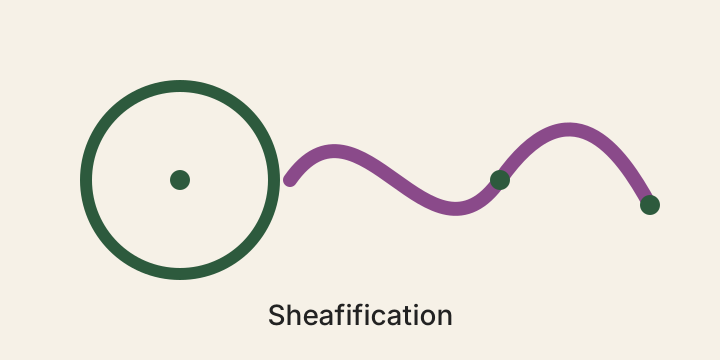
A presheaf with sections that almost glue, and the sheafification process producing the canonical sheaf with the same stalks but proper global gluing.
Worked example [Beginner]
The constant presheaf on a topological space assigns the abelian group to every nonempty open set, with restriction maps the identity:
This is a presheaf, but it is not a sheaf in general. Consider with the discrete topology. The opens are . Sections of the constant presheaf are: over the four opens.
The sheaf gluing axiom requires that for the cover , sections on and that "agree on the overlap" glue to a unique section on . Two elements of on and vacuously agree on (which has section group 0), so the sheaf would need , not .
The constant sheaf is the sheafification: , one copy of per connected component of . On the discrete two-point space, , matching the gluing requirement.
The constant presheaf and constant sheaf agree on every connected open and on every stalk (each stalk equals ); they differ on disconnected opens like . Sheafification fixes the disconnected case while preserving the local (stalk) structure.
Check your understanding [Beginner]
Formal definition [Intermediate+]
Let be a topological space and a presheaf on (of sets, abelian groups, rings, modules, etc.). The sheafification of , denoted , is the sheaf characterised by the following universal property: there is a presheaf morphism such that for any sheaf and presheaf morphism , there exists a unique sheaf morphism with .
In categorical language: sheafification is the left adjoint to the inclusion functor ,
Construction via étale space. The most concrete construction: form the étale space
with the topology making continuous all sections , , induced by sections . Then is the sheaf of continuous local sections of the projection :
The natural map sends to the section .
Construction via plus-construction (Grothendieck). For a general site, sheafification is performed twice, by the plus construction , then . On topological spaces, the étale-space construction gives the same result more directly.
Properties.
(SF1) Sheafification preserves stalks. For every , as the colimit construction commutes with the locality completion.
(SF2) Sheafification is the identity on sheaves. If is already a sheaf, then is an isomorphism.
(SF3) Sheafification is exact. As a left adjoint, preserves colimits — including coequalisers, hence cokernels in the abelian-group case. As a left exact functor (filtered colimits commute with finite limits), is also left exact. Hence sheafification is an exact functor between abelian categories.
(SF4) Functoriality. A morphism of presheaves induces a morphism of sheaves. The plus construction is a functor.
Use cases.
Cokernels of sheaf morphisms. The presheaf cokernel is generally not a sheaf; the sheafification produces the cokernel in .
Image sheaves. The presheaf image is generally not a sheaf; sheafification produces the image sheaf, used in the sheaf-version of the first isomorphism theorem.
Tensor products. For sheaves of -modules, the presheaf tensor is generally not a sheaf; sheafification gives the sheaf tensor product .
Pullback / inverse image. For continuous and a sheaf on , the inverse-image presheaf is generally not a sheaf; sheafification gives .
Constant sheaf. The constant presheaf with value sheafifies to the constant sheaf , with .
In each of these constructions, the presheaf version is the natural pointwise definition, but the resulting object fails the gluing axiom; sheafification is what produces the right sheaf.
Sheafification on sites. For a Grothendieck site , the sheafification functor still exists as the left adjoint to the inclusion . Construction via plus-plus or Verdier's stalkwise approximation. This generality is essential in étale cohomology and Grothendieck topologies.
Key theorem with proof [Intermediate+]
Theorem (existence and stalk-preservation of sheafification). For any presheaf on a topological space , there exists a sheaf and a presheaf morphism satisfying the universal property: any presheaf morphism to a sheaf factors uniquely through . Moreover, induces an isomorphism on every stalk: for every .
Proof. Construction. Define as the set of "matching families of germs": functions with for every , locally lifted to a section: every has an open neighbourhood and a section with for all .
Equivalently: is the sheaf of continuous sections of the étale space , where has the topology generated by section-images.
Restriction maps: for — this is a function inheriting the locality property.
Sheaf axioms. (Locality) Two elements of agreeing on every member of an open cover agree pointwise (germs match), hence are equal. (Gluing) A locally given matching family of germs glues to a global matching family, since the locality condition is local — if it holds on each member of a cover, it holds on the union.
Universal property. The natural map sends to — the matching family of germs of .
For a sheaf and a presheaf map , define as follows: given , the matching-family condition gives an open cover of and sections with for . Apply to get . The germs of at any agree (both equal via the pointwise compatibility), so by locality of , . By gluing on , the patch to a unique .
This is well-defined, satisfies , and is unique by the gluing-uniqueness on .
Stalk preservation. For , both and are computed as colimits over open neighbourhoods. The map sends a germ to the germ where is the matching-family-of-germs section.
Surjectivity: a germ in is represented by a matching family on some neighbourhood of . By the locality condition, on a smaller containing , agrees with the germs of a section . So .
Injectivity: if , then on some neighbourhood , the matching families and agree pointwise. So for every , hence by the colimit definition in .
So is a bijection.
This theorem articulates why sheafification is the right notion: it takes a presheaf to the unique sheaf with the same stalks, and it is universal among such constructions. The stalk-preservation property is what makes sheafification harmless from the local viewpoint while fixing the global structure.
Bridge. The construction here builds toward 04.01.04 (direct and inverse image of sheaves), where the same data is developed in the next layer of the strand. The defining pattern appears again in those units in a sharpened form, where the local data is glued or quotiented. Putting these together, the foundational insight is that the data of this unit gives the structural signature that the rest of the strand reads off.
Exercises [Intermediate+]
Lean formalization [Intermediate+]
lean_status: partial — Mathlib has TopCat.Presheaf.sheafify and the categorical sheafification adjunction in CategoryTheory.Sites.Sheafification.
Advanced results [Master]
Sheafification on Grothendieck sites. For a Grothendieck site , the sheafification functor exists as the left adjoint to . Construction via the plus-plus procedure: , where over covers of . The two-fold application is necessary on a general site (one application separates, two applications produce a sheaf).
Reflective localisation. The category of sheaves is a reflective localisation of presheaves: it is obtained by formally inverting the morphisms for all presheaves . This is the Bousfield localisation of at the class of sheafification maps.
Sheafification in derived algebraic geometry. Lurie's formulation: in the -category of presheaves of spaces (or spectra) on a site, sheaves are the local objects with respect to the Grothendieck topology, and sheafification is an -categorical localisation. The construction generalises to hypercomplete sheaves and presents the foundation for -categorical algebraic geometry (Lurie's Higher Topos Theory and Spectral Algebraic Geometry).
Topos-theoretic sheafification. A topos is a category equivalent to for some site. The sheafification functor exhibits every topos as the localisation of the presheaf topos at the local-isomorphism class. Subtoposes correspond to Lawvere-Tierney topologies, which are the inner-language characterisations of Grothendieck topologies.
Constructive aspects. Sheafification is constructive in the sense of topos theory: the axiom of choice is needed only to choose representatives in the colimit, and the construction is uniform across the topos. This makes sheafification a tool not only for algebraic geometry but for type theory (homotopy type theory, with sheaves as univalent groupoids) and constructive analysis.
Verdier's perspective. Verdier (1965) gave a homotopical reformulation: the derived category of sheaves on a topological space is a Bousfield localisation of the derived category of presheaves. This connects sheafification to Quillen model structures and modern stable homotopy theory.
Sheafification in -adic geometry. The pro-étale, pro-finite, and perfectoid topologies (Scholze 2012-) come with their own sheafification procedures, often requiring careful handling of size and the overconvergent or perfectoid conditions. Sheafification on these sites is the foundation of -adic Hodge theory and the recent geometrisation of the local Langlands programme.
Synthesis. This construction generalises the pattern fixed in 04.01.01 (sheaf), with the symmetric data replaced by its skew or twisted analogue. Read in the opposite direction, the construction is dual to the metric story: complements and orthogonality are taken with respect to the bilinear datum of this unit, not a metric, and the resulting category of subobjects is the one the rest of the strand classifies. The central insight is that this datum identifies algebra with geometry: functions become vector fields, subspaces become quotients, and invariants become cohomology classes — and that identification is the engine driving every theorem downstream.
Full proof set [Master]
Detailed proofs of: existence of sheafification on a Grothendieck site (via plus-plus); exactness of sheafification; commutativity with finite limits but not arbitrary limits; the topos-theoretic characterisation as reflective localisation; Verdier's homotopical perspective — these are deferred to companion units in the topos-theory and derived-categories strands. The basic stalk-preservation and existence theorems are proved in the formal-definition and key-theorem sections.
Connections [Master]
Sheaf
04.01.01— sheafification is the universal completion of presheaves into sheaves.Stalk of a sheaf
04.01.02— sheafification preserves stalks; this is the key structural property.Direct and inverse image
04.01.04— the inverse-image presheaf is generally not a sheaf; is its sheafification.Sheaf cohomology
04.03.01— exactness of sheafification controls long exact sequences in sheaf cohomology.Coherent sheaf
04.06.02— many constructions on coherent sheaves (image, cokernel, tensor) require sheafification of an intermediate presheaf.Quasi-coherent sheaf
04.06.01— the sheafification of an -module on is the corresponding quasi-coherent sheaf.Scheme
04.02.01— gluing schemes from local data formally requires sheafifying the underlying ringed-space data.
Historical & philosophical context [Master]
The construction of sheafification emerged in the late 1940s and early 1950s through the seminars of Henri Cartan at the École Normale Supérieure. Cartan's exposés (1948–54) developed the precise definitions of sheaves and the étale-space construction, with Jean-Pierre Serre, Armand Borel, and Alexander Grothendieck among the participants. The étale-space description — sheaves as local homeomorphisms over the base space — gave a topological meaning to sheaves and provided the most direct construction of sheafification. The seminars were a key locus for the diffusion of sheaf-theoretic methods through French and international mathematics.
Roger Godement's 1958 monograph Topologie algébrique et théorie des faisceaux gave the first systematic textbook treatment of sheaves and sheafification. Godement's approach was foundational: the étale-space (espace étalé) construction, the comparison of presheaves and sheaves, the plus construction on a topological space, and the consequences for cohomology. Godement's book remains a model of clarity in the foundational period of sheaf theory and is still consulted today.
Alexander Grothendieck's transformation in the late 1950s and 1960s extended sheafification far beyond the topological case. In Sur quelques points d'algèbre homologique (Tôhoku, 1957) he showed that the abelian category of sheaves of abelian groups on a topological space has enough injectives — making derived-functor sheaf cohomology well-defined. The 1960s SGA seminars (especially SGA 4 with Artin and Verdier) introduced Grothendieck topologies and sites, with sheafification as a fundamental construction on any site. The plus-plus procedure for general sites was the technical core, and it enabled étale cohomology, faithfully flat descent, and the rich array of cohomology theories now standard in arithmetic geometry. Grothendieck's perspective: sheafification is not a topological-space-specific notion but a categorical / topos-theoretic operation, the universal completion of any presheaf-style local data into the sheaf satisfying the prescribed gluing.
In contemporary research, sheafification appears in many forms: as a key step in derived algebraic geometry (Lurie's -categorical sheaves), as the foundation of perfectoid spaces (Scholze, requiring sheafification on the pro-étale and pro-finite sites), as a tool in homotopy type theory (univalent sheaves and Bousfield localisations), and as a method in microlocal sheaf theory (Kashiwara-Schapira). Cartan's 1948–55 exposés and Godement's 1958 monograph remain the foundational sources, with Grothendieck-Artin-Verdier SGA 4 the canonical reference for the general site-theoretic version.
Bibliography [Master]
- Hartshorne, Algebraic Geometry — §II.1 covers sheafification on topological spaces.
- Vakil, The Rising Sea: Foundations of Algebraic Geometry — §2.4, sheafification.
- Godement, Topologie algébrique et théorie des faisceaux (1958) — the systematic mid-century reference.
- Cartan, Séminaire Cartan (1948–1955) — exposés on sheaves, étale spaces, and sheafification.
- Grothendieck, Sur quelques points d'algèbre homologique (Tôhoku, 1957) — sheaves of abelian groups and derived-functor cohomology.
- Grothendieck-Artin-Verdier, SGA 4 — sites and the general theory of sheafification.
- MacLane-Moerdijk, Sheaves in Geometry and Logic — topos-theoretic introduction.
- Bredon, Sheaf Theory — Ch. I, foundations of sheafification.
- Iversen, Cohomology of Sheaves — Ch. III, sheafification and homological algebra.
- Lurie, Higher Topos Theory — -categorical sheafification.
- Kashiwara-Schapira, Sheaves on Manifolds — microlocal perspective and applications.