Direct and inverse image of sheaves
Anchor (Master): Hartshorne §II; Iversen *Cohomology of Sheaves*; Kashiwara-Schapira *Sheaves on Manifolds*; Grothendieck *Tôhoku* 1957
Intuition [Beginner]
Given a continuous map between topological spaces, sheaf data on one space transports to the other in two natural ways:
Direct image (pushforward) : takes a sheaf on and produces a sheaf on by remembering the sections over preimages. Formally, for an open .
Inverse image (pullback) : takes a sheaf on and produces a sheaf on by germ pullback. The stalks at equal the stalks of at .
Together these form an adjoint pair: . Inverse image is the left adjoint, direct image the right adjoint. This adjunction expresses the universal compatibility between sheaf data on and sheaf data on relative to the map .
Direct and inverse image are everywhere in algebraic and analytic geometry: every morphism of varieties, every covering, every fibration, every embedding induces these functors on sheaves. The Leray spectral sequence computes cohomology of from cohomology of and the right-derived pushforwards . Grothendieck's six-functor formalism (the four functors together with derived tensor product and internal Hom) generalises this picture to derived categories and is the foundational language of modern sheaf theory.
Visual [Beginner]
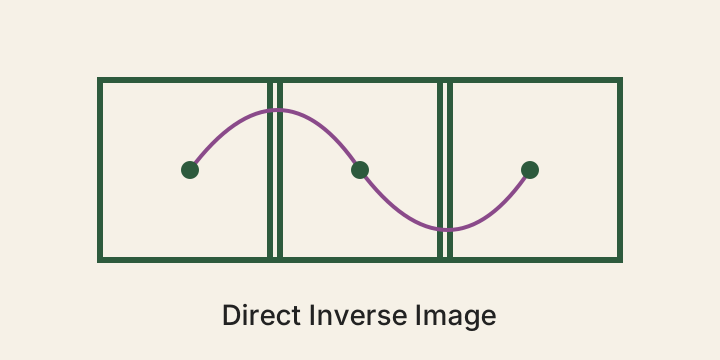
A continuous map between two spaces, with sheaf data being transported along the map: pushforward sends data on the source to data on the target via preimage; pullback sends data on the target to data on the source via stalk-pullback.
Worked example [Beginner]
Let be the squaring map , and consider as a continuous map (with the standard topology).
Pushforward. Take the sheaf of continuous real-valued functions on (the source). Its pushforward on (the target) has
For with , — two intervals. So pairs of continuous functions, one on each interval. The sheaf has more sections downstairs (on the target) than upstairs (on the source intervals individually) — pushforward records the multi-valued nature of the squaring map.
Pullback. Take the constant sheaf on the target . Its pullback to the source is again the constant sheaf on the source — pullback of constant sheaves is constant. More generally, the stalk of at equals the stalk of at — pullback "pulls germs back along ."
For the source embedded in by , the pullback of a sheaf on is a sheaf on the one-point space — equivalently, the stalk . Pullback to a point gives the stalk at that point, recovering local information.
Check your understanding [Beginner]
Formal definition [Intermediate+]
Let be a continuous map of topological spaces.
Direct image. For a presheaf (or sheaf) on , the direct image on is the presheaf
If is a sheaf, is automatically a sheaf (the sheaf axioms are preserved by preimage of open covers). defines a functor .
Inverse image (presheaf version). For a presheaf on , the inverse image presheaf on is
This presheaf is not generally a sheaf (the colimit construction does not preserve gluing).
Inverse image (sheaf version). For a sheaf on , the inverse image on is the sheafification of the inverse-image presheaf:
defines a functor .
Stalk computation. For every ,
The pullback functor recovers the "stalk at " pointwise; this is the defining stalk-functoriality property of .
Adjunction. is left adjoint to :
The unit and counit give the standard adjoint structure.
Pullback for sheaves of -modules. If and are ringed spaces with structure sheaves , and is a morphism of ringed spaces (so has a natural map to ), the -module pullback is
This is left adjoint to on -modules:
Properties.
(DI1) Composition. For and , and .
(DI2) is exact. Filtered colimits commute with finite limits, so the inverse-image presheaf is exact, and sheafification preserves exactness.
(DI3) $f_f^{-1}(V)f_*$ preserves limits but only finite ones in general.
(DI4) Right derived functors $R^i f_f_*R^i f_*\mathcal{F}XR^i f_* \mathcal{F}V \mapsto H^i(f^{-1}(V); \mathcal{F})$.
(DI5) Leray spectral sequence. For and on ,
Cohomology of is computed from cohomology of and the higher direct images.
Examples.
Constant map. For , the global sections as a sheaf on a point (= an abelian group or -module).
Closed immersion. For a closed immersion, is fully faithful — sheaves on embed as sheaves on supported on . The pullback recovers a sheaf on restricted to .
Open inclusion. For an open inclusion, is just restriction , while is "extension by sections" (typically not extension by zero — that is the exceptional inverse image on the lower-shriek side).
Smooth fibration. For a fibration with fibres , — the local system of cohomologies of the fibre. The Leray spectral sequence reads as the classical Leray-Serre spectral sequence of a fibration.
Étale morphism. For étale (local homeomorphism), commutes with stalks at every point (no sheafification needed beyond the presheaf colimit), and is well-behaved on étale sheaves — foundational for étale cohomology.
Key theorem with proof [Intermediate+]
Theorem (adjunction ). For a continuous map and sheaves on , on , there is a natural bijection
Proof. Construction of the bijection on presheaves. For the inverse-image presheaf , we exhibit a natural bijection at the presheaf level, then extend to sheaves via sheafification.
Given a presheaf morphism in , define a presheaf morphism in as follows. For open,
A class is represented by open in and . Define
where and , so we can restrict to .
This is well-defined (independent of representative in the colimit class) and natural in . So gives a map
The inverse direction: given , define by sending to — using that , so .
Verification: these two assignments are inverse to each other and natural in both . So we get
Extension to sheaves. For a sheaf, the right-hand side equals by the universal property of sheafification (presheaf maps from to a sheaf factor uniquely through the sheafification ).
Combining: for a sheaf on and a sheaf on ,
the last equality because is automatically a sheaf when is.
This adjunction is the formal core of the six-functor formalism: the basic functorial relation between sheaf data on and on relative to . All later refinements (right-derived , exceptional inverse , Verdier duality) build on this foundation.
Bridge. The construction here builds toward 04.02.04 (morphism of schemes), where the same data is developed in the next layer of the strand. The defining pattern appears again in those units in a sharpened form, where the local data is glued or quotiented. Putting these together, the foundational insight is that the data of this unit gives the structural signature that the rest of the strand reads off.
Exercises [Intermediate+]
Lean formalization [Intermediate+]
lean_status: partial — Mathlib has TopCat.Presheaf.pushforward and TopCat.Sheaf.pullback with the basic adjunction; the full six-functor derived formalism is partially formalised.
Advanced results [Master]
Right-derived pushforward . The functor is left exact but generally not right exact. Its right-derived functors measure the failure: is the sheafification of the presheaf . The total derived functor on the derived category of bounded-below complexes is the natural object.
Leray spectral sequence. . Foundational tool for computing sheaf cohomology of from sheaf cohomology of and the higher direct images. Special cases: Leray-Serre spectral sequence for fibrations; Künneth formula for products.
Proper base change. For a proper morphism and a Cartesian square with base change , where is the pullback morphism. Proper base change holds for proper and arbitrary — a key technical tool in étale cohomology and the proof of the Weil conjectures.
Smooth base change. For smooth and locally constant sheaves, similar base change identities hold. Combined with proper base change, these make the six-functor formalism well-behaved on quasi-projective morphisms.
Verdier duality. For a "nice" morphism (e.g., locally compact Hausdorff with finite cohomological dimension, or a finite-type morphism of Noetherian schemes), there is an exceptional inverse image right adjoint to (proper pushforward / direct image with compact support). For proper, , and Verdier duality
generalises Poincaré duality, Serre duality, and Grothendieck's coherent duality.
Constructible sheaves. On a stratified topological space , constructible sheaves are sheaves locally constant on each stratum. The six functors preserve constructibility for stratifications-respecting morphisms. Beilinson-Bernstein-Deligne's Faisceaux Pervers (1982) developed the theory of perverse sheaves — a heart of a -structure on the constructible derived category — leading to intersection cohomology and the Hodge-theoretic decomposition theorem.
-modules. On a smooth variety, the Riemann-Hilbert correspondence (Kashiwara, Mebkhout) identifies derived constructible sheaves with derived -modules. The six functor formalism transfers, and the geometric Langlands programme is formulated in this language.
-categorical six functors. Lurie's Higher Algebra and the Gaitsgory-Rozenblyum approach formulate the six functor formalism at the -categorical level, with full coherence data. This is the foundation of derived algebraic geometry and modern arithmetic geometry (perfectoid spaces, prismatic cohomology, motivic homotopy theory).
Synthesis. This construction generalises the pattern fixed in 04.01.01 (sheaf), with the symmetric data replaced by its skew or twisted analogue. Read in the opposite direction, the construction is dual to the metric story: complements and orthogonality are taken with respect to the bilinear datum of this unit, not a metric, and the resulting category of subobjects is the one the rest of the strand classifies. The central insight is that this datum identifies algebra with geometry: functions become vector fields, subspaces become quotients, and invariants become cohomology classes — and that identification is the engine driving every theorem downstream.
Full proof set [Master]
Detailed proofs of: the adjunction (sketched above), the Leray spectral sequence (sketched in Exercise 6), proper base change, Verdier duality, the constructible-sheaf six functor formalism — these are deferred to companion units in the sheaf-cohomology, derived-categories, and étale-cohomology strands. The basic adjunction is proved in the key-theorem section.
Connections [Master]
Sheaf
04.01.01— direct and inverse image are functors between sheaf categories.Stalk of a sheaf
04.01.02— pullback computes stalks: .Sheafification
04.01.03— the inverse-image sheaf is the sheafification of the inverse-image presheaf.Sheaf cohomology
04.03.01— the Leray spectral sequence computes from .Scheme
04.02.01— every morphism of schemes has direct and inverse image functors on sheaves.Morphism of schemes
04.02.04— direct/inverse image is foundational data of a morphism.Coherent sheaf
04.06.02— the question of when preserves coherence (proper morphisms by Grothendieck) is a central theorem.Quasi-coherent sheaf
04.06.01— quasi-coherence is preserved by for quasi-compact-quasi-separated morphisms; by always.
Historical & philosophical context [Master]
The systematic introduction of direct and inverse image of sheaves dates to Alexander Grothendieck's 1957 paper Sur quelques points d'algèbre homologique, published in the Tôhoku Mathematical Journal — known universally as Tôhoku. This paper revolutionised homological algebra and sheaf theory: it introduced abelian categories with enough injectives, established that the category of sheaves of abelian groups on a topological space is such a category, and developed the systematic theory of right-derived functors. The pushforward and pullback for sheaves on topological spaces are introduced in Tôhoku as the basic functorial relations between sheaf categories under continuous maps, with the adjunction established in full generality. Tôhoku also outlined the higher-direct-image and what would become the Leray spectral sequence, generalising Leray's 1946 original construction.
The earlier history is worth noting. Jean Leray, in his 1946 introduction of sheaves while imprisoned at Oflag XVII-A, developed an early form of pushforward — his "spectral sequence of a continuous map" — but in the implicit language of cohomology theories. Henri Cartan's seminars (1948–54) made the constructions precise on topological spaces. Grothendieck's 1957 Tôhoku unified the theory in the categorical language of right-derived functors and made the adjunction structural rather than ad-hoc.
The 1960s saw the major extensions. Grothendieck's Éléments de Géométrie Algébrique (EGA, 1960–67) developed direct and inverse image for sheaves on schemes, with technical hypotheses (quasi-compact-quasi-separated for to preserve quasi-coherence) made precise. The Séminaire de Géométrie Algébrique (SGA, 1960s) — especially SGA 4 with Artin and Verdier — extended the formalism to Grothendieck topologies and étale sites, with and on étale sheaves becoming the foundation of étale cohomology. Pierre Deligne's proof of the Weil conjectures (1974) used proper base change and the Lefschetz trace formula in the étale six-functor formalism.
Jean-Louis Verdier's thesis (1965) introduced the exceptional inverse image and Verdier duality, completing the picture into what is now called the six-functor formalism (with and ). Beilinson-Bernstein-Deligne's 1982 Faisceaux Pervers applied this to constructible sheaves and developed perverse sheaves, leading to intersection cohomology and the Hodge-theoretic decomposition theorem. Kashiwara-Schapira's Sheaves on Manifolds (1990) gave the systematic textbook treatment in the manifold setting, with full microlocal refinements.
In contemporary research, direct and inverse image extend in many directions: Lurie's -categorical six functors (foundations of derived algebraic geometry), Scholze's perfectoid six functors (foundations of -adic Hodge theory and the geometrisation of local Langlands), and Voevodsky-Levine's motivic six functors (foundations for arithmetic geometry). The single pair of functors — introduced in Tôhoku as the basic adjunction between sheaf categories under a continuous map — has thus traversed an enormous landscape, from Leray's wartime origin through Grothendieck's categorical revolution to the cutting edge of modern mathematics. Tôhoku itself remains a remarkably readable foundational text and rewards direct study; Iversen's Cohomology of Sheaves and Kashiwara-Schapira's Sheaves on Manifolds are the canonical modern references.
Bibliography [Master]
- Hartshorne, Algebraic Geometry — §II.1 covers direct and inverse image of sheaves on topological spaces; §III for derived functors.
- Vakil, The Rising Sea: Foundations of Algebraic Geometry — §2.6 (pushforward and pullback).
- Grothendieck, Sur quelques points d'algèbre homologique (Tôhoku Mathematical Journal, 1957) — systematic introduction of pushforward, pullback, and their adjunction.
- Iversen, Cohomology of Sheaves — Ch. III, foundational treatment of direct and inverse image.
- Kashiwara-Schapira, Sheaves on Manifolds — Ch. II–III, complete six-functor formalism on manifolds.
- Verdier, "Catégories dérivées" (1965) — exceptional inverse image and Verdier duality.
- Beilinson-Bernstein-Deligne, Faisceaux Pervers (Astérisque 100, 1982) — six functors on constructible sheaves.
- Grothendieck-Artin-Verdier, SGA 4 — six functors on étale sites.
- Deligne, La conjecture de Weil II (1980) — proof of the Weil conjectures using six-functor methods.
- Lurie, Higher Topos Theory and Higher Algebra — -categorical six functors.
- Gaitsgory-Rozenblyum, A Study in Derived Algebraic Geometry — modern -categorical foundations.