Smooth, étale, and unramified morphisms
Anchor (Master): Grothendieck-Dieudonné EGA IV §17 (étale and smooth morphisms); Grothendieck SGA 1 (étale fundamental group); Milne *Étale Cohomology* Ch. I; Stacks Project Tag 03PC, 02G1, 02GE; Lurie *Spectral Algebraic Geometry* §11
Intuition [Beginner]
When you study a map between geometric spaces, three "good" behaviours stand out: the map can locally look like a projection (image is full-dimensional, fibres carry extra freedom), like a covering (each point of the target has a finite set of preimages, all behaving the same way), or like an embedding into nearby fibres (preimages are isolated and live cleanly inside the source). In algebraic geometry these three behaviours become three precise classes of morphisms: smooth, étale, and unramified.
A smooth morphism is the algebraic-geometric counterpart of a submersion in differential geometry. Pick a smooth point upstairs, and the map looks locally like adding free coordinates to the base — the fibres are smooth varieties of fixed dimension. A covering map of topological spaces becomes an étale morphism when one asks for the algebraic version of "local diffeomorphism." Étale is "smooth and zero-dimensional" — the fibres are finite and disconnected after passing to an algebraic closure, exactly the algebraic shadow of a covering map. Unramified is the weakest of the three: it forbids fibre points from sticking together with multiplicity but allows the morphism to be skinnier than the base would suggest.
The whole power of the étale story is that Zariski topology is too coarse to detect covering maps in algebraic geometry. The squaring map on the complex line is a 2-to-1 cover away from the origin — but no Zariski-open neighbourhood of in the source maps isomorphically to any Zariski-open in the target. Étale-locally, however, this is a perfectly nice covering map, because étale covers play the role of small open sets in the étale topology.
Visual [Beginner]
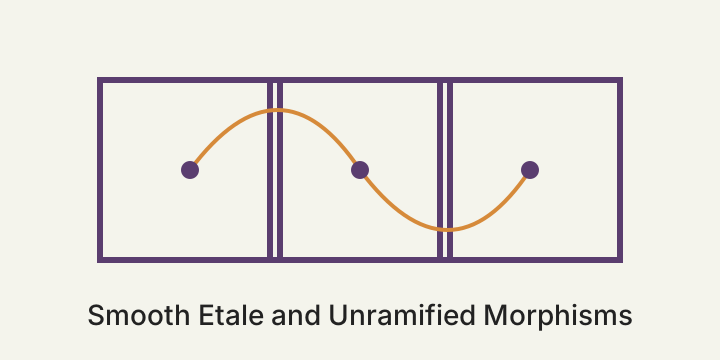
Three side-by-side morphisms over a base: a smooth morphism whose fibres are smooth varieties of positive dimension, an étale morphism whose fibres are finite reduced schemes, and an unramified morphism whose source sits as a closed subset of an étale cover.
Worked example [Beginner]
Take the map that sends , in characteristic different from 2. Geometrically this is the parabola projecting to the -axis. Above each in the base, you find two preimages — the two square roots — and these two preimages are clean separate points. Above there is exactly one preimage, , but the algebraic structure remembers it as a double point: the local fibre ring is , which has a non-zero nilpotent.
This is the typical picture. Away from the origin the map is a clean 2-to-1 cover and is étale. At the origin the fibre is the non-reduced double point, and the map is ramified there. The differential on the source pulls back to , which vanishes exactly at . So the module of relative Kähler differentials is non-zero at the origin and zero elsewhere; the map is étale away from the origin and ramified at the origin.
A second example, same spirit. The -th power map , , sends each non-zero scalar to its -th power. Over a field where is invertible — say , — every point of the target has distinct preimages and the map is étale. Over a field where is not invertible — say , — the map collapses the preimages to one with multiplicity, and the differential becomes identically zero. The map is purely inseparable and ramified everywhere. Slogan: étale = "covering map you can detect by computing the Jacobian, and the answer is non-zero in the right characteristic."
What this tells us: the three classes carve up the rough geometric content of a map into a clean trichotomy. Smooth is "fibres of correct dimension and regular." Étale is "smooth of relative dimension zero." Unramified is "fibres are finite reduced and the residue extensions are separable." The differential is the indicator: it measures how far the map is from being unramified.
Check your understanding [Beginner]
Formal definition [Intermediate+]
Let be a morphism of schemes, locally of finite type. Three local properties of at a point with organise into a tightly linked family.
Definition (unramified). The morphism is unramified at if it is locally of finite type and the relative cotangent stalk vanishes there:
Equivalently, as ideals of , and the residue field extension is finite separable. The morphism is unramified if it is unramified at every .
Definition (smooth). The morphism is smooth at if it is locally of finite presentation, flat at , and the geometric fibre is regular at the point above . The relative dimension of at is the dimension of at . The morphism is smooth of relative dimension if it is smooth at every point with relative dimension .
Definition (étale). The morphism is étale at if it is smooth of relative dimension at , equivalently if it is flat, locally of finite presentation, and unramified at . The morphism is étale if étale at every point.
Cotangent characterisation of smoothness. Suppose is locally of finite presentation and flat at . Then is smooth of relative dimension at if and only if is locally free of rank in a neighbourhood of (Grothendieck-Dieudonné EGA IV.17.5.1). Specialising to : is étale at if and only if is flat, locally finitely presented, and .
Jacobian criterion. Suppose locally on the source is presented as . Form the Jacobian matrix
evaluated at the point . Then is smooth at of relative dimension if and only if the rank of over equals . The étale case is and in .
Stability properties. All three classes are stable under composition and base change. They are local on the source, on the target, and étale-local on the target. Open immersions are étale; closed immersions are unramified but rarely flat (hence rarely étale).
Counterexamples to common slips.
- An unramified morphism need not be étale. Closed immersions are unramified, but they fail flatness in general.
- Bijectivity of points does not imply étale: the Frobenius is a bijection on points, but , so is non-zero and is purely inseparable everywhere.
- Smoothness depends on the geometric fibre. The morphism is locally of finite type and even flat, but the residue extension is purely inseparable, so the geometric fibre is a non-reduced point and the morphism is not smooth.
- Smooth of relative dimension does not imply that is locally a projection from in the Zariski topology — only étale-locally. This is exactly the gap that the étale topology is invented to bridge.
Key theorem with proof [Intermediate+]
Theorem (local structure of unramified morphisms). Let be a morphism locally of finite presentation, and let with . The morphism is unramified at if and only if there exist open neighbourhoods of in and of in with , an étale morphism , and a closed immersion such that .
In words: every unramified morphism factors étale-locally as a closed immersion into an étale cover. This is sometimes called the local étale slice theorem for unramified morphisms.
Proof. Closed immersions are unramified, étale morphisms are unramified, and unramified morphisms compose. So is unramified, and unramifiedness is local on the source, giving unramifiedness at .
Assume is unramified at and locally of finite presentation. Working Zariski-locally we may assume is affine and with for a finitely generated ideal .
Pick generators of . Unramifiedness at means . The conormal sequence
is therefore right-exact with vanishing right-hand term, so the left map is surjective. The middle term is the free -vector space spanned by . Choose among the generators whose differentials form a basis of this vector space at .
Let . The Jacobian matrix is square of size and has non-zero determinant at by choice. By the Jacobian criterion, is étale at the image of .
The remaining generators of vanish on , so the surjection factors through the further quotient by . This presents as a closed subscheme of near . Restricting to a neighbourhood of on which remains étale, and to the preimage of in the closed subscheme of , gives the desired factorisation .
The local structure theorem links unramified morphisms to the more flexible étale class: any unramified morphism is locally a closed-subscheme inclusion inside something étale. Combined with stability under base change, this is the analogue of the implicit function theorem in algebraic geometry. The reference is Grothendieck-Dieudonné EGA IV.18.4.6 [EGA IV §18.4.6] and Stacks Project Tag 04F1 [Stacks Project].
Bridge. The construction here builds toward 04.08.01 (sheaf of differentials), where the cotangent module receives its global incarnation, and appears again in 04.04.02 (Hurwitz formula) in a sharpened form, where the étale locus is exactly the unramified locus of a non-constant cover and the ramification divisor is supported on its complement. Putting these together, the data of an unramified-at- point is the structural signature that the rest of the strand reads off when classifying covers, computing duality, or stratifying singular loci.
Exercises [Intermediate+]
Lean formalization [Intermediate+]
lean_status: none — Mathlib has the commutative-algebra side (RingHom.Smooth, RingHom.Etale, RingHom.Unramified, RingHom.FormallySmooth, KaehlerDifferential), but the scheme-level morphism predicates and the EGA IV.17 equivalences are not yet assembled.
Advanced results [Master]
Cotangent and conormal sequences. For and a closed immersion with smooth over , the conormal sequence
becomes a four-term exact sequence
precisely when is smooth over . The conormal sheaf is then locally free of rank equal to the codimension of in , and the sequence is the algebraic-geometric Gauss formula relating the cotangent, the ambient cotangent, and the conormal.
Formal smoothness, étaleness, unramifiedness. A morphism is formally smooth (resp. étale, unramified) if for every affine -scheme and square-zero ideal , the lifting map is surjective (resp. bijective, injective). EGA IV.17.1.1 and IV.17.3.1 establish that formal smoothness plus locally of finite presentation equals smoothness; same for étale and unramified with finite type sufficing for unramified.
Cotangent complex. The right derived enrichment of is the cotangent complex , an object of the derived category of -modules. Smoothness of is equivalent to being concentrated in degree and locally free; étaleness is the same with rank , hence in the derived category. The cotangent complex is the definitive object for measuring deformation-theoretic obstructions, and the smooth/étale/unramified trichotomy is the degree-0 truncation of a richer derived picture (Illusie, Complexe cotangent et déformations I–II, 1971–72).
Étale fundamental group. For a connected scheme with a geometric point , the étale fundamental group is the automorphism group of the fibre functor
where is the category of finite étale covers of . The group is profinite, and the fibre functor sets up an equivalence
between finite étale covers and finite continuous -sets. This is Grothendieck's Galois theory of schemes (SGA 1 Exposé V).
Comparison with topological . When is a smooth complex variety, the analytification is a complex manifold and carries a topological fundamental group . The étale fundamental group is the profinite completion:
This is the Riemann existence theorem in higher dimensions (SGA 1 Exposé XII). For curves it specialises to the classical fact that finite étale covers of a complex Riemann surface correspond to finite-index subgroups of the topological .
Henselisation and strict henselisation. The étale-local ring at a point with residue field is the henselisation — the inductive limit of over étale neighbourhoods with . Replacing by its separable closure gives the strict henselisation , the étale-local stalk in the étale topology. Hensel's lemma holds in , and many computations that fail Zariski-locally succeed in the henselisation — this is the algebraic substitute for "shrinking to a small open ball."
Kunz's theorem. A noetherian local ring of characteristic is regular if and only if the Frobenius , , is flat (Kunz 1969, American J. Math. 91). This characterises regularity in characteristic via the failure-to-be-étale of Frobenius: regular rings are exactly those where Frobenius behaves "as well as algebraically possible" without ever being étale. Kunz's theorem is a foundational input to tight closure theory and to -singularities in commutative algebra.
Smoothness in the derived setting. In Lurie's Spectral Algebraic Geometry, smooth morphisms of derived schemes are defined by the formal-smoothness condition along simplicial-commutative-ring extensions, and the cotangent complex characterisation continues to hold. Étaleness in the spectral setting recovers the classical étale topology on classical schemes, and the étale site of a derived scheme is the étale site of its underlying classical scheme. The framework extends to -rings and prismatic schemes, where smoothness and étaleness become structural axioms in higher-categorical algebraic geometry.
Synthesis. This unit organises three local conditions on a morphism into a coherent trichotomy: étale = smooth of relative dimension zero = flat + locally finitely presented + unramified, and unramified is the cotangent-stalk-vanishing condition that detects when fibres are finite reduced and residue extensions separable. Read in the opposite direction, the trichotomy is dual to the deformation story: a smooth morphism lifts every infinitesimal thickening, an étale morphism lifts each thickening uniquely, an unramified morphism lifts each thickening at most once. The construction generalises the pattern fixed in 04.02.04 (morphism of schemes), with the relative cotangent sheaf replacing the bare local-ring map as the carrier of structural information, and the local étale slice theorem identifies the étale topology as the natural site for covering-space arguments in algebraic geometry. The defining trichotomy appears again in 04.04.02 (Hurwitz formula) for finite covers of curves and in 04.08.01 (sheaf of differentials) for the global cotangent calculus. The central insight is that étaleness is the algebraic-geometric incarnation of "local diffeomorphism," and the étale fundamental group is the Galois group of the universal cover in this generalised sense.
Full proof set [Master]
The local structure theorem for unramified morphisms is proved in the key-theorem section above. Detailed proofs of the cotangent-rank equivalence (smooth ⟺ locally free of rank = relative dimension), the formal-smoothness criterion, the Jacobian criterion in its full EGA IV.17 generality, the Galois correspondence for finite étale covers, and the comparison theorem with topological are deferred to companion units in the étale-cohomology and deformation-theory strands. Stated without proof — see Grothendieck-Dieudonné EGA IV §17 for the equivalences, SGA 1 Exposé V for the Galois correspondence, and SGA 1 Exposé XII for Riemann existence.
Connections [Master]
Morphism of schemes
04.02.04— smooth, étale, and unramified are properties of morphisms in the EGA IV classification; this unit specialises the general framework of morphism properties to the three local-Jacobian conditions.Sheaf of differentials
04.08.01— the relative cotangent sheaf is the technical engine: unramifiedness is its stalkwise vanishing, smoothness of relative dimension is its local-freeness of rank , and étaleness is the rank-zero locally-free case.Hurwitz formula
04.04.02— for a non-constant morphism of smooth projective curves, the étale locus is the unramified open complement of the ramification divisor, and the Hurwitz formula computes the genus of the source from the degree, the genus of the target, and the ramification contributions.Branched coverings of Riemann surfaces
06.02.02— finite étale covers of a Riemann surface viewed as a smooth curve over are exactly the unbranched coverings in the topological sense, and the étale fundamental group of the curve is the profinite completion of the topological of the underlying surface.Sheaf cohomology
04.03.01— étale cohomology, defined via the étale topology generated by étale morphisms, is the algebraic counterpart of singular cohomology with finite coefficients and is foundational for the Weil conjectures.
Historical & philosophical context [Master]
The Jacobian criterion for smoothness is classical: it appears in 19th-century algebraic and projective geometry as the rank condition that distinguishes smooth points of a variety from singular ones. The Auslander-Buchsbaum-Serre regularity criterion of 1956–58 (Auslander-Buchsbaum 1957, Trans. AMS 85; Serre 1956, Tokyo-Nikko proceedings) characterised regular local rings as those of finite global homological dimension, and gave the homological-algebra foundation on which a clean algebraic-geometric notion of smoothness could be built. Before this, "non-singular" was defined by the Jacobian rank condition for an embedded variety, with no intrinsic-ring-theoretic counterpart.
Alexander Grothendieck and Jean Dieudonné assembled the modern theory in Éléments de Géométrie Algébrique IV (1965–67), particularly §17 on smooth and étale morphisms and §18 on unramified morphisms. The treatment is uniform: smooth, étale, and unramified are all defined via formal lifting properties along nilpotent thickenings, and the equivalences with the cotangent-sheaf criteria and the Jacobian criterion are theorems within this framework. EGA IV.17 establishes the structural facts (composition, base change, locality, openness of the smooth locus); EGA IV.18 gives the local structure theorem for unramified morphisms used in the key-theorem section above.
The étale topology and the étale fundamental group were introduced in Séminaire de Géométrie Algébrique du Bois-Marie 1960–61 (SGA 1), specifically Exposés I–V, where Grothendieck developed the categorical Galois theory of schemes. The fibre functor on finite étale covers, the equivalence with continuous group actions of , and the comparison with topological for complex varieties (Riemann existence in higher dimensions, SGA 1 Exposé XII) are all in SGA 1. The étale cohomology framework grew out of this in SGA 4 (1963–64) and was used decisively by Pierre Deligne in his 1974 proof of the Weil conjectures.
Ernst Kunz contributed the characterisation of regularity via Frobenius flatness in characteristic (Kunz 1969, American J. Math. 91), a result that became central to tight-closure theory (Hochster-Huneke) and to the theory of -singularities. Luc Illusie introduced the cotangent complex as the right derived enrichment of in Complexe cotangent et déformations I–II (Springer LNM 239, 283; 1971–72), placing the smooth/étale/unramified trichotomy in its derived-category home. Jacob Lurie extended the framework to derived and spectral algebraic geometry in Spectral Algebraic Geometry (online, 2018), where smooth and étale morphisms of derived stacks are defined and form the backbone of -categorical algebraic geometry.
Bibliography [Master]
- Grothendieck-Dieudonné, Éléments de Géométrie Algébrique IV (EGA IV), Publ. Math. IHÉS 20 (1964), 24 (1965), 28 (1966), 32 (1967). §17 (smooth and étale morphisms); §18 (unramified morphisms; local structure theorem).
- Grothendieck, Séminaire de Géométrie Algébrique du Bois-Marie 1960–61 (SGA 1), Springer LNM 224, 1971. Exposés I–V (étale morphisms and the étale fundamental group); Exposé XII (Riemann existence theorem).
- Auslander-Buchsbaum, Homological dimension in local rings, Trans. AMS 85 (1957), 390–405. Regularity criterion via finite homological dimension.
- Serre, Sur la dimension homologique des anneaux et des modules noethériens, Proceedings International Symposium on Algebraic Number Theory, Tokyo-Nikko (1956), 175–189.
- Kunz, Characterizations of regular local rings of characteristic p, American J. Math. 91 (1969), 772–784. Regularity ⟺ Frobenius flatness.
- Illusie, Complexe cotangent et déformations I–II, Springer LNM 239 (1971), 283 (1972). The cotangent complex.
- Hartshorne, Algebraic Geometry, Springer GTM 52, 1977. §III.10 (smooth morphisms).
- Vakil, The Rising Sea: Foundations of Algebraic Geometry, online manuscript. §12, §21, §25 (smooth/étale/unramified via differentials).
- Görtz-Wedhorn, Algebraic Geometry I, Vieweg, 2010. §6 (Kähler differentials), §16 (smooth, étale, unramified), §18 (étale local structure).
- Milne, Étale Cohomology, Princeton Mathematical Series 33, 1980. Ch. I (étale morphisms and the étale site).
- Lurie, Spectral Algebraic Geometry, online manuscript, 2018. §11 (smooth and étale morphisms of spectral schemes).
- Stacks Project, https://stacks.math.columbia.edu. Tags 03PC (étale), 02G1 (smooth), 02GE (unramified), 04F1 (local structure of unramified), 03PB (formal smoothness).