Hurwitz formula
Anchor (Master): Hurwitz 1891 *Über Riemann'sche Flächen mit gegebenen Verzweigungspunkten* (Math. Ann. 39, originator); Hartshorne §IV.2; Liu §7.4; Donaldson — Riemann Surfaces §6
Intuition [Beginner]
The Hurwitz formula tells you exactly how the genus changes when you wrap one curve around another. Picture a degree- cover — every point of has preimages in , except over a finite set of branch points where two or more sheets collide. The cover is determined locally by maps that look like , and the integer is the ramification index at each upstairs point.
Hurwitz's accounting principle: each ramification point contributes to a global count, and that count rigidly determines the genus of from the genus of , the degree, and the ramification data. There is no slack.
The headline formula on a degree- tame cover of smooth projective curves: , where adds up over all ramification points . Plug in the genus of the base curve and the ramification, read off the genus of the cover.
Visual [Beginner]
A degree- cover of one curve by another is a stack of sheets glued together at branch points. Most points of the base have disjoint preimages; the branch points are where sheets pinch together. The picture below shows three sheets over a base curve with two branch points where two sheets collide.
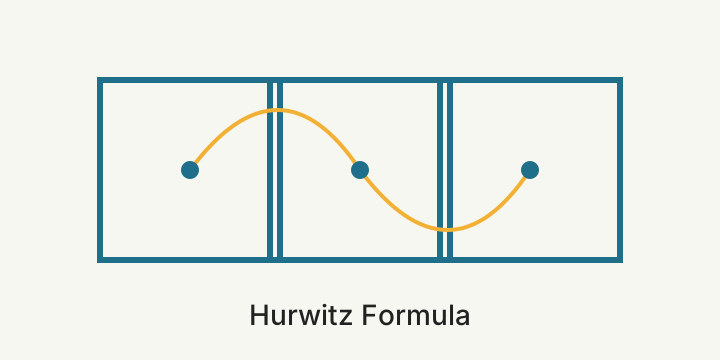
The ramification data — at each upstairs point, how many sheets collide there — is everything Hurwitz needs to read off the genus of the upstairs curve.
Worked example [Beginner]
The cleanest case: the map given by . Both source and target have genus 0. The map has degree . It is ramified at exactly two points: above , where the unique preimage has ramification index (the local model is ), and above , also with index .
Hurwitz: . Plug in , , , and the ramification total :
.
Both sides equal . The formula confirms what we already knew: the -fold cover of branched only at and is itself a copy of .
The takeaway: Hurwitz lets you compute the genus of a cover without ever drawing it, using only the degree and the ramification.
Check your understanding [Beginner]
Formal definition [Intermediate+]
Let be a finite separable morphism of smooth projective curves over an algebraically closed field , of degree . Write for the genera. For a closed point with image , let be a uniformiser at and a uniformiser at .
Definition (ramification index). The ramification index of at is the unique integer with for some unit . Equivalently, where is the discrete valuation at .
The morphism is unramified at iff . Only finitely many points are ramified. The morphism is tame at iff ; wild otherwise. Tameness is automatic in characteristic zero.
Definition (ramification divisor). The ramification divisor of is the effective Weil divisor on $$ R = R_\pi := \sum_{y \in Y} (e_y - 1), y $$ (in the tame case; in the wild case the coefficients are replaced by the order of the different at , see below).
Definition (branch divisor). The branch divisor on is , supported at the points of where has at least one ramified preimage.
The fundamental relation between canonical divisors under pullback is:
Lemma. In the tame case, $\pi^ K_X = K_Y - RY$.*
This is Hartshorne IV.2.3 [Hartshorne §IV.2]. We give the proof in the next section.
Theorem (Hurwitz formula, tame case). For a finite separable tame morphism of smooth projective curves of degree , $$ 2 g_Y - 2 ;=; n (2 g_X - 2) ;+; \deg R ;=; n(2g_X - 2) + \sum_{y \in Y} (e_y - 1). $$
Counter-examples to common slips.
- Forgetting tameness. In characteristic with for some , the formula above fails: the contribution at is the order of the different , which strictly exceeds . The corrected statement reads .
- Confusing branch and ramification divisor. lives on the cover ; lives on the base . The Hurwitz formula uses , not . (Both have the same degree, since preserves degree, but the divisors live on different curves.)
- Inseparable maps. The formula assumes separability of the function-field extension . Purely inseparable maps (only possible in positive characteristic) require a different treatment.
- Non-projective domains. The argument relies on , which uses projectivity of . For affine pieces or open subcurves the formula reformulates as a relation on Euler characteristics.
Key theorem with proof [Intermediate+]
Theorem (Hurwitz formula). Let be a finite separable tame morphism of smooth projective curves over an algebraically closed field , of degree . Then $$ 2 g_Y - 2 ;=; n (2 g_X - 2) ;+; \deg R_\pi. $$
Proof. The argument has two steps: (i) establish as divisor classes on ; (ii) take degrees and use for any divisor on .
Step 1: Pullback of canonical divisors. Choose a meromorphic differential that is non-zero on a Zariski-open subset of . Its pullback is a meromorphic differential on . We compare the divisor of on with the divisor of on .
Local computation. Pick a closed point with , ramification index . Choose a uniformiser at and a uniformiser at such that (tameness lets us absorb the unit factor; in the wild case this normalisation fails). Locally for some with . Then $$ \pi^* \omega ;=; f(u^e) \cdot d(u^e) ;=; e \cdot f(u^e) \cdot u^{e - 1} , du. $$
The factor is a unit at (this is exactly where tameness, , enters). Therefore $$ v_y(\pi^* \omega) ;=; v_y(f(u^e)) + (e - 1) ;=; e \cdot v_x(f) + (e - 1) ;=; e \cdot v_x(\omega) + (e - 1). $$
At an unramified point (), this reduces to .
Globalising. Sum over . The divisor of as a Weil divisor on is $$ (\pi^* \omega) ;=; \sum_{y \in Y} v_y(\pi^* \omega) \cdot y ;=; \sum_y \big[e_y \cdot v_{\pi(y)}(\omega) + (e_y - 1)\big] \cdot y ;=; \pi^(\omega) + R, $$ where the term regroups as the divisor pullback $\pi^(\omega)YD = \sum n_x \cdot xX\pi^* D = \sum_x n_x \sum_{y \mapsto x} e_y \cdot y$). Therefore as divisor classes $$ K_Y ;=; (\pi^* \omega) ;=; \pi^* K_X + R. $$
Step 2: Degrees. Take degrees on both sides. The pullback satisfies for any divisor on , since has degree . Therefore $$ \deg K_Y ;=; n \deg K_X + \deg R, \qquad \text{i.e.}, \qquad 2 g_Y - 2 ;=; n (2 g_X - 2) + \deg R. $$
This completes the proof.
Bridge. The proof is one identity on differentials, taken at every ramification point and globalised. The same local model governs the residue calculus, the local class field theory of curves, and the structure of the different in arithmetic geometry; Hurwitz is the simplest invariant one extracts. In the next units of the curves strand, the same pullback identity controls the genus of plane curves via adjunction (the curve embedded in as a divisor) and the degree of the gonality map (the smallest admitting a degree- cover of ).
Exercises [Intermediate+]
Lean formalization [Intermediate+]
lean_status: none — Mathlib has the language of finite morphisms of schemes and Kähler differentials, but lacks the canonical-pullback identity for finite separable maps of smooth curves and the Hurwitz formula as a derived statement. The roadmap items are listed in lean_mathlib_gap.
Advanced results [Master]
Wild ramification and the different. In characteristic with for some ramified point, the contribution at to exceeds . The corrected formula uses the different , the relative dualising ideal of the extension of local rings : $$ 2 g_Y - 2 ;=; n(2 g_X - 2) ;+; \deg \mathfrak{d}{Y/X}. $$ The order of the different at satisfies $v_y(\mathfrak{d}{Y/X}) \geq e_y - 1yG_y \supseteq G_y^{(1)} \supseteq \cdotsy$.
Cyclic and Kummer covers. A degree- cyclic cover in characteristic prime to is given by extracting an -th root of a divisor: where for an effective divisor on . The ramification is concentrated over , with each point of contributing to . Hurwitz then reads $$ 2 g_Y - 2 ;=; n(2 g_X - 2) + (n - 1) \deg D. $$ This is the standard formula for the genus of a superelliptic curve over , where has degree .
Castelnuovo-Severi inequality. A consequence of Hurwitz: if admits non-constant maps , of degrees to curves of genera , and the maps generate (i.e. is birational onto its image), then $$ g ;\leq; d_1 \cdot g_1 + d_2 \cdot g_2 + (d_1 - 1)(d_2 - 1). $$ Castelnuovo's bound is a key ingredient in the theory of correspondences and the classical proof of the Riemann hypothesis for curves over finite fields.
Riemann existence theorem and the inverse problem. Over , the data of a degree- cover of ramified over a fixed branch divisor is equivalent to the data of a finite-index subgroup of — a homomorphism from to with transitive image. Hurwitz combined with this correspondence gives existence theorems: for every satisfying the Hurwitz constraint and an integrality condition, there exists at least one cover realising those parameters. The Hurwitz space parametrising such covers up to isomorphism is a smooth quasi-projective variety of dimension (degree of the branch divisor) [Donaldson §6].
Application: gonality. The gonality of a curve is the minimal degree of a non-constant map . Hurwitz applied to the gonality cover yields a linear lower bound: where is a Brill-Noether parameter, and combined with the Brill-Noether dimension count classifies generic-curve gonality as .
Synthesis. Hurwitz is the genus-tracking law for finite covers of curves. It packages three apparently distinct phenomena into one identity: the multiplicativity of Euler characteristic under unramified maps (from algebraic topology), the canonical-divisor pullback formula (from algebraic geometry), and the local index calculation for a tame ramification point (from valuation theory). Each ramification point contributes a single integer to a global genus correction, and the formula has no slack — every term is determined by local data. The same identity is the engine of the Castelnuovo-Severi inequality, the existence theorem for branched covers via the Riemann existence theorem, and the gonality/Brill-Noether classification of curves; in every application, the combinatorial input is the same ramification divisor, and the differential-geometric output is a computable genus.
Full proof set [Master]
The proof of the main theorem is given in the Key theorem section. The wild-ramification version follows the same template with replaced by , and the local computation of the different replaces the differential calculus with the structure of higher ramification groups [Serre — Local Fields, Ch. III–IV]. The cyclic-cover case is a direct calculation of the structure sheaf whose pushforward gives , and the ramification is read off the divisor of the section used to define the cover. The Castelnuovo-Severi inequality is proved by considering the product map and applying the adjunction formula on the surface to the curve embedded as a divisor; Hurwitz applied to the projections restricted to yields the bound. The Riemann existence theorem is proved via the étale fundamental group / monodromy correspondence over , where Hurwitz gives the necessary integrality of the genus formula.
Connections [Master]
Riemann-Roch theorem for curves
04.04.01— Hurwitz uses the canonical-divisor degree , which is itself proved from Riemann-Roch applied to the canonical divisor; the two theorems form the foundational pair of curve theory.Sheaf of differentials
04.08.01— the canonical pullback identity is a statement about the relative cotangent sequence , where the cokernel is supported exactly on the ramification locus.Serre duality
04.08.03— the canonical divisor that appears in Hurwitz is the dualising sheaf of the curve, and the formula respects the duality structure: pullback of differentials and pullback of canonical divisors agree because the dualising sheaf is functorial under finite morphisms.Riemann-Hurwitz on Riemann surfaces
06.05.03— the analytic version of the same theorem for branched covers of compact Riemann surfaces, equivalent via Serre's GAGA. The local model is the same.Moduli of curves
04.10.01— Hurwitz spaces parametrising degree- covers of with prescribed branching map to via the source curve; these maps and their image cycles are central to the computation of cohomology classes on .Adjunction formula — for a smooth curve on a smooth surface , . Combined with Hurwitz applied to the projection of a curve in a product of curves, adjunction gives Castelnuovo-Severi.
Étale fundamental group — finite étale covers of are classified by finite-index subgroups of ; Hurwitz reads off the genus of the source from the index and the inertia data, providing an arithmetic-geometric counterpart to the topological covering-space theory.
Historical & philosophical context [Master]
Adolf Hurwitz proved the formula now bearing his name in the 1891 paper Über Riemann'sche Flächen mit gegebenen Verzweigungspunkten (Math. Ann. 39, 1-60) [Hurwitz 1891]. The setting was Riemann surfaces — compact orientable surfaces realised as branched covers of the Riemann sphere — and Hurwitz was concerned with the inverse problem: given a target Riemann surface and a prescribed branching pattern, when does a cover with that branching exist, and how many such covers are there up to isomorphism? The genus formula emerged as the necessary integrality condition.
Riemann had introduced the relevant local data — the Verzweigungsindex (ramification index) — in his 1857 Theorie der Abel'schen Functionen, and the formula for the genus of a smooth plane curve in terms of degree, the Plücker formulas of the 1830s, contained Hurwitz's identity in disguise for the special case of plane projections. Hurwitz's 1891 contribution was the general statement for arbitrary finite covers and the recognition that the ramification data was the only obstruction.
The algebraic-geometric reformulation is due to Weil and Zariski in the 1940s, who reread the formula as the degree comparison of the canonical-divisor pullback identity . The wild-ramification correction in positive characteristic was worked out by Hasse, Artin, and Serre, culminating in the higher ramification groups and the different of Serre's Local Fields (1962). Grothendieck's relative duality (SGA 6) places the formula in the categorical framework of dualising complexes and the trace map for proper morphisms.
Bibliography [Master]
- Hurwitz, A. (1891). Über Riemann'sche Flächen mit gegebenen Verzweigungspunkten. Mathematische Annalen 39, 1-60. [Originator paper.]
- Riemann, B. (1857). Theorie der Abel'schen Functionen. Journal für die reine und angewandte Mathematik 54, 115-155. [Verzweigungsindex first introduced.]
- Hartshorne, R. Algebraic Geometry. Springer GTM 52, §IV.2. [Standard scheme-theoretic reference.]
- Liu, Q. Algebraic Geometry and Arithmetic Curves. Oxford GTM 6, §7.4. [Treatment of Hurwitz with arithmetic care, including the different.]
- Donaldson, S. Riemann Surfaces. Oxford GTM 22, §6. [Analytic treatment with the existence direction via Riemann existence.]
- Serre, J.-P. Local Fields. Springer GTM 67. [Higher ramification groups; the different in characteristic .]
- Arbarello, E.; Cornalba, M.; Griffiths, P.; Harris, J. Geometry of Algebraic Curves, Vol. I. Grundlehren 267. [Ch. III on Hurwitz numbers and the moduli of branched covers.]