Sheaf of differentials
Anchor (Master): Grothendieck-Dieudonné EGA IV; Liu Ch. 6; Hartshorne §II.8
Intuition [Beginner]
The sheaf of differentials is the algebraic-geometry analogue of "" — the differential of a function — packaged into a sheaf that lives on a scheme. On the affine line , the differential of the function is . The sheaf of differentials records all such "" data globally, gluing local pieces consistently.
Why bother building this algebraically? Because algebraic geometry must work over any field, including those where calculus-style limits don't exist (finite fields, -adic fields). Erich Kähler's 1939 Algebra und Differentialrechnung constructed a purely algebraic version of "differentials" using only the ring structure: a Kähler differential is generated by symbols for , subject to the Leibniz and additivity rules.
Grothendieck globalised this in EGA IV (1967): for any morphism of schemes , the relative sheaf is the universal target for -linear derivations on . It is the foundation for the canonical sheaf, Serre duality, and Riemann-Roch.
Visual [Beginner]
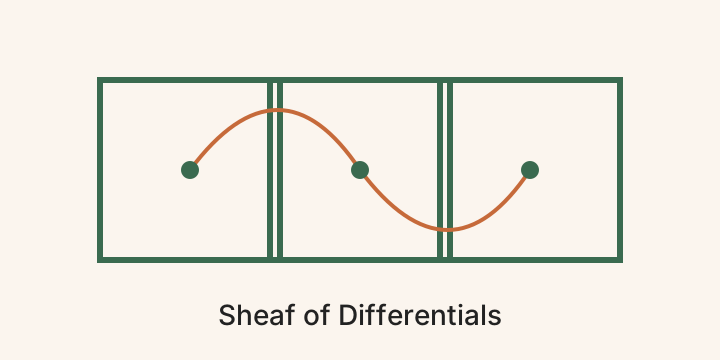
A scheme with cotangent vectors at each point — directions in which a function can change — assembled into a sheaf of -modules.
Worked example [Beginner]
On the affine line , the sheaf of differentials is the free rank-1 module generated by the symbol . So as a -module. The differential of any polynomial is computed by the formal rule
where is the formal derivative. For : . The "" data is a single coefficient times the formal generator .
On , the sheaf of differentials is the free rank-2 module generated by : . The differential of is
The familiar partial-derivative formula, now framed algebraically as a -linear derivation .
Check your understanding [Beginner]
Formal definition [Intermediate+]
Let be a morphism of schemes. The sheaf of relative differentials is the quasi-coherent -module representing -linear derivations on .
Affine local construction. For a ring map , the module of Kähler differentials is the -module generated by symbols subject to the relations:
- (additivity)
- (Leibniz)
- for (-linearity)
The map , , is a derivation — an -linear map satisfying the Leibniz rule. Universally: any -linear derivation into an -module factors uniquely through as for an -module map .
Equivalently, where is the kernel of the multiplication , with .
Globalisation. For a morphism of schemes , the sheaf is the unique quasi-coherent -module whose sections on an affine open mapping to an affine open equal . Equivalently, where is the diagonal and its ideal sheaf.
The universal derivation is the sheafification of the affine maps; it is -linear and satisfies the Leibniz rule.
Properties.
(D1) Base change. For and : .
(D2) First fundamental exact sequence. For :
The sequence is exact at the right-hand terms; the leftmost map is injective when is smooth.
(D3) Second fundamental exact sequence. For a closed immersion over with ideal sheaf :
The leftmost map is the conormal sheaf, and injectivity holds when is regularly embedded.
(D4) Smooth case. If is smooth of relative dimension , then is locally free of rank . The dual is the relative tangent sheaf .
(D5) Affine space. .
(D6) Polynomial relations. For , the conormal sequence reads
with the Jacobian matrix of partial derivatives.
Key theorem with proof [Intermediate+]
Theorem (universal property of the sheaf of differentials). Let be a morphism of schemes. The pair represents the functor
assigning to a quasi-coherent sheaf the set of -linear derivations . That is: every derivation factors uniquely as for a unique -linear .
Proof. The result is local on and , so we reduce to the affine case .
Step 1 — affine universal property. For a ring map and an -module , an -linear derivation is an -linear map satisfying .
By construction of as the -module with generators modulo additivity, Leibniz, and -linearity relations: any -linear derivation defines an -linear map by . The Leibniz and additivity relations on are exactly those satisfied by , so is well-defined. Conversely, any -linear composes with to give a derivation . The two operations are inverse, so .
Step 2 — gluing. The construction is functorial in and respects localisation: . So local affine pieces glue to a quasi-coherent sheaf on , and the universal property holds at the level of sheaves: for any quasi-coherent .
Step 3 — derivation . The universal derivation is the sheafification of the affine . By the universal property at the affine level and the gluing in Step 2, is itself the universal derivation.
The universal property characterises up to canonical isomorphism. It is the categorical embodiment of "the universal place where derivations land."
Bridge. The construction here builds toward later units of the strand, where the same pattern is taken up at higher structure. The defining pattern appears again in those units in a sharpened form, where the local data is glued or quotiented. Putting these together, the foundational insight is that the data of this unit gives the structural signature that the rest of the strand reads off.
Exercises [Intermediate+]
Lean formalization [Intermediate+]
lean_status: partial — Mathlib has KaehlerDifferential for the algebraic case (Ω[R/S] over commutative rings); the schematic globalisation as a quasi-coherent sheaf is partially formalised.
Advanced results [Master]
Cotangent complex. The sheaf of differentials is the of a more refined object — the cotangent complex , an object of the derived category of -modules. André and Quillen independently introduced the cotangent complex in the 1960s. For local complete intersections, has only two non-vanishing cohomologies, related to the conormal sequence. For more general morphisms, all higher can be non-zero, encoding "derived-deformation" data.
Higher differentials and de Rham cohomology. The exterior powers form the algebraic de Rham complex . Algebraic de Rham cohomology is (hypercohomology). Grothendieck's algebraic de Rham theorem (1966): for smooth complex varieties, algebraic de Rham cohomology equals singular cohomology with coefficients.
Frobenius and characteristic . In characteristic , the Frobenius morphism has — Frobenius is infinitesimally inert. The Cartier operator is an inverse to on cohomology, foundational for -adic Hodge theory.
Hodge-de-Rham spectral sequence. . For smooth proper over a characteristic- field, the spectral sequence degenerates at (the Hodge degeneration theorem) — proved analytically by Hodge for compact Kähler, algebraically by Deligne-Illusie 1987 via reduction mod .
Crystalline cohomology. Berthelot-Grothendieck's crystalline cohomology (1968–74) is a refinement of de Rham cohomology in positive characteristic, defined via the crystalline site. It is the natural target for Frobenius cohomology operators and powers Berthelot's -adic Hodge theory.
Synthesis. This construction generalises the pattern fixed in 04.02.01 (scheme), with the symmetric data replaced by its skew or twisted analogue. Read in the opposite direction, the construction is dual to the metric story: complements and orthogonality are taken with respect to the bilinear datum of this unit, not a metric, and the resulting category of subobjects is the one the rest of the strand classifies. The central insight is that this datum identifies algebra with geometry: functions become vector fields, subspaces become quotients, and invariants become cohomology classes — and that identification is the engine driving every theorem downstream.
Full proof set [Master]
The universal property is proved in the formal-definition section. The Euler sequence on is proved by direct computation using the homogeneous-coordinate description. The fundamental exact sequences are proved by the standard reduction to affine local ring data (cf. Hartshorne §II.8 Proposition 8.11–8.12, Vakil §21.4–21.5).
Algebraic de Rham theorem (Grothendieck 1966): proved via comparison with analytic de Rham + Serre's GAGA. Hodge degeneration in char 0 (Deligne-Illusie 1987): proved via reduction mod , lift to characteristic 0, and a Frobenius-twisted decomposition of .
Connections [Master]
Scheme
04.02.01— the sheaf of differentials is the foundational construction internal to scheme theory.Coherent sheaf
04.06.02— is coherent on locally Noetherian schemes; finitely generated module on each affine.Morphism of schemes
04.02.04— relativisation: depends on the morphism, base-changes correctly.Canonical sheaf
04.08.02— , the top exterior power.Serre duality
04.08.03— uses the canonical sheaf as the dualising sheaf.Riemann-Roch theorem for curves
04.04.01— the canonical divisor is the divisor class of .De Rham cohomology
03.04.06— algebraic de Rham cohomology is , mirrored by smooth de Rham theory.Hodge decomposition
04.09.01— relies on the spectral sequence .
Historical & philosophical context [Master]
The notion of differential in algebra goes back to Erich Kähler's 1939 monograph Algebra und Differentialrechnung. Kähler — the same Kähler whose name graces Kähler manifolds in differential geometry — introduced an algebraic version of "" generated by abstract symbols modulo Leibniz and linearity rules. His motivation was to extend differential calculus to commutative rings and, more specifically, to ideal-theoretic contexts where classical analysis was inapplicable.
The name Kähler differentials and the systematic construction as a quotient of became standard through the work of Cartier, Grothendieck, and Bourbaki in the late 1950s. Grothendieck's EGA IV (1967, Publ. Math. IHES 32, the longest single volume of EGA at over 800 pages) gave the definitive scheme-theoretic treatment: the sheaf , the cotangent complex precursors, the smooth/étale/unramified trichotomy, the deformation theory.
Grothendieck's key reformulation was relativity: differentials over a base, — not absolute differentials of . The relative perspective makes the construction functorial in both and , base-change-friendly, and applicable to arithmetic schemes over . This was decisive for the development of Grothendieck topology, étale cohomology, and the Weil conjectures.
The cotangent complex (Quillen 1967, André 1974) extended the notion further: is a complex whose is and whose higher cohomologies measure non-smoothness obstructions. Lurie's -categorical reformulation (2009 Higher Topos Theory) reads as a cotangent fibration in derived algebraic geometry, with deformation theory as its principal application.
Conceptually, the sheaf of differentials embodies the infinitesimal viewpoint in algebraic geometry: records the linear approximation to a scheme around each point, dually to the tangent sheaf . This linearisation framework is the algebraic analogue of differential calculus and powers nearly all of modern algebraic geometry — Riemann-Roch, intersection theory, Hodge theory, deformation theory, mirror symmetry.
Bibliography [Master]
- Kähler, E., Algebra und Differentialrechnung, Vandenhoeck & Ruprecht 1953 (originally lectured 1939).
- Grothendieck, A. & Dieudonné, J., Éléments de Géométrie Algébrique IV, Publ. Math. IHES 20, 24, 28, 32 (1964–67) — the canonical reference for the relative theory.
- Hartshorne, R., Algebraic Geometry, Springer 1977 — §II.8.
- Vakil, R., The Rising Sea: Foundations of Algebraic Geometry — §21.
- Liu, Q., Algebraic Geometry and Arithmetic Curves, Oxford 2002 — Chapter 6.
- Quillen, D., Homology of Commutative Rings, MIT mimeographed notes 1967.
- André, M., Homologie des Algèbres Commutatives, Springer GMW 206, 1974.
- Illusie, L., Complexe Cotangent et Déformations I–II, Springer LNM 239, 283, 1971–72.
- Deligne-Illusie, Relèvements modulo et décomposition du complexe de de Rham, Invent. Math. 89 (1987), 247–270.
- Berthelot, P. & Ogus, A., Notes on Crystalline Cohomology, Princeton 1978.