Morphism of schemes
Anchor (Master): Hartshorne §II–§III; Vakil; Grothendieck-Dieudonné EGA I, IV; Mumford *Red Book*
Intuition [Beginner]
A morphism of schemes is the algebraic-geometric notion of a "map between geometric objects." Where a continuous map between topological spaces is a function preserving open sets, a morphism of schemes is more: it is a continuous map of underlying topological spaces together with a compatible map of structure sheaves, going in the opposite direction. The structure sheaf data records "which functions are regular" on each open set, and a morphism must respect this — pulling back regular functions on to regular functions on .
For affine schemes, morphisms reverse: a morphism corresponds to a ring map . So affine schemes embody the equivalence "rings = geometry, with arrows reversed." More general morphisms are built up from this affine case by gluing.
The richness of scheme theory comes from the properties of morphisms: finite type, separated, proper, flat, smooth, étale, affine, projective, quasi-finite, immersion, and many more. Each property names a precise geometric or algebraic condition, and the systematic classification of morphism properties is a major theme of EGA IV (the longest of Grothendieck's foundational treatises). A morphism of schemes is not just a map; it is a map of a particular type, and the type encodes how it behaves geometrically.
Visual [Beginner]
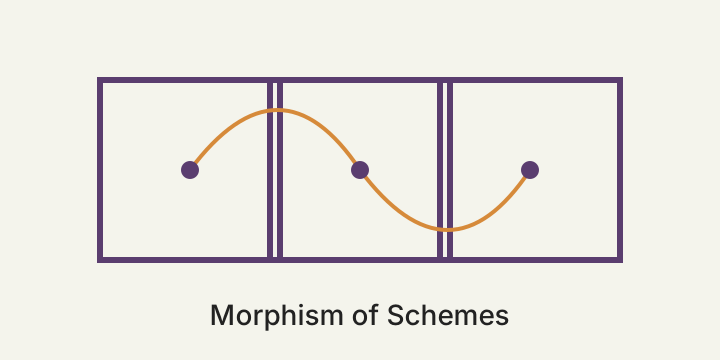
A morphism between two schemes, with the underlying continuous map of topological spaces and a structure-sheaf map going in the opposite direction.
Worked example [Beginner]
The morphism of affine schemes corresponding to is the squaring map. The ring map , , induces a map of spectra reversing the direction.
Pointwise: a point of over an algebraically closed is an element of . The squaring morphism sends (corresponding to the prime ) to (corresponding to ). The preimage of is , two points for and one (with multiplicity 2) for .
Another example: the embedding of a closed point corresponding to the quotient . The ring map sends . The induced morphism is the inclusion of the closed point into the line.
A non-affine example: the projection from the product onto the second factor. This is not induced by a single ring map — is not affine — but it is a well-defined morphism of schemes, built up from morphisms on affine charts and glued.
Check your understanding [Beginner]
Formal definition [Intermediate+]
Let be schemes (locally ringed spaces locally isomorphic to spectra). A morphism of schemes is a morphism of locally ringed spaces:
(M1) A continuous map of underlying topological spaces.
(M2) A morphism of sheaves of rings on — equivalently, by adjunction, a sheaf-of-rings morphism on .
(M3) The induced map on stalks is a local ring homomorphism for every — i.e., it sends the maximal ideal into the maximal ideal .
The locality condition (M3) is essential: it is what distinguishes a scheme morphism from an arbitrary ringed-space morphism.
Affine case (anti-equivalence). . The functors and are mutually inverse equivalences. Every morphism of affine schemes is determined by a ring map.
General morphisms via affine cover. A morphism between general schemes is determined by its restriction to an affine cover of and a compatible affine cover of with . The morphism is then a morphism of affine schemes, given by a ring map .
Properties of morphisms. Major classes (developed in Hartshorne §II.3 and EGA I, IV):
(P1) Finite type. is locally of finite type if for every there is an affine in such that admits an affine cover with each a finitely generated -algebra. Of finite type if additionally the cover is finite.
(P2) Affine. is affine if is affine for every affine open .
(P3) Closed / open immersion. is a closed immersion if it is a homeomorphism onto a closed subset and the induced map is surjective. An open immersion is a homeomorphism onto an open subset with .
(P4) Separated. is separated if the diagonal morphism is a closed immersion.
(P5) Proper. is proper if it is separated, of finite type, and universally closed (every base change is closed). Equivalently (valuative criterion): for every discrete valuation ring with field of fractions , every commutative diagram with and extends uniquely to .
(P6) Flat. is flat at if is a flat -module via . Flat if flat at every point.
(P7) Smooth. is smooth of relative dimension if it is locally of finite presentation, flat, and the geometric fibres are smooth -dimensional varieties.
(P8) Étale. is étale if it is smooth of relative dimension 0, equivalently flat and unramified — locally a quasi-finite separable morphism.
(P9) Finite. is finite if it is affine and for every affine open , with a finite -algebra (finitely generated as a -module).
(P10) Quasi-compact. is quasi-compact if is quasi-compact for every quasi-compact open .
These properties are stable under composition, base change, and locality (with appropriate qualifications). The systematic classification is the central subject of EGA IV.
Functor of points. A scheme is determined by its functor of points , . A morphism is determined by the natural transformation , . This functorial perspective (Grothendieck) is often the most natural way to specify and reason about morphisms.
Diagonal and base change. For and , the fibre product is the scheme satisfying the universal property:
Existence of fibre products in is a foundational theorem (Grothendieck EGA I §3). The diagonal , , is the morphism testing separatedness.
Key theorem with proof [Intermediate+]
Theorem (anti-equivalence of affine schemes and commutative rings). The functor is an anti-equivalence of categories. Equivalently, for commutative rings ,
Proof. Forward direction. A ring homomorphism induces a morphism as follows.
Map of underlying spaces. Send to . The preimage of a prime under a ring homomorphism is a prime, so this is well-defined. Continuity: the preimage of the basic open is , an open set. So the map is continuous.
Sheaf map $\varphi^\sharp : \mathcal{O}{\mathrm{Spec}(B)} \to \mathrm{Spec}(\varphi) \mathcal{O}_{\mathrm{Spec}(A)}D(b) \subseteq \mathrm{Spec}(B)\mathcal{O}(D(b)) = B[b^{-1}]\mathrm{Spec}(\varphi)^{-1}(D(b)) = D(\varphi(b))\mathcal{O}(D(\varphi(b))) = A[\varphi(b)^{-1}]\varphiB[b^{-1}] \to A[\varphi(b)^{-1}]b'/b^n \mapsto \varphi(b')/\varphi(b)^n\varphi^\sharp$ on basic opens; it extends to a sheaf map on all opens.
Locality on stalks. At , the stalk map sends . The maximal ideal goes to (since ). So is local.
This shows is a morphism of schemes.
Reverse direction (faithful). Two distinct ring maps give distinct morphisms. If for some , then and act differently on , hence are different sheaf morphisms.
Reverse direction (full). Given a morphism , recover a ring map. Let — using that global sections of the structure sheaf on recover .
This satisfies as a morphism of schemes: the underlying continuous map matches because the locality condition (M3) on stalks forces for every (the local ring map respects maximal ideals); the sheaf maps match because both equal the localised version of on basic opens.
So is fully faithful. Together with essential surjectivity (every affine scheme is by definition a ), this is the anti-equivalence.
This anti-equivalence — commutative algebra dual to affine algebraic geometry — is the foundational theorem of scheme theory and the basis for every algebraic-geometric calculation. Every property of affine morphisms translates to a property of ring maps, and vice versa. This dictionary is what makes scheme theory powerful.
Bridge. The construction here builds toward later units of the strand, where the same pattern is taken up at higher structure. The defining pattern appears again in those units in a sharpened form, where the local data is glued or quotiented. Putting these together, the foundational insight is that the data of this unit gives the structural signature that the rest of the strand reads off.
Exercises [Intermediate+]
Lean formalization [Intermediate+]
lean_status: partial — Mathlib has AlgebraicGeometry.Scheme.Hom, the affine-Spec adjunction, and a substantial library of properties of morphisms (closed immersion, finite, proper, separated, ...).
Advanced results [Master]
Anti-equivalence and gluing. as full subcategory of . General schemes are obtained by gluing affines along open subschemes; morphisms of schemes are obtained by gluing morphisms of affines along compatible open subschemes. This is the local-to-global principle for the category of schemes.
Functor of points and Yoneda. A scheme is determined by its functor of points . Conversely, a representable functor comes from a unique scheme. This functorial perspective is foundational for moduli theory, where many "moduli functors" have representable solutions (Hilbert schemes, Picard schemes, moduli of curves under additional conditions).
Properties stable under base change. Properties stable under arbitrary base change include: finite type, finite presentation, separated, proper, flat, smooth, étale, finite, immersion, affine, projective. Properties NOT stable under arbitrary base change but stable under flat base change (or equivalent): integral fibres, geometric connectedness. These finer behaviours are systematically classified in EGA IV.
Faithfully flat descent. A morphism that is faithfully flat (flat plus surjective) and quasi-compact is an effective epimorphism in : properties of can often be detected after base change to . The classical statement: a quasi-coherent module on is uniquely determined (with descent data) by its pullback to . Grothendieck's faithfully flat descent (FGA exposé 190, 1959) is one of the most powerful tools in algebraic geometry.
Six-functor formalism for morphisms. Direct image , inverse image , proper-pushforward , exceptional inverse on derived categories of (quasi-)coherent sheaves. Verdier duality gives — the algebraic-geometric incarnation of Poincaré-Serre duality.
Smooth and étale: deformation-theoretic characterisations. is smooth iff every infinitesimal extension lifts uniquely (the formal smoothness criterion). Étale iff smooth of relative dimension 0. The deformation-theoretic characterisations connect EGA IV to the cotangent complex and modern derived deformation theory.
Stable algebraic geometry. Higher categorical morphisms — morphisms of derived schemes, -stacks, and prismatic schemes — extend the EGA IV framework. Lurie's Spectral Algebraic Geometry formalises the -categorical version, with derived versions of finite type / smooth / étale, and a full six-functor formalism in the derived setting.
Galois descent and Galois groups. A finite étale morphism corresponds (when is connected with a geometric point ) to a continuous action of the étale fundamental group on the fibre — Grothendieck's Galois theory of schemes (SGA 1). This unifies classical Galois theory of fields with topological covering theory of spaces.
Synthesis. This construction generalises the pattern fixed in 04.02.01 (scheme), with the symmetric data replaced by its skew or twisted analogue. Read in the opposite direction, the construction is dual to the metric story: complements and orthogonality are taken with respect to the bilinear datum of this unit, not a metric, and the resulting category of subobjects is the one the rest of the strand classifies. The central insight is that this datum identifies algebra with geometry: functions become vector fields, subspaces become quotients, and invariants become cohomology classes — and that identification is the engine driving every theorem downstream.
Full proof set [Master]
Detailed proofs of: the affine anti-equivalence (sketched in the key-theorem section); existence of fibre products in ; valuative criteria for separatedness and properness; faithfully flat descent; the deformation-theoretic characterisations of smooth and étale; six-functor formalism for morphisms — these are deferred to companion units in the schemes, derived-categories, and étale-cohomology strands. The basic anti-equivalence is proved in the key-theorem section.
Connections [Master]
Scheme
04.02.01— schemes are the objects; morphisms are the arrows.Affine scheme
04.02.02— affine morphisms correspond to ring maps via anti-equivalence.Projective scheme
04.02.03— projective morphisms admit closed embeddings into projective bundles; specialisations of EGA IV properties.Sheaf
04.01.01— morphisms of schemes carry a sheaf-of-rings component; the locality condition makes them well-behaved.Direct and inverse image
04.01.04— every morphism induces on sheaves.Quasi-coherent sheaf
04.06.01— quasi-coherence is preserved by always; by for quasi-compact-quasi-separated morphisms.Coherent sheaf
04.06.02— coherence is preserved by for finite-type morphisms; by for proper morphisms (Grothendieck's finiteness theorem, EGA III).Riemann-Roch theorem for curves
04.04.01— Riemann-Roch is a statement about morphisms to a point and properties of the corresponding pushforward.
Historical & philosophical context [Master]
The notion of morphism of schemes was formalised by Alexander Grothendieck and Jean Dieudonné in Éléments de Géométrie Algébrique I (EGA I, 1960), specifically §1 (definitions) and §6 (separated and proper morphisms). Grothendieck's foundational insight was that algebraic geometry should be the study of schemes and their morphisms, with morphisms being the maps of locally ringed spaces respecting the local-ring structure. This was a categorical reformulation of the classical varieties-and-rational-maps language, and it had transformative consequences.
Before Grothendieck, algebraic geometers worked primarily with varieties (irreducible reduced schemes of finite type over a field) and rational maps (partial maps defined on dense open subsets). The pre-Grothendieck framework — Weil's Foundations of Algebraic Geometry (1946), van der Waerden, Severi — used a complicated mixture of birational geometry, intersection theory, and ad-hoc constructions. The functorial language was missing, the relative perspective was missing, and many natural questions could not be cleanly stated.
Grothendieck's reformulation in EGA I §1 introduced morphisms of schemes as morphisms of locally ringed spaces (the locality condition on stalks being the essential addition over arbitrary ringed-space morphisms). The anti-equivalence was the foundational theorem, and general schemes were built by gluing affines via morphisms. This made every commutative ring — Noetherian or not, integral or not, of arbitrary characteristic — an algebraic-geometric object, and every morphism of rings a corresponding morphism of schemes.
The systematic theory of properties of morphisms was then developed in EGA II–IV (1961–67). EGA II (1961) covered ample line bundles and projective morphisms. EGA III (1961–63) covered cohomology of coherent sheaves, including Grothendieck's finiteness theorem for proper morphisms. EGA IV (1965–67), in four parts, was a tour-de-force classification of morphism properties: locally Noetherian, locally of finite type, locally of finite presentation, étale, smooth, flat, faithfully flat, finite, quasi-finite, separated, proper, immersion, finite presentation. Each property received the full systematic treatment: definition, stability under composition / base change / locality, criteria, examples, counterexamples, fibre-wise behaviour. The total length of EGA IV approaches 2000 pages, and it remains the canonical reference for the algebraic-geometric working mathematician.
The conceptual achievement of EGA I–IV was the relative perspective: algebraic geometry is fundamentally relative, with every scheme being a scheme over some base , and every property of schemes generalising to a property of morphisms. This perspective enabled enormous generalisations: the étale fundamental group (SGA 1), étale cohomology (SGA 4), the proof of the Weil conjectures (Deligne, 1973–74), the finiteness theorems for moduli (Faltings, Mochizuki), and modern arithmetic geometry (perfectoid spaces, Scholze 2012; the geometrisation of local Langlands, Fargues-Scholze 2021). The relative-morphism perspective also extended into derived algebraic geometry (Lurie, Töen-Vezzosi), where morphisms of derived schemes carry homotopical data that recovers cohomology and obstruction theory naturally.
Pierre Deligne, Luc Illusie, Michel Raynaud, and the entire Bourbaki community contributed to extending and applying the EGA I–IV framework. David Mumford's The Red Book of Varieties and Schemes (Lectures on Curves on an Algebraic Surface, 1966; expanded into the Red Book in 1988) provides the most accessible introduction to scheme-theoretic morphisms and is the canonical pedagogical reference. Robin Hartshorne's Algebraic Geometry (1977) gives the standard textbook treatment, and Ravi Vakil's The Rising Sea: Foundations of Algebraic Geometry (the contemporary canonical online textbook) presents the full modern perspective.
In contemporary research, morphisms of schemes remain central: in arithmetic (heights, equidistribution, Mordell-Weil, BSD), in derived algebraic geometry (Lurie's Spectral Algebraic Geometry), in -adic Hodge theory (perfectoid morphisms, prismatic morphisms), in moduli theory (representability of moduli functors, Artin's representability theorem), and in the homotopical geometry of -stacks. The single concept — a morphism of locally ringed spaces respecting local rings — has thus traversed an enormous landscape, from Grothendieck's 1960 definition through 70 years of foundational and applied work.
Bibliography [Master]
- Hartshorne, Algebraic Geometry — §II.3 covers morphisms of schemes.
- Vakil, The Rising Sea: Foundations of Algebraic Geometry — §6–§9 (morphisms and their properties).
- Grothendieck-Dieudonné, Éléments de Géométrie Algébrique I (EGA I, 1960) — §1 and §6 introduce morphisms of schemes.
- Grothendieck-Dieudonné, EGA IV (1965–67) — the systematic classification of morphism properties (~2000 pages).
- Mumford, The Red Book of Varieties and Schemes — Ch. II covers morphisms.
- Eisenbud-Harris, The Geometry of Schemes — geometric introduction with attention to morphisms.
- Liu, Algebraic Geometry and Arithmetic Curves — morphisms with arithmetic emphasis.
- Görtz-Wedhorn, Algebraic Geometry I — comprehensive modern treatment of morphisms.
- Deligne, La conjecture de Weil II (1980) — applications of EGA IV in proof of the Weil conjectures.
- Lurie, Spectral Algebraic Geometry — derived / -categorical morphisms of derived schemes.
- Stacks Project — (https://stacks.math.columbia.edu) — exhaustive online reference for properties of morphisms.