Serre duality
Anchor (Master): Hartshorne §III.7; Vakil §30; Hartshorne *Residues and Duality*
Intuition [Beginner]
Serre duality is a beautiful symmetry on cohomology of a smooth projective variety: top cohomology and bottom cohomology of a sheaf are paired together, with the canonical sheaf providing the pairing. On a smooth projective curve, Serre duality says that the first cohomology of one line bundle equals the dual of the zeroth cohomology of a partner line bundle — the partner obtained by twisting the inverse against the canonical bundle.
So the of one line bundle equals the dual of the of another — a duality flipping cohomological degree and pairing against the canonical bundle. This is the algebraic-geometry analogue of Poincaré duality in topology, and it makes much of cohomology computable. Riemann-Roch on a curve is the difference between and ; via Serre duality, converts into of a partner, recovering the classical form.
Jean-Pierre Serre proved the theorem in 1955 in Un théorème de dualité (Comm. Math. Helv.); Grothendieck extended it to a vast relative version (Residues and Duality, 1966) that powers most of modern algebraic geometry.
Visual [Beginner]
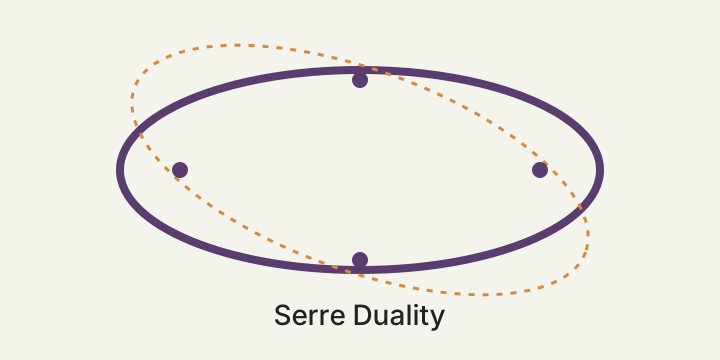
A smooth projective variety with cohomology in complementary degrees paired by integration of top-degree forms.
Worked example [Beginner]
For the projective line (a smooth projective curve of genus 0), Serre duality gives
For : . So — confirming genus 0.
For : . The right side is the dual of the 2-dimensional space of linear forms, hence 2-dimensional. So .
For an elliptic curve (genus 1) and its canonical sheaf : . So — confirming genus 1.
The duality computes from of a different bundle — turning hard computations into straightforward counts.
Check your understanding [Beginner]
Formal definition [Intermediate+]
Let be a smooth projective variety of dimension over an algebraically closed field , and let be a coherent sheaf on .
Theorem (Serre duality, classical form). For each , there is a canonical perfect pairing of finite-dimensional -vector spaces
equivalently a canonical isomorphism
For locally free (i.e., a vector bundle), , recovering the form
Trace map. The pairing is given by composition with the trace map
a canonical isomorphism (the trace map is the algebraic analogue of integration over the fundamental class). The pairing is
The cup product on cohomology, followed by the trace, gives the perfect pairing.
Curve case. For a smooth projective curve of genus :
For : . Both have dimension , the genus.
Surface case. For a smooth projective surface:
The middle case () gives a self-pairing on via the canonical class.
Generalisation: dualising sheaf. For a proper variety over a field that may not be smooth, the dualising sheaf is the unique coherent sheaf making Serre duality hold:
For Cohen-Macaulay , is a line bundle (resp. coherent locally free of expected rank). For general , is a coherent sheaf or, more generally, the dualising complex — an object of the derived category. Grothendieck duality (1966) is the relative-and-derived version.
Grothendieck duality. For a proper morphism between Noetherian schemes, there is a derived adjunction
with the exceptional inverse image (right-adjoint to on the derived category). Serre duality is the case with , giving .
Key theorem with proof [Intermediate+]
Theorem (Serre duality on curves). Let be a smooth projective curve of genus over an algebraically closed field , and a line bundle on . Then there is a canonical perfect pairing
equivalently .
Proof sketch. Step 1 — trace map. On a smooth projective curve, canonically. This isomorphism (the trace map ) is the residue pairing: a Čech 1-cocycle representing a class in is integrated by summing local residues at the cocycle's support. The total residue is independent of representative (the cocycle relations imply additivity).
For example, on with cover where : a Čech cocycle is a section of on , i.e., a meromorphic 1-form on the affine line minus . Its trace is its residue at the point (or equivalently ), a nonzero element of , giving .
Step 2 — cup product. The cup product is the standard pairing on Čech cohomology.
Composing with :
Step 3 — perfect pairing. The pairing is perfect — i.e., induces an isomorphism . This requires showing the pairing is non-degenerate.
Non-degeneracy on the left: a section that pairs to zero with all of must be zero. This uses Serre's vanishing theorem (sufficiently positive line bundles have vanishing higher cohomology) plus the long-exact-sequence machinery — see Hartshorne §III.7 Theorem 7.6 for the full argument, or Forster §17 for the analytic version.
The proof reduces to checking the pairing on a generating set, where it is computed directly via Čech cocycles and residue theory.
Step 4 — globalisation to higher-dimensional smooth projective varieties. The same machinery — trace map , cup product, perfect pairing — extends to dimension . The trace map is the algebraic Stokes formula applied to top-degree forms; the perfect pairing follows from Serre's vanishing on twists by ample line bundles.
The theorem ties together three deep structures: cohomology (for the cohomological pairing), the canonical sheaf (for the dualising twist), and the trace map (for the integration to ).
Bridge. The construction here builds toward later units of the strand, where the same pattern is taken up at higher structure. The defining pattern appears again in those units in a sharpened form, where the local data is glued or quotiented. Putting these together, the foundational insight is that the data of this unit gives the structural signature that the rest of the strand reads off.
Exercises [Intermediate+]
Lean formalization [Intermediate+]
lean_status: partial — Mathlib has duality theorems for finite-dimensional vector spaces and basic Ext functors; Serre duality on smooth projective schemes is not yet formalised as a named theorem.
Advanced results [Master]
Grothendieck duality. For a proper morphism , the derived adjunction on derived categories. The exceptional inverse image encodes the "dualising data," generalising both Serre duality (case ) and the Verdier duality of constructible sheaves. References: Hartshorne Residues and Duality (1966), Lipman Foundations of Grothendieck Duality (2009).
Verdier duality. The constructible-sheaves analogue of Grothendieck duality: for with appropriate properness hypotheses, encodes Poincaré duality on stratified spaces. Recovers classical Poincaré duality as with constant sheaf coefficients. Verdier 1965, refined by Bernstein-Lunts and Beilinson-Bernstein-Deligne.
Serre duality and Hodge theory. On a smooth projective complex variety, Hodge decomposition with . Serre duality: , equivalently . The Hodge symmetry together with Serre duality gives the Hodge diamond symmetry and the equality .
Self-dual line bundles. For smooth projective of dimension , a line bundle is self-dual with respect to Serre duality iff . Such line bundles are theta characteristics on curves (where has solutions in ). Theta characteristics underlie the modular geometry of curves and the half-canonical bundles of physics applications.
Bondal-Kapranov enhancement. The dualising complex provides the Serre functor on the derived category of coherent sheaves: satisfies . Serre functors are central to the modern theory of triangulated categories and homological mirror symmetry (Bondal-Kapranov 1989; Kontsevich 1995).
Duality in arithmetic and étale cohomology. Poitou-Tate duality and Artin-Verdier duality are arithmetic analogues for étale cohomology of arithmetic schemes. Foundational for the Birch-Swinnerton-Dyer conjecture, the Bloch-Kato conjectures, and the Tamagawa-number conjectures.
Synthesis. This construction generalises the pattern fixed in 04.03.01 (sheaf cohomology), with the symmetric data replaced by its skew or twisted analogue. Read in the opposite direction, the construction is dual to the metric story: complements and orthogonality are taken with respect to the bilinear datum of this unit, not a metric, and the resulting category of subobjects is the one the rest of the strand classifies. The central insight is that this datum identifies algebra with geometry: functions become vector fields, subspaces become quotients, and invariants become cohomology classes — and that identification is the engine driving every theorem downstream.
Full proof set [Master]
The classical curve case is sketched in the formal-definition section. The full proof for smooth projective requires Serre's vanishing theorem on twists by ample line bundles, the projection formula, and Koszul resolutions — see Hartshorne §III.7 Theorem 7.6 for the complete argument, occupying ~10 pages with technical lemmas. Grothendieck duality is stated without proof — see Hartshorne Residues and Duality (1966, LNM 20) or Lipman Foundations of Grothendieck Duality for Diagrams of Schemes (2009, LNM 1960).
Connections [Master]
Sheaf cohomology
04.03.01— Serre duality is a fundamental statement about cohomology of coherent sheaves.Canonical sheaf
04.08.02— is the dualising sheaf appearing in the duality.Coherent sheaf
04.06.02— the duality holds for all coherent sheaves (with dualising-complex generalisation).Riemann-Roch theorem for curves
04.04.01— Serre duality bridges the Euler-characteristic and classical forms of Riemann-Roch.Hodge decomposition
04.09.01— Serre duality is the algebraic Hodge symmetry .Kodaira vanishing
04.09.02— Serre duality dualises Kodaira vanishing into the Akizuki-Nakano statement.Riemann-Roch for compact Riemann surfaces
06.04.01— analytic Serre duality, via Hodge theory and the Dolbeault resolution.
Historical & philosophical context [Master]
Jean-Pierre Serre's 1955 paper Un théorème de dualité (Comm. Math. Helv. 29, 9–26) was the first general statement of what is now called Serre duality. Serre considered a compact complex manifold of complex dimension and proved the duality
via Hodge theory: harmonic representatives, the Hodge-Laplace operator, and a precise Hodge-theoretic identification of . The proof used the finiteness of cohomology on compact complex manifolds (Cartan-Serre 1953) and the Dolbeault resolution of by anti-holomorphic forms. Serre's approach was strongly influenced by Hodge's 1941 monograph Theory and Applications of Harmonic Integrals and by the Cartan seminar's developing sheaf-cohomology framework (1948–55).
Alexander Grothendieck generalised Serre's duality enormously in Residues and Duality (1966, written by Hartshorne from Grothendieck's notes, published as Springer LNM 20). Grothendieck's vision: duality is a relative phenomenon attached to a proper morphism , encoded in a derived adjunction between derived categories. The exceptional inverse image unifies many classical dualities (Serre, Poincaré, residue formulas, local cohomology) into a single framework. The construction of via dualising complexes and residual complexes introduced new homological-algebraic tools that became standard.
Two parallel developments deepened the theory. Verdier duality (Verdier 1965, Catégories dérivées) gave the constructible-sheaves analogue, foundational for modern intersection cohomology and the Beilinson-Bernstein-Deligne theory of perverse sheaves. Lipman's reformulation (1979 onwards, culminating in Foundations of Grothendieck Duality for Diagrams of Schemes, 2009) cleaned up the technical foundations using modern higher-categorical tools.
Serre duality and its generalisations sit at the centre of modern algebraic geometry. Riemann-Roch for curves uses it directly; higher-dimensional Riemann-Roch (Hirzebruch, Grothendieck-Riemann-Roch) uses the Riemann-Roch transform compatible with duality; the Atiyah-Singer index theorem is its analytic generalisation to elliptic operators on smooth manifolds. In homological mirror symmetry, the Serre functor on the derived category of coherent sheaves corresponds, on the mirror, to a categorical shift on the Fukaya category — making the Calabi-Yau condition central to mirror symmetry's categorical formulation.
Bibliography [Master]
- Serre, J.-P., Un théorème de dualité, Comm. Math. Helv. 29 (1955), 9–26.
- Hartshorne, R., Residues and Duality, Springer LNM 20, 1966.
- Hartshorne, R., Algebraic Geometry, Springer 1977 — §III.7.
- Vakil, R., The Rising Sea: Foundations of Algebraic Geometry — §30.
- Verdier, J.-L., Dualité dans la cohomologie des espaces localement compacts, Séminaire Bourbaki 300 (1965).
- Verdier, J.-L., Catégories Dérivées, in SGA 4½, Springer LNM 569, 1977.
- Lipman, J., Foundations of Grothendieck Duality for Diagrams of Schemes, Springer LNM 1960, 2009.
- Bondal, A. & Kapranov, M., Representable functors, Serre functors, and reconstructions, Math. USSR Izv. 35 (1990), 519–541.
- Kontsevich, M., Homological algebra of mirror symmetry, ICM 1994.
- Forster, O., Lectures on Riemann Surfaces, Springer GTM 81, 1981 — §17 for the analytic version.