Canonical sheaf
Anchor (Master): Hartshorne §II.8, §III.7; Vakil §21; Iitaka *Algebraic Geometry*
Intuition [Beginner]
The canonical sheaf is the line bundle of "top-degree differential forms" on a smooth variety. On a smooth curve, it is the line bundle of holomorphic 1-forms; on a smooth surface, it is the line bundle of holomorphic 2-forms; and so on. Its sections are the natural "volume forms" of algebraic geometry.
Bernhard Riemann implicitly introduced the canonical divisor in his 1857 paper Theorie der Abelschen Functionen: he showed that on a Riemann surface of genus , the space of everywhere-holomorphic 1-forms has dimension exactly . This dimension equality — genus = dimension of holomorphic 1-forms — is one of the foundational identities of algebraic geometry. Grothendieck made the construction functorial in EGA: is the determinant of the cotangent sheaf, for smooth of dimension .
The canonical sheaf governs three deep structures: Serre duality (the duality on cohomology pairs against ), the canonical embedding of curves of genus , and the Kodaira dimension of a variety (a birational invariant measuring how positive is).
Visual [Beginner]
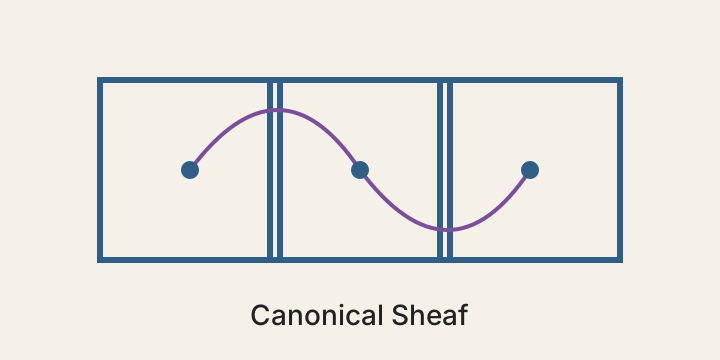
A smooth curve with everywhere-holomorphic 1-forms; the canonical sheaf assembles all such forms into a single line bundle.
Worked example [Beginner]
The canonical sheaf of is — the line bundle of degree . There are no global sections: . Geometrically: there are no everywhere-holomorphic 1-forms on the Riemann sphere. This matches the formula for the genus-0 case.
For the genus-1 elliptic curve (e.g., ), the canonical sheaf is — the structure-sheaf line bundle of degree 0. There is exactly one global holomorphic 1-form (up to scalar): . Indeed, matches the dimension of .
For a curve of genus : has degree , and . The map given by these holomorphic 1-forms — the canonical map — is an embedding for non-hyperelliptic curves, the canonical embedding of classical algebraic geometry.
Check your understanding [Beginner]
Formal definition [Intermediate+]
Let be a smooth variety of dimension over a field . The canonical sheaf is the determinant line bundle of the cotangent sheaf:
Since is locally free of rank (smooth case), the top exterior power is locally free of rank 1 — a line bundle on . Its associated divisor class is the canonical divisor class.
Local description. On a coordinate chart with local parameters trivialising , is the free -module generated by the single element
A change of coordinates transforms the generator by the Jacobian determinant: .
Sections. A global section of is an everywhere-regular volume form: a top-degree differential form whose representation in local coordinates has no poles. The space of global sections is finite-dimensional for proper.
Generalisation to non-smooth . For a variety that is not smooth but is Cohen-Macaulay (or even more generally), there is a dualising sheaf extending the smooth case. For local complete intersections, is still a line bundle (computed by an adjunction formula); for general , may only be a coherent sheaf. The general construction is via Grothendieck's Residues and Duality (Hartshorne LNM 20, 1966).
Key formulas.
(C1) Smooth projective curves. (line bundle of holomorphic 1-forms), with and — the genus formula.
(C2) Projective space. , derived from the Euler sequence and computing the determinant.
(C3) Adjunction formula. For a smooth divisor on a smooth variety:
This is Adjunction: the canonical bundle of a hypersurface is the canonical bundle of the ambient variety twisted by the divisor class, restricted to the hypersurface.
(C4) Product formula. .
(C5) Smooth complete intersection in . For a smooth complete intersection of degrees :
In particular: a smooth quintic threefold in has — Calabi-Yau.
Kodaira dimension. The asymptotic growth of as defines the Kodaira dimension :
This is a birational invariant. corresponds to uniruled / Fano-like varieties; to Calabi-Yau; to general type. Iitaka's classification of algebraic varieties is organised by Kodaira dimension.
Key theorem with proof [Intermediate+]
Theorem (canonical divisor degree on a smooth projective curve). Let be a smooth projective curve of genus over an algebraically closed field . Then the canonical sheaf has degree and .
Proof. Step 1 — relating to . On a smooth curve (dimension 1), is locally free of rank 1, so — the canonical sheaf and the cotangent sheaf coincide.
Step 2 — defining the genus. The geometric genus of a smooth projective curve is defined as . This matches Riemann's 1857 definition: the dimension of the space of everywhere-holomorphic 1-forms.
Step 3 — Riemann-Roch with . Apply the Riemann-Roch theorem 04.04.01 to the divisor :
The left side: by definition of genus. The second term: (only constant functions on a connected projective curve).
So: , giving .
Step 4 — alternative derivation via Riemann-Hurwitz. For the projective line (genus 0): , and indeed by the Euler sequence. For higher genus, the Riemann-Hurwitz formula applied to a degree- map recovers from the ramification data.
The identity is the foundational computation linking the topological invariant (genus = number of holes) to the algebraic invariant (canonical divisor degree). Both Riemann's original 1857 and Roch's 1865 papers exploit this identification.
Bridge. The construction here builds toward later units of the strand, where the same pattern is taken up at higher structure. The defining pattern appears again in those units in a sharpened form, where the local data is glued or quotiented. Putting these together, the foundational insight is that the data of this unit gives the structural signature that the rest of the strand reads off.
Exercises [Intermediate+]
Lean formalization [Intermediate+]
lean_status: partial — Mathlib has Kähler differentials and exterior powers; the named canonical sheaf on a smooth scheme is partial.
Advanced results [Master]
Riemann-Roch and Serre duality intertwined. The canonical sheaf is the dualising sheaf in Serre duality: for locally free on smooth projective of dimension . The Riemann-Roch formula on a curve uses this directly: .
Iitaka's classification. Iitaka stratifies smooth projective varieties by Kodaira dimension into birational equivalence classes. For surfaces (dim 2), the Enriques-Kodaira classification (Enriques 1914, Kodaira 1960s) refines this: surfaces are ruled or rational; are K3, abelian surfaces, Enriques, hyperelliptic; are properly elliptic; are of general type.
Kodaira-Spencer and deformation theory. Infinitesimal deformations of a smooth proper variety are classified by where is the tangent sheaf. By Serre duality, this equals , connecting deformation theory to canonical-sheaf cohomology. Kodaira-Spencer (1958) developed the analytic deformation theory; Schlessinger and Lichtenbaum-Schlessinger (1967) the algebraic.
Canonical models and minimal models. For a variety of general type , the canonical ring is finitely generated (Birkar-Cascini-Hacon-McKernan 2010, J. Amer. Math. Soc.). The canonical model is a (mildly singular) variety birational to , with ample. This is the higher-dimensional analogue of the canonical embedding for curves.
Calabi-Yau and mirror symmetry. Compact Kähler manifolds with are Calabi-Yau. Yau's theorem (1978, Comm. Pure Appl. Math) — solving the Calabi conjecture — proves they admit Ricci-flat Kähler metrics. Mirror symmetry pairs Calabi-Yau threefolds in mirror pairs with swapped Hodge numbers. The canonical sheaf governs the duality.
Anticanonical and Fano. A Fano variety is a smooth projective with ample (i.e., ample). Examples: , smooth quadrics, del Pezzo surfaces. Fano varieties have abundant rational curves and are central to birational geometry.
Synthesis. This construction generalises the pattern fixed in 04.08.01 (sheaf of differentials), with the symmetric data replaced by its skew or twisted analogue. Read in the opposite direction, the construction is dual to the metric story: complements and orthogonality are taken with respect to the bilinear datum of this unit, not a metric, and the resulting category of subobjects is the one the rest of the strand classifies. The central insight is that this datum identifies algebra with geometry: functions become vector fields, subspaces become quotients, and invariants become cohomology classes — and that identification is the engine driving every theorem downstream.
Full proof set [Master]
The genus formula is proved in the formal-definition section. The adjunction formula is proved in Exercise 4. The canonical embedding theorem is proved in Exercise 6 with the Riemann-Roch separation criterion. Iitaka's classification and Birkar-Cascini-Hacon-McKernan are stated without proof — see Iitaka Algebraic Geometry GTM 76 1982; BCHM Existence of minimal models for varieties of log general type, J. Amer. Math. Soc. 23 (2010), 405–468.
Connections [Master]
Sheaf of differentials
04.08.01— , the top exterior power.Line bundle
04.05.03— is a line bundle on smooth ; one of the most important line bundles in algebraic geometry.Picard group
04.05.02— , the canonical divisor class.Riemann-Roch theorem for curves
04.04.01— uses via as the correction term.Serre duality
04.08.03— is the dualising sheaf in Serre duality.Hodge decomposition
04.09.01— in the Hodge decomposition.Kodaira vanishing
04.09.02— vanishing for ample, .Moduli of curves
04.10.01— the canonical line bundle on relates to tautological classes .
Historical & philosophical context [Master]
Bernhard Riemann's 1857 Theorie der Abelschen Functionen (J. reine angew. Math. 54) introduced the concept implicitly, computing the dimension of the space of "everywhere-finite integrals of the first kind" on a Riemann surface — what would become . He proved this dimension equals the genus of the surface: a topological invariant equal to the maximum number of independent closed curves cuttable without disconnecting. This identity — dim of holomorphic 1-forms = genus — is the foundational identification of algebraic geometry, deeply connecting topology and complex analysis.
Riemann's term Geschlecht (genus) was new; his proof of the dimension formula used the Dirichlet principle — minimisation of an energy functional — which Weierstrass later showed required additional rigour (provided by Hilbert in 1900 via Hilbert space methods). Riemann's direct intuition: a surface of genus has independent "holes," and each hole supports an independent closed 1-form of period 1 around it.
Felix Klein and Henri Poincaré extended Riemann's analytic perspective in the 1880s. Klein's Über Riemann's Theorie der algebraischen Functionen und ihrer Integrale (1882) was the first systematic exposition of Riemann's work in modernised language. The algebraic / scheme-theoretic perspective came much later: Severi, Castelnuovo, and Enriques developed the Italian school's birational classification in the early 20th century, with the canonical class as a central tool.
Grothendieck systematised the construction in EGA: is the determinant line bundle of the cotangent sheaf, functorially. For non-smooth , the dualising sheaf extends the construction via Grothendieck's 1966 Residues and Duality (LNM 20, written by Hartshorne from Grothendieck's notes). The dualising sheaf is the unique coherent sheaf making Serre duality hold for arbitrary proper over a field — for Cohen-Macaulay , it is a line bundle; in general it is a complex (the dualising complex ).
Kunihiko Kodaira's 1953–1958 work established the canonical sheaf's role in classifying complex surfaces — the Enriques-Kodaira classification. Iitaka's 1971 paper on the Kodaira dimension introduced the asymptotic invariant as the primary birational classifier in higher dimensions. The minimal model program (Reid, Mori, Kollár, Birkar-Cascini-Hacon-McKernan) places at the centre of higher-dimensional birational geometry: minimisation of via blowdowns and flips.
The canonical sheaf is one of the most-studied objects in algebraic geometry. Riemann-Roch, Serre duality, Hodge theory, Calabi-Yau structures, mirror symmetry, the Mori program — all are organised by the behaviour of . Riemann's 1857 insight that holomorphic 1-forms count the genus started a thread that continues into 21st-century mathematics.
Bibliography [Master]
- Riemann, B., Theorie der Abelschen Functionen, J. reine angew. Math. 54 (1857), 115–155.
- Roch, G., Über die Anzahl der willkürlichen Constanten in algebraischen Functionen, J. reine angew. Math. 64 (1865), 372–376.
- Hartshorne, R., Algebraic Geometry, Springer 1977 — §II.8, §III.7.
- Hartshorne, R., Residues and Duality, Springer LNM 20, 1966.
- Vakil, R., The Rising Sea: Foundations of Algebraic Geometry — §21.
- Iitaka, S., Algebraic Geometry: An Introduction to Birational Geometry of Algebraic Varieties, Springer GTM 76, 1982.
- Mori, S., Threefolds whose canonical bundles are not numerically effective, Annals of Mathematics 116 (1982), 133–176.
- Birkar, C., Cascini, P., Hacon, C., McKernan, J., Existence of minimal models for varieties of log general type, J. Amer. Math. Soc. 23 (2010), 405–468.
- Yau, S.-T., On the Ricci curvature of a compact Kähler manifold and the complex Monge-Ampère equation I, Comm. Pure Appl. Math. 31 (1978), 339–411.
- Kodaira, K., On compact analytic surfaces I–III, Annals of Math 71 (1960), 77 (1963), 78 (1963).