Hamilton's principle of least action
Anchor (Master): Hamilton 1834 (originator); Arnold §4 + Appendix 1; Abraham-Marsden *Foundations of Mechanics* §3.5; Marsden-Ratiu *Introduction to Mechanics and Symmetry* Ch. 1
Intuition [Beginner]
Imagine throwing a ball from your hand to a target. Of all the curves through space the ball could trace between those two points in a fixed time, only one is actually realised by gravity. Hamilton's principle says: the realised curve is the one that makes a single number — the action — as small as possible (or, more precisely, stationary). The action is built by adding up the difference between kinetic and potential energy along the path, integrated over time.
This is striking because Newton's laws are local: at every instant the force tells the ball how to accelerate. Hamilton's principle is global: the entire trajectory is selected at once by an extremal property of an integral. Both descriptions give the same trajectories, but they package the physics differently.
The payoff is that the global formulation does not care what coordinates you use. Newton's becomes complicated in spherical, rotating, or curvilinear coordinates; the action is just a number, and you can compute it in whatever coordinate system is convenient. This coordinate independence builds toward the geometric formulation of mechanics on manifolds, where a configuration space need not have any natural coordinates at all.
Visual [Beginner]
A picture of three paths between two fixed endpoints in configuration space — one straight, one wildly oscillating, one the actual physical trajectory — with a number (the action) attached to each. The realised path is the one whose action is stationary against small perturbations.
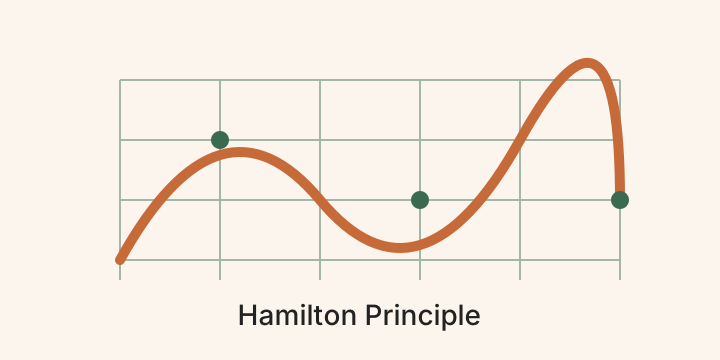
The mental image is a marble that finds the path of least resistance through a landscape of possible histories.
Worked example [Beginner]
Consider a ball of mass thrown straight up. The Lagrangian is kinetic minus potential energy: , where . Ask: among all paths from to over the interval , which one is the realised trajectory?
Compare two candidates by approximating the action as a Riemann sum with three sample points and step size .
Candidate 1: the straight-line guess , with constant velocity . At the integrand is . At it is . The midpoint average over the interval is approximately , matching the exact value.
Candidate 2: the gravity-driven path , with velocity . At the integrand is . At it is . At it is . A rough average gives roughly , matching the exact value of .
The straight-line guess gives a smaller action than the realised path, which seems backwards. The resolution: Hamilton's principle says the action is stationary, not necessarily minimal. For short enough time intervals it is a minimum; for longer intervals it can be a saddle. What this tells us is that the variational principle picks out the physical trajectory among all comparison paths — it does not promise a global minimum.
Check your understanding [Beginner]
Formal definition [Intermediate+]
Let be a smooth manifold (the configuration space) and a smooth function (the Lagrangian). For two points and times , let be the space of smooth paths with , . The action functional is
A variation with fixed endpoints is a smooth one-parameter family , , with . In a chart, with .
Hamilton's principle. A path is a physical trajectory of the Lagrangian system iff is a critical point of , meaning for every variation vanishing at the endpoints.
The corresponding Euler-Lagrange equations in a coordinate chart are
These equations transform covariantly between charts because is a coordinate-independent integral, so the system defines an intrinsic second-order ODE on .
Counterexamples to common slips
- The action need not be a minimum: for time intervals longer than a conjugate point, the physical trajectory is a saddle point of .
- Hamilton's principle on a fixed time interval is not invariant under reparametrisations even when is time-independent. The reparametrisation-invariant statement is Maupertuis' principle of action on a fixed energy level, which gives geodesics in the Jacobi metric.
- The variational principle requires the endpoints to be fixed. Free-boundary variations introduce boundary terms that change the conclusion.
Key theorem with proof [Intermediate+]
Theorem (equivalence of Hamilton's principle and the Euler-Lagrange equations). Let be smooth and let be a smooth path with , . Then is a critical point of on if and only if satisfies the Euler-Lagrange equations in every coordinate chart.
Proof. Work in a single chart on identifying a neighbourhood of the image of with an open set ; the global statement follows by a partition-of-unity argument and the fact that the conclusion is local.
Let be smooth with , and let . Then . Differentiating in and evaluating at ,
Integration by parts on the second term, using to kill the boundary,
Combining,
For the only-if direction, suppose is a critical point. The integrand contracted with arbitrary smooth vanishing at the endpoints integrates to zero. By the fundamental lemma of the calculus of variations applied componentwise, the bracketed expression vanishes pointwise, giving the Euler-Lagrange equations.
For the if direction, suppose satisfies the Euler-Lagrange equations. Then the integrand vanishes identically, so the integral is zero for every variation. Hence is a critical point.
Bridge. The Euler-Lagrange equations derived here builds toward 05.00.03 (Legendre transform), where the fibre derivative , , converts the second-order Euler-Lagrange flow on into the first-order Hamiltonian flow on . The same variational pattern appears again in 05.00.04 (Noether's theorem), where invariance of the Lagrangian under a one-parameter group of diffeomorphisms gives, by the same first-variation calculation along the symmetry direction, a conserved quantity along physical trajectories. The bridge between Hamilton's principle and the symplectic geometry of is exactly the Legendre transform: this is precisely what identifies the Lagrangian formulation with the Hamiltonian formulation. Putting these together, the foundational reason classical mechanics admits two equivalent intrinsic formulations is that the action functional is a single coordinate-free scalar, and its critical points can be described either as a second-order flow on or, by Legendre transform, as a Hamiltonian flow on .
Exercises [Intermediate+]
Lean formalization [Intermediate+]
Mathlib does not currently package the action functional or the first-variation formula as reusable lemmas. A target statement at Mathlib level would be:
[object Promise]The blocking gap is the Banach manifold structure on the path space and a clean statement of the fundamental lemma on a smooth manifold. See lean_mathlib_gap in the frontmatter.
Advanced results [Master]
The variational characterisation of physical trajectories has structural consequences far beyond rederiving Newton's equations.
Coordinate independence and intrinsic mechanics. Because is a single number assigned to a path, its critical-point set is independent of any coordinate choice. The Euler-Lagrange equations in different charts are related by the chain rule in a way that makes their common zero set a well-defined section of . The geometric statement is that there is a canonical second-order vector field on — the Lagrangian semispray — whose integral curves are exactly the physical trajectories.
Reparametrisation pitfall and Maupertuis' principle. Hamilton's principle on a fixed time interval is not invariant under , even when is autonomous. The reparametrisation-invariant principle is Maupertuis' principle: among paths of fixed energy on a Riemannian configuration space with , the physical trajectories are critical points of the abbreviated action . Equivalently, they are geodesics in the Jacobi metric . This is exactly the limit in which mechanics becomes pure geometry — the trajectory of a particle in a potential is a geodesic in a conformally rescaled metric, which is the same as the optical-mechanical analogy that motivated Hamilton's original 1834 paper.
D'Alembert's principle and non-conservative forces. When some forces are not derivable from a potential — friction, externally applied torques, generalised forces in engineering systems — the variational principle generalises to . The resulting equations are . This is d'Alembert's principle of virtual work. The structure of the proof — vary the action, integrate by parts, demand vanishing on arbitrary variations — is identical to the conservative case; only the right-hand side acquires a non-potential term.
Holonomic and nonholonomic constraints. For a holonomic constraint , the augmented Lagrangian on yields, on variation, the constraint (from ) and the equations of motion with constraint force (from ). The Lagrange multiplier is the intrinsic measure of the normal force needed to enforce the constraint. For nonholonomic constraints — velocity-dependent constraints not integrable to a configuration constraint — the situation is subtler: d'Alembert's principle (vary then constrain) and the variational principle (constrain then vary) are not equivalent, and the physical answer is d'Alembert.
Field theory generalisation. For a field on spacetime valued in a target manifold , the action is . Variations with compactly supported give the Euler-Lagrange field equations . Klein-Gordon, Maxwell, Yang-Mills, and the Einstein-Hilbert action of general relativity all fit this template. The transition from particle mechanics to field theory is exactly the transition from to a jet bundle of sections of a fibre bundle over , with the Lagrangian a function on the first jet.
Synthesis. The action functional is a single geometric scalar attached to a path, and Hamilton's principle says nothing more than that physical trajectories are its critical points. The foundational reason this principle is equivalent to Newton's laws — and not merely a reformulation but a generalisation — is that the principle generalises cleanly to settings where Newton's laws cease to make immediate sense: to mechanical systems on Lie groups (rigid-body and fluid dynamics, where the Euler-Arnold equations arise as Euler-Lagrange equations of a one-sided-invariant Lagrangian on ), to constrained systems with nonholonomic constraints, and to relativistic field theories where there is no preferred time. This is exactly the same conceptual pattern as the move from coordinate-bound calculus to differential forms: a global invariant scalar, a derivative operator, and a fundamental lemma replace ad hoc local computations. Putting these together, the variational characterisation identifies physical trajectories with critical points of — and the bridge between this analytical statement and the symplectic geometry of is the Legendre transform, which produces the Hamiltonian flow as the dual picture. Read in the opposite direction, the existence of an action principle for a system is itself a structural fact: every system whose dynamics can be derived from a Lagrangian has the symplectic structure of available to it, with all the conservation laws (Noether), integrability theorems (Liouville-Arnold), and reduction techniques (Marsden-Weinstein) that flow from that structure.
Full proof set [Master]
Lemma (fundamental lemma of the calculus of variations on a manifold). Let be a smooth manifold, a smooth path, and a continuous section of $\gamma^ T^Q\gamma\int_{t_0}^{t_1} \omega(\eta), dt = 0\eta\gamma^ TQt_0t_1\omega \equiv 0$.*
Proof. In a chart, pulled back along . The hypothesis becomes for all smooth vanishing at the endpoints. Apply the -version of the lemma componentwise: choose for a bump supported near a hypothetical zero of , contradiction. The chart-independent statement follows because vanishing of a section is a local property.
Theorem (Hamilton's principle on ). Let be smooth and a smooth path with , . The path is a critical point of on iff satisfies the Euler-Lagrange equations in every coordinate chart.
Proof. Proved in §Key theorem above; the chart-by-chart argument together with the lemma above gives the global statement.
Theorem (Maupertuis' principle). On a Riemannian configuration space with and energy , the physical trajectories of energy are critical points of the abbreviated action on the space of paths from to with . Equivalently, they are geodesics of the Jacobi metric .
Proof sketch. Fix the energy along the path. Conservation of energy along an Euler-Lagrange trajectory makes automatic. The action splits as , and using gives . Critical points of at fixed energy are critical points of . The Jacobi-metric form follows from , which is the length functional for .
Connections [Master]
Lagrangian on
05.00.01. Hamilton's principle is the variational characterisation of the second-order ODE on defined by a Lagrangian; the Euler-Lagrange equations identify the integral curves of the Lagrangian semispray.Legendre transform
05.00.03. The fibre derivative converts the Euler-Lagrange flow into the Hamiltonian flow ; this is exactly the bridge between Hamilton's principle and the symplectic geometry of phase space.Noether's theorem
05.00.04. A one-parameter symmetry group of the Lagrangian gives, by the same first-variation calculation along the symmetry direction, a conserved quantity along physical trajectories — translation gives momentum, rotation gives angular momentum, time-translation gives energy.Cotangent bundle
05.02.05. The Hamiltonian formulation lives on with its canonical symplectic form ; Hamilton's principle on is the Lagrangian shadow of the variational principle on extended phase space.Hamilton-Jacobi equation
05.05.04. Viewing the action as a function of the endpoint of a path of physical trajectories produces a solution of the partial differential equation ; this is the bridge from the variational principle to the WKB / geometric-optics regime.Moment map
05.04.01. When a Lie group acts on preserving the Lagrangian, the Noether-conserved quantity is exactly the moment map of the lifted action on — the Lagrangian symmetry and the Hamiltonian moment-map construction are the same data viewed through the Legendre transform.
Historical & philosophical context [Master]
Pierre-Louis Maupertuis announced a principle of least action in 1744 in a paper to the French Academy of Sciences, claiming that nature acts so as to minimise a quantity called action (which he identified imprecisely with ) [pending]. His statement was metaphysical as much as mathematical and the precise formulation was due to Euler in the same year, working independently. Joseph-Louis Lagrange's 1788 Mécanique analytique placed the variational principle on solid analytical foundations and derived the equations now bearing his name in their general coordinate form, treating mechanics as a subject reducible to analysis without diagrams [pending].
William Rowan Hamilton's 1834 paper On a general method in dynamics in Phil. Trans. R. Soc. [Hamilton 1834] introduced the modern formulation. Hamilton's contribution was to view the action as a function of the endpoint of an extremal path — this characteristic function turned the variational principle into a tool for solving the equations of motion via the Hamilton-Jacobi partial differential equation. Hamilton's motivation was the optical-mechanical analogy: the same mathematics governs Fermat's principle of stationary time in optics and the principle of stationary action in mechanics, and the wave-front geometry of optics has a direct counterpart in the level sets of the characteristic function. This analogy was the conceptual seed of Schrödinger's wave mechanics nearly a century later.
V. I. Arnold's Mathematical Methods of Classical Mechanics (1974 in Russian; Springer GTM 60, 2nd English edition 1989) established the modern geometric framing in which Hamilton's principle is a statement about a real-valued functional on a space of paths in a configuration manifold, with the Euler-Lagrange equations interpreted intrinsically as a second-order vector field on [pending]. Abraham-Marsden's Foundations of Mechanics (1967, 2nd ed. 1978) and Marsden-Ratiu's Introduction to Mechanics and Symmetry (1994/1999) developed the symmetry-and-reduction programme that connects Hamilton's principle to symplectic reduction, the moment map, and the geometric origins of conservation laws [pending].