Lagrangian mechanics on the tangent bundle
Anchor (Master): Abraham-Marsden *Foundations of Mechanics* §3.5; Arnold *Mathematical Methods* §4 + Appendix 1; Souriau *Structure des systèmes dynamiques* (1970); Lagrange *Mécanique analytique* (1788, originator)
Intuition [Beginner]
Classical mechanics asks: given a system of particles or a rigid body, what path does it follow over time? The Lagrangian answer reframes the question. Instead of writing forces and integrating Newton's equations, you write a single number for every state — the Lagrangian — and the system follows whichever path makes the total of along it as small as possible (more precisely, a critical value).
The state of a mechanical system has two parts: where it is and how fast it is moving. A pendulum's state is its angle and its angular velocity. A planet's state is its position and its velocity. Together these form a single point in a doubled-up space called the tangent bundle — one copy of the configuration space for positions, another for velocities at each position. The Lagrangian eats such a state and returns a number, usually built from kinetic energy minus potential energy.
The Euler-Lagrange equations are what falls out when you ask "for which paths is the total extremised?" They reproduce Newton's second law for a particle in a potential, give the geodesic equation on a curved surface, and govern almost every mechanical system you can write down.
Visual [Beginner]
A schematic of a configuration space with a path on it, alongside the tangent bundle where the lifted path lives. The action is the area swept by the Lagrangian along the lifted path; the equation of motion says this area is at a critical value.
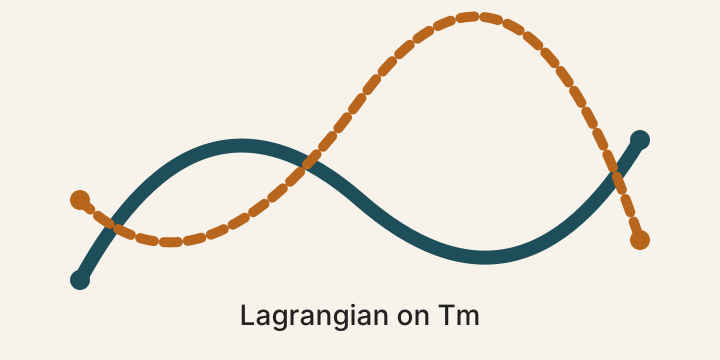
The picture to keep in mind: the configuration space holds positions, the tangent bundle holds positions-and-velocities together, and the Lagrangian assigns a single number to each such position-velocity pair.
Worked example [Beginner]
Take a single particle of mass moving along a line in the potential (a harmonic oscillator with spring constant ). The Lagrangian is kinetic energy minus potential energy:
The Euler-Lagrange equation rearranges into Newton's second law. The momentum-like quantity is ; its rate of change is . The position-derivative of is . Setting "rate of change of equals position-derivative of " gives , equivalent to . The solutions are — the ordinary harmonic motion.
What this tells us: the Lagrangian encodes the same physical content as Newton's second law , packaged as one scalar function on the tangent bundle. Pick the right and the equation of motion appears mechanically.
Check your understanding [Beginner]
Formal definition [Intermediate+]
Let be a smooth manifold of dimension , called the configuration space. Its tangent bundle is the smooth -dimensional manifold whose points are pairs with and . In local coordinates on , the induced coordinates on are written — the are the components of in the basis .
A Lagrangian is a smooth function . The action functional assigns to each smooth path the real number
where is the velocity of at time .
A variation of with fixed endpoints is a smooth one-parameter family , , with and , for all . The path is a critical point of if for every such variation.
In coordinates, the Euler-Lagrange equations for a critical path are
The Lagrangian is regular at if the fibre Hessian at . Regularity at every point makes the Euler-Lagrange system a second-order ODE on (equivalently a vector field on ). The Lagrangian is hyper-regular if the fibre derivative , , is a global diffeomorphism — the hypothesis required for the Hamiltonian formulation.
Counterexamples to common slips
- The fibre Hessian condition is not redundant. on has ; the Euler-Lagrange equation collapses to the algebraic identity rather than determining . Singular Lagrangians appear in gauge theory and require constraint analysis (Dirac-Bergmann).
- Adding a total time derivative changes the action by a boundary term, not the equations of motion. If , then . Variations with fixed endpoints leave the boundary term invariant, so and have identical critical paths.
- The Euler-Lagrange equation transforms covariantly under change of coordinates on . This is what makes the formulation manifold-intrinsic: solutions are paths in , not coordinate expressions, and the equations have the same form in any chart.
Key theorem with proof [Intermediate+]
Theorem (variational characterisation of motion). Let be a smooth Lagrangian and a smooth path. Then is a critical point of the action among paths with fixed endpoints if and only if satisfies the Euler-Lagrange equations
Proof. Work in a coordinate chart on in which the path stays. Let be a smooth one-parameter variation with (the variation is a vector field along vanishing at the endpoints). Differentiate in at :
Integrate the second term by parts. The boundary contribution vanishes because vanishes at the endpoints. The bulk gives
This integral vanishes for every smooth vanishing at the endpoints if and only if the bracketed coefficient vanishes for every and every . (The implication "vanishes for every implies coefficient vanishes" is the fundamental lemma of the calculus of variations: if a continuous function on satisfies for every smooth bump function supported in the interior, then — supported by choosing to be a bump concentrated where has a definite sign.)
The vanishing of the coefficient is exactly the Euler-Lagrange equation. Conversely, if the Euler-Lagrange equation holds along , the integrand vanishes pointwise and is a critical point.
Bridge. The Euler-Lagrange computation here builds toward the coordinate-free symplectic formulation of mechanics: the Poincaré-Cartan one-form on encodes the same data, and the Euler-Lagrange equations reappear as for the energy . This identifies Lagrangian dynamics on with the geometry of a particular two-form on , the same template that appears again in the Hamiltonian setting 05.01.02 where carries its canonical symplectic form. The Legendre transform identifies primitives with primitives — pulling on back to on — and putting these together one sees that classical mechanics is the foundational source of symplectic geometry: every standard Hamiltonian system on is dual to a hyper-regular Lagrangian system on .
Exercises [Intermediate+]
Advanced results [Master]
The coordinate-free Lagrangian formalism on admits a structure that mirrors the symplectic formalism on and provides the bridge between them.
The Poincaré-Cartan one-form and the Lagrangian two-form. Given a Lagrangian , the Poincaré-Cartan one-form is
Its construction is intrinsic: where is the canonical one-form on and , , is the fibre derivative (Legendre transform). The Lagrangian two-form is closed by construction; it is non-degenerate at exactly when the fibre Hessian is non-degenerate at — that is, exactly when is regular at .
The energy function and the Lagrangian vector field. The energy associated to is
where is the Liouville (dilation) vector field on that scales fibres of . For with quadratic in , Euler's theorem on homogeneous functions gives , so — the total mechanical energy.
Theorem (intrinsic Euler-Lagrange equation). For a regular Lagrangian , the Euler-Lagrange equations on are equivalent to the equation
for the unique second-order vector field on . The integral curves of project to solutions of the Euler-Lagrange system on .
This is the cleanest statement: a regular Lagrangian determines a closed two-form and a function , and the equation of motion is the Hamiltonian-style equation for relative to . When is hyper-regular and defines the Hamiltonian on , the fibre derivative pulls the canonical symplectic form on back to on , and the Lagrangian vector field is -related to the Hamiltonian vector field .
Regularity, hyper-regularity, and the Legendre map. The fibre derivative is a fibrewise map covering the identity on . The differential of along the fibre at is the Hessian . Regular means is a local diffeomorphism; hyper-regular means a global diffeomorphism. Hyper-regularity is the standard hypothesis under which Lagrangian and Hamiltonian formulations are interconvertible. The harmonic oscillator and any geodesic Lagrangian are hyper-regular; the relativistic point-particle Lagrangian is regular but not hyper-regular without further care; gauge Lagrangians like on are not even regular, requiring constraint analysis.
Examples.
Free particle on . . Hyper-regular. . . Euler-Lagrange: . Solutions are straight lines at constant velocity.
Particle in a potential. . Hyper-regular. . Euler-Lagrange: — Newton's second law.
Geodesics on a Riemannian manifold . . Hyper-regular (the fibre Hessian is the metric tensor itself). The fibre derivative is , the musical isomorphism. Euler-Lagrange yields the geodesic equation . The geodesic flow on is the Lagrangian vector field .
Pendulum. , . Hyper-regular. . Euler-Lagrange: . The phase portrait on has the libration-rotation separatrix at energy .
Synthesis. The Lagrangian formulation generalises Newton's laws from the metric setting on to mechanics on an arbitrary smooth manifold. The action is the bridge between the path-space view (motion as a critical point of an integral) and the field-on- view (motion as the integral curve of a vector field). This is exactly the relation that recurs throughout symplectic geometry: a closed two-form plus a function determines a vector field, and integrating that vector field reproduces the dynamics. Putting these together one sees that the Lagrangian and Hamiltonian sides of classical mechanics are dual presentations of the same data: the Poincaré-Cartan one-form on and the canonical one-form on are pulled to one another by the Legendre map, and the foundational reason classical mechanics gives rise to symplectic geometry is exactly this — the variational principle on identifies critical paths with integral curves of the Lagrangian vector field, and the Legendre map identifies that vector field with the Hamiltonian flow of on . The bridge is constructed once and runs in both directions.
Full proof set [Master]
Lemma (fundamental lemma of the calculus of variations). Let be continuous and suppose for every smooth with . Then .
Proof. Suppose for some , say . By continuity, on a neighbourhood . Choose a smooth bump supported in this neighbourhood with . Then , contradicting the hypothesis.
Lemma (variational derivative of the action). Let be a one-parameter family of paths with and variation . Then
Proof. Differentiate under the integral, . Integrate the second term by parts: . Combine.
Theorem (variational characterisation of motion, restated). A path is a critical point of among variations with fixed endpoints if and only if satisfies the Euler-Lagrange equations.
Proof. Combining the two preceding lemmas: is critical iff for every with , iff (by the fundamental lemma applied component-wise) the integrand coefficient vanishes pointwise, iff satisfies the Euler-Lagrange equations.
Theorem (intrinsic Euler-Lagrange equation). Let be regular. There exists a unique second-order vector field on satisfying where and . Its integral curves project to Euler-Lagrange solutions on .
Proof sketch. In coordinates, . Compute . The second-order condition on is fixed; the equation at the -component reads . Regularity of inverts the fibre Hessian to determine uniquely; this along integral curves, recovering the Euler-Lagrange equation. The construction of from the fibre derivative shows the equation is coordinate-independent.
Connections [Master]
Hamilton's principle of least action
05.00.02. The variational characterisation proved here is the formal version of the principle of least action: a path is a motion if and only if its action is critical. The principle is the foundational axiom from which the Euler-Lagrange equations are derived.Legendre transform / fibre derivative
05.00.03. The Legendre transform , , is the bridge between the Lagrangian formalism on the tangent bundle developed here and the Hamiltonian formalism on the cotangent bundle. The Hamiltonian is .Noether's theorem
05.00.04. Continuous symmetries of a Lagrangian system give conserved quantities along solutions of the Euler-Lagrange equations. Translation symmetry of in conserves the conjugate momentum ; time-translation symmetry conserves the energy .Symplectic manifold
05.01.02. The two-form on is symplectic when is regular; it is the pullback of the canonical symplectic form on along the Legendre map. Lagrangian mechanics is the foundational source of symplectic structures on cotangent bundles, the prototype symplectic manifolds.Cotangent bundle
05.02.05. The Lagrangian formulation on is dual, via the Legendre transform, to the Hamiltonian formulation on . The Poincaré-Cartan one-form on pulls back from the canonical one-form on .Variational calculus on manifolds
03.04.08. The Euler-Lagrange machinery developed there is the differential-forms framework underlying the proof of the variational characterisation theorem above; this unit specialises to the mechanics setting where the integrand has the specific form .
Historical & philosophical context [Master]
Joseph-Louis Lagrange's Mécanique analytique (1788) [Lagrange 1788] introduced the analytical formulation of mechanics. Working without the modern apparatus of manifolds and tangent bundles, Lagrange wrote the equations of motion in generalised coordinates — coordinates adapted to the constraints of the system rather than Cartesian space — and derived the Euler-Lagrange equations from a variational principle. The book opens with the famous remark that it contains no diagrams, and the entire mechanics of constrained systems is reduced to the manipulation of a single function . This was the first complete coordinate-invariant treatment of mechanics; the manifold structure was implicit in the freedom to choose generalised coordinates, even though smooth manifolds as a formal notion were a nineteenth-century development.
Felix Klein's Erlangen programme (1872) and the rise of differential geometry in the work of Riemann and his successors provided the language in which Lagrange's formalism could be stated intrinsically. Élie Cartan's Leçons sur les invariants intégraux (1922) [Cartan 1922] introduced the Poincaré-Cartan one-form and gave the modern coordinate-free expression of the Euler-Lagrange equations as a relation between differential forms on phase space. Jean-Marie Souriau's Structure des systèmes dynamiques (1970) [Souriau 1970] and Ralph Abraham and Jerrold Marsden's Foundations of Mechanics (1978) [Abraham-Marsden] codified the fully manifold-theoretic version: configuration space is a smooth manifold , the Lagrangian is a function , the Lagrangian two-form on is the pullback of the canonical symplectic form on along the fibre derivative, and the equation of motion is the integral curve of the Lagrangian vector field .
Vladimir Arnold's Mathematical Methods of Classical Mechanics (Russian original 1974, English 1978) [Arnold] became the standard pedagogical exposition. Arnold's framing places the geometric objects first — configuration manifold, tangent bundle, Lagrangian — and treats coordinate calculations as derived. The fibre derivative, the variational principle, and the bridge to Hamiltonian mechanics via the Legendre transform are presented as a single coherent development; Lagrange's coordinate computations are the local form of an intrinsic geometric structure.
The conceptual claim — that mechanics is the geometry of together with a Lagrangian — has propagated far beyond classical mechanics. Field theory replaces with a jet bundle and the Lagrangian with a Lagrangian density; gauge theory replaces with a connection-dependent functional on the space of connections; string theory studies infinite-dimensional analogues on loop and path spaces.