Noether's theorem
Anchor (Master): Noether 1918 *Invariante Variationsprobleme* (originator); Olver *Applications of Lie Groups to Differential Equations* Ch. 4-5; Marsden-Ratiu *Introduction to Mechanics and Symmetry* Ch. 4 + 11; Arnold §20
Intuition [Beginner]
A symmetry of a physical system is a transformation that leaves the rules of motion unchanged. If you do an experiment in your kitchen, then carry the apparatus to the next room and repeat the experiment, you get the same result: the laws of mechanics do not depend on where in space you stand. Spatial translation is a symmetry. Likewise, rotating the apparatus by any angle, or running the experiment tomorrow instead of today, gives the same outcome. Each of these symmetries reflects a deep structural feature of the system.
Noether's theorem says that every continuous symmetry of a mechanical system corresponds to a quantity that does not change as the system evolves. Translation in space gives momentum. Translation in time gives energy. Rotation gives angular momentum. The pattern is exact, not metaphorical: each conserved quantity is built directly out of the symmetry that generates it.
The reason this is striking is that conservation laws had been discovered empirically over centuries by Galileo, Newton, Euler, and others, each as a separate fact about specific systems. Noether's theorem builds toward a single explanation: conservation is the shadow of symmetry. The same theorem appears again in field theory and in modern gauge theory, where it underlies the conservation of electric charge and every other physical current.
Visual [Beginner]
A picture of a particle's trajectory in two-dimensional space, with a one-parameter family of translated copies of the trajectory drawn beside it. An arrow labelled "symmetry direction" points along the family. A second arrow shows the conserved quantity (a single number) that stays the same as the particle moves along its actual path. The visual conveys that a symmetry direction in the space of all paths gives rise to a function on the system that does not change with time.
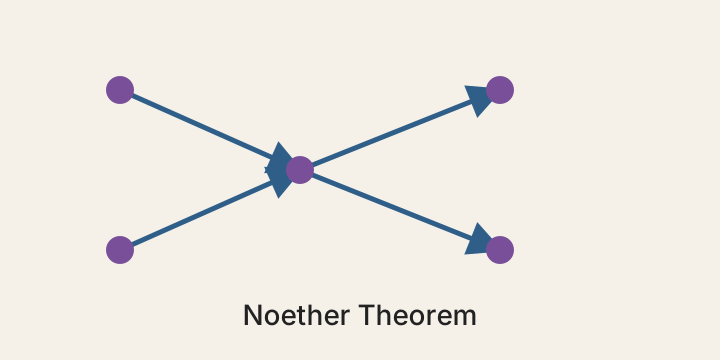
The mental image is a slider that shifts the entire trajectory along a symmetry direction; if the physics does not notice the shift, then a specific number — the conserved quantity — does not change as the particle moves.
Worked example [Beginner]
Consider a free particle of mass moving along a line, with Lagrangian , where is the velocity. The position does not appear in — the Lagrangian is invariant under the spatial translation for every real number . The infinitesimal generator of this family of symmetries is the vector field in the direction.
Noether's recipe says: the conserved quantity is the rate of change of with respect to velocity, multiplied by the symmetry direction. The slope of in the velocity direction is , and multiplying by the symmetry direction gives the candidate .
Check that is conserved. The free particle satisfies Newton's first law: , so is constant. So is constant in time. With initial velocity , the conserved quantity is , and that value persists for all time.
What this tells us is that translation invariance of the Lagrangian forces — linear momentum — to be conserved. The same recipe applied to a rotationally invariant Lagrangian gives angular momentum; applied to a time-translation symmetry, it gives energy. The recipe is mechanical and uniform across cases.
Check your understanding [Beginner]
Formal definition [Intermediate+]
Let be a smooth manifold and a smooth Lagrangian. A one-parameter family of transformations of is a smooth map with a diffeomorphism for each and . The infinitesimal generator is the vector field defined by .
The family lifts to a one-parameter family of diffeomorphisms of via the tangent map: . The infinitesimal generator of the lifted family is the prolongation , defined as . In a chart on with , the prolongation reads .
The Lagrangian is invariant under if for every . The infinitesimal version is , where denotes the Lie derivative along acting on smooth functions .
The Noether charge associated to is the smooth function defined in coordinates by
The intrinsic definition is , where is the Poincaré-Cartan one-form on .
Counterexamples to common slips
- The lift to matters: a function on that is -invariant gives a -invariant pullback to , but a Lagrangian that depends on requires the prolongation , not just , to act correctly.
- Discrete symmetries (parity, time reversal) do not produce Noether charges. The theorem requires a continuous one-parameter family.
- A symmetry of the equations of motion need not be a symmetry of the Lagrangian. The hypothesis is invariance of (or, more generally, invariance of up to a total time derivative — a divergence symmetry).
- If is invariant only up to a total time derivative , the Noether charge picks up an additional term involving the generating function .
Key theorem with proof [Intermediate+]
Theorem (Noether 1918). Let be smooth and let be a one-parameter family of diffeomorphisms of generated by . If is invariant under , that is for all , then the Noether charge is constant along every solution of the Euler-Lagrange equations.
Proof. Work in a coordinate chart on . Let be a smooth path satisfying the Euler-Lagrange equations . Differentiate the invariance condition with respect to at . The left side becomes the action of the prolongation on :
where the last term uses along , which equals in the chart. Now substitute the Euler-Lagrange equation into the right-hand side:
Hence is constant along . The chart-independent statement follows because is an intrinsic scalar on and the Euler-Lagrange equations are an intrinsic second-order ODE on .
Bridge. The Noether charge derived here builds toward 05.04.01 (moment map), where a Lie-group action on a symplectic manifold by symplectomorphisms is encoded by a single map whose components are the Noether charges of the individual one-parameter subgroups. The same first-variation pattern appears again in 05.01.02 (symplectic manifold), where the Hamiltonian shadow of Noether's theorem is the Poisson-commutation : a function on phase space generates a one-parameter family of canonical transformations preserving if and only if is constant along the Hamiltonian flow of . The bridge between the Lagrangian Noether construction and the Hamiltonian moment map is the Legendre transform: this is exactly what identifies the Lagrangian conserved quantity with the moment-map component in dual coordinates on . Putting these together, the foundational reason classical conservation laws line up with the symplectic moment-map theory is that both are coordinate expressions of the same intrinsic data — a one-parameter group of symmetries of the action functional.
Exercises [Intermediate+]
Lean formalization [Intermediate+]
Mathlib does not currently package the Noether correspondence between Lagrangian symmetries and conserved quantities. A target statement at Mathlib level would be:
[object Promise]The blocking gap is the prolongation of a vector field on to one on as a Mathlib-level construction, together with the clean Euler-Lagrange-equation statement noted in lean_mathlib_gap.
Advanced results [Master]
The Noether correspondence is the structural backbone of the symmetry-conservation programme in mechanics and field theory.
Hamiltonian counterpart. Pass to the cotangent bundle 05.02.05 via the Legendre transform 05.00.03. A vector field on lifts to a Hamiltonian vector field on whose Hamiltonian function is . The condition becomes the Poisson-bracket identity , where is the corresponding Hamiltonian. The Lagrangian conserved quantity and the Hamiltonian conserved quantity are the same function on in dual coordinates: this is exactly the bridge between the two formulations.
Moment maps. When a Lie group acts on by diffeomorphisms preserving , every generates a vector field and a corresponding Noether charge . The map defined by is the moment map 05.04.01 of the lifted action. Equivariance of under the coadjoint action of on is automatic when is connected and the action lifts canonically. The Marsden-Weinstein reduction theorem then identifies the symplectic quotient with a smaller symplectic manifold on which the reduced Hamiltonian flow lives. Noether's theorem is the input data; moment-map theory is the geometric output.
Field theory and the Noether currents. For a Lagrangian density on a spacetime , infinitesimal symmetries give rise not to a single conserved scalar but to a conserved current satisfying . Spacetime translations give the canonical stress-energy tensor; Lorentz transformations give the angular-momentum-and-boost current; internal symmetries give gauge currents (electromagnetic, isospin, baryon number, lepton number). General relativity, Yang-Mills, and the Standard Model all rest on this template. The relation between a one-parameter symmetry of and a conservation law generalises the Lagrangian charge from a function on to a section of — the conserved -form on spacetime.
Inverse Noether. A function Poisson-commuting with generates a one-parameter family of canonical transformations preserving — the symplectic-manifold 05.01.02 viewpoint. Pulled back to the Lagrangian side under the Legendre transform, is the Noether charge of a one-parameter family of generalised symmetries — symmetries that may act on the velocities as well as the positions, or that lift only to rather than to . The Cartan-Lie classification of symmetries of variational problems, due to Lie and refined by Cartan and Olver, gives the precise correspondence: every conserved quantity in a regular variational problem is generated by a generalised symmetry, and conversely. The classical Noether's theorem is the special case where the symmetry is a point transformation — acting on alone — rather than a generalised contact or higher-order symmetry.
Divergence symmetries. A vector field on for which for some function is a divergence symmetry. The associated conserved charge is . Galilean boosts of a free particle illustrate the construction: the boost sends to itself plus the total derivative , and the corresponding Noether charge is , conserved under uniform motion. Divergence symmetries do not generate further isolated conservation laws beyond those from strict symmetries, but they are essential for capturing centre-of-mass relations and for understanding the Galilean and Poincaré algebras.
Synthesis. The Noether correspondence identifies symmetries with conservation laws: every smooth one-parameter family of symmetries of the action functional generates a function on that is constant along physical trajectories. The foundational reason this correspondence works is that both the action 05.00.02 and the symmetry are intrinsic geometric data on the configuration manifold — the action is a coordinate-free real number attached to a path, and a symmetry is a coordinate-free vector field — so their interaction must produce a coordinate-free conserved scalar. The bridge between the Lagrangian Noether charge and the Hamiltonian moment map 05.04.01 is the Legendre transform 05.00.03: this is exactly what identifies the function on with the linear-in- Hamiltonian on , putting the theorem and the moment-map construction on the same footing. Putting these together, classical mechanics, gauge theory, and general relativity all share the same conservation-law machinery: pick a continuous symmetry of the action, run the Noether recipe, read off the current. Read in the opposite direction, every conservation law in a regular variational problem generalises to a Lie-symmetry generator under the Cartan-Lie classification, so the bridge between conserved quantities and symmetries is exact rather than approximate. The same theorem appears again in field theory as Noether currents and recurs in modern gauge theory as the source of every physical conservation law — electric charge, baryon number, and stress-energy among them.
Full proof set [Master]
Theorem (Noether, Lagrangian form). Let be smooth and let generate a one-parameter family of diffeomorphisms of . If for all , then is constant along solutions of the Euler-Lagrange equations.
Proof. Proved in §Key theorem above; the chart-by-chart calculation together with the intrinsic identification gives the global statement.
Theorem (divergence-symmetry generalisation). If generates a one-parameter family for which for some smooth , then the modified charge is constant along solutions of the Euler-Lagrange equations.
Proof. In a chart, differentiate the relation at . The left side gives , and the right side gives . Substituting the Euler-Lagrange equation and rearranging produces , so is conserved.
Theorem (Hamiltonian counterpart and moment map). Let be a smooth left action of a Lie group preserving , with infinitesimal action . Define by . Then is a momentum map for the cotangent-lifted action, and each component Poisson-commutes with the Hamiltonian .
Proof. The cotangent-lifted action of on preserves the canonical one-form because the lift is by pullback of diffeomorphisms. Hence it preserves . The vector field generating the -component of the action on is , which satisfies , the defining equation for to be a Hamiltonian function for . Equivariance under the coadjoint action follows from the chain rule. Poisson-commutation is the Hamiltonian shadow of pushed forward by .
Theorem (field-theory Noether). Let be a smooth Lagrangian density on (the first jet bundle of a fibre bundle over an -dimensional spacetime ), and let be a smooth vector field on that prolongs to a symmetry of . Then the Noether current satisfies on solutions of the Euler-Lagrange field equations.
Proof sketch. Replicate the point-particle proof on the jet bundle: differentiate the symmetry condition at , substitute the Euler-Lagrange field equations , and recognise the result as . The divergence-symmetry generalisation goes through verbatim, replacing by for some -form and modifying the current to .
Connections [Master]
Hamilton's principle
05.00.02. The Noether-theorem proof reuses the first-variation calculation underlying Hamilton's principle, applied along the symmetry direction rather than along an arbitrary fixed-endpoint variation; the same integration-by-parts pattern produces both the Euler-Lagrange equations and the conserved Noether charge.Legendre transform
05.00.03. The fibre derivative converts the Lagrangian Noether charge into the linear-in- Hamiltonian on phase space, identifying the Lagrangian and Hamiltonian sides of the symmetry-conservation correspondence.Moment map
05.04.01. When a Lie group acts on preserving the Lagrangian, the assembled Noether charges for form the components of the moment map of the cotangent-lifted action; the Lagrangian symmetry datum and the Hamiltonian moment-map datum are the same object viewed through the Legendre transform.Symplectic manifold
05.01.02. Noether's correspondence is the input that makes Marsden-Weinstein symplectic reduction possible: once the conserved quantities form a moment map for a group action, the level sets descend to a smaller symplectic manifold capturing the reduced dynamics.Lagrangian on
05.00.01. The intrinsic statement of Noether's theorem uses the Poincaré-Cartan one-form on defined by the Lagrangian, packaging the conserved charge as .Hamilton-Jacobi equation
05.05.04. Conserved Noether charges are constants of integration in the Hamilton-Jacobi separation-of-variables programme: each Poisson-commuting symmetry of supplies a coordinate that separates the Hamilton-Jacobi PDE, reducing the dynamics to quadrature on the level sets of the conserved quantities.
Historical & philosophical context [Master]
Emmy Noether's Invariante Variationsprobleme, presented to the Königliche Gesellschaft der Wissenschaften zu Göttingen in 1918 and published in the Nachrichten of that society [Noether 1918], established what is now called Noether's theorem (and its second theorem, on infinite-dimensional symmetries and Bianchi identities, central to the gauge theories developed decades later). The paper was submitted by Felix Klein and David Hilbert in connection with their work on the variational structure of general relativity: Hilbert had derived the Einstein field equations from a variational principle in late 1915, and a question about the apparent failure of energy conservation in the resulting theory motivated the search for a precise relation between symmetries and conservation laws. Noether's two theorems supplied the answer, and the second theorem in particular explained why energy conservation in general relativity takes a different form from its Newtonian counterpart.
Noether had been an unpaid Privatdozentin at Göttingen, denied a salaried position because of her sex despite Hilbert's repeated advocacy, and the Invariante Variationsprobleme paper appeared while her position remained informally precarious. Her result was recognised within a small circle (Hilbert, Klein, Weyl) but did not enter mainstream physics curricula until the 1950s, when the rise of gauge field theory made the Noether correspondence the canonical organising principle of conservation laws. Hermann Weyl's 1929 gauge principle, the source of modern Yang-Mills theory, is in retrospect a direct continuation of Noether's second theorem — local gauge invariance forces the existence of a connection one-form whose curvature drives the dynamics, and the associated conserved currents are the Noether currents of the local symmetry.
V. I. Arnold's Mathematical Methods of Classical Mechanics (1974 Russian, 1989 second English edition) [pending] gave Noether's theorem the modern coordinate-free framing in §20, presenting it as a statement about vector fields on the configuration manifold and their prolongations to . P. J. Olver's Applications of Lie Groups to Differential Equations (1986; 2nd ed. 1993) [pending] developed the algebraic-geometric extension to generalised symmetries on jet bundles, giving the inverse-Noether classification and the field-theory Noether current in its full generality. Marsden-Ratiu's Introduction to Mechanics and Symmetry [pending] tied the theorem into the moment-map and reduction programme that dominates the modern symplectic-mechanics literature.