Hilbert space
Anchor (Master): Reed-Simon Vol. I §II; Conway §I
Intuition [Beginner]
A Hilbert space is a setting where dot-product geometry still works, even when the vectors are functions or infinite lists.
The dot product answers three questions at once: how long is a vector, what angle do two vectors make, and what is the shadow of one vector on another? A Hilbert space keeps those answers and adds completeness, so limits of converging approximations remain inside the space.
This is why quantum mechanics uses Hilbert spaces. A state can be a wavefunction rather than an arrow in ordinary space, but length, angle, projection, and orthogonality still make sense [quantum-well Hilbert Space.md].
Visual [Beginner]
In a Hilbert space, projection is still geometry. A vector splits into the closest point on a subspace plus a perpendicular error.
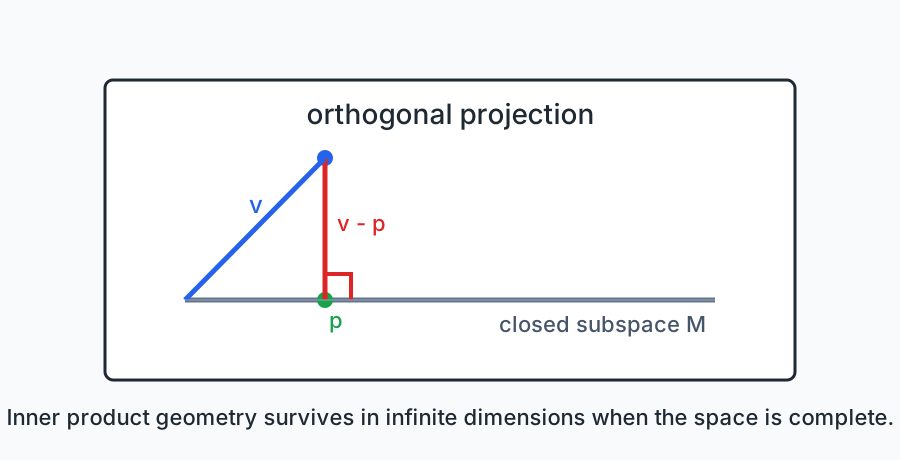
That picture is finite-dimensional, but the theorem survives for closed subspaces of Hilbert spaces. The word "closed" matters because it prevents the closest point from being missing.
Worked example [Beginner]
Think of a sound wave as a vector. One pure tone is another vector. Projecting the sound wave onto the pure tone measures how much of that tone is present.
If two tones are orthogonal, they do not overlap under the inner-product measurement. A complicated signal can be decomposed into mutually orthogonal tones, and the length-squared of the signal splits into contributions from those tones.
The same idea appears in quantum mechanics: projecting a state onto a measurement direction gives the amplitude for that outcome. Hilbert spaces are the geometry behind that rule.
Check your understanding [Beginner]
Formal definition [Intermediate+]
Let be a vector space over or 01.01.03. An inner product on is a function
that is linear in one variable, conjugate symmetric, and positive definite:
The inner product defines a norm
A Hilbert space is an inner-product space that is complete for this norm [Reed-Simon Vol. I §II]. Thus every Hilbert space is a Banach space 02.11.04, but not every Banach space is Hilbert; the norm must arise from an inner product.
Vectors are orthogonal if . A family is orthonormal if each vector has norm one and distinct vectors are orthogonal.
Key theorem with proof [Intermediate+]
Theorem (Cauchy-Schwarz inequality). For all vectors in an inner-product space,
Proof. If , both sides are zero. Assume . In the real case, for every scalar ,
This quadratic polynomial in is nonnegative for all real , so its discriminant is nonpositive:
Taking square roots gives the result.
In the complex case, choose a scalar with such that . Apply the real calculation to the real-valued expression for real . This yields the same inequality.
Bridge. The construction here builds toward 02.11.03 (unbounded self-adjoint operators), where the same data is upgraded, and the symmetry side is taken up in 03.10.02 (cft basics). The defining pattern appears again in those units in a sharpened form, where the local data is glued or quotiented. Putting these together, the foundational insight is that the data of this unit gives the structural signature that the rest of the strand reads off.
Exercises [Intermediate+]
Lean formalization [Intermediate+]
lean_status: partial — Mathlib has inner-product spaces, Hilbert spaces via CompleteSpace, orthogonal projection, and Cauchy-Schwarz. The current unit records the project-facing concept; later spectral-theorem units need more operator-theoretic infrastructure.
Projection theorem [Master]
Let be a closed linear subspace of a Hilbert space . For every , there is a unique such that . This is the orthogonal projection of onto [Conway §I].
Existence follows by minimizing the distance from to . Completeness and closedness produce a limit point in for a minimizing sequence, while the parallelogram identity forces that minimizing sequence to be Cauchy. Uniqueness follows from the Pythagorean identity: if both have perpendicular errors, then is perpendicular to itself, so it is zero.
The projection theorem implies the orthogonal decomposition
for every closed subspace .
Bases, operators, and spectral theory [Master]
Hilbert spaces admit orthonormal bases in the analytic sense: a vector is recovered as a norm-convergent expansion in basis vectors. This generalizes Fourier series and gives as the model separable infinite-dimensional Hilbert space [quantum-well Infinite dimensional Hilbert spaces.md].
Bounded operators on Hilbert spaces have adjoints, and self-adjoint operators are the analytic replacement for symmetric matrices. The spectral theorem turns suitable self-adjoint operators into multiplication operators. Quantum mechanics uses this theorem to represent observables by self-adjoint operators and measurements by projections [quantum-well Hilbert Space.md].
In CFT 03.10.02, the Hilbert-space formalism supports state spaces, adjoints, unitarity, and radial quantization. The analytic details belong to operator theory, but the geometric substrate is the inner product plus completeness.
Connections [Master]
Vector space
01.01.03— Hilbert spaces begin as vector spaces.Bilinear/quadratic forms
01.01.15— inner products are positive definite sesquilinear forms whose diagonal gives the norm.Banach space
02.11.04— every Hilbert space is Banach for its inner-product norm.CFT basics
03.10.02— state spaces and unitarity require Hilbert-space language.Fredholm operators
03.09.06— Hilbert-space adjoints and orthogonal decompositions sharpen Fredholm theory in elliptic analysis.
Historical & philosophical context [Master]
Hilbert-space language arose from integral equations, Fourier analysis, and the spectral theory of infinite matrices. Hilbert's work on quadratic forms and integral equations supplied the first major examples; von Neumann then axiomatized the Hilbert-space framework for quantum mechanics.
The conceptual change was that geometry no longer required finite dimension. Orthogonality, projection, and spectral decomposition became tools for functions and operators, not only for arrows in Euclidean space [Reed-Simon Vol. I §II].
Bibliography [Master]
- Reed, M. and Simon, B., Methods of Modern Mathematical Physics, Vol. I: Functional Analysis, Academic Press, 1980. §II.
- Conway, J. B., A Course in Functional Analysis, 2nd ed., Springer, 1990. §I.
- von Neumann, J., Mathematical Foundations of Quantum Mechanics, Princeton University Press, 1955.
- Riesz, F. and Sz.-Nagy, B., Functional Analysis, Frederick Ungar, 1955.
Wave 2 Phase 2.2 unit #4. Produced as the Hilbert-space prerequisite for CFT and later spectral-theorem material.