Spin group
Anchor (Master): Lawson-Michelsohn Spin Geometry §I.2.9; Atiyah-Bott-Shapiro §3
Intuition [Beginner]
Rotations in three-dimensional space can be described by quaternions. A unit quaternion rotates a vector, and changing that quaternion to its negative gives the same rotation.
That sign ambiguity is not a defect. It is the first visible sign of the Spin group. Spin is a hidden rotation group that sits above the ordinary rotation group. Each ordinary rotation has two Spin representatives, usually written and .
The construction starts from a Clifford algebra 03.09.02. Unit vectors act like mirrors. Products of two mirrors act like rotations. The Spin group consists of the even products that have length one.
Visual [Beginner]
The map from Spin to ordinary rotations is two-to-one: two opposite Spin points represent one rotation.
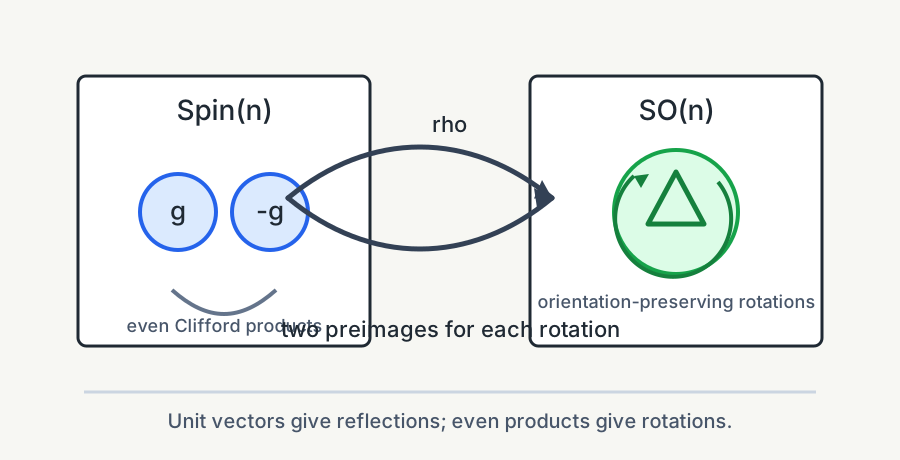
This is why a spinor can change sign after a full turn and return after two full turns. The rotation in space has come back, but the lifted Spin element has moved from to .
Worked example [Beginner]
In the plane, take two perpendicular unit vectors and in the Clifford algebra. Their product behaves like an imaginary unit because 03.09.02.
A rotation by angle is encoded by
The half-angle is the important feature. When , the expression is , not . When , it returns to .
So Spin remembers a finer motion than the visible rotation. A full turn in ordinary space is not a closed path upstairs in Spin.
Check your understanding [Beginner]
Formal definition [Intermediate+]
Let be a finite-dimensional real inner-product space, using the Lawson-Michelsohn Clifford convention 01.01.15, 03.09.02. Write for its Clifford algebra and for the even part.
For a unit vector , the element is invertible in the Clifford algebra, with . Clifford conjugation by products of unit vectors sends to itself and preserves the quadratic form [Lawson-Michelsohn §I.2.9].
The Pin group is the subgroup of invertible Clifford elements generated by unit vectors:
The Spin group is its even part:
For with the positive definite form, write . The twisted adjoint action [notation crosswalk #6: adopted from LM] defines a homomorphism
and for this is the connected double cover of [Atiyah-Bott-Shapiro §3]. The twist by the parity-grading involution is necessary: the untwisted conjugation does not preserve when is odd, while does. The spin double cover is precisely the same data as the unit-vector products in ; this identifies a topological universal cover with an algebraic subgroup, which is exactly the bridge between rotational and Clifford geometry.
Key theorem with proof [Intermediate+]
Theorem (unit-vector conjugation gives reflection). Let satisfy . Decompose as , where is orthogonal to . Then
Thus Clifford conjugation by a unit vector fixes the line spanned by and negates its orthogonal complement.
Proof. Since , . The Clifford relation gives when is orthogonal to . Hence
The first term is
because . The second term is
Adding the two terms gives . This is the reflection across the line . The negative of this transformation is the reflection in the hyperplane . Products of an even number of such Clifford unit vectors therefore give orientation-preserving orthogonal transformations.
Bridge. The construction here builds toward 03.09.04 (spin structure on an oriented riemannian manifold), where the same data is upgraded, and the symmetry side is taken up in 03.09.08 (dirac operator). The defining pattern appears again in those units in a sharpened form, where the local data is glued or quotiented. Putting these together, the foundational insight is that the data of this unit gives the structural signature that the rest of the strand reads off.
Exercises [Intermediate+]
Lean formalization [Intermediate+]
lean_status: none — Mathlib has Clifford algebras and Lie groups, but not the packaged Clifford-group, Pin, Spin, or double-cover API required for this unit.
The relevant future formalization should define a subgroup of CliffordAlgebra Q generated by vectors of nonzero norm, prove preservation of the embedded vector space under the twisted adjoint action, and specialize the image/kernel theorem to positive definite real forms.
Spin as a double cover [Master]
For a positive definite real -space, the action of on by the twisted adjoint representation [notation crosswalk #6: adopted from LM] lands in . The subgroup lands in because it consists of even products of unit vectors. The Cartan-Dieudonné theorem supplies surjectivity onto : every orientation-preserving orthogonal transformation is a product of an even number of reflections [Lawson-Michelsohn Theorem I.2.3].
Theorem (Cartan-Dieudonné). Every element is a product of at most reflections in hyperplanes through the origin. In particular, is a product of an even number of such reflections.
Proof. Induction on . The case is immediate: , where is the unique reflection. For and , distinguish two cases.
If has a fixed vector , then preserves the orthogonal hyperplane , where it acts as an element of . By induction, is a product of at most reflections in hyperplanes of ; each such reflection extends to a reflection of fixing . So is a product of at most reflections.
If has no nonzero fixed vector, choose any unit vector . Set ; since , . The reflection in the hyperplane satisfies . Compute and , so , giving . Hence has a fixed vector, namely . Apply the previous case to : it is a product of at most reflections. So is a product of at most reflections.
The kernel in is for . If an even Clifford product acts as the identity on every vector via , then for all (the twist by is the identity on even elements). So is central in the algebra generated by , namely . The centre of for positive-definite is when is even, and (with the volume element) when is odd. In both cases, restricting to (where Spin sits) and to the unit-norm condition leaves only [Atiyah-Bott-Shapiro §3].
Thus
is exact. For , is connected and simply connected, so is the universal covering homomorphism of .
The Pin sequence. The same machinery applied to the full Pin group gives a parallel exact sequence [Lawson-Michelsohn Theorem I.2.6]:
Pin contains both even and odd products of unit vectors, hence projects to all of via Cartan-Dieudonné. The kernel computation uses the same centre-of-Clifford-algebra argument, restricted to Pin. The Pin sequence is not unique: there are two non-isomorphic Pin groups, and , distinguished by whether the squared reflection in a unit vector with or is the identity or . Both fit into a extension; only the Spin subgroup is the same in both.
Low-dimensional identifications [Master]
The smallest Spin groups explain much of the notation used later.
The map is the quaternionic double cover: unit quaternions act on imaginary quaternions by conjugation. Its kernel is , matching the general Clifford construction. In dimension four, the split into two factors reflects the decomposition of two-forms into self-dual and anti-self-dual parts, a feature used in four-dimensional gauge theory 03.07.05.
The convention is Lawson-Michelsohn's. Physics texts often reverse this sign; the resulting real Clifford table exchanges and . The abstract double cover remains the same for Euclidean , but Clifford-module formulas must be translated before comparing signs.
Extension to dimensions 5 and 6. The Clifford chessboard (03.09.11) gives explicit identifications for the next two cases [Lawson-Michelsohn Theorem I.7.1]:
For : by the chessboard but with the underlying real form at the chessboard cell . The even subalgebra contains as the unit-norm-Clifford subgroup of ; this is precisely , the compact symplectic group of quaternionic matrices preserving the standard quaternionic Hermitian form. Dimension check: , and is connected and simply connected, so the double cover lifts.
For : the even subalgebra (chessboard cell over — which equals at this coordinate). The unit-norm subgroup is the unitary group ; restricting to elements of determinant 1 (forced by the spin constraint) gives . Dimension check: , and is connected and simply connected.
The full table of low-dimensional identifications:
| half-spinor structure | |||
|---|---|---|---|
| 2 | 1 | one 1-dim complex | |
| 3 | 3 | one 2-dim complex (= 1-dim quaternionic) | |
| 4 | 6 | two 2-dim complex (the split) | |
| 5 | 10 | one 4-dim complex (= 2-dim quaternionic) | |
| 6 | 15 | two 4-dim complex (the split) | |
| 7 | (no classical isomorphism) | 21 | one 8-dim real |
| 8 | (no classical isomorphism) | 28 | two 8-dim real (triality, see 03.09.13) |
After dimension 8, no classical-group isomorphism exists. The triality of (03.09.13) is the structural reason: dimension 8 is the unique value where vector and half-spinor representations have matching dimension, after which the dimension counts diverge for good.
Spin representations [Master]
The inclusion lets the group act on Clifford modules. After complexification, irreducible Clifford modules produce the spin representation. When is even, the volume element splits the complex spin representation into half-spin representations
These representations supply the fibres of spinor bundles 03.09.05. A spin structure 03.09.04 is exactly the topological data that lets the local spin representation patch together over a manifold. The Dirac operator 03.09.08 then differentiates sections of the resulting spinor bundle.
Proposition (LM I.6.3, spinor representation as a Lie-algebra map). The spinor representation has differential given by Clifford multiplication. Identifying with the bivector subspace via , the differential acts as for and , where the dot is Clifford multiplication inside on the irreducible module . The proof tracks one-parameter subgroups: for , the curve acts on by left Clifford multiplication, and differentiating at recovers itself acting by Clifford product. This identifies the Lie-algebra action with the restriction of the Clifford module structure to , a fact that pins down the spinor representation up to the half-spin splitting in even rank. The proposition is the algebraic root of the Lichnerowicz formula [03.09.14, 03.09.16]: the bivector-Clifford identification is what makes the curvature of the spin connection enter the squared Dirac operator as a scalar plus an endomorphism of .
Connections [Master]
Bilinear and quadratic forms
01.01.15— the quadratic form gives the unit-vector relation inside the Clifford algebra.Clifford algebra
03.09.02— Spin is an even subgroup of the invertible Clifford elements.Principal bundle
03.05.01— spin structures are principal -bundles mapping to frame bundles.Spin structure
03.09.04— the double cover is the structural map used in the definition.Dirac operator
03.09.08— spinor bundles and spin connections derive from Spin representations.
We will see in 03.09.11 the chessboard classification of that pins down the spin representations dimension by dimension; this builds toward the triality phenomenon in 03.09.13 and appears again in the parallel-spinor / Berger-holonomy bijection of 03.09.18. The pattern recurs at every dimension where an exceptional spinorial accident produces an exceptional Lie group. The foundational insight is that is exactly the unit-norm products of vectors in — this identifies the topological double cover with an algebraic subgroup. Putting this together with the Clifford action gives the bridge between abstract algebra and rotational geometry; the spin group is an instance of the universal Pin/Spin construction.
Historical & philosophical context [Master]
The spin double cover entered mathematics through the Clifford-algebraic treatment of orthogonal transformations and through the representation theory surrounding the Dirac equation. Atiyah, Bott, and Shapiro used Clifford modules to organize real -theory and Bott periodicity, making Spin groups part of the bridge between quadratic forms, topology, and elliptic operators [Atiyah-Bott-Shapiro §3].
Lawson and Michelsohn's treatment fixes the convention and develops Pin and Spin groups before spin structures and Dirac operators [fast-track Lawson-Michelsohn-Spin-Geometry-683x1024__51a67ee44f.jpg]. This order is the one used in the spin-geometry strand of this curriculum.
Bibliography [Master]
- Lawson, H. B. and Michelsohn, M.-L., Spin Geometry, Princeton University Press, 1989. §I.2.
- Atiyah, M. F., Bott, R., and Shapiro, A., "Clifford Modules", Topology 3 (1964), supplement 1, 3-38.
- Chevalley, C., The Algebraic Theory of Spinors, Columbia University Press, 1954.
- Porteous, I. R., Clifford Algebras and the Classical Groups, Cambridge University Press, 1995.
Wave 2 Phase 2.2 unit #2. Produced as the Spin-group prerequisite for spin structures and Dirac-type constructions.