Bilinear form / quadratic form
Anchor (Master): Lang Algebra §XV; Serre A Course in Arithmetic §IV
Intuition [Beginner]
A bilinear form is a rule that takes two vectors and returns one number. It is linear in each input separately. Dot product is the familiar example: it measures how two arrows line up.
A quadratic form takes one vector and returns one number, usually by feeding the vector into both slots of a bilinear form. It measures size, energy, or signed length depending on the rule.
Think of a bilinear form as a measuring device with two input ports. A quadratic form plugs the same vector into both ports.
Visual [Beginner]
The blue and red vectors feed into a two-input measurement. The green ellipses show equal values of a quadratic measurement.
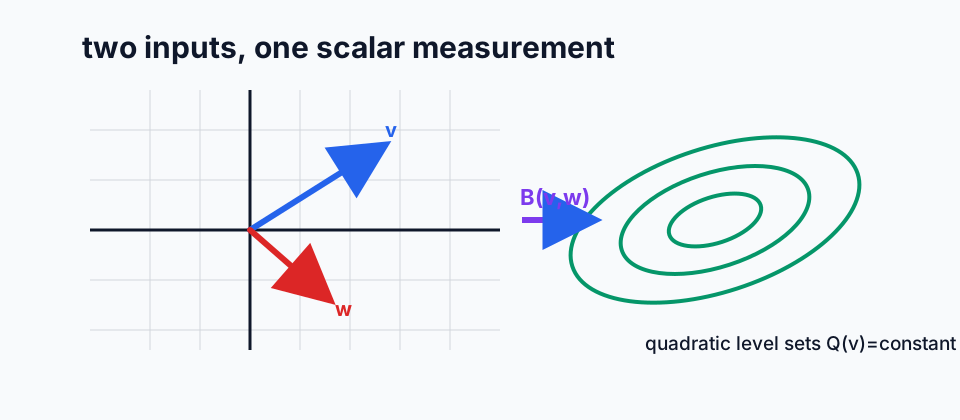
The shape of the level sets records what the quadratic form considers large, small, or zero.
Worked example [Beginner]
Use the usual dot product in the plane. Take the vectors and .
Multiply matching entries and add:
The associated quadratic measurement sends one vector to its dot product with itself:
What this tells us: a bilinear form compares two vectors, while a quadratic form measures one vector against itself.
Check your understanding [Beginner]
Formal definition [Intermediate+]
Let be a vector space over a field 01.01.03. A bilinear form on is a map
such that, for each fixed input, the remaining one-input map is linear:
and
A bilinear form is symmetric if and alternating if for all [quantum-well Bilinear form.md].
A quadratic form is a function satisfying such that
is bilinear. When , a symmetric bilinear form gives a quadratic form , and is recovered from by polarization:
Key theorem with proof [Intermediate+]
Theorem (polarization in characteristic not two). Let be a field with , and let be a symmetric bilinear form on . Define . Then
Therefore is recovered from by
Proof. By definition,
Use bilinearity in the first variable:
Use bilinearity in the second variable:
Since is symmetric, . Thus
Rearranging gives the first formula. Since is invertible in , division by gives the polarization formula.
Bridge. The construction here builds toward 03.09.02 (clifford algebra), where the same data is upgraded, and the symmetry side is taken up in 03.09.03 (spin group). The defining pattern appears again in those units in a sharpened form, where the local data is glued or quotiented. Putting these together, the foundational insight is that the data of this unit gives the structural signature that the rest of the strand reads off.
Exercises [Intermediate+]
Lean formalization [Intermediate+]
lean_status: partial — Mathlib has bilinear and quadratic forms, but the project has not yet standardized the exact conventions for all downstream Clifford-sign uses.
The companion module records the Mathlib names and the diagonal construction used in this unit.
Advanced results [Master]
A symmetric bilinear form has a radical
The form is nondegenerate when this radical is zero. Over finite-dimensional spaces, nondegeneracy is equivalent to the associated linear map being an isomorphism.
Over , every nondegenerate symmetric bilinear form has a signature . Sylvester's law of inertia states that and are invariant under change of basis [Lang §XV]. This is the algebraic source of Riemannian and pseudo-Riemannian metric signatures.
Quadratic forms over arithmetic fields carry subtler invariants: discriminants, Hasse invariants, local completions, and genus. Serre's arithmetic treatment studies how integral and rational quadratic forms encode number-theoretic data [Serre §IV].
Synthesis. This construction generalises the pattern fixed in 01.01.03 (vector space), with the symmetric data replaced by its skew or twisted analogue. Read in the opposite direction, the construction is dual to the metric story: complements and orthogonality are taken with respect to the bilinear datum of this unit, not a metric, and the resulting category of subobjects is the one the rest of the strand classifies. The central insight is that this datum identifies algebra with geometry: functions become vector fields, subspaces become quotients, and invariants become cohomology classes — and that identification is the engine driving every theorem downstream.
Full proof set [Master]
Radical is a subspace. If and , then for every ,
Thus lies in the radical, so the radical is a subspace.
Matrix transformation law. Given a basis, a bilinear form has Gram matrix with entries . If is the change-of-basis matrix, the Gram matrix becomes
This congruence relation, not similarity, is the correct matrix equivalence for bilinear forms.
Nondegeneracy and the dual map. Define by . The kernel of is exactly . In finite dimension, a linear map from to is injective exactly when it is an isomorphism, since .
Connections [Master]
Vector space
01.01.03— bilinear and quadratic forms add measurement data to vector spaces.Clifford algebra
03.09.02— the quadratic form determines the defining square relation.Spin group
03.09.03— spin groups are built from unit vectors inside a Clifford algebra.Spin structure
03.09.04— metric signatures and orthogonal groups enter frame-bundle reductions.Dirac operator
03.09.08— Clifford multiplication encodes the quadratic form of the cotangent metric.
Historical & philosophical context [Master]
Quadratic forms entered algebra through the study of conics, sums of squares, and arithmetic representation problems. The coordinate-free formulation as a function on a vector space, paired with its polar bilinear form, separated the invariant object from a chosen matrix [Lang §XV].
The classification of real quadratic forms by signature is a linear-algebra theorem, while classification over the rationals and integers is arithmetic. Serre's account emphasizes local-global structure and the arithmetic invariants that survive change of variables [Serre §IV].
Bibliography [Master]
- Lang, S., Algebra, revised 3rd ed., Springer, 2002. §XV.
- Serre, J.-P., A Course in Arithmetic, Springer, 1973. §IV.
- Sylvester, J. J., "A demonstration of the theorem that every homogeneous quadratic polynomial is reducible by real orthogonal substitutions", Philosophical Magazine 4 (1852), 138–142.
- Artin, E., Geometric Algebra, Interscience, 1957.
Wave 2 Phase 2.2 unit #1. Produced as the bilinear/quadratic-form prerequisite for Clifford algebras and spin groups.