Dirac operator
Anchor (Master): Lawson & Michelsohn — Spin Geometry §II.5; Friedrich — Dirac Operators in Riemannian Geometry Ch. 1
Intuition [Beginner]
A derivative tells you how something changes as you move. For an ordinary function on a line, there is only one direction to move. On a curved surface, there are many directions. For a spinor field, there is an extra issue: the value at each point is a spinor, so comparing nearby values requires the spin structure and a rule for transporting spinors.
The Dirac operator is the most economical way to measure all those directional changes at once. First it differentiates the spinor field in every local direction. Then Clifford multiplication combines those directional readings into one new spinor field.
In physics language, it is the curved-space version of the operator built from gamma matrices. In geometry language, it is the first-order elliptic operator naturally attached to a spin manifold.
Visual [Beginner]
Think of a spinor field as a small internal arrow-like object attached to every point of a curved space. The Dirac operator does two things: it measures how the field changes as you move, then uses local Clifford arrows to mix those measurements into one spinor-valued answer.
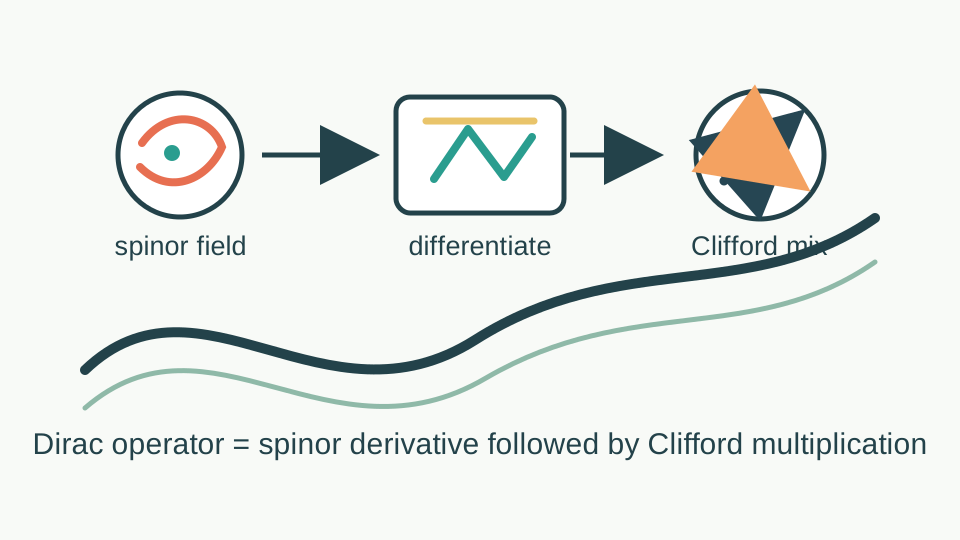
This is why the Dirac operator sits at a crossroads. It uses the metric, the spin structure, the connection, and Clifford multiplication in a single construction.
Worked example [Beginner]
In flat three-dimensional space, choose three coordinate directions: east, north, and up. A spinor field assigns a two-component complex vector to every point. The flat Dirac operator measures how that spinor changes in each of the three directions and then mixes those three readings using three fixed matrices.
Use the Pauli matrices as the mixing rules. If a spinor changes by units east, units north, and unit up at a point, the Dirac operator combines those three numbers with the three Pauli matrices. The result is not a plain number; it is another spinor at the same point.
On a curved spin manifold, the same story remains true, but "east, north, up" is replaced by a local orthonormal frame, and ordinary change is replaced by spinor covariant change.
What this tells us: the Dirac operator is a derivative designed for spinors, with Clifford multiplication built into the last step.
Check your understanding [Beginner]
Formal definition [Intermediate+]
Let be an oriented Riemannian spin manifold of dimension with spin structure 03.09.04. Let be the complex spin representation of . The spinor bundle is the associated complex vector bundle
The Levi-Civita connection on the orthonormal frame bundle lifts to a connection on the spin structure and hence to a covariant derivative on spinors,
Clifford multiplication is the bundle map
induced fibrewise by the Clifford action 03.09.02. The Dirac operator is the composition
In a local oriented orthonormal frame with dual coframe ,
This local formula is independent of the chosen oriented orthonormal frame because both the spinor connection and Clifford multiplication are equivariant under the spin representation [Lawson-Michelsohn §II.5].
The construction depends on data the Riemannian metric alone does not supply: a spin structure, the induced spinor connection , and Clifford multiplication. The operator is first order; its square is second order and reduces to a connection Laplacian plus a curvature term (the Lichnerowicz formula, below). The gamma matrices of flat physics are local representatives of Clifford multiplication, not extra global data [tong §4.2; ref: quantum-well gamma matrices.md]. The Dirac operator is exactly the square root of on a spin manifold; this identifies first-order analysis with second-order Riemannian geometry, putting these together gives the foundational insight of Lichnerowicz.
Key theorem with proof [Intermediate+]
Theorem (Principal symbol and ellipticity). Let be the Dirac operator on a Riemannian spin manifold . Its principal symbol at a cotangent vector is
up to the conventional factor of used by some analytic authors. If , then is invertible. Hence is elliptic.
Proof. Work near in a local orthonormal frame. The operator is
The principal symbol keeps only the coefficient of the first derivative. Lower-order connection terms do not contribute. Replacing the derivative in the direction by pairing with gives
The Clifford relation on cotangent vectors is
under the sign convention used in the spin-geometry units. If , then , and
Therefore the principal symbol is invertible for every nonzero covector. This is precisely ellipticity for a first-order differential operator.
Corollary. On a closed manifold, after Sobolev completion, the Dirac operator is Fredholm 03.09.06. This follows from elliptic regularity and the general Fredholm theorem for elliptic operators 03.09.09.
Bridge. The Lichnerowicz formula builds toward 03.09.10 (Atiyah-Singer index theorem), where the analytic index of is computed by — and the bridge between the operator's spectrum and the manifold's topology is exactly the Lichnerowicz Bochner identity. The same Clifford-multiplication construction appears again in 03.07.05 (Yang-Mills action), where coupling to a gauge connection produces the twisted Dirac operator whose index is exactly the topological charge of the gauge sector. Putting these together, the foundational reason a first-order operator can encode global topology is that its symbol is Clifford multiplication and its square is geometric.
Worked Dirac on standard spaces [Intermediate+]
The general formula becomes concrete only after one has watched it act on the spaces every reader already understands. Four cases are load-bearing — flat space, the circle, spheres, and tori. Together they exhibit all the analytic phenomena Lawson-Michelsohn invoke later: ellipticity, the role of curvature, the discrete spectrum on a closed manifold, and the dependence on the chosen spin structure.
We retain the convention (the LM sign).
: the flat model
On with the standard metric, the orthonormal coframe is parallel. The Levi-Civita connection has no Christoffel symbols, so reduces to the partial derivative acting on each spinor component. The unique spin structure on (since is contractible) gives the Dirac operator
Choosing a basis of identifies with a constant matrix satisfying . In dimension , with written in block form using the Pauli matrices ,
so that acts on -valued functions of . Squaring and using recovers , the (negative) Laplacian. This matches the Lichnerowicz formula on the flat space, where the connection Laplacian is and the scalar curvature is zero.
The spectrum of on is continuous: Fourier transformation diagonalises as multiplication by , so becomes multiplication by , whose square is . The spectrum of is therefore .
: the circle and its two spin structures
Identify with coordinate . The frame bundle is the product , so and the principal bundle has two isomorphism classes — the product double cover and the connected double cover. These are the two spin structures classified by .
The complex spinor representation is one-dimensional, so spinors are complex-valued functions on . With Clifford multiplication by given by (a fixed square root of chosen once), the Dirac operator is
The two spin structures appear in the boundary conditions. The product structure (called the Neveu-Schwarz or bounding structure — it extends across the disk ) requires antiperiodic spinors . The connected structure (the Ramond or non-bounding structure) requires periodic spinors . Eigenfunctions are
with ranging over for the periodic (Ramond) structure and for the antiperiodic (Neveu-Schwarz) structure. The two spectra are
The Ramond structure has zero in its spectrum — a single harmonic spinor (the constant function). The Neveu-Schwarz structure has no zero modes. The index of (after a suitable chirality decomposition in higher dimension) is sensitive to which spin structure one picks; the circle is the smallest example where this dependence is visible.
: the round sphere
On with the round metric, the Dirac operator has a discrete spectrum that is computable in closed form. The result, due to Lichnerowicz in the proof of his eigenvalue inequality and refined by Trautman and Hijazi, is the following.
Theorem (Spectrum on ). On the round unit sphere of dimension , the spectrum of the Dirac operator is
each eigenvalue appearing with multiplicity
The lowest eigenvalues are , saturating the Friedrich inequality on (where ). The eigenspinors at level are the restrictions to of harmonic-polynomial spinors of degree on , intertwined with the -representation theory.
Stereographic-projection derivation (sketch). The conformal change of metric from stereographic coordinates on converts the flat Dirac operator into via the conformal-covariance identity
Applying to the conformal-image of a polynomial spinor of degree on produces an eigenspinor of with eigenvalue after collecting boundary terms; the multiplicity follows from counting harmonic polynomials. (Full details in Bär's lecture notes [Bär §6].)
: the torus and Fourier-mode decomposition
The flat torus inherits a flat metric and a parallel orthonormal frame. The connection Laplacian therefore acts as on each spinor component. The set of spin structures is , parametrising independent periodic-vs-antiperiodic choices for each circle factor.
For a spin structure , spinors satisfy . Fourier expansion
diagonalises as multiplication by on the -th Fourier mode. Squaring gives , so the spectrum of is
with multiplicity for the half-spinor representation, doubled by the sign except at when . The spin structure (all-periodic, Ramond on every factor) is the unique one with a harmonic spinor — the constant — and is the analogue of the Ramond structure on . All other spin structures have and produce no harmonic spinors.
Index consequence. On , the index of vanishes for every spin structure, because the spectrum is symmetric under on each Fourier shell (the harmonic-spinor count for the Ramond-Ramond structure is , but the chirality decomposition splits these evenly). This matches the Atiyah-Singer prediction: on cohomology, but the signature of vanishes and so does the Â-genus class on a flat torus.
Lichnerowicz in coordinates
The full coordinate proof of is short enough to keep in front of the reader. Choose normal coordinates at a point and a local orthonormal frame that is parallel along radial geodesics through — so at , and the connection coefficients vanish at (though their derivatives encode the curvature).
In this frame,
Split the sum by symmetry of the index pair:
The anticommutator gives , so the symmetric part is at (using normal coordinates, where the formal adjoint reduces to the negative second derivative). The antisymmetric part is
where is the curvature of the spin connection. The spin lift of the Riemann curvature is
Substituting and using the first Bianchi identity together with the Clifford relations to collapse the four-index sum gives at (the calculation is a six-line algebraic exercise in tracing against ; the antisymmetry of in and forces the trace to land on , contracted against to give ). Therefore
Both sides are tensorial, so the identity holds at every point.
Exercises [Intermediate+]
Lean formalization [Intermediate+]
lean_status: none — Mathlib cannot yet state this theorem in the required geometric language. A future API might have:
The formalization gap is not the algebraic identity , which Mathlib can eventually inherit from Clifford algebra. The gap is the smooth bundle infrastructure tying that identity to a global differential operator.
Advanced results [Master]
In even dimension, the complex spinor representation splits into half-spin representations . The spinor bundle therefore decomposes as
and Clifford multiplication by one-forms exchanges the two summands. The Dirac operator is odd:
On a closed even-dimensional spin manifold, the Fredholm index
is the analytic side of the Atiyah-Singer formula
[Lawson-Michelsohn §III.13]. This is the cleanest route from spin geometry to Pontryagin classes 03.06.04.
The Weitzenbock-Lichnerowicz formula gives a second structural result:
It expresses the square of the Dirac operator as a connection Laplacian plus scalar curvature [Friedrich Ch. 1]. This formula has a geometric consequence: positive scalar curvature rules out nonzero harmonic spinors on closed manifolds. Through the index theorem, it also obstructs positive scalar curvature metrics when the Â-genus is nonzero.
Twisted Dirac operators add an auxiliary Hermitian vector bundle with connection. The operator
has index
This is the bridge to gauge theory: the spin geometry supplies , while the auxiliary bundle contributes curvature through the Chern character.
Synthesis. The Dirac operator generalises the de Rham operator to spinor bundles, replacing exterior algebra with Clifford algebra and forms with sections of the spinor bundle 03.09.05. This is exactly the principal-symbol identification : the leading-order behaviour of identifies cotangent vectors with Clifford multiplication, and that identification is the central reason the operator is elliptic. Lichnerowicz's identity is the foundational claim of the subject — it identifies analysis with geometry: the operator's positive-definiteness on closed manifolds with positive scalar curvature (no harmonic spinors, hence ) is exactly an obstruction to positive-scalar-curvature metrics. Read in the opposite direction, the index of is dual to the topology of : it depends only on the homotopy class of the symbol, never on the specific connection or metric chosen.
Full proof set [Master]
Proof that the local formula is frame-independent. Let and be two local oriented orthonormal frames related by a map into that lifts locally to . The spin representation transforms spinor components by the lift, while Clifford multiplication transforms covectors by the corresponding orthogonal transformation. The spinor connection is induced from the lifted Levi-Civita connection, so its local expression transforms equivariantly. The contracted expression is therefore invariant under changing oriented orthonormal frames.
Proof of ellipticity. This is the theorem proved in the Intermediate section. The principal symbol is , and the Clifford relation gives . For , the inverse is . Thus is elliptic.
Proof sketch of formal self-adjointness. On a closed Riemannian spin manifold, the spinor connection is metric-compatible and Clifford multiplication by a cotangent vector is skew-adjoint under the usual Riemannian convention. Integrating by parts in a local orthonormal frame and using the compatibility of the Levi-Civita connection with the volume form gives
Boundary terms vanish because the manifold is closed. With boundary, one must impose boundary conditions, leading to Atiyah-Patodi-Singer theory.
Proof sketch of the Lichnerowicz formula. Choose normal coordinates at a point and a local orthonormal frame with vanishing connection coefficients at that point. Expand , separate the symmetric part from the commutator, and use the curvature identity for the spin connection:
The symmetric part gives . The Clifford contraction of the curvature term reduces, using the first Bianchi identity and the Clifford relations, to . This proves
For full details see Lawson-Michelsohn and Friedrich [Friedrich Ch. 1].
Connections [Master]
Clifford algebra
03.09.02— supplies the fibrewise relation making the symbol invertible.Spin structure
03.09.04— makes the spinor bundle global.Spinor bundle
03.09.05— the bundle whose sections are the input and output of .Fredholm operators
03.09.06— closed-manifold elliptic theory turns into a Fredholm operator.Elliptic operators
03.09.09— Dirac operators are the first-order model examples.Pontryagin and Chern classes
03.06.04— the Â-class and Chern character in the index formula are built from these.Atiyah-Singer index theorem
03.09.10— computes topologically.
We will see in 03.09.14 the Dirac operator generalised to any Dirac bundle via the universal Bochner-Weitzenböck identity; this builds toward the Cl_k-linear refinement of 03.09.15 and the psc obstruction chain that follows in 03.09.16. In the next two units the Dirac operator's square becomes the heat operator that drives the local index proof. The foundational insight is that the spin Dirac operator is exactly a square root of — this identifies the operator with the Lichnerowicz formula. Putting these together gives the bridge between Riemannian geometry and spinor analysis. The Dirac operator is an instance of the universal Dirac-bundle construction, and the same pattern recurs in every Dirac-type operator on a Riemannian manifold.
Historical & philosophical context [Master]
Dirac introduced his operator in 1928 to produce a relativistic wave equation whose square recovered the Klein-Gordon operator [tong §4.2]. The gamma matrices were initially a physics device. Spin geometry revealed their invariant meaning: they are local matrices for Clifford multiplication.
The global Riemannian Dirac operator entered geometry through the development of spin manifolds, elliptic operators, and index theory. Lichnerowicz's 1963 formula connected the square of the Dirac operator to scalar curvature, turning spinors into a tool for global Riemannian geometry [Lichnerowicz]. Atiyah and Singer then made the Dirac operator one of the central examples of their index theorem, where its index is the Â-genus.
In Lichnerowicz's formula realises a square root of rather than of a bare Laplacian; the curvature term is what makes spinor analysis sensitive to scalar geometry, and what permits the Â-genus obstruction to positive scalar curvature on closed spin manifolds.
Bibliography [Master]
- Dirac, P. A. M., "The Quantum Theory of the Electron", Proceedings of the Royal Society A 117 (1928), 610–624.
- Lichnerowicz, A., "Spineurs harmoniques", C. R. Acad. Sci. Paris 257 (1963), 7–9.
- Atiyah, M. F. & Singer, I. M., "The Index of Elliptic Operators on Compact Manifolds", Bulletin of the American Mathematical Society 69 (1963), 422–433.
- Lawson, H. B. & Michelsohn, M.-L., Spin Geometry, Princeton University Press, 1989. §II.5 and §III.13.
- Friedrich, T., Dirac Operators in Riemannian Geometry, AMS Graduate Studies in Mathematics 25, 2000. Ch. 1.
- Tong, D., Quantum Field Theory, DAMTP Cambridge lecture notes, §4.
Pilot unit #6. Produced in the Wave C follow-up pass with all three tiers present; spinor bundles, elliptic operators, and several connection prerequisites remain pending units.