Spin structure on an oriented Riemannian manifold
Anchor (Master): Lawson & Michelsohn — Spin Geometry §II.1–II.2
Intuition [Beginner]
Spin geometry deals with a peculiar fact about rotations. Walk a vector around a closed loop on a curved surface and it returns rotated. Walk a spinor — the kind of object an electron's wavefunction is built from — around the same loop and it can return with a sign flip, even when the rotation it experienced was a full turn that returned every ordinary vector to its starting position.
A spin structure is the rule book that makes those sign flips globally consistent. Without it, the sign flips disagree between different paths and there is no coherent way to define a spinor field on the whole manifold. With it, every loop on the manifold gets an unambiguous sign, and spinors become globally meaningful.
The catch: not every manifold admits such a rule book. The obstruction lives in a single piece of cohomological data (the second Stiefel-Whitney class) and it can be nonzero. When it vanishes, spin structures exist; the number of distinct rule books is then counted by another piece of cohomology (the first Stiefel-Whitney class, with values in ).
Visual [Beginner]
Imagine the space of orthonormal frames at every point as a small ladder you can spin. A spin structure tells you how to lift each spin of the ladder to a double ladder where two full turns equal one — and how to do this consistently across the manifold.
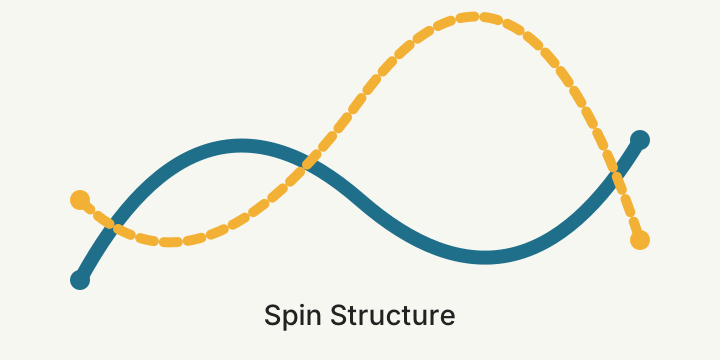
The point is consistency. Each chart of the manifold can lift its frame bundle locally — there is no obstruction in a single chart. The obstruction lives in the gluing rules between charts, which is why the topology of matters.
Worked example [Beginner]
Take the circle . Its frame bundle is the product (one tangent direction at each point), and as you walk around the circle the orthonormal frame returns to itself after one lap. There are exactly two ways to lift this to a spin structure: the periodic one, where spinors return to themselves after one lap, and the antiperiodic one, where they pick up a minus sign.
These two structures are not equivalent, and physics distinguishes them. The antiperiodic one is the rule book a spinor at the boundary of a disk would inherit from the disk's interior; the periodic one is the rule book that survives when no disk is glued in. In string theory the two structures are called Neveu-Schwarz and Ramond, and they correspond to different sectors of the same theory.
The torus has spin structures, one for each independent choice on the two circle factors.
Check your understanding [Beginner]
Formal definition [Intermediate+]
Let be an oriented Riemannian manifold of dimension . Its oriented orthonormal frames assemble into the frame bundle , a principal whose fibre over consists of all positively-oriented orthonormal frames of . The Spin group sits inside the even part of the Clifford algebra (unit 03.09.02) and double-covers :
A spin structure on is a pair consisting of:
- a principal , and
- a bundle map over the identity of that is equivariant with respect to the cover — meaning for all and — and that restricts on each fibre to a copy of the double cover .
A manifold equipped with such a structure is called a spin manifold. The set of spin structures on a fixed , when nonempty, is a torsor for (Theorem below); the bundle map is part of the data, and two non-isomorphic spin structures can have isomorphic underlying -bundles.
Proposition. The following data on are equivalent:
(i) a spin structure in the sense above;
(ii) a cohomology class of lifts of an -cocycle for , satisfying ;
(iii) a homotopy class of lifts of the classifying map through .
In dimension two, (i)–(iii) are further equivalent to a choice of square root of the canonical line bundle ; on a 4-manifold, to a square root of the determinant line bundle of the spinor bundle. The non-orientable analogue is a Pin structure, defined using ; the two signs are inequivalent. Existence is not automatic — , for instance, admits none. The existence of a spin structure is precisely the vanishing of ; this identifies a topological obstruction with a structure-group lift, putting these together gives the universal characteristic-class framework.
Key theorem with proof [Intermediate+]
Theorem (Existence and classification of spin structures). Let be a connected oriented Riemannian manifold. Then admits a spin structure if and only if its second Stiefel-Whitney class vanishes:
If , the set of spin structures on is in canonical bijection with — non-canonically, after choosing a basepoint spin structure.
Proof sketch. Pick a good open cover of with transition functions for . A spin structure amounts to a choice of lift such that , satisfying the cocycle condition
Each individual lift exists locally because is surjective and is contractible. The triple product projects to via , hence lies in . The assignment defines a Čech 2-cochain whose class in is the obstruction to lifting — and this class is precisely (a calculation using the universal Stiefel-Whitney classes pulled back along the classifying map ).
So iff some coherent system of lifts exists. When it does, the freedom in choosing the lifts is parametrised by changing each by a factor subject to — i.e., by a Čech 1-cocycle with coefficients in . Two systems give isomorphic spin structures iff they differ by a coboundary, so the set of spin structures is a torsor for . ∎
Corollary. has a unique spin structure when (e.g., simply-connected manifolds).
Bridge. A spin structure is a lift of the -frame bundle to a -bundle; the obstruction is the second Stiefel-Whitney class , and the lifts (when they exist) form a torsor over . This builds toward 03.09.05 (spinor bundle), where the associated bundle construction converts the lifted frame into a complex vector bundle of spinors. The Clifford action of on that bundle then appears again in 03.09.08 (Dirac operator) and ultimately in 03.09.10 (Atiyah-Singer), where the index of is computed by the -genus. Putting these together, the foundational reason spin geometry is more than oriented Riemannian geometry is exactly the vanishing of — that single cohomology class is dual to the entire spinorial machinery.
Exercises [Intermediate+]
Examples [Master]
| Manifold | Number of spin structures | |
|---|---|---|
| , for | (unique) | |
| (the periodic and antiperiodic spin structures) | ||
| Orientable surface of genus | ||
| for odd | ||
| for even | nonzero | — no spin structure |
| surface | ||
| Lie groups (compact, simply connected) |
The two spin structures on correspond physically to the periodic (Ramond) and antiperiodic (Neveu-Schwarz) sectors in 2D conformal field theory — the antiperiodic one is the bounding spin structure that extends to the disk. On a torus the four spin structures (one bounding, three non-bounding) reproduce the exact partition-function structure of the free fermion at finite temperature.
The row has a clean obstruction: where is the generator of , so vanishes iff is odd.
Pin± and the unoriented case [Master]
For non-orientable manifolds (or oriented manifolds where one wants to encode orientation reversal), the relevant double cover is
where and are the two non-isomorphic double covers of corresponding to the two choices of sign for in the Clifford algebra of (cf. unit 03.09.02).
A Pin± structure is the analogous lift of the (full, possibly non-orientable) frame bundle . Their existence obstructions are different: a Pin⁺ structure exists iff , while a Pin⁻ structure exists iff . The two notions agree on orientable manifolds, where Pin± reduces to Spin (since ).
This signature-sensitivity of Pin± reflects the same convention dependence we saw for in unit 03.09.02: the sign on the Clifford relation matters at the topological level, not just the algebraic.
Connection to physics: spinor fields on curved space [Master]
Spin structures are the data physics actually requires when fermions are written on a Riemannian or Lorentzian manifold. The construction proceeds in three steps; each step requires its predecessor.
Step 1: associated bundle. Given a spin structure and a representation on a complex vector space — typically the spinor representation arising from a complex Clifford module — the spinor bundle is the associated bundle
Sections of are spinor fields. The naive attempt to build a spinor bundle directly from — without lifting to a Spin bundle first — fails on every spin-obstructed manifold; equivalently, is a global object only when .
Step 2: spinor covariant derivative. The Levi-Civita connection on defines a connection on . Because is a local diffeomorphism, this connection has a unique lift to a connection on , hence to a covariant derivative on . The Bianchi identity, torsion freedom, and curvature relations on all promote to corresponding statements on .
Step 3: Dirac operator. Composing with Clifford multiplication in the fibres yields the Dirac operator
a first-order elliptic differential operator (treated in unit 03.09.08). Its square, by the Lichnerowicz formula, is the connection Laplacian plus a quarter of the scalar curvature: (we use for scalar curvature throughout the spin-geometry chapter, distinguishing it from the Riemann tensor ; Lawson-Michelsohn overload the symbol for both). The spin structure is the input that makes each step globally defined; without it, is locally well-defined but not a global bundle, and and are not globally specified.
In Lorentzian signature the relevant double cover is of the proper orthochronous component, with causality and time-orientation as additional data; the existence obstruction remains .
Spin cobordism [Master]
A spin cobordism between two closed spin -manifolds and is a compact spin -manifold whose boundary inherits the disjoint-union spin structure (the bar denotes the opposite orientation). Two spin manifolds are spin-cobordant if such a exists. The set of equivalence classes forms the spin cobordism group
Disjoint union gives an abelian group structure, with the empty manifold as the identity and orientation reversal as the inverse. The Cartesian product makes a graded ring.
The low-dimensional values are
The generators are
- : a single point, weight by counting (with sign for orientation).
- : with the Ramond (periodic) spin structure. The Neveu-Schwarz structure bounds the disk and is therefore zero.
- : with the all-Ramond spin structure (the only one that does not bound).
- : every closed spin 3-manifold is the boundary of a spin 4-manifold (a consequence of together with the unique-spin-lift property in low dimensions).
- : detected by the signature, with contributing signature as the generator (after the Rokhlin theorem refines this to generated by a manifold with ).
Theorem (Anderson-Brown-Peterson 1967). The spin cobordism ring $\Omega_^{\mathrm{Spin}}$ is detected after 2-localisation by Stiefel-Whitney and KO-characteristic numbers. Specifically, the natural map*
combining the spin orientation $\Omega_^{\mathrm{Spin}} \to KO_*(\mathrm{pt})\Omega_*^{\mathrm{Spin}} \otimes \mathbb{Q}$ is detected by Pontryagin numbers.*
[Anderson-Brown-Peterson 1967]. The proof reduces — after a chain of Adams-Novikov spectral sequence calculations — to identifying the spectrum of spin cobordism with a wedge of Eilenberg-MacLane spectra and shifts of . The result was the prototype for the modern view of cobordism rings as homotopy of Thom spectra, and it remains the canonical computation that controls the Â-genus's role as an integer-valued invariant on spin manifolds (the integrality of on a closed spin manifold descends from the spin orientation ).
In particular, is the index of the Dirac operator, integer-valued because of the Atiyah-Singer theorem and integer-determined because of Anderson-Brown-Peterson. The image of this map populates the Â-genus integrality lattice that obstructs positive scalar curvature in dimensions (the Gromov-Lawson-Rosenberg programme — pursued in unit 03.09.16 when shipped).
Connections [Master]
Clifford algebra
03.09.02— the source of as a subgroup of .Spin group
03.09.03— the structure group of the lift.Stiefel-Whitney classes
03.06.03— the precise cohomological obstruction to spin existence; relatedly for orientability and for Pin⁻.Spinor bundle
03.09.05— the associated bundle that requires a spin structure to define globally.Dirac operator
03.09.08— the elliptic operator on the spinor bundle whose existence presupposes a spin structure.Atiyah-Singer index theorem
03.09.10— the Â-genus side of the index formula for the Dirac operator integrates Pontryagin classes against the spin manifold's tangent bundle; spin is exactly what makes the analytic side definable.
We will see in 03.09.16 how a spin structure is the prerequisite for the entire psc obstruction chain; this builds toward Hitchin's α-invariant in 03.09.15 and the Witten positive-mass theorem in 03.09.17. In the next two units we promote the spin structure to the spinor bundle and the Dirac operator that act on it. The foundational reason a spin structure exists at all is the vanishing of — this is exactly the same obstruction that shows up in every higher Whitehead-tower stage. The bridge between bundle theory and characteristic-class theory is precisely this: a spin structure identifies with the obstruction to lifting the frame bundle to a -bundle. The spin condition is an instance of the broader pattern of structure-group reduction.
Historical & philosophical context [Master]
The notion of spin structure crystallised in the late 1950s through work of Borel and Hirzebruch on characteristic classes, Atiyah and Hirzebruch on -theory of compact Lie groups, and Milnor's brief but decisive 1963 note characterising the obstruction by [Milnor *Enseign. Math.* 1963]. The geometric content was already implicit in the physics of the late 1920s — Weyl's 1929 paper on the Dirac equation in general relativity and Fock's contemporaneous treatment — but neither author had access to a topological language sharp enough to express the obstruction. Characteristic class theory had to mature first.
Spin sits in a hierarchy of Whitehead-tower obstructions on : orientability is , spin is , the next stage is the String structure condition lifting through , followed by Fivebrane and beyond. Stolz and Teichner [pending] propose that elliptic cohomology is the natural recipient of String structures in the way ordinary -theory is the natural recipient of Spin structures.
A spin structure on a Riemann surface, viewed as a square root of the canonical bundle, encodes the choice between periodic and antiperiodic boundary conditions for fermions traversing nontrivial cycles. This is the geometric content of the Ramond–Neveu-Schwarz sector decomposition in two-dimensional conformal field theory 03.10.02; the obstruction is precisely the condition that admit a square root, and the choice of square root is the spin structure.
Bibliography [Master]
- Lawson, H. B. & Michelsohn, M.-L., Spin Geometry, Princeton University Press, 1989. (Pending in archive — see docs/catalogs/NEED_TO_SOURCE.md #75. Definition II.1.3 + Proposition II.1.15 are the canonical references.)
- Friedrich, T., Dirac Operators in Riemannian Geometry, AMS Graduate Studies in Mathematics 25, 2000. (Alternative anchor; Ch. 1.)
- Milnor, J., "Spin Structures on Manifolds", L'Enseignement Mathématique 9 (1963), 198–203. (The original characterisation by .)
- Atiyah, M. F., "Riemann Surfaces and Spin Structures", Annales scientifiques de l'É.N.S. 4 (1971), 47–62.
- Karoubi, M., "Algèbres de Clifford et K-théorie", Annales scientifiques de l'É.N.S. 1 (1968), 161–270. (For the K-theoretic incarnation.)
- Anderson, D. W., Brown, E. H. & Peterson, F. P., "The Structure of the Spin Cobordism Ring", Annals of Mathematics 86 (1967), 271–298. (The structure theorem for .)
Pilot unit #2 (apex-first), upgraded in Pass 4 to all three tiers with a spin-cobordism Master sub-section. The deepening was produced under the Lawson-Michelsohn equivalence-pass, with Anderson-Brown-Peterson 1967 as the cobordism-ring anchor.