Unbounded self-adjoint operators
Anchor (Master): Reed-Simon Vol. I §VIII; Kato Perturbation Theory §V
Intuition [Beginner]
A bounded operator is a machine whose output size is controlled by the input size. Many operators in physics and geometry are not like that. Differentiation can make a rapidly wiggling function much larger.
For an unbounded operator, the first question is not just "what rule does it use?" but "which inputs are allowed?" The allowed inputs form the domain. A derivative operator may be meaningful on smooth functions but not on every vector in a Hilbert space 02.11.08.
Self-adjointness is the symmetry condition that makes such an operator behave like a real symmetric matrix, even in infinite dimensions.
Visual [Beginner]
The operator is defined only on a dense domain inside the Hilbert space. Its adjoint symmetry depends on that domain, not only on the formula.
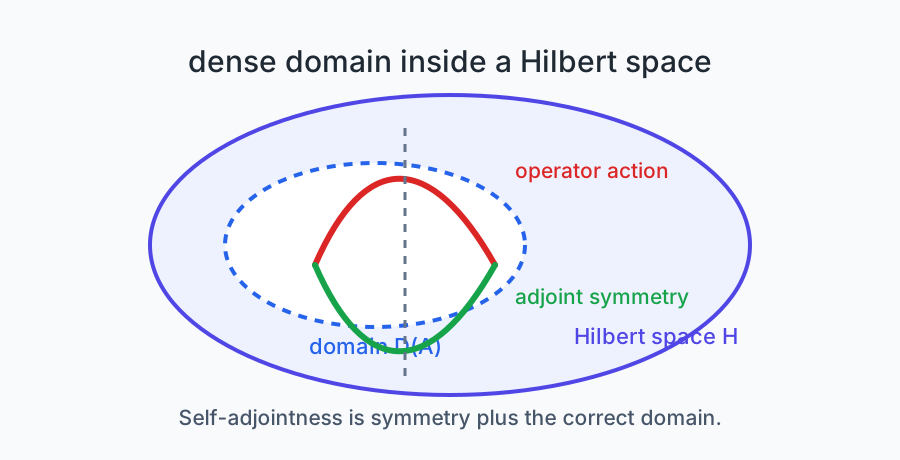
Two operators can use the same formula but have different domains. For unbounded operators, that difference changes the mathematics.
Worked example [Beginner]
Think of the derivative machine. Feed it the function and it returns . Feed it a function with a sharp corner and the ordinary derivative may fail at the corner.
So the derivative machine needs a domain: a class of functions where the rule makes sense and where the output still belongs to the Hilbert space under study.
On an interval, boundary conditions are part of the domain. A derivative with periodic boundary behavior and a derivative with zero-endpoint behavior can have the same local formula but different global operators.
Check your understanding [Beginner]
Formal definition [Intermediate+]
Let be a complex Hilbert space. An unbounded operator on is a linear map
defined on a linear subspace , called its domain. The operator is densely defined if is dense in .
For a densely defined operator , the adjoint is defined as follows. A vector belongs to if there is a vector such that
for every . Then [Reed-Simon §VIII].
The operator is symmetric if , meaning and for . It is self-adjoint if , including equality of domains.
Key theorem with proof [Intermediate+]
Theorem (self-adjoint operators are symmetric). If is self-adjoint, then
for all .
Proof. Self-adjointness means as operators, including equality of domains. Hence and for every .
By the definition of the adjoint, for every and ,
Since and on this domain, the identity becomes
Thus every self-adjoint operator is symmetric.
Bridge. The construction here builds toward 03.09.08 (dirac operator), where the same data is upgraded, and the symmetry side is taken up in 03.09.09 (elliptic operators on a manifold). The defining pattern appears again in those units in a sharpened form, where the local data is glued or quotiented. Putting these together, the foundational insight is that the data of this unit gives the structural signature that the rest of the strand reads off.
Exercises [Intermediate+]
Lean formalization [Intermediate+]
lean_status: none — current Mathlib does not provide the unbounded-operator domain API needed for this unit in a packaged form.
The expected formalization would introduce densely defined linear operators as maps from a submodule domain to a Hilbert space, define adjoints by the Riesz representation theorem on dense domains, and separate symmetric, closed, essentially self-adjoint, and self-adjoint operators.
Advanced results [Master]
A densely defined operator is closed if its graph is closed in . Symmetric operators need not be self-adjoint; the obstruction is measured by deficiency spaces
Von Neumann's deficiency-index theorem characterizes self-adjoint extensions by the dimensions of these two spaces [Reed-Simon §VIII].
For self-adjoint , the spectral theorem supplies a projection-valued measure such that
on its natural domain. This functional calculus is the analytic foundation for Hamiltonians in quantum mechanics and for Dirac-type operators after Sobolev completion 03.09.08.
Synthesis. This construction generalises the pattern fixed in 02.11.08 (hilbert space), with the symmetric data replaced by its skew or twisted analogue. Read in the opposite direction, the construction is dual to the metric story: complements and orthogonality are taken with respect to the bilinear datum of this unit, not a metric, and the resulting category of subobjects is the one the rest of the strand classifies. The central insight is that this datum identifies algebra with geometry: functions become vector fields, subspaces become quotients, and invariants become cohomology classes — and that identification is the engine driving every theorem downstream.
Full proof set [Master]
Closedness of self-adjoint operators. If , then is closed. To see that adjoints are closed, take with and . For every ,
Thus and . Hence is closed when .
Reality of expectation values. If is self-adjoint and , then
so is real.
Connections [Master]
Hilbert space
02.11.08— domains, adjoints, and spectral theory live in Hilbert spaces.Dirac operator
03.09.08— Dirac operators are naturally unbounded before Sobolev completion.Elliptic operators
03.09.09— elliptic self-adjoint operators have discrete spectral behavior on compact manifolds.CFT basics
03.10.02— quantum Hamiltonians and mode operators require domain control.
Historical & philosophical context [Master]
Stone's theorem and von Neumann's work on quantum mechanics made self-adjointness the correct infinite-dimensional replacement for Hermitian matrices. Symmetric differential expressions became physical observables only after their domains produced self-adjoint operators.
Kato's perturbation theory organized stability questions for closed and self-adjoint operators, especially the behavior of spectra under analytic and relatively bounded perturbations [Kato §V].
Bibliography [Master]
- Reed, M. and Simon, B., Methods of Modern Mathematical Physics, Vol. I: Functional Analysis, Academic Press, 1980. §VIII.
- Kato, T., Perturbation Theory for Linear Operators, Springer, 1966. §V.
- von Neumann, J., Mathematical Foundations of Quantum Mechanics, Princeton University Press, 1955.
- Stone, M. H., "Linear transformations in Hilbert space", American Mathematical Society Colloquium Publications 15, 1932.
Wave 2 Phase 2.4 unit #1. Produced as the unbounded-operator prerequisite for Dirac and elliptic analysis.