Double cover
Anchor (Master): Hatcher §1.3; Bredon Topology and Geometry §III.3
Intuition [Beginner]
A double cover is a space lying over another space with two points upstairs above each point downstairs. Locally it looks like two separate copies of the same small neighborhood.
The interesting behavior is global. As you move around the base, the two sheets may return to themselves, or they may swap. The Möbius band boundary over its center circle is a basic two-sheeted picture.
Spin geometry uses an algebraic double cover: lies over with two group elements above each rotation. A spin structure uses that cover to lift frame data 03.09.04.
Visual [Beginner]
A double cover has two local sheets over the same base. A loop in the base can preserve or exchange the sheets.
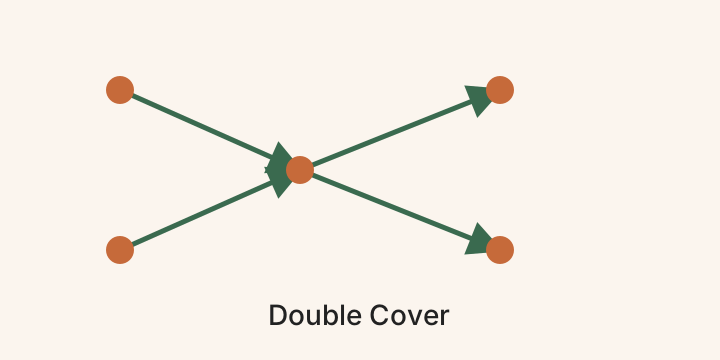
The two sheets are locally separate, even when the whole cover is connected.
Worked example [Beginner]
Map a circle to another circle by doubling the angle. A point on the lower circle has exactly two points above it: two angles that differ by half a turn.
Walk once around the lower circle. Upstairs, a lift can travel only halfway around before reaching the other point over the start. A second trip returns it to the original point.
What this tells us: a double cover can store a two-valued choice that changes when one moves around a loop.
Check your understanding [Beginner]
Formal definition [Intermediate+]
A double cover is a covering map whose fiber has two points for every [Hatcher §1.3]. Equivalently, each has an open neighborhood such that
over .
A deck transformation of is a homeomorphism such that . For a connected double cover, a nonidentity deck transformation necessarily swaps the two points in each fiber.
Key theorem with proof [Intermediate+]
Theorem (Connected double covers are regular). Let be a connected double cover with connected and locally path connected. Then the cover is regular, and its deck group has order when the cover is nontrivial.
Proof. Choose a base point and write the fiber as . The monodromy action of on the fiber gives a transitive subgroup of the permutation group when is connected. The only transitive subgroup of is itself.
The stabilizer of is therefore a normal subgroup of index in . Normality is the covering-space criterion for regularity [Hatcher §1.3]. A regular two-sheeted cover has deck group acting freely and transitively on the two-point fiber, so the deck group is isomorphic to .
Bridge. The construction here builds toward 03.09.04 (spin structure on an oriented riemannian manifold), where the same data is developed in the next layer of the strand. The defining pattern appears again in those units in a sharpened form, where the local data is glued or quotiented. Putting these together, the foundational insight is that the data of this unit gives the structural signature that the rest of the strand reads off.
Exercises [Intermediate+]
Lean formalization [Intermediate+]
lean_status: none is recorded because the curriculum needs covering spaces, deck transformations, double covers, and principal -bundles as one connected API before Lean statements should be attached.
Advanced results [Master]
Connected double covers of a connected, locally path-connected, semilocally simply connected space correspond to index- subgroups of the fundamental group, equivalently to nonzero homomorphisms up to the usual basepoint choices [Hatcher §1.3].
When the cover is regular, its deck group is , and the covering map is a principal -bundle. The Lie-group homomorphism is a double cover with kernel ; pulling this cover back along structure-group data is the local algebraic source of spin lifting problems.
Synthesis. This construction generalises the pattern fixed in 03.02.01 (smooth manifold), with the symmetric data replaced by its skew or twisted analogue. Read in the opposite direction, the construction is dual to the metric story: complements and orthogonality are taken with respect to the bilinear datum of this unit, not a metric, and the resulting category of subobjects is the one the rest of the strand classifies. The central insight is that this datum identifies algebra with geometry: functions become vector fields, subspaces become quotients, and invariants become cohomology classes — and that identification is the engine driving every theorem downstream.
Full proof set [Master]
The classification by index- subgroups is the standard covering-space classification specialized to two sheets. A connected covering corresponds to the subgroup . The number of sheets is the index of this subgroup, so a double cover gives index . Conversely, an index- subgroup determines a connected two-sheeted cover.
Index- subgroups are normal, so the corresponding cover is regular. The quotient acts as the deck group and has order .
Connections [Master]
Double covers connect covering-space theory
03.12.02to principal bundles03.05.01. The map is a double cover used by spin group theory03.09.03. A spin structure03.09.04is a lift of the orthonormal frame bundle through that double cover.The same two-valued monodromy viewpoint appears in characteristic-class obstructions: the failure to lift structure groups is recorded by cohomological data, especially Stiefel-Whitney classes in the spin case
03.06.03.
Historical & philosophical context [Master]
Covering spaces entered algebraic topology as a bridge between local topology and fundamental groups. The classification of covering spaces by subgroups of the fundamental group is a standard result in the modern presentation [Hatcher §1.3].
The spin double cover arose from the representation theory of Clifford algebras and rotation groups. In differential geometry it appears through the short exact sequence , which supplies the lifting problem for spin structures 03.09.04.
Bibliography [Master]
- Allen Hatcher, Algebraic Topology, §1.3. [Hatcher §1.3]
- Glen Bredon, Topology and Geometry, §III.3. [Bredon §III.3]
- H. Blaine Lawson and Marie-Louise Michelsohn, Spin Geometry, §I.2. [Lawson-Michelsohn §I.2]