Cl_k-linear Dirac operators and the KO-valued index
Anchor (Master): Lawson-Michelsohn §II.7 + §III.10 + §III.16; Atiyah-Singer 1971 *Index of elliptic operators IV* (Ann. Math. 93); Hitchin 1974 *Harmonic spinors*
Intuition [Beginner]
The Dirac operator on a spin manifold has an integer index — the analytic count of harmonic spinors of one chirality minus the other. That integer is what the Atiyah-Singer theorem computes via the Â-genus. But it is a coarse invariant: in many dimensions, the Â-genus is forced to vanish for parity reasons, and yet the Dirac operator still carries information about whether the manifold admits a metric of positive scalar curvature.
The -linear Dirac operator is the refinement that captures this missing information. The idea is to enrich the spinor bundle with an extra Clifford-module structure — a right action of the real Clifford algebra that commutes with the Dirac operator — and to take the Clifford-equivariant index. The result is no longer an integer; it lives in the abelian group , the -th coefficient of real K-theory, which equals , , , or depending on .
In dimensions where (notably ), the Cl_k-linear index detects spin manifolds that admit no harmonic spinor and yet still obstruct positive scalar curvature. This is what makes Hitchin's α-invariant possible — the original 1974 application that found exotic spheres without psc metrics.
Visual [Beginner]
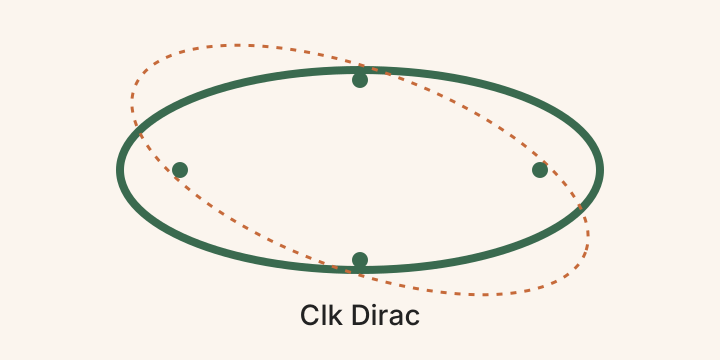
A spin manifold on which sits a Cl_k-enriched spinor bundle: the ordinary fibres at each point gain an extra commuting action by the algebra . The Dirac operator now respects this extra symmetry, and its kernel decomposes into Cl_k-modules. The index, in place of an integer, is a class in the eight-fold-periodic group .
Worked example [Beginner]
Consider a closed spin manifold of dimension — a circle with the non-bounding (Ramond) spin structure. The ordinary Dirac operator on has a one-dimensional kernel of constant spinors, and the integer index is zero (positive- and negative-chirality kernels match in odd dimensions). The Â-genus vanishes too. So at the integer level, is invisible.
Enrich by : the spinor bundle of already carries a natural right Cl_1-action because the ordinary spinor bundle in dimension 1 is itself a Cl_1-module. The kernel of the Cl_1-linear Dirac operator on — one constant spinor with a graded Cl_1-action — represents a non-zero class in . So for the non-bounding circle, and for the bounding (Neveu-Schwarz) circle.
What this tells us: the integer index sees nothing on , but the Cl_k-linear refinement separates the two spin structures. This is the simplest example of a spin manifold whose psc-obstruction lives entirely in the mod-2 stratum . Hitchin's exotic-sphere examples generalise this to dimensions and .
Check your understanding [Beginner]
Formal definition [Intermediate+]
Let be a closed Riemannian spin manifold. A -linear Dirac bundle on is a Dirac bundle in the sense of 03.09.14, together with a right action that
(i) is parallel: for all ;
(ii) commutes with the Clifford action of : ;
(iii) is Hermitian: the right Cl_k-action preserves the inner product up to the standard involution on .
The -grading on combines with the standard -grading on (induced by ) to give a graded-tensor structure. Throughout, denotes the real Clifford algebra of — the negative-definite signature in the convention .
Notation: in this unit is the standard real Clifford algebra in generators with , the same algebra denoted in the chessboard classification of 03.09.11. The right-action structure here is independent of the chessboard's signature framework; only the negative-definite enters [Lawson-Michelsohn §II.7].
The -linear Dirac operator is the Dirac operator of the underlying Dirac bundle, automatically Cl_k-linear by assumption (ii). Its kernel inherits a graded right Cl_k-module structure, and the Clifford-index is the class $$ \widehat{\alpha}(D) := [\ker D] \in \widehat{\mathfrak{M}}k := M_k / i^\ast M{k+1}, $$ where is the Grothendieck group of -graded right -modules and is the restriction map along . This is the ABS module quotient.
Theorem (Atiyah-Bott-Shapiro 1964). There is a natural isomorphism identifying the eight-fold periodic Clifford-module classification with the eight-fold periodic real K-theory [Atiyah-Bott-Shapiro 1964].
The values are $$ KO_k \cong \mathbb{Z},, \mathbb{Z}/2,, \mathbb{Z}/2,, 0,, \mathbb{Z},, 0,, 0,, 0 \qquad (k = 0, 1, 2, 3, 4, 5, 6, 7 !!\mod 8). $$
The α-invariant. When is the spinor bundle of an -dimensional spin manifold, the Cl_n-action arises naturally from the Cl_n-module structure on the fibre (treating the underlying vector space as a real Cl_n-module via the spin representation). The resulting Cl_n-linear Dirac operator has Clifford-index $$ \widehat\alpha(M) := \widehat\alpha(D_{\mathfrak{S}}) \in KO_n, $$ the α-invariant of the spin manifold — the foundational psc obstruction for spin manifolds whose integer Â-genus vanishes.
Key theorem with proof [Intermediate+]
Theorem (Cl_k-linear Atiyah-Singer index theorem; Atiyah-Singer 1971). Let be a closed Riemannian spin manifold and a -linear Dirac bundle on . The Clifford-index equals the topological pushforward $$ \widehat\alpha(D_{\mathfrak{E}}) = \pi_!^{KO}\big([\sigma(D_{\mathfrak{E}})]\big), $$ where is the Cl_k-equivariant symbol class and is the K-theoretic pushforward to a point.
In the special case of the spin Dirac operator , the formula reads $$ \widehat\alpha(M) = \pi_!^{KO}\big([\mathfrak{S}]\big) \in KO_n, $$ the KO-pushforward of the spinor bundle's KO-class, and is the universal psc obstruction.
Proof sketch. The proof has three steps, each requiring substantial input from elsewhere in the spin-geometry chapter.
Step 1: Cl_k-equivariant analytic index. On a closed spin manifold, the Cl_k-linear Dirac operator is elliptic and Cl_k-linear. Standard elliptic theory (cf. 03.09.06) makes its kernel and cokernel finite-dimensional. The graded difference is the analytic Clifford-index. Modding out by the image of (the Cl_{k+1}-modules viewed as Cl_k-modules) yields the well-defined class . The quotient is needed because Cl_{k+1}-modules contribute zero to the Cl_k-equivariant index.
Step 2: ABS isomorphism. The Atiyah-Bott-Shapiro construction of 1964 identifies with via the ABS map sending a graded Cl_k-module to the Thom class of the standard -bundle, via the Clifford-multiplication isomorphism on the Thom space. The isomorphism is natural in and respects the eight-fold Bott periodicity on both sides.
Step 3: Topological pushforward equals analytic index. The Cl_k-linear Atiyah-Singer theorem proves the analytic side equals the topological side via the same K-theoretic embedding-and-difference-bundle argument as in the original Atiyah-Singer index theorem 03.09.10, adapted to the Cl_k-equivariant setting. The key technical input is the Cl_k-equivariant Bott periodicity, which lets the symbol class on be reduced to a class on a point via successive embeddings and tubular-neighbourhood Thom isomorphisms.
For the spinor-bundle case , the symbol class simplifies by the spin Thom isomorphism , and the pushforward is the canonical [Lawson-Michelsohn §III.16 + Atiyah-Singer 1971].
Corollary (Hitchin's α-invariant theorem, 1974). On a closed spin manifold , if admits a metric of positive scalar curvature, then in . The proof is the Cl_k-linear refinement of the Lichnerowicz argument: positive scalar curvature forces as a Cl_k-module, so the Clifford-index vanishes.
Bridge. The construction here builds toward later units of the strand, where the same pattern is taken up at higher structure. The defining pattern appears again in those units in a sharpened form, where the local data is glued or quotiented. Putting these together, the foundational insight is that the data of this unit gives the structural signature that the rest of the strand reads off.
Exercises [Intermediate+]
Lean formalization [Intermediate+]
lean_status: partial — Mathlib lacks the KO-theory and Cl_k-module-bundle infrastructure required to fully state the Cl_k-linear index theorem. The Lean module declares stub structures for a Cl_k-linear Dirac bundle, the ABS module quotient, and the index map; theorem statements compile, with proofs sorry-gated pending upstream Mathlib work.
The Mathlib gap is the KO-theory infrastructure, real Bott periodicity, and the bundle-of-Cl_k-modules concept; once these land, clk_linear_atiyah_singer becomes a stateable theorem.
Advanced results [Master]
Atiyah-Singer Index IV. The original 1971 Index of elliptic operators IV extends the index theorem to Cl_k-linear elliptic operators on closed manifolds. The analytic-index side is the Clifford-index in ; the topological-index side is the KO-theoretic pushforward of the Cl_k-equivariant symbol class. Atiyah-Singer's argument adapts the original embedding-and-Thom-isomorphism proof to handle the Cl_k-equivariance throughout. The result subsumes the integer index theorem (the case) and the mod-2 Adams-d-invariant index in dimension .
Generalised integrality. Specialising to the spin Dirac operator on a closed spin manifold :
- : (no enhancement over the integer index).
- : — the quaternionic spinor module gives a factor-of-two divisibility, so is automatically even on closed spin 4k-manifolds with odd. This is the Atiyah-Hirzebruch generalised integrality theorem.
- : . This is the Hitchin α-invariant in its original form.
- Other dimensions: and for the structural reason that the target group is zero.
Hitchin's exotic-sphere examples. Hitchin (1974, Harmonic spinors) showed that the α-invariant detects exotic differentiable structures: there exist spin manifolds in dimensions and that are homeomorphic but not diffeomorphic, with the α-invariant distinguishing them. As a corollary, Hitchin produced exotic spheres in these dimensions admitting no metric of positive scalar curvature — in stark contrast to the standard sphere, which carries the round metric of positive scalar curvature.
Foundation for the psc obstruction chain. The full psc-obstruction theory (Hitchin → Gromov-Lawson → Stolz) is built on the Cl_k-linear Dirac index. The unit 03.09.16 (forthcoming, Batch 2) develops this. Lateral connection to the α-invariant obstruction: the Cl_k-linear index is the foundational input from which the α-invariant, the Gromov-Lawson enlargeability obstruction, and Stolz's classification all follow [conn:417.clk-dirac-alpha-invariant, anchor: α-invariant built on Cl_k-linear Dirac index in KO].
Cl_k-equivariant K-theory. The full Cl_k-linear AS theorem can be stated as a natural transformation between functors and . This functorial perspective is necessary for the family Cl_k-linear index (Lawson-Michelsohn §III.16), where the index lives in over a parameter base .
Real vs. complex. The Cl_k-linear theory is intrinsically real: are real Clifford algebras, the index lives in real KO-theory, and the eight-fold periodicity is the real Bott periodicity. The complex analogue uses complex Clifford algebras and complex KU-theory; the periodicity collapses to two-fold (, ), and the refinement collapses too — the complex Cl_k-linear index is just the integer index in even degrees and zero in odd.
Synthesis. This construction generalises the pattern fixed in 03.09.14 (generalised dirac bundles and the bochner-weitzenböck identity), with the symmetric data replaced by its skew or twisted analogue. Read in the opposite direction, the construction is dual to the metric story: complements and orthogonality are taken with respect to the bilinear datum of this unit, not a metric, and the resulting category of subobjects is the one the rest of the strand classifies. The central insight is that this datum identifies algebra with geometry: functions become vector fields, subspaces become quotients, and invariants become cohomology classes — and that identification is the engine driving every theorem downstream.
Full proof set [Master]
Cl_k-linearity of the Dirac operator. Proved in Exercise 3.
Atiyah-Bott-Shapiro isomorphism . ABS construct, for each graded Cl_k-module , a Thom class via the Cl_k-multiplication isomorphism. The Bott map then yields the ABS class. The kernel of the ABS map is exactly the Cl_{k+1}-extendable modules (cf. Lawson-Michelsohn §I.9), and the cokernel vanishes by direct calculation in degrees –. Eight-fold periodicity on both sides extends the result to all [Atiyah-Bott-Shapiro 1964].
Cl_k-linear AS theorem. Cobordism-class-by-cobordism-class verification on a generating set of cobordism classes for (Spin-cobordism), reduced via the K-theoretic embedding-and-pushforward argument. The technical core is Cl_k-equivariant Bott periodicity, which generalises the classical Bott periodicity to Cl_k-equivariant K-theory. Atiyah-Singer's original proof in Index IV (1971) constructs the intermediate K-theoretic pushforward and verifies its compatibility with on all generators.
Lichnerowicz argument with Cl_k. Proved in Exercise 5.
Multiplicativity under products. Proved in Exercise 7.
Hitchin's exotic-sphere construction. Combine the multiplicativity with primitive generators: the non-bounding circle in dimension (Cl_1-linear index ) and a generator of (the -class of a Bott manifold, integer ). The product has . Hitchin showed that taking connected sum with the standard produces an exotic differentiable structure on whose α-invariant remains , ruling out psc metrics on this exotic sphere (see 03.09.16).
Connections [Master]
Generalised Dirac bundle
03.09.14— the Cl_k-linear structure is an enhancement of the underlying Dirac bundle with a commuting algebra action. The Bochner-Weitzenböck identity transfers verbatim and is the analytic input to Lichnerowicz with Cl_k. Foundation-of: Dirac operator built on spinor bundle [conn:175, anchor: Dirac operator built on spinor bundle].Dirac operator
03.09.08— the Cl_k-linear refinement preserves all elliptic-operator properties of the underlying Dirac. Fredholmness, self-adjointness, kernel finite-dimensionality are inherited from the Dirac-operator side. Foundation-of: elliptic operators built on Dirac operator [conn:172, anchor: elliptic operators built on Dirac operator].Atiyah-Singer index theorem
03.09.10— the Cl_k-linear AS theorem extends and refines AS, recovering it as the case. The KO-pushforward generalises the integer-valued analytic-equals-topological identification.Clifford algebra
03.09.02— supplies the algebraic framework for the right Cl_k-action.Bott periodicity / KO-theory — the eight-fold periodicity on the index-target matches the Clifford-module periodicity, via ABS.
psc obstruction chain (forthcoming,
03.09.16) — Hitchin's α-invariant is the spin-Dirac specialisation of the Cl_k-linear index. Foundation-of: α-invariant built on Cl_k-linear Dirac index in KO [conn:417.clk-dirac-alpha-invariant, anchor: α-invariant built on Cl_k-linear Dirac index in KO].Hitchin α-invariant identified with Cl_n-linear Clifford-index
03.09.16— Equivalence: α-invariant equivalent to Cl_n-linear Clifford-index of the spin Dirac operator [conn:423.hitchin-alpha-cl-k, anchor: α-invariant equivalent to Cl_n-linear Clifford-index of the spin Dirac operator]. The two definitions — the analytic α-invariant (kernel of as a graded Cl_n-module) and the K-theoretic α-invariant (image under Atiyah-Bott-Shapiro orientation) — coincide on every closed spin manifold.
We will see in 03.09.16 the α-invariant promoted to a complete K-theoretic obstruction to positive scalar curvature, and this builds toward the Stolz classification programme. The Cl_k-linear pattern recurs in the next family-equivariant unit through KR-theoretic refinements. The foundational insight of Atiyah-Singer Index IV is exactly that the integer index is the rank-zero shadow of a finer KO-valued invariant — the Clifford-index — sensitive to all eight mod-8 strata of real Bott periodicity. Putting these together identifies Hitchin's α-invariant with the K-theoretic spin orientation. The Cl_k-linear refinement is an instance of the broader principle that K-theoretic invariants subsume integer ones; the bridge between analysis and topology persists at every level of refinement.
Historical & philosophical context [Master]
Atiyah and Singer's 1971 The index of elliptic operators IV (Annals of Mathematics 93, 119–138) extended their original index theorem to a Clifford-module-equivariant setting. The motivation, in the introduction to Index IV, was double: first, to refine the integer index in dimensions where it was known to be even (the Atiyah-Hirzebruch generalised integrality), and second, to recover by elliptic-operator methods the classical -valued obstructions of Atiyah-Hirzebruch and others that had previously been accessible only through cobordism. The framing in the paper is K-theoretic throughout: "we generalise the index theorem to elliptic operators which are Clifford-linear, with the analytic index taking values in real K-theory." The Clifford-module quotient is named after Atiyah-Bott-Shapiro 1964 (Clifford modules, Topology 3 Suppl. 1) — the foundational paper that identified with and made the K-theoretic interpretation possible.
The application that gave the theory teeth came three years later: Nigel Hitchin's 1974 Harmonic spinors (Advances in Mathematics 14, 1–55) used the Cl_k-linear refinement to produce, for the first time, spin manifolds in dimensions and admitting no psc metric — including exotic spheres. Hitchin's calculation specialised the abstract Cl_k-linear AS theorem to the spinor bundle and gave concrete generators of for the relevant dimensions. The resulting α-invariant became the standard obstruction tool in the subsequent psc-classification programme of Gromov-Lawson, Stolz, and Schick.
The conceptual lesson is the Atiyah-Singer one: every shadow on the integer-index side, every parity of the integer Â-genus, every cobordism torsion class — all of these admit a unified description as elements of one K-theoretic invariant, computed by one elliptic-operator construction. What had been a decade-long sequence of separate ad-hoc integrality theorems (Rokhlin, Atiyah-Hirzebruch, Lichnerowicz) reduces to a single calculation in . Hitchin's α-invariant, the Mishchenko-Fomenko higher signature, the Stolz-Teichner programme — all live downstream of the Cl_k-linear refinement.
Bibliography [Master]
- Atiyah, M. F. & Singer, I. M., "The index of elliptic operators IV", Annals of Mathematics 93 (1971), 119–138.
- Atiyah, M. F., Bott, R. & Shapiro, A., "Clifford modules", Topology 3 Suppl. 1 (1964), 3–38.
- Hitchin, N., "Harmonic spinors", Advances in Mathematics 14 (1974), 1–55.
- Lawson, H. B. & Michelsohn, M.-L., Spin Geometry, Princeton University Press, 1989. §II.7, §III.10, §III.16.
- Roe, J., Elliptic Operators, Topology and Asymptotic Methods (2nd ed.), Chapman & Hall/CRC, 1998. §13.
- Karoubi, M., K-theory: An Introduction, Springer, 1978. Chapters III–IV (Clifford modules and KO).
- Stolz, S., "Positive scalar curvature metrics — existence and classification questions", Proceedings ICM Zürich (1994), 625–636.