Leray-Hirsch theorem and the splitting principle for vector bundles
Anchor (Master): Bott-Tu §17, §21; Borel-Hirzebruch 1958/59; Milnor-Stasheff §16; Husemoller §16
Intuition [Beginner]
The splitting principle is the cleanest pedagogical move in the theory of characteristic classes: to compute characteristic classes of a vector bundle, pretend the bundle is a sum of line bundles. This works because every formula you can write down for sums of line bundles, that holds for all such sums, holds for arbitrary vector bundles.
The reason this is allowed is the Leray-Hirsch theorem, which says: if you have a fibre bundle whose fibre cohomology classes extend to global classes on the total space, then the total space cohomology is a free module over the base cohomology with these classes as a basis. Apply this to the bundle of complete flags inside a vector bundle, and you get a covering space (the flag bundle) on which the original vector bundle splits as a sum of line bundles, and on which the cohomology pulls back injectively. Anything you compute upstairs, you can read off downstairs.
The result is a calculus: write the total Chern class formally as a product over of factors , with the "Chern roots", expand symbolically, then re-package into actual Chern classes at the end. This is how Pontryagin classes are computed, how Whitney sum formulas are derived, how Chern character is constructed, and how almost every characteristic-class identity in twentieth-century topology was proved.
Visual [Beginner]
Picture a vector bundle as a stack of vector spaces over the base. To split it into lines, choose at every point a complete flag — a tower of subspaces the fibre, where each has dimension . The space of all such flags varies smoothly over the base; this is the flag bundle.
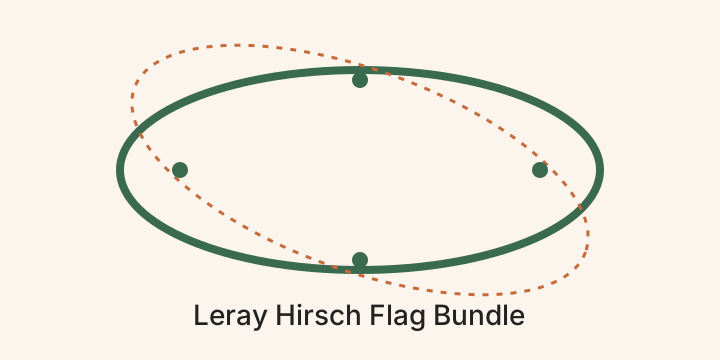
On the flag bundle, the original bundle splits as the direct sum of the line bundles . Cohomology pulls back injectively from the base to the flag bundle, so any formula derived upstairs (where everything splits into lines) is an honest formula downstairs (where the bundle is its original twisted self).
Worked example [Beginner]
For a complex vector bundle of rank over a base , the flag bundle is the projectivisation — a fibre bundle with fibre over each point of . On there is a tautological line bundle whose fibre over is the line .
By Leray-Hirsch, the cohomology of is a free -module with basis where is the first Chern class of the dual tautological bundle. Specifically, , with expressible as in the cohomology ring.
This relation is Grothendieck's definition of the Chern classes: the Chern classes are the coefficients of the unique relation that satisfies in over . The relation is the splitting principle made concrete: factoring identifies the Chern roots as the formal "first Chern classes of the line factors" of , and the symmetric functions in recover .
Check your understanding [Beginner]
Formal definition [Intermediate+]
Theorem (Leray-Hirsch, 1948). Let be a fibre bundle with fibre , with a connected CW complex and the base ring a principal ideal domain. Suppose:
- is a finitely generated free -module for each .
- There exist classes $e_1, \ldots, e_n \in H^(E; k)kH^(F; k)$.
Then the map $$ H^(B; k) \otimes_k H^(F; k) \to H^(E; k), \qquad \beta \otimes \iota^(e_i) \mapsto \pi^(\beta) \cdot e_i, $$ is an isomorphism of graded $H^(B; k)$-modules.
This is a module isomorphism, not (in general) a ring isomorphism — the cup product on may differ from the tensor product. The proof, given in 03.13.02 Exercise 8, is that the Leray-Serre spectral sequence collapses at .
Projective bundle. For a complex vector bundle of rank , the projectivisation has fibre . Let be the tautological line bundle whose fibre at is the line . Set (the dual sign convention follows Bott-Tu §21).
The classes restrict to a basis of on each fibre. By Leray-Hirsch, $$ H^(\mathbb{P}(E); \mathbb{Z}) \cong H^(B; \mathbb{Z})[x] / (x^n + c_1(E) x^{n-1} + \cdots + c_n(E)), $$ where the relation defines the Chern classes . This is Grothendieck's definition of Chern classes [Grothendieck 1958].
Splitting principle. For a complex vector bundle of rank , the iterated projectivisation $$ F\ell(E) \to B $$ — the flag bundle, with fibre the variety of complete flags in — pulls back to a bundle that splits as a direct sum of line bundles: $$ \sigma : F\ell(E) \to B, \qquad \sigma^* E \cong L_1 \oplus L_2 \oplus \cdots \oplus L_n. $$ The pullback on cohomology $$ \sigma^* : H^(B; \mathbb{Z}) \to H^(F\ell(E); \mathbb{Z}) $$ is injective, by iterating Leray-Hirsch on each successive projectivisation. The injectivity is what powers the proof technique.
Chern roots. On , write . Then $$ \sigma^* c(E) = \sigma^*\bigl(1 + c_1(E) + \cdots + c_n(E)\bigr) = \prod_{i=1}^n (1 + x_i). $$ The are the Chern roots of . Any symmetric polynomial in is the pullback of a polynomial in the Chern classes ; specifically, is the -th elementary symmetric function. Identities in Chern classes follow from identities in Chern roots.
Pontryagin classes (real bundles). For a real vector bundle of rank , the Pontryagin classes are defined via complexification : $$ p_i(E_{\mathbb{R}}) := (-1)^i c_{2i}(E_{\mathbb{R}} \otimes_{\mathbb{R}} \mathbb{C}) \in H^{4i}(B; \mathbb{Z}). $$ The splitting principle for runs through and identifies real Chern roots in pairs, with the elementary symmetric functions in the squared roots. The construction is the structural reason Pontryagin classes live in degree and have the Whitney sum formula modulo -torsion.
Key theorem with proof [Intermediate+]
Theorem (Leray-Hirsch). In the setup above, the map $H^(B; k) \otimes H^(F; k) \to H^(E; k)\beta \otimes \iota^(e_i) \mapsto \pi^(\beta) \cdot e_iH^(B; k)$-modules.
Proof. The Leray-Serre spectral sequence of the fibration has , which by hypothesis is the constant local system . The classes supply a section of the projection — that is, each has a global cohomology lift, namely itself.
Define a map $$ \Phi : H^(B; k) \otimes_k H^(F; k) \to H^(E; k), \qquad \beta \otimes \iota^(e_i) \mapsto \pi^*(\beta) \cdot e_i. $$ We show is an isomorphism via the spectral sequence.
The spectral sequence is multiplicative: each page is a bigraded ring and is a derivation. The classes are in (the entire cohomology) but their image in is the basis of . By multiplicativity, products for generate the entire associated graded: $$ E_\infty^{p, q} = \pi^(H^p(B; k)) \cdot e_i \quad \text{(where } \deg \iota^(e_i) = q\text{)}. $$
We claim no differential for is non-zero. Suppose for some . Then is a non-zero class in . But is a genuine class on (a permanent cycle), so on the spectral-sequence side as well. Hence each survives to .
Multiplicativity then forces all on for any to vanish: write a class as with and a basis of . Then since both terms vanish (the first because is in the bottom row and from row goes to negative row , outside support; the second because each has a permanent-cycle lift ).
Hence , and the filtration on has associated graded with . The map on associated gradeds is an isomorphism by inspection. Since both sides are filtered by -degree and respects filtration, itself is an isomorphism.
Theorem (Splitting principle). Let be a complex vector bundle of rank over a paracompact base. There exists a space (the complete flag bundle) such that:
- The pullback $\sigma^ EF\ell(E)\sigma^* E \cong L_1 \oplus \cdots \oplus L_n$.*
- The pullback on cohomology $\sigma^ : H^(B; R) \to H^(F\ell(E); R)R$.*
Proof. Construct inductively. Let be the projectivisation. The pullback on contains the tautological line subbundle , with quotient a rank- bundle. By induction (replace by and iterate), we obtain a tower of projectivisations $$ F\ell(E) = F_n \to F_{n-1} \to \cdots \to F_1 = \mathbb{P}(E) \to B $$ with each step a projectivisation. On , the iterated quotient produces line bundles with .
Injectivity of : each step is a projective bundle, and the pullback is injective by Leray-Hirsch (the cohomology of is a free -module of rank , with basis for of the tautological line on ). Composing injections gives the injectivity of .
Corollary (Whitney sum formula via splitting). For complex vector bundles , $$ c(E \oplus F) = c(E) \cdot c(F). $$
Proof. Pull back to , where splits as with the first lines coming from and the last from . Then $$ \sigma^* c(E \oplus F) = \prod_{i=1}^{n+m}(1 + x_i) = \prod_{i=1}^n (1 + x_i) \cdot \prod_{j=n+1}^{n+m}(1 + x_j) = \sigma^* c(E) \cdot \sigma^* c(F). $$ Since is injective, on .
Synthesis. Leray-Hirsch is exactly the collapse-at- specialisation of Leray-Serre. The splitting principle is the foundational technique that reduces characteristic-class identities on arbitrary bundles to symmetric-function identities on Chern roots. The flag bundle is the bridge between the simple case and the general case.
Bridge. The construction here builds toward later units of the strand, where the same pattern is taken up at higher structure. The defining pattern appears again in those units in a sharpened form, where the local data is glued or quotiented. Putting these together, the foundational insight is that the data of this unit gives the structural signature that the rest of the strand reads off.
Exercises [Intermediate+]
Lean formalization [Intermediate+]
[object Promise]The flag bundle, Leray-Hirsch, and the splitting principle are all absent from Mathlib at this level of generality. Mathlib has projective spaces and projective bundles in its algebraic-geometry layer but not the topological projective bundle theorem; the cohomology-ring computation for would be a substantial Mathlib contribution.
Advanced results [Master]
Borel presentation of flag-manifold cohomology. For a compact Lie group with maximal torus and Weyl group , the flag manifold has cohomology $$ H^(G/T; \mathbb{Q}) \cong H^(BT; \mathbb{Q}) / I_W, $$ where is the ideal generated by positive-degree -invariants. For , this is the Schubert presentation: , the polynomial ring modulo the ideal of elementary symmetric functions. The proof uses the Serre spectral sequence of together with Borel's identification [Borel-Hirzebruch 1958]. The flag-bundle splitting principle is the geometric counterpart.
Schubert calculus. The cohomology of the Grassmannian has an additive basis given by Schubert classes — Poincaré duals of Schubert varieties. The cup-product structure constants are the Littlewood-Richardson coefficients, governing how products of Schubert classes decompose. The splitting principle gives an alternative presentation of as the symmetric polynomials in the Chern roots of the tautological subbundle modulo the Whitney relation; the bridge between the Schubert and Borel presentations is one of the central themes of geometric representation theory.
Generalised splitting principles. The technique generalises beyond complex vector bundles. For an oriented real bundle, the oriented flag bundle parametrises oriented complete flags; its cohomology is computed by Leray-Hirsch with coefficients (or with coefficients on the orientable case using ). For a principal -bundle, the Borel construction supplies an analogous reduction; classifying maps to recover characteristic classes through . The Borel-Weil theorem identifies cohomology of as Lie-algebra representations.
Splitting principle for -theory. A direct -theoretic analogue: for a complex vector bundle , the total space of the complete flag bundle has for a Weyl-relation ideal . This identifies -classes of as symmetric functions in the line factors . The K-theoretic Chern character is the universal natural transformation that this picture makes computable.
Grothendieck's perspective. Alexander Grothendieck reformulated Chern classes in his 1958 Bull. Soc. Math. France paper using exactly the projective bundle theorem of Leray-Hirsch. For , the relation for in defines uniquely. This axiomatic definition is the route used in algebraic geometry, where the spectral-sequence machinery is replaced by sheaf-cohomology and the projective bundle formula becomes a statement about the structure of the Chow ring (or the K-theory ring) of . Grothendieck-Riemann-Roch is the global generalisation.
Splitting principle for orientifolds and equivariant bundles. In string theory and equivariant K-theory, the splitting principle generalises to settings with finite-group symmetries. For a -equivariant bundle, the real flag bundle parametrises -equivariant flags; its cohomology computes equivariant characteristic classes (Stiefel-Whitney for the real case, Pontryagin for the complex involution case). The framework of Atiyah-Segal completion and equivariant K-theory makes the splitting principle work in arbitrary equivariant settings.
Full proof set [Master]
Leray-Hirsch — alternative proof via the bar construction. An alternative proof of Leray-Hirsch, following the modern operadic perspective: model the fibration by the bar construction . The cohomology of the total space is computed by the dual cobar construction, and the existence of global lifts is exactly the hypothesis that the cobar differential vanishes on the basis. The collapse-at- statement becomes a statement about the cobar complex being a free module. This is Eilenberg-Moore in reverse.
Projective bundle theorem — full computation. For a complex vector bundle of rank , write . The tautological line bundle has fibre at equal to the line . Set .
Step 1: each fibre of has cohomology , with the same generator pulled back from the projection. The classes on restrict to a -basis of fibre cohomology in each fibre.
Step 2: by Leray-Hirsch, as a graded -module.
Step 3: the relation. The class must lie in the module spanned by , so there exist unique classes (with ) such that $$ x^n + c_1 \cdot x^{n-1} + c_2 \cdot x^{n-2} + \cdots + c_n = 0. $$ The classes are the Chern classes; this is Grothendieck's definition.
Step 4: matching with the curvature definition. For a smooth bundle with a connection of curvature , the Chern-Weil definition gives coefficients of , and one verifies on the projective bundle that the Grothendieck and Chern-Weil definitions coincide [Bott-Tu §21 + §23].
Splitting principle — naturality and uniqueness. The flag bundle construction is functorial: a bundle map over induces a map over . The pullback of Chern roots respects this functoriality. Hence any natural transformation of cohomology that vanishes on sums of line bundles vanishes universally, by the splitting principle.
Pontryagin classes of complex bundles. For a complex vector bundle of complex rank , view it as a real bundle of real rank . The complexification splits as , where is the complex conjugate bundle. The Chern roots of are (negatives of the Chern roots of ). Hence $$ c(E_{\mathbb{R}} \otimes \mathbb{C}) = c(E) c(\overline{E}) = \prod_i (1 + x_i)(1 - x_i) = \prod_i (1 - x_i^2). $$ The Pontryagin classes follow: $$ p_i(E_{\mathbb{R}}) = (-1)^i c_{2i}(E_{\mathbb{R}} \otimes \mathbb{C}) = e_i(x_1^2, \ldots, x_n^2). $$ A complex bundle has only "even" Pontryagin classes; this is the structural reason for the degree- shift.
Connections [Master]
Leray-Serre spectral sequence
03.13.02— the Leray-Hirsch theorem is the collapse-at- specialisation of Leray-Serre. The hypothesis that fibre classes lift to total-space classes forces the spectral sequence to degenerate. Foundation-of relation; anchor phrase: Leray-Hirsch is the collapse-at- case of Leray-Serre.Künneth formula
03.04.12— byconn:436.kunneth-leray-hirsch, Leray-Hirsch built on Künneth on each fiber (foundation-of). When fibre cohomology is finite-dimensional and a global lift exists, Leray-Hirsch reduces to fibrewise Künneth times base cohomology — fibre-Künneth is exactly the Leray-Hirsch input.Pontryagin and Chern classes
03.06.04— byconn:444.leray-hirsch-splitting, splitting principle built on Leray-Hirsch theorem applied iteratively to flag-bundle projections (foundation-of). The splitting principle is the cleanest route to the Whitney sum formula, the multiplicativity of Chern character, and the symmetric-function identities that govern characteristic classes.Classifying spaces
03.08.04— the splitting principle factors through the classifying-space picture: , where the right-hand side has the Borel-Weil cohomology presentation . Byconn:445.splitting-flag-borel, splitting principle equivalent to Borel presentation H(BG) = H*(BT)^W* (equivalence). For , acts by permuting Chern roots — the universal splitting principle is exactly this cohomology fact.K-theory
03.08.01— K-theoretic splitting principle: -classes of vector bundles are symmetric functions in line-bundle classes on the flag bundle. The Chern character is the universal natural transformation realising this picture rationally.Vector bundle
03.05.02— Chern classes are characteristic invariants of vector bundles, computed by the splitting principle.Spectral sequence (general)
03.13.01— the Leray-Hirsch theorem rests on the multiplicative structure of the Leray-Serre spectral sequence, which itself rests on the multiplicative structure of a filtered DGA (developed in the apex unit).Stiefel-Whitney classes
03.06.03— the real splitting principle (with coefficients) gives Stiefel-Whitney classes of a real bundle as symmetric functions of "Stiefel-Whitney roots" in the real flag bundle.
The splitting principle is the bridge between the pedagogically simple case (sums of line bundles, where everything is computable) and the general case (arbitrary vector bundles, where bundle isomorphism is hard). It is one of the core techniques of twentieth-century algebraic topology.
Throughlines and forward promises. The splitting principle is the foundational technique for characteristic-class identities. We will see the Whitney sum formula, the multiplicativity of the Chern character, and every symmetric-function calculation in characteristic-class theory route through this machine. The pattern recurs in K-theory (Chern character), in equivariant cohomology (Borel construction), and in Schubert calculus (divided-difference operators). The foundational reason characteristic-class identities reduce to symmetric-function identities is exactly the Borel presentation — this is precisely the equivalence the splitting principle realises geometrically on flag bundles. Putting these together: Leray-Hirsch is a specialisation of Leray-Serre at -collapse; the splitting principle is an instance of fibrewise Künneth; the Borel presentation is the cohomology fact behind the universal splitting. The bridge between the simple case (sums of line bundles) and the general case (arbitrary bundles) is exactly the cohomologically-injective pullback to the flag bundle.
Historical & philosophical context [Master]
The Leray-Hirsch theorem was announced by Guy Hirsch in his 1948 C. R. Acad. Sci. Paris note Un isomorphisme attaché aux structures fibrées (227), where he established that for a fibre bundle whose fibre cohomology is finitely generated and admits global lifts to the total space, the cohomology of the total space is a free module over the base cohomology. Hirsch was a Belgian topologist working in the Brussels group, and his note appeared two years after Leray's original spectral-sequence announcement. The theorem was developed independently of Leray's and Serre's work but turned out, with hindsight, to be the cleanest collapse criterion for what would become the Leray-Serre spectral sequence — the hypothesis on global lifts is exactly what guarantees the spectral sequence degenerates at .
The splitting principle as a systematic technique for characteristic-class computations was made into a discipline by Armand Borel and Friedrich Hirzebruch in their 1958 and 1959 papers Characteristic classes and homogeneous spaces I, II (Amer. J. Math. 80, 81). Borel and Hirzebruch worked in the framework of compact Lie groups: for a compact connected Lie group with maximal torus , they observed that the natural map is rationally a finite covering with deck group (the Weyl group), so . Specialising to and : the map is an isomorphism, identifying Chern classes with symmetric polynomials in the universal Chern roots . Pulling back along a classifying map recovers the splitting principle for any rank- complex bundle.
The key insight of Borel-Hirzebruch was that this picture gives a universal splitting principle: the universal vector bundle pulls back to the universal sum of line bundles along the inclusion , and any natural identity in characteristic classes that holds on must hold on by pullback injectivity. This is the form of the principle most useful in calculations: rather than constructing a flag bundle for each individual bundle, one works with the universal flag bundle once and forever.
The geometric form via flag bundles — the form Bott and Tu emphasise in §21 — was developed in parallel by Steven Halperin and others in the 1960s and 1970s. This form has the advantage of being immediately constructive: given a specific bundle , one builds the specific flag bundle and verifies that Chern roots make sense pointwise. The Borel-Hirzebruch universal form is the abstract shadow.
Alexander Grothendieck's 1958 Bull. Soc. Math. France paper La théorie des classes de Chern gave a different — and ultimately deeper — perspective. Grothendieck observed that the projective bundle theorem (the Leray-Hirsch identification of ) could itself be taken as the definition of Chern classes: the unique sequence of base classes that make the relation hold in the cohomology ring of the projective bundle. This axiomatic definition lifts directly to algebraic geometry, where is a projective bundle in the algebraic sense and is replaced by the Chow ring (or the K-theory ring, or any cohomological functor satisfying naturality and projective-bundle decomposition). The splitting principle in algebraic geometry — for a coherent sheaf on a Noetherian scheme — is a direct consequence of Grothendieck's projective-bundle reformulation.
The pedagogical reframing of Bott-Tu §17 + §21 + §22 deserves separate mention. Bott and Tu treat Leray-Hirsch and the splitting principle as the practical computational engine that powers the entire theory of characteristic classes. Their §21 — titled simply "The splitting principle" — is barely four pages: state Leray-Hirsch, observe that the projective bundle satisfies the hypothesis with as fibre basis, iterate to get the flag bundle, conclude with the formal computation of Whitney sum and Chern character. The brevity is the point: once Leray-Hirsch is in hand from §17, the splitting principle is a one-page corollary, and the entire characteristic-class calculus follows from this single observation. This is the cleanest derivation in algebraic topology of a piece of machinery that had taken thirty years to develop.
Bibliography [Master]
- Hirsch, G., "Un isomorphisme attaché aux structures fibrées", C. R. Acad. Sci. Paris 227 (1948), 1328–1330.
- Borel, A. & Hirzebruch, F., "Characteristic classes and homogeneous spaces I", Amer. J. Math. 80 (1958), 458–538.
- Borel, A. & Hirzebruch, F., "Characteristic classes and homogeneous spaces II", Amer. J. Math. 81 (1959), 315–382.
- Grothendieck, A., "La théorie des classes de Chern", Bull. Soc. Math. France 86 (1958), 137–154.
- Bott, R. & Tu, L. W., Differential Forms in Algebraic Topology, Graduate Texts in Mathematics 82, Springer, 1982. §17, §21, §22.
- Milnor, J. & Stasheff, J., Characteristic Classes, Annals of Mathematics Studies 76, Princeton University Press, 1974. §16.
- Husemoller, D., Fibre Bundles, 3rd ed., Graduate Texts in Mathematics 20, Springer, 1994. §16.
- Atiyah, M. F., K-Theory, Benjamin, 1967. §2 — splitting principle for K-theory.
- Hirzebruch, F., Topological Methods in Algebraic Geometry, 3rd ed., Springer, 1966.
Bott-Tu Pass 4 — Agent C — N9. Leray-Hirsch theorem (collapse-at- of Leray-Serre); projective bundle theorem with Grothendieck's definition of Chern classes; splitting principle via iterated projectivisation; Whitney sum, Pontryagin, Chern character via Chern roots. Master Historical channels Borel-Hirzebruch 1958/1959 directly: universal form $H^(BG; \mathbb{Q}) = H^(BT; \mathbb{Q})^W$ gives a universal splitting principle.