Topological K-theory
Anchor (Master): Atiyah K-Theory §1-§2; Husemoller §10
Intuition [Beginner]
Topological K-theory is a way to count vector bundles when ordinary counting is too rigid. Two bundles can be added by direct sum, just as two piles can be combined. But subtraction is not always visible as an actual bundle.
K-theory fixes this by allowing formal differences. A class can look like , meaning "bundle minus bundle " in a controlled bookkeeping system.
This bookkeeping is powerful because vector bundles carry geometric information about the base space. K-theory packages that information into an abelian group.
Visual [Beginner]
Bundles add by stacking fibers. K-theory then permits stable differences between stacks.
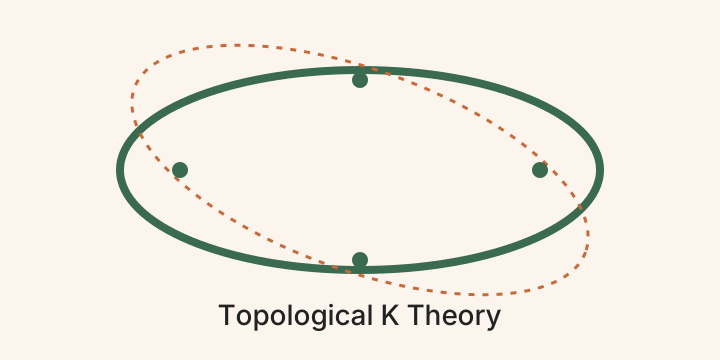
The result is not a single bundle in general. It is a stable class that remembers how bundles compare after extra summands are allowed.
Worked example [Beginner]
Over a point, a complex vector bundle is just a complex vector space. Its only invariant is dimension.
The bundle represents , and represents . In K-theory, the formal difference represents .
So behaves like the integers. Ordinary bundles give nonnegative dimensions, and K-theory adds the missing negative and difference classes.
What this tells us: K-theory turns vector-bundle addition into group-valued topology.
Check your understanding [Beginner]
Formal definition [Intermediate+]
Let be a compact Hausdorff space. Let be the commutative monoid of isomorphism classes of complex vector bundles over , with addition induced by direct sum 03.05.02. The complex topological K-group is the Grothendieck group completion of this monoid [Atiyah §1].
Elements of may be represented by formal differences . The relation is stable: when there exists a bundle such that
A continuous map induces a pullback homomorphism .
Key theorem with proof [Intermediate+]
Theorem (Universal property of group completion). Let be a commutative monoid. Its Grothendieck group has a monoid map such that every monoid map from to an abelian group factors uniquely through a group homomorphism .
Proof. Construct from pairs with the relation
for some . Addition is defined by , and the inverse of is . The map is the class of .
Let be a monoid map into an abelian group. Define . The defining relation makes this independent of representatives, and the formula is additive. It satisfies .
If also satisfies , then . Thus .
Bridge. The construction here builds toward 03.08.07 (bott periodicity), where the same data is developed in the next layer of the strand. The defining pattern appears again in those units in a sharpened form, where the local data is glued or quotiented. Putting these together, the foundational insight is that the data of this unit gives the structural signature that the rest of the strand reads off.
Exercises [Intermediate+]
Lean formalization [Intermediate+]
lean_status: none is recorded because the geometric vector-bundle construction of , its functoriality, and its connection to Bott periodicity are not yet packaged in Mathlib.
Advanced results [Master]
For compact Hausdorff , is the Grothendieck group of complex vector bundles, and reduced K-theory is the kernel
for a based connected compact space [Atiyah §1]. Higher groups are defined by suspension, for example in one common convention.
The representing-space viewpoint identifies stable vector-bundle data with maps into . Bott periodicity then supplies the two-periodic structure of complex K-theory 03.08.07.
Synthesis. This construction generalises the pattern fixed in 03.05.02 (vector bundle), with the symmetric data replaced by its skew or twisted analogue. Read in the opposite direction, the construction is dual to the metric story: complements and orthogonality are taken with respect to the bilinear datum of this unit, not a metric, and the resulting category of subobjects is the one the rest of the strand classifies. The central insight is that this datum identifies algebra with geometry: functions become vector fields, subspaces become quotients, and invariants become cohomology classes — and that identification is the engine driving every theorem downstream.
Full proof set [Master]
The construction of is the Grothendieck group completion applied to . The theorem above proves its universal property. Pullback functoriality follows because preserves direct sums and isomorphism classes, so it defines a monoid homomorphism before group completion and a group homomorphism afterward.
For the point, by dimension, and the Grothendieck group of is . Therefore .
Connections [Master]
Topological K-theory depends on vector bundles
03.05.02and classifying spaces03.08.04. It is the input for Bott periodicity03.08.07, which turns the suspension-defined groups into a periodic theory. It also supplies the symbol class target in the Atiyah-Singer index theorem03.09.10.Characteristic classes
03.06.04give natural transformations out of K-theory after rationalization through the Chern character. This ties the vector-bundle bookkeeping of K-theory to the differential-form representatives built by Chern-Weil theory03.06.06.
Historical & philosophical context [Master]
Atiyah's K-Theory develops the subject from vector bundles, Grothendieck groups, exact sequences, and Bott periodicity [Atiyah §1]. The notation and functorial viewpoint used here follow that source.
Husemoller presents K-theory in the language of fibre bundles, emphasizing the direct-sum monoid and its group completion [Husemoller §10].
Bibliography [Master]
- Michael Atiyah, K-Theory, §1-§2. [Atiyah §1]
- Dale Husemoller, Fibre Bundles, §10. [Husemoller §10]
- Alexander Grothendieck, work on the group completion idea in algebraic geometry and K-theory. [Grothendieck K-theory]