Pontryagin and Chern classes
Anchor (Master): Milnor-Stasheff — Characteristic Classes; Kobayashi-Nomizu Vol. II Ch. XII
Intuition [Beginner]
A vector bundle is like attaching a small vector space to every point of a shape. Some bundles are plain: the fibres line up like a product. Others twist. Characteristic classes are the bookkeeping system for that twisting.
Chern classes measure twisting for complex bundles. Pontryagin classes measure twisting for real bundles, often by first letting the real bundle use complex numbers and then reading the even part of the answer. They are not single numbers at first; they live in cohomology, which records how local data fits around holes and higher-dimensional cycles.
The slogan is: if a bundle cannot be untwisted globally, its characteristic classes remember the obstruction. Zero classes do not always prove the bundle is plain, but nonzero classes prove that some twisting is present.
Visual [Beginner]
The splitting principle says that, for computing characteristic classes, we may pretend a complicated complex bundle has been split into line bundles. Each line bundle contributes one simple root. Multiplying the simple factors gives the total class.
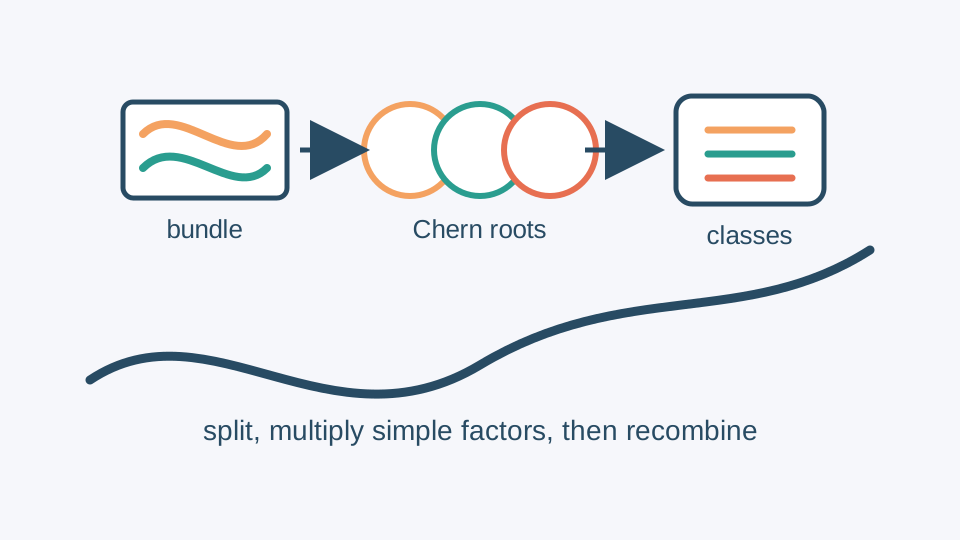
This is like factoring a polynomial. The roots may live in a larger bookkeeping space, but symmetric combinations of the roots return to the original space. That is why the final classes are attached to the original bundle.
Worked example [Beginner]
The tautological line bundle over the complex projective line is a standard example. A point of the base is a complex line through the origin in , and the fibre over that point is the line itself.
This bundle twists once. Its first Chern class is a generator of the second cohomology of the base. If we reverse the convention and use the dual line bundle, the first Chern class changes sign. If we take a product line bundle over the same base, the first Chern class is zero.
For a rank-two complex bundle that behaves like two line bundles with first Chern classes and , the total Chern class behaves like
What this tells us: higher Chern classes are symmetric records of the line-bundle twists hiding inside a vector bundle.
Check your understanding [Beginner]
Formal definition [Intermediate+]
Let be a rank- complex vector bundle. Choose a connection with curvature matrix . The total Chern class of is the inhomogeneous cohomology class
whose real de Rham image is represented by the Chern-Weil determinant
Here is the degree- component. The determinant coefficients are invariant polynomials on , so this is an instance of the Chern-Weil homomorphism 03.06.06 [quantum-well Characteristic polynomial.md].
Let be a rank- real vector bundle. Its complexification is . The Pontryagin classes are
For an oriented rank- real bundle, the Euler class is a further characteristic class, represented in Chern-Weil theory by the Pfaffian of the curvature matrix. This unit focuses on Chern and Pontryagin classes; the Euler class will be treated separately.
Axioms and normalization
Chern classes can be characterized by the following properties [Milnor-Stasheff Ch. 14]:
- Naturality: .
- Whitney product formula: .
- Normalization: for the tautological line bundle , is the positive generator of .
- Rank bound: for .
Pontryagin classes are natural and multiplicative for direct sums of real bundles after accounting for complexification:
Three distinctions are worth making explicit. Pontryagin classes live in degrees divisible by , since . Chern classes are integral; Chern-Weil forms represent their image in real de Rham cohomology, and integrality is a separate theorem. For a real bundle , is the even Chern class of the complexification with the sign , not the -th Chern class of itself.
Key theorem with proof [Intermediate+]
Theorem (Whitney product formula via Chern-Weil). Let and be complex vector bundles over . Then
Consequently, if splits as a direct sum of line bundles , and , then
Proof. Choose connections on and with curvature matrices and . The direct-sum connection on has block-diagonal curvature
Apply the determinant formula for total Chern classes:
The determinant of a block-diagonal matrix is the product of the determinants of the blocks:
Passing to cohomology gives . If each is a line bundle, then because all higher Chern classes vanish for rank one. Iterating the product formula gives .
Remark. The same argument proves the product formula for Pontryagin classes after replacing real bundles by their complexifications and using .
Synthesis. Chern and Pontryagin classes are exactly the universal characteristic classes of complex and real vector bundles. The splitting principle is the foundational technique by which every characteristic-class identity reduces to a symmetric-function calculation. Pontryagin classes generalise complex Chern classes to real bundles via .
Bridge. The total Chern character builds toward 03.09.10 (Atiyah-Singer index theorem), where the topological side of the index formula identifies the analytical with the integral — this is exactly the cohomological packaging Atiyah-Singer requires. The same classes appear again in 03.08.07 (Bott periodicity) as generators: the Chern character identifies with , and Pontryagin classes are the foundational obstructions to a real bundle admitting a stable framing. Putting these together, characteristic classes are dual to bundle structure: every change in topology shows up as a polynomial in or that no amount of analytic effort can hide.
Exercises [Intermediate+]
Lean formalization [Intermediate+]
lean_status: none — this material is not yet available as bundle-level characteristic-class theory in Mathlib. The expected future API would include classes such as:
Promoting this unit to lean_status: full requires the Chern-Weil and classifying-space infrastructure listed in the frontmatter gap.
Advanced results [Master]
The splitting principle is more than a computational trick. It says that characteristic-class identities may be verified after pulling a bundle back to a flag bundle where the pulled-back bundle has line-bundle quotients and the pullback map on cohomology is injective [Milnor-Stasheff Ch. 14]. Thus Chern-class calculations reduce to symmetric polynomial algebra in formal variables , the Chern roots.
In this language,
and for a real bundle whose complexified roots occur in opposite pairs ,
The Pontryagin classes are therefore the even symmetric functions in the formal curvature roots. Rationally, they generate much of the characteristic-class information of real bundles; integrally, torsion phenomena require Stiefel-Whitney classes and finer data.
For , with , the Euler sequence gives
The underlying real tangent bundle has
after truncation above real degree . For , this gives , and since , the signature theorem reads .
These classes also enter index theory. The Â-class is a formal power series in Pontryagin classes:
The Todd class is a formal power series in Chern roots:
These are the characteristic forms that appear in the Dirac and Dolbeault index formulae.
Projectivization and the Grothendieck definition of Chern classes
Let be a rank- complex vector bundle. Its projectivization is the fibre bundle
whose fibre is the projective space of complex lines through the origin in . Over there is a tautological line subbundle whose fibre at a point is the line itself. Set .
Theorem (Grothendieck definition; Bott-Tu §20.4). The cohomology of the projectivization is
as a free -module of rank with basis .
In other words, the Chern classes are the unique cohomology classes on such that
in . This is Grothendieck's definition of Chern classes: they are the coefficients of the universal relation that the hyperplane class satisfies on the projectivization. The Leray-Hirsch theorem ensures is a free -module on , and the rank bound then expresses in terms of lower powers; the coefficients of that expression are by definition the Chern classes. The consistency with the Chern-Weil definition (the determinant formula in the Formal definition) follows from the splitting principle: pulling back to the flag bundle, the Grothendieck relation factors as , identifying the elementary symmetric functions of the line-bundle Chern roots with the Chern classes — exactly the splitting-principle formula.
Top Chern class equals Euler class
Theorem (Bott-Tu §21.4). Let be a rank- complex vector bundle. Regarding as an oriented rank- real vector bundle , the top Chern class agrees with the Euler class:
This is the bridge that routes the entire global-angular-form / Hopf-Poincaré apparatus of 03.05.10 pending into Chern-class computations on complex manifolds. The proof, given below, uses the splitting principle. As a corollary, for any closed almost-complex manifold of complex dimension , recovering the topological Euler characteristic from the top Chern number.
Universal characteristic classes as ring generators of and
Theorem (LM B.2, generators of ). The Chern classes generate the polynomial ring
the Stiefel-Whitney classes generate
and the Pontryagin classes generate
with and . The proof rests on the maximal-torus calculation 03.08.04. For , restriction to identifies with , and the Weyl group acts by permuting the . The fundamental theorem of symmetric functions identifies the invariant subring with where the elementary symmetric polynomials are the Chern classes of the universal rank- bundle (this is the splitting-principle identification of the Chern roots with the universal ). For at mod- coefficients, the corresponding flag-bundle calculation uses and the Weyl group of acts as the full symmetric group on letters, producing as elementary symmetric functions in the rank-1 Stiefel-Whitney generators. For at rational coefficients, the maximal torus has rank and the Weyl group is (signed permutations), whose invariants are polynomials in the squared roots — these are the Pontryagin classes — together with an Euler-class generator in even rank. The unit 03.06.03 handles the Stiefel-Whitney calculation in detail; this section closes the loop with the parallel results for Chern and Pontryagin classes. The implication for any principal bundle is universal: characteristic classes of are precisely the elements of pulled back along the classifying map from these universal ring generators.
Full proof set [Master]
Proof of the splitting principle. Let be a rank- complex vector bundle. Let be the complete flag bundle whose fibre over consists of flags in . The pulled-back bundle carries a tautological filtration by subbundles
where each quotient is a line bundle. The standard Leray-Hirsch argument shows is injective. Therefore any universal identity in Chern classes may be checked after pulling back to , where the Whitney formula reduces it to a calculation with line bundles.
Proof of the axiomatic uniqueness of Chern classes. Assume a theory of classes satisfying naturality, Whitney product, normalization on , and the rank bound. Pull any rank- complex bundle back to its flag bundle. There the total class must equal , where are the first Chern classes of the line-bundle quotients. Since pullback is injective, the original class is forced. Existence is supplied by the classifying-space construction or by Chern-Weil representatives followed by integrality theorems.
Proof of Pontryagin multiplicativity. Complexification commutes with direct sum:
Apply the Whitney product formula for Chern classes, then take the even components with the signs . The total class satisfies .
Proof of the tangent formula. The Euler sequence
is exact. The Whitney formula gives
Since and , the result is with cohomological truncation.
Proof of the Whitney product formula via Mayer-Vietoris and Leray-Hirsch (alternative route). The splitting-principle proof above establishes Whitney by reducing to line bundles. A second proof, structurally distinct, runs through the projectivization and the Leray-Hirsch decomposition where . The short exact sequence on , restricted to the open subscheme where the tautological line is transverse to , produces a Mayer-Vietoris sequence. The Grothendieck relation for factors as via the closed-subset decomposition of into and glued along their normal bundles. Equating coefficients of on both sides yields , the Whitney formula. This Mayer-Vietoris-via-Leray-Hirsch route depends on the Leray-Hirsch theorem [03.13.03 — pending] rather than on the flag-bundle splitting principle, and it generalises to the Bott-Tu §21 proof of more refined Chern-class identities.
Proof that via the splitting principle. Pull back to the flag bundle , where splits as with . Each complex line bundle , regarded as a real rank- oriented bundle, has Euler class (this is the rank- case, where the Pfaffian curvature representative agrees with the first-Chern-class curvature representative under the standard normalisation). The Whitney product formula for the Euler class on direct sums of oriented real bundles, , gives
Pullback by is injective on cohomology, so the identity holds on . As a corollary, for any closed complex manifold of complex dimension , by the Hopf index theorem applied to 03.05.10 pending.
Connections [Master]
Chern-Weil homomorphism
03.06.06— supplies curvature representatives for the real de Rham images of Chern and Pontryagin classes.Stiefel-Whitney classes
03.06.03— mod-2 companions for real bundles; obstructs spin structures03.09.04.Spin structure
03.09.04— Pontryagin classes enter the Â-genus of spin manifolds.Dirac operator
03.09.08— its index is expressed using Pontryagin classes through the Â-class.Atiyah-Singer index theorem
03.09.10— characteristic classes are the topological side of the formula.Bott periodicity
03.08.07— Chern classes and Chern characters mediate between vector bundles and cohomology in complex -theory.Sphere bundle and Hopf index
03.05.10pending — bridging-theorem: identifies the top Chern class with the Euler class of the underlying real bundle, routing complex characteristic classes into the global-angular-form / Hopf-Poincaré machinery. Anchor phrase: top Chern class equals Euler class.Leray-Serre spectral sequence
03.13.02— byconn:442.serre-gysin-euler, Gysin sequence + Euler class derived from Serre spectral sequence of an oriented sphere bundle (foundation-of). For an oriented -bundle, Serre SS collapses at except for one differential of bidegree ; that differential is multiplication by the Euler class.Leray-Hirsch and splitting principle
03.13.03— byconn:444.leray-hirsch-splitting, splitting principle built on Leray-Hirsch theorem applied iteratively to flag-bundle projections (foundation-of). Iterating Leray-Hirsch on the flag bundle splits formally as a sum of line bundles; characteristic classes become elementary symmetric functions of formal Chern roots.
Throughlines and forward promises. Chern and Pontryagin classes are the foundational invariants of vector bundles. We will see the splitting principle of 03.13.03 reduce every characteristic-class identity to a symmetric-function calculation; we will see Chern-Weil 03.06.06 supply differential-form representatives; we will later see the universal-bundle apparatus of 03.08.05 route the entire theory through classifying spaces. This pattern recurs whenever a vector bundle appears. The foundational reason is exactly the Whitney sum identity combined with the splitting principle on rank-1 factors. Putting these together: Pontryagin classes are an instance of complex Chern classes via ; the Borel-Hirzebruch presentation is precisely the universal characteristic-class statement. The bridge between bundle topology and symmetric polynomials is exactly the splitting principle; this pattern recurs in every characteristic-class computation in the curriculum.
Historical & philosophical context [Master]
Chern classes arose from Chern's differential-geometric study of Hermitian manifolds and complex vector bundles, while Pontryagin classes arose from Pontryagin's work on real vector bundles and smooth manifolds [Milnor-Stasheff Chs. 14–15]. The decisive synthesis was that these classes could be described both topologically, through classifying spaces, and geometrically, through curvature via Chern-Weil theory.
Characteristic classes record the failure of a bundle to split as a sum of line bundles in cohomological algebra. The splitting principle reduces the verification of any universal identity to a calculation in line bundles via a cohomologically injective pullback to the flag bundle.
Bibliography [Master]
- Chern, S. S., "Characteristic Classes of Hermitian Manifolds", Annals of Mathematics 47 (1946), 85–121.
- Pontryagin, L. S., "Characteristic cycles on differentiable manifolds", Mat. Sbornik 21 (1947), 233–284.
- Borel, A. & Hirzebruch, F., "Characteristic Classes and Homogeneous Spaces I", American Journal of Mathematics 80 (1958), 458–538.
- Milnor, J. & Stasheff, J., Characteristic Classes, Princeton University Press, 1974.
- Kobayashi, S. & Nomizu, K., Foundations of Differential Geometry, Vol. II, Wiley, 1969. Ch. XII.
- Bott, R. & Tu, L. W., Differential Forms in Algebraic Topology, Springer, 1982.
Pilot unit #5. Produced in the Wave C parallel-session pass with all three tiers present; depends on the Chern-Weil unit 03.06.06, which was produced in the same pass.