Poincaré-Cartan integral invariants
Anchor (Master): Poincaré 1890 *Les Méthodes Nouvelles de la Mécanique Céleste* Vol. III §245-§249 (originator); Cartan 1922 *Leçons sur les invariants intégraux*; Arnold *Mathematical Methods of Classical Mechanics* §44 + Appendix 1; Abraham-Marsden *Foundations of Mechanics* §3.4
Intuition [Beginner]
Hamiltonian mechanics on a phase space of positions and momenta has a clock running alongside it. Stack the clock on top of the phase space, and you get extended phase space: a single big space where every point records a position, a momentum, and a moment in time. A trajectory of the mechanical system becomes a curve through this extended space, drawn out as time advances.
On extended phase space there is one privileged one-form: the Poincaré-Cartan one-form . It packages the symplectic data and the energy together. What Poincaré discovered in 1890 is that integrating around any closed loop in extended phase space gives a number that the Hamiltonian flow cannot change. Slide the loop along by the flow and the integral stays the same.
This is a generalisation of conservation of energy and conservation of phase volume rolled into one statement. It produces a whole family of integral invariants, one for each even degree from 2 up to the dimension of phase space. The top one is the Liouville volume; the bottom one is the loop integral itself.
Visual [Beginner]
A schematic of extended phase space: a horizontal time axis with phase space drawn vertically as a stack of slices, and a tube of trajectories cutting through the slices. A closed loop is drawn on one slice, then transported along the tube to a later slice; the loop integral of around either rim is the same number.
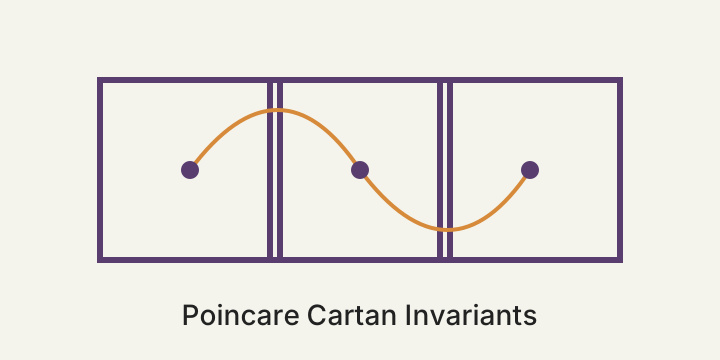
The picture marks the loop on each rim of the tube and the tube itself, illustrating that the bottom rim and the top rim carry equal integrals.
Worked example [Beginner]
Take the one-dimensional harmonic oscillator: position , momentum , energy . A periodic orbit at energy is a circle of radius in the plane, traversed in time .
Lift the orbit into extended phase space by also marking time. The orbit becomes a helix wrapping around the time axis, one full turn per unit of time scaled by the period. Pick the closed loop at time — the original circle.
The Poincaré-Cartan integral around the time-zero loop is
The term drops out because the loop sits at a single time and along it. The part is the area enclosed in the plane, which is . After one period the orbit returns to itself, so the same loop appears at time with the same . What this tells us: the loop integral is the action of the orbit, for the oscillator at energy , and the Hamiltonian flow preserves this action exactly.
Check your understanding [Beginner]
Formal definition [Intermediate+]
Let be a smooth manifold and its cotangent bundle, with canonical one-form and canonical symplectic form (sign convention as in 05.02.05; for the Poincaré-Cartan setup we use the opposite-sign canonical one-form , matching Arnold §44). The extended phase space is the product with coordinate on the second factor and pull-backs of from the first.
For a smooth time-dependent Hamiltonian , the Poincaré-Cartan one-form is
on . Its exterior derivative is the closed two-form
on . The form has rank and a one-dimensional kernel at every point; the unique (up to scaling) direction in that projects to on the time factor is the suspended Hamiltonian vector field
where is the (time-dependent) Hamiltonian vector field of on defined by 05.02.01. Trajectories of the original Hamiltonian system are integral curves of .
For each , the closed two-form has a -th wedge power ( factors), a closed -form on . The Poincaré-Cartan integral invariants are the integrals
over closed one-cycles and closed -cycles in . The case recovers the symplectic volume on each time slice, the Liouville form of 05.02.07.
Key theorem with proof [Intermediate+]
Theorem (Poincaré-Cartan integral invariants). *Let be a smooth Hamiltonian on , the suspended vector field, and its flow on for parameter . Then for every closed one-cycle and every closed -cycle () on which the flow is defined,*
Proof. Differentiate the loop integral in . The standard flow identity gives
Cartan's formula expands the Lie derivative:
The second term vanishes by construction: , so . The first term is exact, and the integral of an exact one-form around a closed cycle is zero by Stokes:
Hence , so the loop integral is constant in .
For the higher invariants, the same Cartan calculation applied to uses closedness of and . The graded Leibniz rule gives . Then (the first term because , the second because ). So , and integrating over a closed -cycle gives .
Geometric reformulation. Equivalently, given two closed loops that bound a tube of trajectories of in , Stokes' theorem yields
because the tangent space to at every point contains the kernel direction , so restricted to vanishes pointwise. The loop integrals on the two rims of any tube of trajectories are equal.
Bridge. The Poincaré-Cartan calculation here builds toward 05.02.04 (action-angle coordinates), where the action variables are defined as along basis loops on a Liouville torus, and the conservation of the actions under the Hamiltonian flow is exactly the first Poincaré-Cartan invariant applied to Poisson-commuting integrals; the construction appears again in the Liouville-Arnold integrability theorem, where the same loop integrals on a compact connected level set produce the angle-conjugate coordinates. Putting these together, the foundational reason integrable systems have global action-angle coordinates is exactly the Poincaré-Cartan invariance: the loop integrals identify cohomology classes on level sets with conserved quantities, and the bridge between the analytic identity and the geometric conclusion is the foundational reason action variables are coordinate-free conserved quantities of every integrable system.
Counterexamples to common slips
- Energy is not constant along unless the loop sits at fixed time. The full integrand has a non-zero contribution along any loop with non-zero time displacement. The conserved quantity is the integral, not the integrand.
- The kernel direction is the suspended vector field, not the bare . On extended phase space, alone does not lie in ; only does. The component is what cancels the piece in .
- The first integral invariant is not the Liouville volume. The first invariant is a one-cycle integral; the Liouville volume is the top wedge power integrated over a -cycle. They live at opposite ends of the graded family .
- Closedness alone is insufficient. The proof uses both and the characterisation of the Hamiltonian direction; without the kernel input, would not vanish and the Lie derivative would not be exact.
Exercises [Intermediate+]
Lean formalization [Intermediate+]
[object Promise]The proof would proceed by establishing the kernel characterisation via Hamilton's equations, applying Cartan's formula to get , and concluding by Stokes that the loop integral of an exact one-form on a closed cycle vanishes. Each step is a candidate Mathlib contribution, listed in the lean_mathlib_gap field above.
Advanced results [Master]
The Poincaré-Cartan invariants are the canonical hierarchy of conserved quantities of a Hamiltonian flow on extended phase space. Stating the family in its full graded form, and tracing the invariants back to their cohomological origin, makes the position of the Liouville volume and the action variables in classical mechanics structurally precise.
The graded family. On extended phase space with Poincaré-Cartan one-form and , the wedge powers for form a graded family of closed forms each preserved by the suspended Hamiltonian flow . The corresponding integral invariants are:
- (degree 1, integrand ): the first integral invariant, over a closed one-cycle. Poincaré 1890.
- (degree 2, integrand ): the second integral invariant, over a closed two-cycle. Cartan 1922.
- (degree , integrand ): the -th integral invariant, a relative invariant in Cartan's terminology.
- (degree , integrand ): the Liouville volume, the top-degree case. Recovers
05.02.07.
The Cartan-formula proof is uniform across the family: closedness of plus the kernel characterisation kill the Lie derivative on each wedge power.
Relative versus absolute invariants. Cartan distinguished absolute integral invariants (preserved by every flow that preserves the form) from relative ones (preserved only by Hamiltonian flows on closed cycles, with boundary corrections in general). The Liouville volume is absolute on ; the Poincaré loop integral is relative — its invariance requires the closed-loop hypothesis, since for an open one-chain with boundary , has a non-vanishing boundary contribution. The relative-invariant terminology is exactly this: invariance modulo exact one-forms or boundary corrections.
Maupertuis principle. On the energy level for a time-independent , the spatial one-form alone gives the Maupertuis variational principle . The temporal correction has fixed extremum on level sets when the elapsed time is held constant in the variation, so the Hamilton principle on extended phase space reduces to the spatial principle on the energy shell. This identifies trajectories with critical points of the spatial action and is the geometric-optics limit of Hamilton-Jacobi: on the energy shell is the eikonal one-form.
Action-angle and Liouville-Arnold. For an integrable system with Poisson-commuting integrals (with ) and a compact connected regular level set , the Liouville-Arnold theorem gives and constructs action-angle coordinates on a tubular neighbourhood. The action coordinates are exactly the first Poincaré-Cartan invariants on basis loops:
The angles are the canonical conjugates determined by on the neighbourhood. Putting these together, action-angle coordinates are the geometric realisation of the Poincaré-Cartan invariants as -tuples of conserved quantities and their conjugates. The bridge between the analytic identity and the geometric conclusion is the foundational reason every integrable system carries action-angle coordinates: the loop integrals identify cohomology classes on the Liouville torus with action variables, and the central insight is that the structure of the torus is the cohomological shadow of the Poincaré-Cartan invariance.
Cohomological framing. The first Poincaré-Cartan invariant is a pairing between and the de Rham class of (where has a class only when restricted to closed-orbit cycles). On a Liouville torus, is a closed one-form (after restriction; though not exact on ), and the cohomology classes are exactly the actions . The higher invariants pair with via . The graded family of Poincaré-Cartan invariants is the de Rham pairing of the closed forms with the homology of cycles preserved by the suspended flow.
Generalisations to general one-forms. Cartan's 1922 Leçons sur les invariants intégraux developed the path-method machinery for general one-forms on a manifold with rank- and a one-dimensional kernel. The corresponding flow preserves loop integrals of and the wedge powers of . The Hamiltonian case is the special case . The contact-geometry case is the special case where is a contact one-form on a -manifold and the kernel direction is the Reeb vector field; the contact form and Reeb satisfy , the contact analogue of the kernel characterisation. Putting these together, the Poincaré-Cartan invariants are the Hamiltonian instance of a wider Cartan-style invariant theory of one-forms with one-dimensional kernel.
Synthesis. The Poincaré-Cartan integral invariants are the canonical hierarchy of conserved quantities of a Hamiltonian flow, derived from the Poincaré-Cartan one-form by exterior calculus and the kernel characterisation . The proof reduces in three lines to closedness of and the kernel input — no specific input from the Hamiltonian enters. Read in the opposite direction, every conserved loop integral on extended phase space is a Poincaré-Cartan invariant, and the bridge between the analytic identity and the geometric conclusion is the foundational reason that action variables, the Liouville volume, and the higher invariants are coordinate-free conserved quantities of every Hamiltonian system. The central insight is that the graded family produces all integral invariants by the same Cartan-formula calculation. Putting these together, the entire structural apparatus of conserved quantities in Hamiltonian mechanics — action variables, Liouville volume, Maupertuis principle, action-angle coordinates — recurs as a special case of the single identity .
Full proof set [Master]
Theorem (first Poincaré-Cartan invariant). *On extended phase space , the loop integral is invariant under the suspended Hamiltonian flow for every closed one-cycle .*
Proof. See the Intermediate Key theorem section above. The chain of identities is (kernel characterisation, verified in Exercise 2), (Cartan's formula plus the kernel input), then by Stokes on the closed cycle.
Theorem (-th Poincaré-Cartan invariant). For each , the integral is invariant under for every closed -cycle .
Proof. The graded Leibniz rule gives . Cartan's formula gives (first term: ; second term: ). Hence , and by the standard flow identity .
Lemma (kernel characterisation of ). The two-form has rank at every point of , hence a one-dimensional kernel; the unique direction in that projects to on the time factor is .
Proof. In coordinates , . The matrix of in the ordered basis has the block-form
with rank . The kernel is spanned by , verified by direct contraction: (computed in Exercise 2). The projection of onto has coefficient one.
Theorem (tube identity). Let be two closed one-cycles bounding a compact tube of trajectories of . Then .
Proof. By Stokes, . The tangent space at every point contains the kernel direction , so has rank at most one — but is a two-form, so pointwise. Hence .
Theorem (Maupertuis principle). On a fixed energy level for a time-independent Hamiltonian, varied paths joining two configurations in time intervals of fixed length extremise , equivalently , over the level set.
Proof. Hamilton's principle on extended phase space gives stationarity of on the level set. Fixing the elapsed time across the variation makes constant, so the variation reduces to . Trajectories on are the critical points.
Connections [Master]
Hamiltonian vector field
05.02.01. The kernel characterisation on extended phase space is the natural reformulation of the defining equation on phase space; the one extra dimension is the suspension that makes the kernel one-dimensional.Liouville's volume theorem
05.02.07. The top integral invariant on extended phase space restricts on each time slice to the symplectic volume on ; the Cartan-formula calculation on recovers the Liouville theorem on each fixed-time slice as the top-degree case.Action-angle coordinates
05.02.04. Action variables on a Liouville torus are the first Poincaré-Cartan invariants applied to basis loops; angle coordinates are the canonical conjugates. The Liouville-Arnold theorem packages the action variables and angles into global coordinates on the tubular neighbourhood of a regular compact level set.Symplectic manifold
05.01.02. Closedness — the half of the symplectic-form definition that does not use non-degeneracy — is what makes the Poincaré-Cartan calculation work; without it, acquires a non-vanishing term.Cotangent bundle
05.02.05. The canonical one-form on is the spatial half of the Poincaré-Cartan one-form; is the configuration setting and is the extended setting. The naturality of propagates to the naturality of on .Hamilton-Jacobi equation
05.05.04. The Hamilton-Jacobi PDE is the eikonal equation for the action defined via the line integral over a Lagrangian section of . The Poincaré-Cartan invariant is what makes well-defined on the section up to global cohomology.Generating functions
05.05.03. The first Poincaré-Cartan invariant is the obstruction to a generating function being globally well-defined: a canonical transformation has a generating function iff it preserves up to exact corrections, which is the cocycle condition for the loop-integral pairing.
Historical & philosophical context [Master]
Henri Poincaré published the first integral invariant in Les Méthodes Nouvelles de la Mécanique Céleste Vol. III §245-§249 in 1899 (the volume bearing the date 1899 in print, with the integral-invariant material drawn from his earlier 1890 Acta Mathematica paper Sur le problème des trois corps et les équations de la dynamique [Poincaré]). The motivation was the three-body problem: Poincaré sought conserved quantities of the planetary Hamiltonian to control the long-time behaviour of perturbed orbits. The loop integral on extended phase space gave the first non-energy conserved quantity on a generic three-body orbit. Poincaré called it the invariant intégral relatif: relative because the invariance hypothesis is the closed-loop condition, not absolute over open chains.
Élie Cartan extended Poincaré's invariants to the general theory in Leçons sur les invariants intégraux (Hermann, Paris, 1922) [Cartan]. Cartan's framing replaced Poincaré's coordinate computations with the modern exterior-calculus formalism: a one-form on a manifold with rank- and one-dimensional kernel produces a hierarchy of integral invariants by wedging . The Hamiltonian case is the special case . Cartan's Leçons also introduced the absolute / relative distinction and the path-method that later became Moser's trick 05.01.05. The phrase "Poincaré-Cartan integral invariants" attributes the first invariant to Poincaré and the systematic theory to Cartan.
Arnold Mathematical Methods of Classical Mechanics §44 [Arnold] gives the modern symplectic-manifold treatment: extended phase space with the suspended Hamiltonian vector field , kernel characterisation, and the graded family of invariants. Arnold's framing emphasises the Liouville volume as the top-degree case and the action variables as the loop integrals on integrable level sets, packaging the Liouville-Arnold theorem 05.02.04 as a global statement about Poincaré-Cartan invariants on a Liouville torus. Abraham-Marsden Foundations of Mechanics §3.4 [Abraham-Marsden] gives the canonical mathematical-physics treatment, deriving the invariants from the Cartan-formula calculation on extended phase space and showing the cohomological framing of action variables.
The Poincaré-Cartan invariants are the structural ancestor of several twentieth-century developments: symplectic capacities and Gromov's non-squeezing theorem (which place the Poincaré loop integral inside a wider rigidity theory); contact geometry (where the contact one-form and Reeb vector field satisfy , the contact analogue of the Hamiltonian kernel); and KAM theory (where the action variables on Liouville tori serve as the unperturbed coordinates against which Diophantine tori are measured).