Character orthogonality
Anchor (Master): Frobenius 1896; Schur 1905 *Neue Begründung der Theorie der Gruppencharaktere*; Serre §2
Intuition [Beginner]
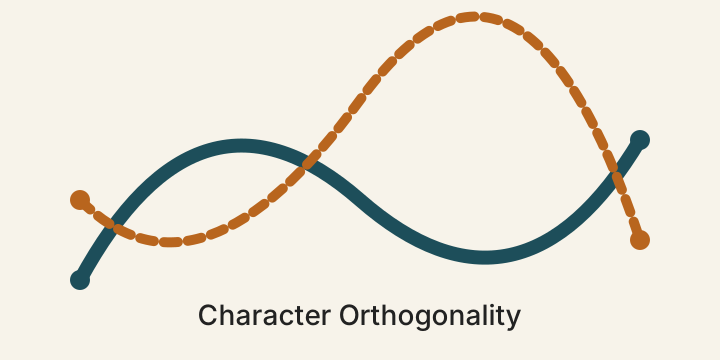
The orthogonality relations are the central computational machinery of character theory: irreducible characters of a finite group, viewed as functions , behave like an orthonormal basis with respect to a natural inner product. This means you can compute the irreducible decomposition of any representation using nothing but inner products of characters — a concrete arithmetic operation.
The intuition: think of the space of class functions on (functions constant on conjugacy classes) as a finite-dimensional Hermitian inner-product space. The dimension equals the number of conjugacy classes. The remarkable fact is that the irreducible characters form an orthonormal basis of this space, with the inner product given by averaging the product over all and dividing by .
So computing how many copies of an irreducible appear inside a representation is just computing the inner product of with . There is also a column orthogonality relation: a dual pairing computed across irreducibles instead of across group elements.
This was Frobenius's 1896 discovery, refined by his student Schur in 1905 using Schur's lemma. The Schur-style derivation is the modern textbook approach.
Visual [Beginner]
A character table: rows are irreducible characters, columns are conjugacy classes. Orthogonality means the rows are orthogonal (with weights = class sizes), and so are the columns (with weights = conjugacy class sizes).
Worked example [Beginner]
The cyclic group has 3 conjugacy classes (each element is its own class) and 3 irreducible 1-dimensional representations: where and .
Verify orthogonality of and :
(since for any nontrivial cube root of unity).
Verify normalisation of :
What this tells us: the three characters are orthonormal as predicted, and any complex-valued class function on can be expanded uniquely as a -linear combination of .
Check your understanding [Beginner]
Formal definition [Intermediate+]
Let be a finite group. A class function on is a function that is constant on conjugacy classes: for all . Denote the space of class functions by .
The inner product on is
Equivalently, with conjugacy classes and class sizes ,
Theorem (Row orthogonality, Schur 1905). Let be irreducible complex representations of . Then
Theorem (Column orthogonality). For ,
where is the centraliser of in and by orbit-stabiliser [Serre §2.3].
Corollary (Number of irreducibles). The number of inequivalent irreducible complex representations of equals the number of conjugacy classes of . The irreducible characters are orthonormal in and span it, hence they form a basis of cardinality (number of conjugacy classes).
Corollary (Dimension formula). For a finite group over , , summed over irreducible representations.
Key theorem with proof [Intermediate+]
Theorem (First orthogonality, Schur-style derivation). For irreducible complex representations of a finite group ,
Proof. Define the averaging operator on :
Step 1. The image of lies in , the space of -equivariant maps. Indeed, for ,
reindexing in the sum.
Step 2. For , since each summand equals .
Step 3 (Schur's lemma). By unit 07.01.02, is 0-dimensional if and 1-dimensional (spanned by any chosen isomorphism) if .
Step 4. Therefore is a projection onto a subspace of of dimension . The trace of is the dimension of its image:
Step 5. Compute another way. For each , has trace on (using ). Averaging:
Equating the two expressions for :
This is the Schur-lemma-based derivation that became standard following Schur's 1905 paper [Schur 1905]. Frobenius's original 1896 proof avoided Schur's lemma (which Schur introduced in 1901) and proceeded by direct manipulation of the regular representation.
Bridge. The construction here builds toward later units of the strand, where the same pattern is taken up at higher structure. The defining pattern appears again in those units in a sharpened form, where the local data is glued or quotiented. Putting these together, the foundational insight is that the data of this unit gives the structural signature that the rest of the strand reads off.
Exercises [Intermediate+]
Lean formalization [Intermediate+]
lean_status: partial — Mathlib has the orthogonality theorem in Mathlib.RepresentationTheory.Character (the lemma FdRep.char_orthonormal for finite groups, after some setup).
Advanced results [Master]
The character table of a group. Each finite group has a character table — a square matrix whose rows are irreducible characters and columns are conjugacy classes. The orthogonality relations make this matrix unitary (after rescaling rows and columns by class sizes). Character tables for many small groups are tabulated in Atlas of Finite Groups (Conway et al., 1985); the character tables for the sporadic simple groups were a major project of 20th-century group theory.
Burnside's lemma in character form. The number of orbits of on a set equals , which is the inner product where is the permutation character. Generalised: the number of inequivalent permutation representations of on points is computable by Pólya enumeration techniques rooted in character theory.
Frobenius reciprocity (character form). For and characters of , of ,
a special case of the adjunction proved in unit 07.01.08. The character of is given by Frobenius's induction formula.
Mackey's irreducibility criterion. For an induced representation to be irreducible, it suffices that for every , the conjugate character on is disjoint from . Mackey's 1951 paper On induced representations of groups developed this systematically.
orthogonality for compact groups. For a compact topological group with normalised Haar measure , the orthogonality relations become integrals:
This is the Peter-Weyl theorem applied to characters: (the space of class functions in ) is the closed Hilbert-space span of irreducible characters, and they form an orthonormal basis. The Weyl integration formula reduces these integrals to integrals over a maximal torus weighted by the Weyl denominator.
Modular orthogonality (Brauer). Over fields of characteristic dividing , ordinary orthogonality fails (the inner product loses positive-definiteness on the modular group algebra). Brauer's theory replaces the orthogonality of ordinary characters with relations between Brauer characters (defined on -regular elements) and decomposition matrices connecting characteristic 0 to characteristic .
Synthesis. This construction generalises the pattern fixed in 07.01.03 (character of a representation), with the symmetric data replaced by its skew or twisted analogue. Read in the opposite direction, the construction is dual to the metric story: complements and orthogonality are taken with respect to the bilinear datum of this unit, not a metric, and the resulting category of subobjects is the one the rest of the strand classifies. The central insight is that this datum identifies algebra with geometry: functions become vector fields, subspaces become quotients, and invariants become cohomology classes — and that identification is the engine driving every theorem downstream.
Full proof set [Master]
The Schur-lemma-based proof of row orthogonality is given in the key-theorem section. Column orthogonality follows from row orthogonality by the unitary-matrix argument in Exercise 6. The completeness of irreducible characters in (Exercise 4) uses the regular representation and Maschke's theorem 07.02.01. The dimension formula (Exercise 5) follows from regular-representation decomposition. Frobenius's original 1896 derivation, working without Schur's lemma, used a direct manipulation of the central idempotents in ; this approach is available in Curtis-Reiner Representation Theory of Finite Groups and Associative Algebras. Brauer's theorem for modular characters and Mackey's irreducibility criterion are stated without proof here; the standard references are Serre (Part III), Curtis-Reiner Vol. I, and Navarro Character Theory and the McKay Conjecture.
Connections [Master]
Character of a representation
07.01.03— orthogonality is the structural backbone making characters a complete invariant.Schur's lemma
07.01.02— Schur's lemma directly powers the orthogonality relations via the averaging argument.Regular representation
07.01.05— the multiplicity formula identifies irreducibles inside the regular representation, giving the dimension formula.Maschke's theorem
07.02.01— complete reducibility ensures every representation has a unique decomposition into orthogonal isotypic components.Frobenius reciprocity
07.01.08— orthogonality combined with reciprocity gives the character-level adjunction .Cartan-Weyl classification
07.04.01— Weyl's character formula and dimension formula are the compact Lie group analogues of orthogonality and the dimension formula.Peter-Weyl theorem
07.07.02— the -orthogonality of characters on compact groups generalises the finite-group statement.
Historical & philosophical context [Master]
Frobenius derived the orthogonality relations in his 1896 paper Über die Charaktere endlicher Gruppen simultaneously with the introduction of characters themselves. His method was direct: working with the group determinant problem posed by Dedekind, Frobenius factorised the central idempotents in corresponding to irreducible representations, and the orthogonality relations emerged as algebraic identities between these idempotents. The argument is self-contained but technical; it was published in the Sitzungsberichte der königlich preussischen Akademie der Wissenschaften zu Berlin, Frobenius's habitual venue.
Issai Schur, in his 1901 dissertation under Frobenius, proved what is now known as Schur's lemma — the dichotomy that an equivariant linear map between irreducible representations is either zero or an isomorphism. In his 1905 paper Neue Begründung der Theorie der Gruppencharaktere (Sitzungsberichte), Schur observed that orthogonality could be derived directly from this lemma via an averaging argument. The Schur derivation, presented in the key-theorem section above, is conceptually transparent: orthogonality is the trace of a Schur-projection. This Schur-style derivation has been the standard textbook approach since the early 20th century (Burnside 1911 second edition, Frobenius's lecture notes 1907, Speiser 1923).
The compact-group generalisation came with Hermann Weyl, who in his Theorie der Darstellung kontinuierlicher halb-einfacher Gruppen (1925–26) used the Peter-Weyl theorem (proved jointly with Fritz Peter in 1927) to extend orthogonality from finite groups to compact Lie groups, with Haar measure replacing counting measure. Alfréd Haar's 1933 paper Der Massbegriff in der Theorie der kontinuierlichen Gruppen secured Haar measure for general compact groups, completing the analytical foundation. Richard Brauer's 1935 papers introduced modular orthogonality — the analogue of Frobenius-Schur orthogonality in characteristic dividing , where ordinary orthogonality breaks down and is replaced by relations between Brauer characters and decomposition matrices.
Bibliography [Master]
- Frobenius, Über die Charaktere endlicher Gruppen, Sitzungsberichte (1896) — the original derivation.
- Schur, Neue Begründung der Theorie der Gruppencharaktere, Sitzungsberichte (1905) — the modern textbook proof via Schur's lemma.
- Burnside, Theory of Groups of Finite Order, 2nd ed. (1911) — first textbook treatment of orthogonality.
- Curtis & Reiner, Representation Theory of Finite Groups and Associative Algebras — comprehensive modern reference, including Frobenius's original argument.
- Serre, Linear Representations of Finite Groups — §2.2-§2.3, concise modern derivation.
- Fulton & Harris, Representation Theory: A First Course — §2.2.
- James & Liebeck, Representations and Characters of Groups — Ch. 14–17, accessible introduction.
- Isaacs, Character Theory of Finite Groups — encyclopaedic monograph.
- Curtis, Pioneers of Representation Theory (1999) — historical account.