Maschke's theorem
Anchor (Master): Heinrich Maschke 1899 *Beweis des Satzes, dass diejenigen endlichen linearen Substitutionsgruppen...*; Lang Ch. XVIII; Curtis-Reiner
Intuition [Beginner]
Maschke's theorem is the cornerstone result of finite-group representation theory: every representation of a finite group over a field of characteristic 0 (or any field whose characteristic does not divide ) decomposes as a direct sum of irreducible representations. In other words, the irreducibles are atoms and every representation is a finite disjoint union of these atoms.
The intuition: think of a representation as a vector space with a -action. Maschke's theorem says you can always find a basis adapted to the -action — a basis where the action is "block-diagonal" with each block being an irreducible representation. There's no genuine entanglement that prevents the splitting.
The proof uses a beautiful trick called averaging over : given any subrepresentation , find a complementary -invariant subspace by starting with any complement and averaging it under the -action. The averaging needs to make sense — and that fails precisely when is divisible by the field characteristic.
Heinrich Maschke proved this in 1899 in Mathematische Annalen. When the averaging trick fails (characteristic dividing ), one enters modular representation theory — Brauer's 1935 framework, where representations are no longer atomic and a richer structure (blocks, defect groups) takes over.
Visual [Beginner]
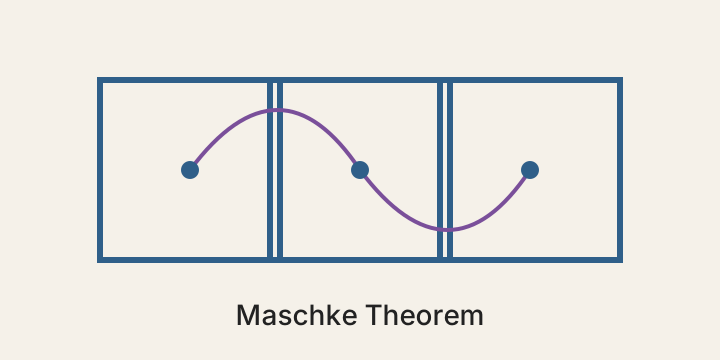
A finite-group representation decomposed into irreducible blocks: each block is invariant under , and the blocks together span the whole space.
Worked example [Beginner]
The cyclic group acting on by cyclic permutation of coordinates: sends to .
This 3-dimensional real representation is reducible: the line is a 1-dimensional invariant subspace (every cyclic permutation fixes the all-ones vector). So has a 1-dim subrepresentation; can we find a complementary 2-dim invariant subspace?
By Maschke (working over since in ), yes: the orthogonal complement of — the plane — is invariant under cyclic permutation. So as -representations.
What this tells us: the 3-dim permutation representation of on decomposes as a 1-dim principal piece plus a 2-dim "standard" piece. Over , the 2-dim piece further splits into two 1-dim pieces (eigenspaces of for the eigenvalues and ). So over , the regular representation of decomposes into three 1-dim irreducible pieces: .
Check your understanding [Beginner]
Formal definition [Intermediate+]
Let be a group and a field. A representation of is completely reducible (or semisimple) if every -invariant subspace has a -invariant complement , i.e., with both being -subrepresentations. Equivalently, decomposes as a direct sum of irreducible subrepresentations.
Theorem (Maschke 1899). Let be a finite group and a field whose characteristic does not divide (in particular, any field of characteristic 0). Then every finite-dimensional representation of over is completely reducible [Serre §1.3].
Equivalent formulation. The group algebra is semisimple as a -algebra, i.e., for some division algebras over (Artin-Wedderburn).
Counter-example. Maschke fails in characteristic dividing . Take and with the generator acting by . The line is invariant (the action sends to itself), but no transverse line is invariant: any vector is sent to , so the line through is not preserved. Hence is reducible (it has the invariant line) but not completely reducible (no invariant complement to that line).
This failure launches modular representation theory — Brauer's 1935 framework, where representations of over fields of characteristic exhibit a richer structure (indecomposable but not irreducible modules, blocks, defect groups, decomposition matrices).
Generalisations.
- Compact Lie groups. Every finite-dimensional continuous representation of a compact Lie group on a complex vector space is completely reducible. The proof uses Haar measure and the unitarian trick (Weyl 1925–26).
- Reductive Lie algebras. Finite-dimensional representations of complex semisimple Lie algebras are completely reducible (Weyl's theorem on complete reducibility).
- Reductive algebraic groups. Over algebraically closed characteristic-0 fields, finite-dimensional representations of reductive algebraic groups are completely reducible. In characteristic , the Mumford conjecture (proved by Haboush 1975) gives a partial replacement.
Key theorem with proof [Intermediate+]
Theorem (Maschke). Let be a finite group, a field with invertible in . Every finite-dimensional -representation of is completely reducible.
Proof (averaging-projection argument). Let be a finite-dimensional -representation over , and let be a -invariant subspace. We construct a -invariant complement .
Step 1 (start with any projection). Since is finite-dimensional, pick any -linear projection , i.e., a linear map satisfying for all and . (Such exists by linear algebra: extend a basis of to a basis of and project onto along the chosen complement.) The projection is in general not -equivariant.
Step 2 (averaging). Define the averaged projection
The factor is well-defined because is invertible in .
Step 3 (verification). Verify three properties of :
(a) Image lies in . For any and , , , and since is -invariant, . So each summand lies in , hence so does the average.
(b) . For , (since is -invariant), so ( is identity on ). Then . Each summand equals , so the average is .
(c) -equivariance. For ,
where we substituted in the sum (which is bijective on ).
Step 4 (define complement). Set . Since is -equivariant, is a -invariant subspace.
Step 5 (decomposition). From (a) and (b), is a projection onto . By the standard projection identity, .
Step 6 (induction). Apply the same argument to the subrepresentations and to further decompose. Since is finite, this process terminates with written as a direct sum of irreducible -subrepresentations.
Remark. The proof gives an explicit construction of the complement via the averaged projection. The Hermitian-inner-product variant of the proof: choose any inner product on , average it over to make it -invariant, and take to be the orthogonal complement of with respect to the averaged inner product. Both proofs require and fail in characteristic .
Bridge. The construction here builds toward later units of the strand, where the same pattern is taken up at higher structure. The defining pattern appears again in those units in a sharpened form, where the local data is glued or quotiented. Putting these together, the foundational insight is that the data of this unit gives the structural signature that the rest of the strand reads off.
Exercises [Intermediate+]
Lean formalization [Intermediate+]
lean_status: partial — Mathlib has Maschke's theorem in Mathlib.RepresentationTheory.Maschke: the statement that every -submodule of a finite-dimensional -module has a complement is formalised, with the explicit averaging-projection construction.
Advanced results [Master]
Artin-Wedderburn structure theorem. Maschke implies that is a semisimple -algebra; by Artin-Wedderburn (1907 / 1927), every finite-dimensional semisimple -algebra is isomorphic to a finite product of matrix algebras:
with the product running over irreducible representations . This is the Wedderburn decomposition of the group algebra. Over , the analogous decomposition involves matrix algebras over — the real Frobenius-Schur classification of irreducible representations into real, complex, and quaternionic types.
Rickard equivalences and Broué's conjecture. In modular representation theory, blocks of that share the same defect group are conjectured (Broué 1990) to be derived equivalent. The Rickard-Linckelmann theory of splendid Rickard tilting complexes provides a categorification of Maschke's complete-reducibility failure: blocks are "as semisimple as possible" relative to their defect group structure. This is the most active branch of modern modular representation theory.
Schur indices. For a finite group and an absolutely irreducible representation over , the Schur index measures the obstruction to defining over the smaller field : is realisable over a number field iff divides the local Schur indices at completions of . The Brauer-Speiser theorem bounds Schur indices for symmetric and alternating groups.
Maschke for Hopf algebras. Maschke's theorem generalises to finite-dimensional Hopf algebras over a field: a finite-dimensional Hopf algebra is semisimple iff there exists an integral with (Larson-Sweedler 1969). For a group algebra, the integral is and , recovering Maschke. For quantum groups at roots of unity, the integral vanishes and a richer modular structure emerges.
Reductive algebraic groups. For a reductive algebraic group over an algebraically closed field of characteristic 0, finite-dimensional rational representations of are completely reducible (Weyl). In characteristic , complete reducibility fails in general, replaced by the Mumford conjecture (Haboush 1975): a -stable line bundle on a -orbit closure has a -equivariant section vanishing only on the boundary. This is the foundation of geometric invariant theory in positive characteristic.
Synthesis. This construction generalises the pattern fixed in 07.01.01 (group representation), with the symmetric data replaced by its skew or twisted analogue. Read in the opposite direction, the construction is dual to the metric story: complements and orthogonality are taken with respect to the bilinear datum of this unit, not a metric, and the resulting category of subobjects is the one the rest of the strand classifies. The central insight is that this datum identifies algebra with geometry: functions become vector fields, subspaces become quotients, and invariants become cohomology classes — and that identification is the engine driving every theorem downstream.
Full proof set [Master]
The averaging-projection proof of Maschke's theorem is presented in the key-theorem section. The Hermitian-inner-product proof (Exercise 1) is the alternative using -invariant unitarisation. The compact-group analogue (Exercise 6) uses Haar measure as the integration replacement. Artin-Wedderburn is proved in any standard graduate algebra text (Lang Ch. XVIII, Curtis-Reiner Vol. I); the proof factors any semisimple algebra into matrix algebras over division rings via the Jacobson density theorem and primitive idempotents. The Lie-theoretic and modular generalisations (Weyl complete reducibility, Brauer's modular character theory, Broué's conjecture) are referenced rather than proved here; they occupy the bulk of Knapp's Lie Groups Beyond an Introduction and the entire monograph of Navarro Character Theory and the McKay Conjecture.
Connections [Master]
Group representation
07.01.01— Maschke is the structural theorem organising all of finite-group representation theory.Schur's lemma
07.01.02— Maschke (semisimplicity) plus Schur (irreducible morphisms) together give the structure of finite-group representations.Character of a representation
07.01.03— characters are well-defined invariants because of complete reducibility — every representation has a character determined by its irreducible decomposition.Character orthogonality
07.01.04— orthogonality combined with Maschke gives the multiplicity formula for irreducibles in any representation.Regular representation
07.01.05— the regular representation decomposes via Maschke into irreducible isotypic components, giving the dimension formula .Cartan-Weyl classification
07.04.01— the analogous compact-Lie-group statement is foundational to the classification of representations of compact semisimple Lie groups.Highest weight representation
07.03.01— Weyl's complete-reducibility theorem for semisimple Lie algebras is the Lie-theoretic analogue of Maschke.
Historical & philosophical context [Master]
Heinrich Maschke (1853–1908) was a German-American mathematician who proved his theorem in 1899, in a paper titled Beweis des Satzes, dass diejenigen endlichen linearen Substitutionsgruppen, in welchen einige durchgehends verschwindende Coefficienten auftreten, intransitiv sind (Mathematische Annalen 52). The verbose German title translates roughly as Proof of the theorem that those finite linear substitution groups in which some entirely vanishing coefficients occur are intransitive. The substantive content — every finite-group representation over a characteristic-0 field is completely reducible — is the foundation of the entire modern theory.
Maschke's proof used the averaging trick we present in the key-theorem section. The trick was already present implicitly in earlier work of Frobenius and Schur on group characters — the averaging operator appears throughout Frobenius's 1896–1898 papers — but Maschke gave the cleanest formulation and the cleanest proof of complete reducibility itself. His paper appeared in Mathematische Annalen, then under the editorship of David Hilbert and Felix Klein, and was widely read.
The 20th century extended Maschke's framework dramatically. Hermann Weyl's 1925–26 papers on compact semisimple Lie groups used the unitarian trick — averaging over Haar measure — to prove the analogous complete-reducibility theorem in the continuous setting. This required Alfréd Haar's 1933 construction of Haar measure on locally compact groups (proved for general compact groups by André Weil 1940), giving Weyl's unitarian trick a rigorous foundation. The Lie-algebra analogue — Weyl's theorem on complete reducibility for semisimple Lie algebras — was proved separately, with three different proofs (Weyl's analytic, Brauer's algebraic, Whitehead's cohomological).
Richard Brauer's 1935 paper Über die Darstellung von Gruppen in Galois'schen Feldern (Math. Ann. 110) launched modular representation theory: the systematic study of finite-group representations in characteristic dividing , where Maschke fails. Brauer introduced modular characters (defined on -regular elements), blocks (decomposition of the group algebra into indecomposable two-sided ideals), and defect groups (measuring how far each block is from being semisimple). Modern modular representation theory — through the work of Alperin, Broué, Lusztig, Rickard, and others — sits among the deepest and most active areas of finite-group theory, with conjectures (Alperin's weight conjecture, Broué's abelian defect conjecture, the McKay conjecture) connecting modular characters to ordinary characters via local-global principles. The McKay conjecture for the prime 2 was proven by Malle-Späth in 2016; the conjecture for unitary groups by Cabanes-Späth in 2024.
Bibliography [Master]
- Maschke, Beweis des Satzes, dass diejenigen endlichen linearen Substitutionsgruppen, in welchen einige durchgehends verschwindende Coefficienten auftreten, intransitiv sind, Mathematische Annalen 52 (1899) — the original.
- Brauer, Über die Darstellung von Gruppen in Galois'schen Feldern, Mathematische Annalen 110 (1935) — modular representation theory.
- Weyl, Theorie der Darstellung kontinuierlicher halb-einfacher Gruppen durch lineare Transformationen, I–IV, Mathematische Zeitschrift (1925–26) — unitarian trick for compact Lie groups.
- Serre, Linear Representations of Finite Groups — §1, classical proof.
- Fulton & Harris, Representation Theory: A First Course — §1.1, modern textbook proof.
- Lang, Algebra — Ch. XVIII, Maschke and Artin-Wedderburn.
- Curtis & Reiner, Representation Theory of Finite Groups and Associative Algebras — comprehensive reference for ordinary and modular representation theory.
- Navarro, Character Theory and the McKay Conjecture (2018) — modern modular representation theory and global-local principles.
- Linckelmann, Block Theory of Finite Group Algebras (2018) — modern derived-equivalence approach.
- Curtis, Pioneers of Representation Theory (1999) — historical account including Maschke and Brauer.