Regular representation
Anchor (Master): Frobenius 1898 *Über Relationen zwischen den Charakteren einer Gruppe und denen ihrer Untergruppen*; Serre §1–§2
Intuition [Beginner]
The regular representation is the natural action of a group on itself by left multiplication, lifted from a set action to a vector-space action. Form the group algebra : the vector space with basis indexed by group elements. Then acts on by sending to — the regular representation .
Why does this object matter? It is the universal representation in the following sense: every irreducible representation of over appears inside with multiplicity exactly . This is one of the most beautiful "coincidences" in finite group theory and gives the dimension formula
where are the irreducible representations of .
Frobenius introduced the regular representation in 1898 as the main computational object of finite-group representation theory. It is where you find every irreducible at once, weighted by dimension. Computations of character tables, character orthogonality, and the central decomposition of as a sum of matrix-algebra blocks all run through the regular representation.
Visual [Beginner]
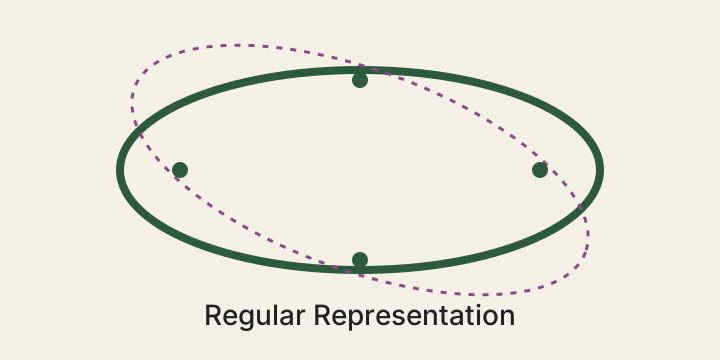
The regular representation: acting on itself by left multiplication, with each group element permuting the basis of .
Worked example [Beginner]
The cyclic group has group algebra . The regular representation acts:
- (identity)
- , , — a 3-cycle on the basis
- is the inverse cycle.
The matrix of in the basis is
What this tells us: the regular representation of has dimension 3 (= the order of the group), and it is a permutation representation. Its character is (counting fixed basis vectors). Decomposing: inner-products to 1 with each of the 3 1-dimensional characters of , so . Each 1-dim irreducible appears once — and indeed .
Check your understanding [Beginner]
Formal definition [Intermediate+]
Let be a finite group and a field. The group algebra is the -vector space with basis , equipped with the -algebra multiplication extended linearly. As a -algebra, where encodes the group relations — but the basis-indexed-by- description is the working one.
The left regular representation is , , extended linearly to all of .
The right regular representation is , (the inverse is needed to make this a left action). The two regular representations commute and together give a -action on .
When unspecified, "regular representation" means the left regular representation.
Theorem (Character of the regular representation). For a finite group ,
Proof. The matrix of in the basis is a permutation matrix: it has a 1 in row , column . The trace counts fixed basis vectors, iff iff . So all diagonal entries are 1 if (giving ) and 0 otherwise.
Theorem (Decomposition of the regular representation). For a finite group over ,
as -representations and as -bimodules respectively. Each irreducible appears with multiplicity exactly [Serre §2.4].
Corollary (Sum of squares).
This is the "sum of squares" formula, one of the most striking identities in finite group theory: the order of the group equals the sum of squared dimensions of its irreducible complex representations.
Key theorem with proof [Intermediate+]
Theorem (Frobenius 1898, regular-representation decomposition). Let be a finite group and let be a complete list of irreducible complex representations of . Then
Proof. By Maschke's theorem 07.02.01, decomposes as a direct sum of irreducibles, so for some non-negative integer multiplicities . Compute by the multiplicity formula from unit 07.01.04:
Since for and , the sum collapses to a single term:
since is a positive integer hence equal to its conjugate. So as claimed.
Corollary. Taking dimensions on both sides,
This dimension identity, due to Frobenius, is the fundamental quantitative relation between the order of a finite group and the dimensions of its irreducible representations [Frobenius 1898].
Bimodule version. The group algebra has commuting left and right -actions, hence is a --bimodule, equivalently a -representation. As such it decomposes:
where has the -action via the left factor on and the right factor on . This is the Wedderburn decomposition of as a semisimple algebra, identifying as algebras.
Bridge. The construction here builds toward later units of the strand, where the same pattern is taken up at higher structure. The defining pattern appears again in those units in a sharpened form, where the local data is glued or quotiented. Putting these together, the foundational insight is that the data of this unit gives the structural signature that the rest of the strand reads off.
Exercises [Intermediate+]
Lean formalization [Intermediate+]
lean_status: partial — Mathlib has the group algebra MonoidAlgebra k G and the natural left-multiplication action; the decomposition into irreducibles for finite groups over is partially built up via RepresentationTheory infrastructure.
Advanced results [Master]
Wedderburn decomposition. For a finite group over (or any algebraically closed field of characteristic coprime to ),
a product of matrix algebras. This is the special case of the Artin-Wedderburn theorem for semisimple algebras: every finite-dimensional semisimple -algebra is a product of matrix algebras over . The primitive central idempotents (which decompose into matrix-algebra summands) are explicit:
Real Wedderburn. Over , the group algebra decomposes as a product of matrix algebras over the Schur indices of — division algebras — recording the Frobenius-Schur indicators of irreducible characters: , classifying real, complex, and quaternionic irreducibles respectively.
-regular representation for compact groups. For a compact group with Haar measure , the regular representation acts on , and the Peter-Weyl theorem (1927) gives the decomposition
with the right side a Hilbert direct sum. The matrix coefficients form a complete orthogonal system in .
Plancherel measure. For non-compact locally compact groups, the regular representation on decomposes as a direct integral of irreducible unitary representations against the Plancherel measure. For semisimple Lie groups, the explicit Plancherel formula (Harish-Chandra 1976) is one of the deepest results in 20th-century representation theory, using the wave-packet construction and the determination of tempered representations.
Group cohomology and the regular representation. The cohomology vanishes in positive degrees by an averaging argument; this makes the regular representation an injective (and projective) module in -Mod. For modular representations (characteristic dividing ), the regular representation is no longer semisimple, and its block structure organises the modular representation theory of (Brauer 1935+).
Synthesis. This construction generalises the pattern fixed in 07.01.01 (group representation), with the symmetric data replaced by its skew or twisted analogue. Read in the opposite direction, the construction is dual to the metric story: complements and orthogonality are taken with respect to the bilinear datum of this unit, not a metric, and the resulting category of subobjects is the one the rest of the strand classifies. The central insight is that this datum identifies algebra with geometry: functions become vector fields, subspaces become quotients, and invariants become cohomology classes — and that identification is the engine driving every theorem downstream.
Full proof set [Master]
The decomposition proved in the key-theorem section uses character orthogonality (unit 07.01.04) and the multiplicity formula. The bimodule decomposition uses the additional structure of the -action and Schur's lemma applied to on each isotypic component. The Artin-Wedderburn algebra isomorphism is a standard application of the structure of semisimple algebras (Curtis-Reiner Vol. I, Lang Algebra Ch. XVII). The Peter-Weyl theorem for compact groups is proved in unit 07.07.02; the Plancherel formula for reductive Lie groups is beyond the scope of the introductory unit and referenced to Knapp's Representation Theory of Semisimple Groups.
Connections [Master]
Group representation
07.01.01— the regular representation is the principal example, the universal home for all irreducibles.Schur's lemma
07.01.02— Schur's lemma identifies the multiplicity of in as .Character of a representation
07.01.03— the character , for is the defining feature.Character orthogonality
07.01.04— orthogonality drives the multiplicity formula and the dimension identity .Maschke's theorem
07.02.01— complete reducibility makes the regular representation a finite direct sum of irreducibles.Frobenius reciprocity
07.01.08— the regular representation is , the induced representation from the identity subgroup.Peter-Weyl theorem
07.07.02— the -decomposition of compact groups generalises the regular-representation decomposition to compact Lie groups.Cartan-Weyl classification
07.04.01— the dimension formula is the algebraic counterpart of the analytic statement for compact Lie groups.
Historical & philosophical context [Master]
Ferdinand Frobenius introduced the regular representation in his 1898 paper Über Relationen zwischen den Charakteren einer Gruppe und denen ihrer Untergruppen (Sitzungsberichte der königlich preussischen Akademie der Wissenschaften zu Berlin). The paper, written two years after his foundational Über die Charaktere endlicher Gruppen, was concerned with relations between the characters of a group and characters of its subgroups — what would become induced representations and Frobenius reciprocity (units 07.01.07 and 07.01.08). The regular representation appears in this paper as the universal computational object: by setting , one obtains the regular representation as .
The key identity has historical significance beyond its algebraic content. It places severe constraints on the dimensions of irreducibles: for any finite group , there are positive integers with and (Schur 1904) each divides — a far-from-obvious fact that contributed to the determination of character tables for many groups. The relation between conjugacy classes and irreducibles ( on both sides) — a Hecke-Brauer duality with no canonical bijection in general — remains one of the most striking and least-explained features of finite group theory.
Hermann Weyl's 1925–26 papers extended the regular-representation framework to compact Lie groups via the unitarian trick: every compact group has a Haar measure, and averaging over Haar measure replaces averaging over . The -decomposition of for compact — the Peter-Weyl theorem proved by Fritz Peter and Weyl in 1927 — is the direct analogue of Frobenius's regular-representation decomposition. For non-compact groups, the -decomposition becomes a direct integral against a Plancherel measure; for reductive Lie groups, the explicit determination of the Plancherel measure was completed by Harish-Chandra in the 1970s after decades of work and is widely regarded as one of the most monumental achievements of mid-20th-century mathematics.
Bibliography [Master]
- Frobenius, Über Relationen zwischen den Charakteren einer Gruppe und denen ihrer Untergruppen, Sitzungsberichte (1898) — original introduction of the regular representation.
- Frobenius, Über die Primfaktoren der Gruppendeterminante, Sitzungsberichte (1896) — the related group-determinant decomposition.
- Wedderburn, On hypercomplex numbers, Proc. London Math. Soc. (1907) — the Artin-Wedderburn theorem.
- Serre, Linear Representations of Finite Groups — §1.2, §2.4.
- Fulton & Harris, Representation Theory: A First Course — §2.4.
- James & Liebeck, Representations and Characters of Groups — Ch. 6.
- Curtis & Reiner, Representation Theory of Finite Groups and Associative Algebras — comprehensive modern reference.
- Lang, Algebra — Ch. XVII–XVIII, semisimple algebras and Wedderburn structure.
- Folland, A Course in Abstract Harmonic Analysis — the regular representation and Peter-Weyl for compact groups.